







Compare Top Egyptian Cryptocurrency Exchanges
1. Bybit
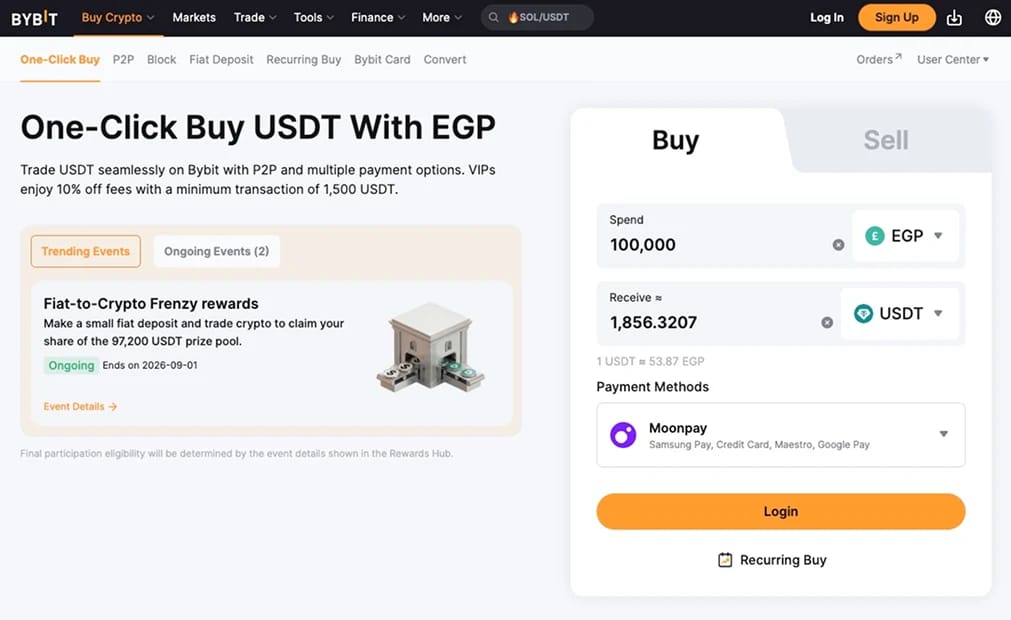
Bybit tops the list because it better addresses the realities of Egypt than any other exchange. EGP deposits are made easy with direct EGP deposits via card, Google Pay and Samsung Pay. The EGP P2P market is also liquid; deposits through it incur no Bybit fees, and the entire app is available in Arabic.
We tested buying USDT from a merchant with 1,000-plus trades and 99% completion, and it settled over InstaPay in under five minutes, with the escrow releasing cleanly. Spot fees are a flat 0.1%, and the platform adds margin and futures trading, copy trading, demo trading, Earn, crypto loans, and trading bots.
For Muslim users weighing the Dar al-Ifta fatwa, Bybit's Islamic Account strips interest-based elements and was built with Shariah advisors, which is useful for investors in Egypt. The honest caveat is the big one: Bybit holds no CBE license, your bank may still flag the P2P transfer, and there is no local recourse if something goes wrong.
Pros
- Accepts direct EGP deposits and offers a liquid EGP P2P with zero-fee deposits and a full Arabic interface.
- Flat 0.1% spot fees, plus copy trading, demo trading, earn, and bots in one app.
- Shariah-compliant Islamic Account option and routine 1:1 proof-of-reserves audits.
Cons
- No CBE license, so use sits outside Egyptian law.
- Banks can flag or freeze the EGP transfer behind a P2P trade.
- No local legal protection if a counterparty or the platform fails.
2. Binance
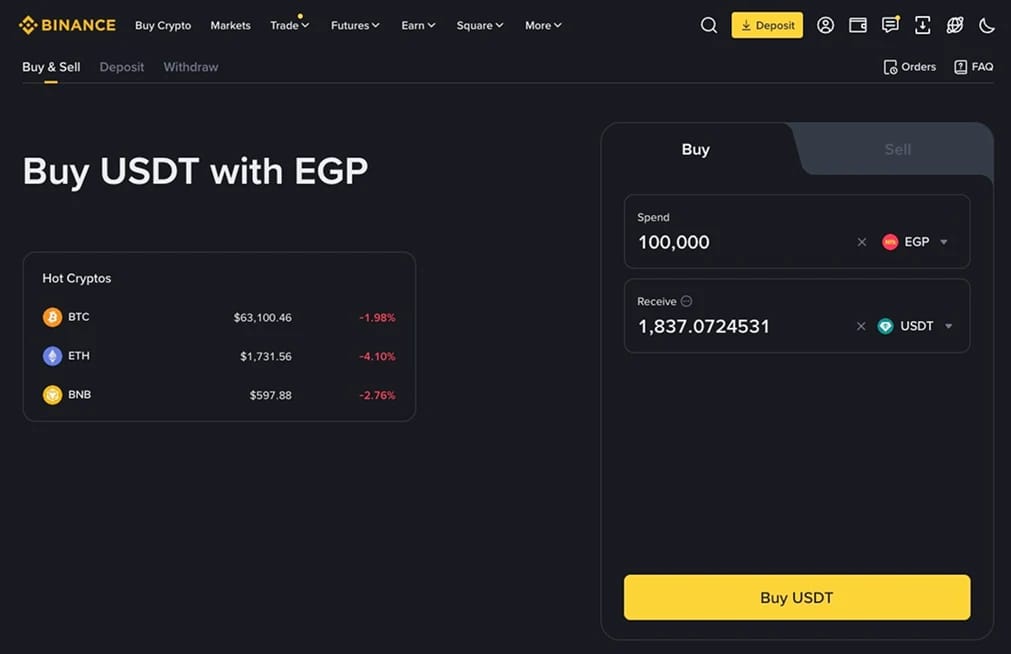
Binance is the one to use when liquidity is the point, as it is the world’s largest crypto exchange, serving 320 million clients globally. Its EGP P2P book is the deepest here by a wide margin, listing more than a hundred local payment methods, which means tighter spreads on the USDT you are actually buying and faster fills when you trade size.
Funding runs through that P2P market in pounds, with spot fees at 0.10% and the Arabic interface most local traders already know. The SAFU fund and regular proof of reserves back balances, and the depth makes it the natural off-ramp when you need to convert a larger position back to EGP quickly.
The caveats are the same as every venue here, only larger given the volume that flows through it. Binance is not CBE-licensed, Egyptian banks watch for repeated transfers to known P2P merchants, and the platform's global regulatory record is mixed, so size your reliance on it with that in mind.
Pros
- Deepest EGP P2P liquidity here, with the tightest USDT spreads.
- 0.10% spot fees, a full product suite, and an Arabic interface.
- SAFU fund and regular proof of reserves behind user balances.
Cons
- No CBE license; trading from Egypt remains outside the law.
- High P2P volume can draw more bank scrutiny on your transfers.
- Mixed global regulatory history across several jurisdictions.
3. Gate
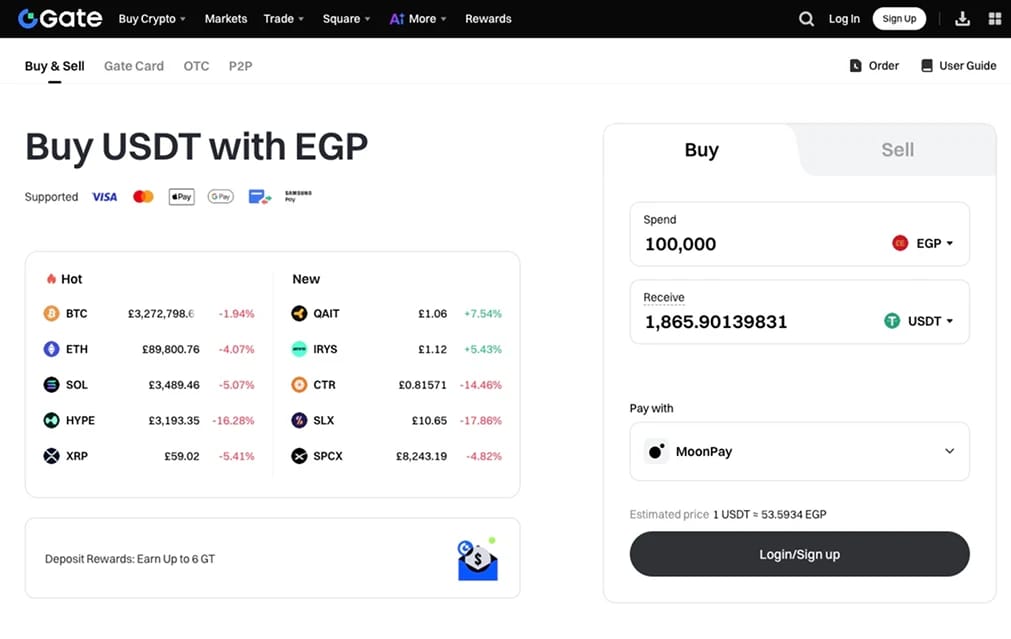
Gate is the pick when range is what you are after, offering stablecoins, altcoins, memecoins, and small-cap tokens. It lists more than 4,800 assets, far more than any other exchange here, so it is where you go for small-cap tokens you will not find elsewhere. Trading since 2013, it publishes proof-of-reserves reports with a ratio above 100%.
For Egyptian users, the P2P desk supports a wide spread of local rails, including Vodafone Cash, Telda, InstaPay, and Fawry, with standard spot fees of 0.20% that drop when you hold the GT token. In testing, large-cap books filled cleanly, while the thinner micro-cap pairs behaved as expected, with wider spreads that demand real research first.
The trade-offs match the category. Gate is unlicensed in Egypt like the rest; the sheer length of the listings means plenty of volatile names to be careful with, and native Arabic support is thinner than on Bybit or Binance. Still, no exchange mentioned here matches its selection. It also does not provide Shariah-compliant trading.
Pros
- 4,800+ assets, by far the widest range available to Egyptian users.
- Broad EGP P2P rails: Vodafone Cash, Telda, InstaPay, and Fawry.
- Proof of reserves above 100%, plus GT discounts and staking.
Cons
- No CBE license, so the same legal and banking risks apply.
- Many low-cap listings are thin and need careful research.
- Arabic support is lighter than in the larger exchanges.
4. KuCoin
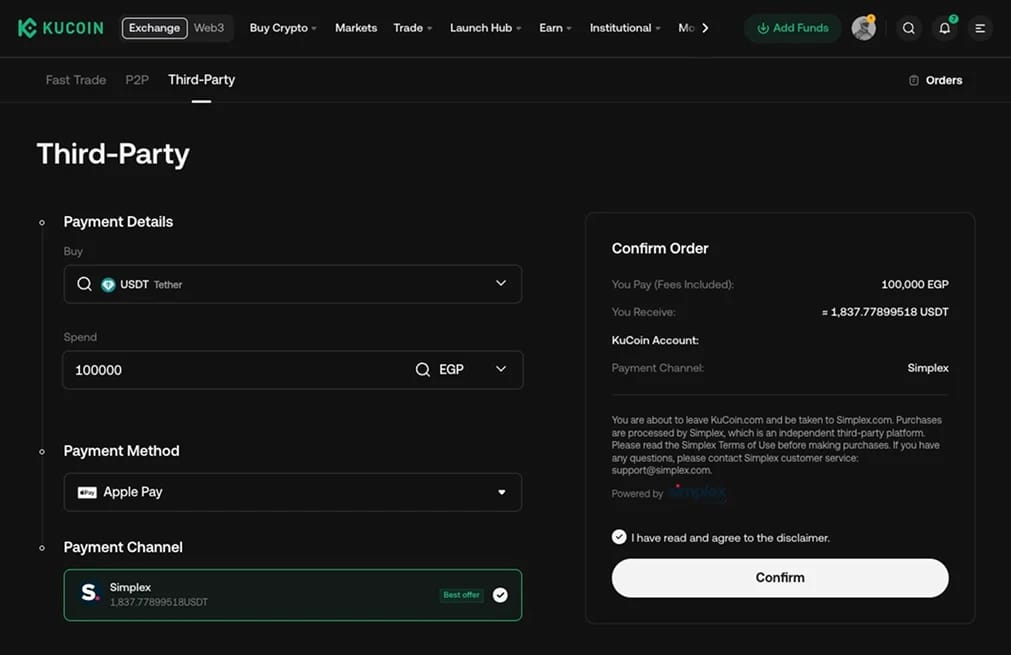
KuCoin earns its spot for passive income and altcoin hunting. Its Earn program offers flexible savings, staking, borrowing, and lending products, and it has built a reputation since 2017 for listing promising tokens early. It lists 900+ digital assets across spot, margin, and futures markets, with up to 100x leverage.
In Egypt, it only offers P2P for EGP deposits, which means settling via InstaPay, Vodafone Cash, and Orange Money, with a 0.10% spot trading fee and a clean mobile app. The trading bots handle grid and DCA strategies, which suit anyone looking to slowly average into USDT or BTC rather than time the market.
The offshore downsides carry over in full. KuCoin holds no CBE license; the P2P-only funding means you are fully reliant on merchant quality, and the platform has faced regulatory inquiries and a past security incident abroad. The high headline yields also come from higher-risk products, so read the terms before locking funds.
Pros
- Earn products, early listings, and 900+ assets to choose from.
- EGP P2P via InstaPay, Vodafone Cash, and Orange Money.
- Trading bots for grid and DCA strategies.
Cons
- No CBE license; P2P-only funding leans on merchant quality.
- Headline yields apply to higher-risk products, so read the terms.
- Has faced regulatory inquiries and a security incident elsewhere.
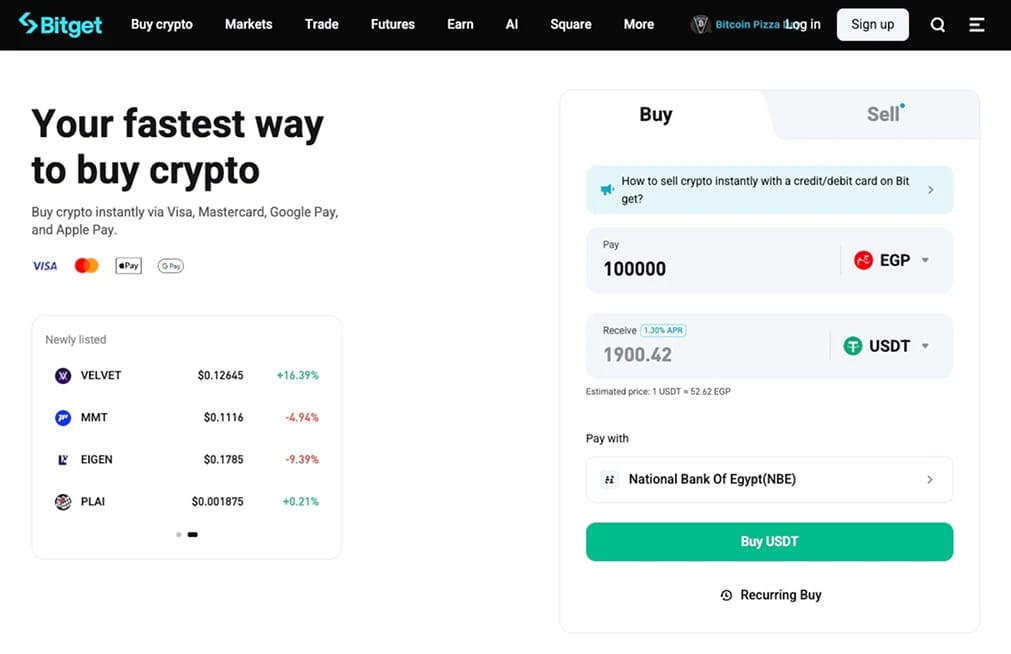
5. Bitget
Bitget leads the list for copy trading, with both spot and futures copy trading supported. It runs one of the largest social-trading networks on the market, with well over 100,000 lead traders publishing strategies and full risk stats, so a newer Egyptian user can follow a proven trader instead of guessing into a falling pound on their own.
Funding works through P2P or card, with spot fees from 0.1% and futures at 0.02% maker and 0.06% taker. The app adds trading bots and Bitget Earn, plus a large Protection Fund and monthly Merkle-tree proof-of-reserves back balances, which is reassurance that matters when there is no local safety net behind you.
Similar to the other exchanges, it holds no CBE license, so the legal and banking risks are identical to the rest. Copy trading can amplify a bad lead trader's losses as easily as a good one's gains, and Arabic and local support are lighter than on Bybit or Binance. Treat the follow features as a starting point, not autopilot.
Pros
- One of the largest copy-trading networks, with 100,000+ lead traders.
- Low fees starting at 0.1% for spot and 0.02% maker / 0.06% taker on futures.
- Large Protection Fund and monthly Merkle-tree proof of reserves.
Cons
- No CBE license, so the same legal and banking risks apply.
- Copy trading amplifies a poor lead trader's losses, not just gains.
- Lighter Arabic and local support than the top two venues.
6. MEXC
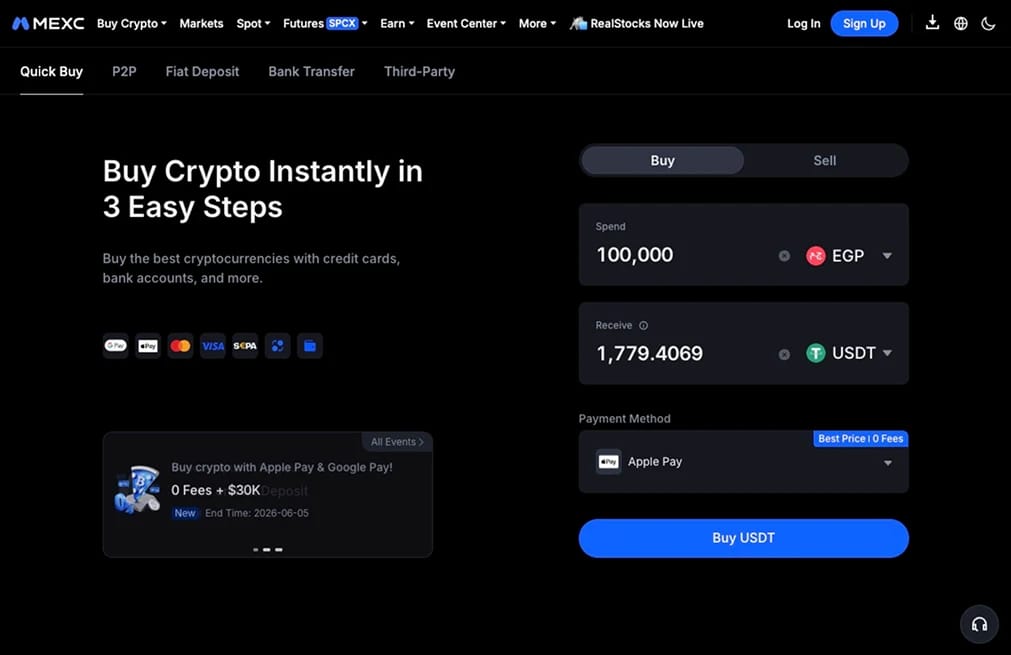
MEXC is the venue for traders chasing leverage and fast listings. It runs perpetual futures with up to 500x leverage on select contracts, a zero maker and 0.02% taker futures fee, and a listing pipeline that often beats larger exchanges to new tokens across thousands of pairs.
For Egyptian users, it funds through P2P and card. The economics suit anyone running derivatives or dollar-cost averaging, since the futures fees are among the lowest anywhere, and copy trading lets newer users follow more experienced ones. A demo mode is there to practice before risking real EGP.
Two warnings stand out. Extreme leverage magnifies losses as fast as gains, so the 500x ceiling is a tool for experienced traders, not a feature to chase. And like the rest of this list, MEXC holds no CBE license and offers no local protection, so treat it as the high-risk corner of an already high-risk market.
Pros
- Up to 500x leverage on select contracts, the highest option here.
- Zero maker and 0.02% taker futures fees, with thousands of pairs.
- Fast listings, copy trading, and a risk-free demo mode.
Cons
- 500x leverage is high-risk and suits only experienced traders.
- No CBE license, so the same legal exposure applies.
- Thinner Arabic and local support than the top two venues.
How to Choose a Crypto Exchange in Egypt
The cheapest fee is not what to optimize for here. In Egypt, the real costs are legal exposure and the spread you pay on the P2P leg, so weigh both before committing real money:
- Accept the legal reality first. None of these platforms is CBE-licensed, and trading crypto from Egypt sits outside Banking Law No. 194. That is a risk to price in with eyes open, not something any exchange feature can remove.
- Judge the P2P desk, not the headline fee. On every exchange here, your real entry cost is the merchant's USDT spread over the market rate, plus any pound premium. A 0.1% trading fee is noise next to a 2% spread on a bad P2P fill.
- Use mobile wallets and InstaPay carefully. Banks flag repeated transfers to known P2P merchants, so many traders route through Vodafone Cash, Orange Cash, or InstaPay. Keep volumes modest, keep records, and never send EGP unless the exchange escrow is already locked.
- Test the loop before you scale. Move a small amount, say 1,000 to 5,000 EGP, in and straight back out. Buy USDT from a merchant with 100-plus trades and 98%-plus feedback, then cash out. Ten minutes of this teach more than any rating.
Crypto and Bitcoin Regulation in Egypt
Egypt sits at the strict end of the global spectrum, and the rules have not loosened. A few pieces define where things stand:
- Banking Law No. 194 of 2020: Article 206 prohibits issuing, trading, promoting, or operating any platform dealing in crypto assets without prior CBE approval.
- No licenses, ever: The CBE has not granted a single crypto license since the law passed, which turns the approval requirement into a de facto blanket ban. There is no domestic exchange and no licensing framework on the books.
- Repeated public warnings: The CBE has issued multiple advisories, including renewed warnings in 2025 after a rise in local crypto adverts, each stressing fraud risk, volatility, and the absence of legal protection.
- A religious layer: Egypt's Dar al-Ifta issued a fatwa declaring crypto trading impermissible under Islamic law. It is non-binding, but it shapes local sentiment and feeds demand for Shariah-screened products.
The practical reading is blunt. Holding crypto is not itself singled out as a crime, but buying, selling, promoting, or running a platform is prohibited, and the lack of recourse is the point regulators keep making.
Millions trade through offshore P2P anyway, but it is a genuine legal risk, not a grey area.
How Does Egypt Tax Crypto?
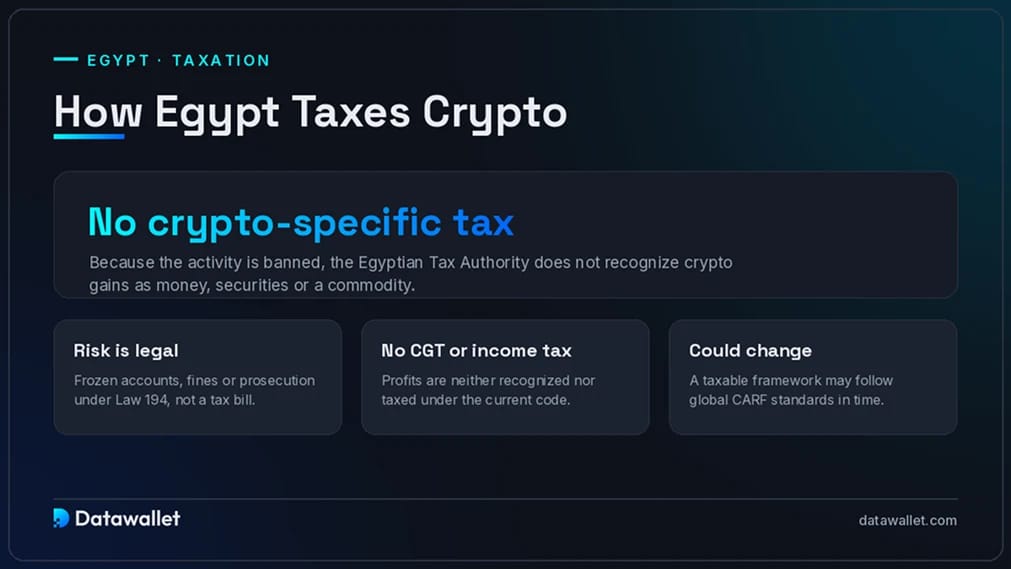
Egypt has no crypto tax framework, and the ban is the reason. Because the CBE prohibits unlicensed crypto activity, there is no legal basis to recognize gains or losses, so the Egyptian Tax Authority does not treat crypto as money, a security, or a commodity.
- No crypto-specific capital gains or income tax: Profits from buying, selling, or holding are neither recognized nor taxed under the current code, simply because the activity is not legally acknowledged.
- The risk is legal, not fiscal: The real exposure for an Egyptian trader is not a tax bill. It is the prospect of frozen bank accounts, fines, or prosecution under Law No. 194, a very different calculation from most countries.
- This could change: Egypt may eventually move toward a regulated, taxable framework, especially as global standards like the Crypto-Asset Reporting Framework take hold. For now, none of that exists.
None of this is tax or legal advice. Given the prohibition, anyone trading from Egypt should treat the legal risk as the main consideration and speak with a qualified Egyptian lawyer before acting.
Cryptocurrency Adoption in Egypt
Egypt is one of the most active crypto markets in the Arab world despite the ban, and the drivers are specific to the country:
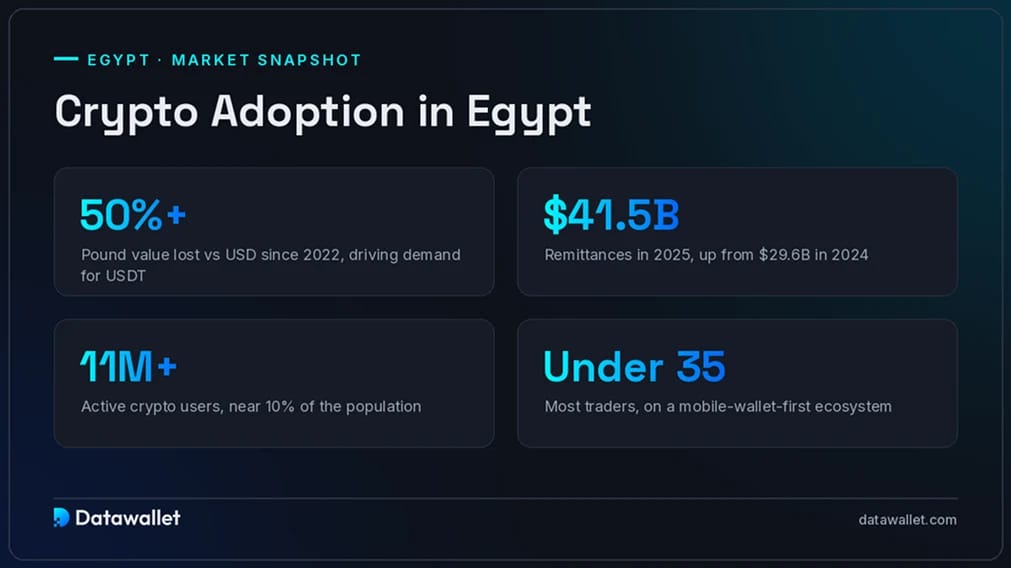
- A pound problem. The pound has lost more than half its value against the dollar since 2022, accelerating after the March 2024 float that pushed it past 49 to the dollar under an $8 billion IMF program. Holding USDT works as a homemade dollar account, which is why stablecoins, not Bitcoin, dominate everyday use.
- A remittance giant. Egypt took in about $29.6 billion in remittances in 2024, rising to a record $41.5 billion in 2025, among the largest inflows worldwide. Crypto rails undercut the 5% to 10% that Western Union, MoneyGram, and bank wires charge on Gulf and Europe corridors.
- Young and mobile-first. Most traders are under 35, and a dense mobile-wallet ecosystem led by Vodafone Cash and Orange Cash gives them an off-bank rail that pairs naturally with P2P.
Estimates vary, but several trackers put active Egyptian crypto users above 11 million, near 10% of the population, with projections climbing into 2026. The market grows because the economic pressure behind it is not letting up.
How to Buy Bitcoin in Egypt
Buying Bitcoin in Egypt means going through a global exchange's P2P market, since there is no legal local rail. The sequence we use:
- Pick a venue and verify: Register on your chosen platform and complete KYC with your national ID or passport. Most verify in minutes. Understand before you start that this activity is not legal under Egyptian law.
- Fund in EGP through P2P: Open the P2P desk and buy USDT from a high-completion merchant, settling in pounds over InstaPay, Vodafone Cash, Orange Cash, or a bank transfer. Confirm the escrow is locked before you send any EGP.
- Swap USDT for BTC: Move from the P2P balance to the spot market and trade USDT for BTC, using a limit order near the spread rather than a one-tap instant buy, which usually carries a wider margin.
- Mind the banking footprint: Keep transfer sizes modest, avoid sending repeatedly to the same merchant, and keep your own records. Banks monitor for patterns that look like P2P crypto trading.
- Move to self-custody: Long-term holders should take BTC off the exchange to a hardware or mobile wallet. Our best crypto wallets guide covers the options, and always double-check the network and address before sending.
Final Thoughts
There is no clean or fully legal way to buy crypto in Egypt, and any honest guide has to start there. What exists is a set of global platforms, reached through P2P, that millions use to hold dollars and hedge against a falling pound, accepting real legal and banking risks to do so.
If you decide that trade-off is yours to make, Bybit is the one we would set up first: liquid EGP P2P, zero-fee deposits, an Arabic interface, and an Islamic Account option. Keep Binance alongside it for the deepest liquidity when you need to convert size.
Two facts should stay pinned for any Egyptian buyer this year. There is no CBE-licensed venue and no local recourse, and your real costs are the P2P spread and the legal exposure, not the headline trading fee. Move a small amount through the full loop before you ever trust a platform with real size.
Our Methodology
To build this list, we opened accounts on each platform from Egypt, completed KYC with a national ID, funded each via the P2P desk in EGP via InstaPay and mobile wallets, bought USDT and BTC, and cashed back out to a local wallet. Six factors drove the ranking:
- Trust Score: A 0 to 5 rating weighing security and custody record, proof-of-reserves transparency, operating history, and how the platform handles a region with no local license.
- EGP P2P Quality: Merchant depth, completion rates, USDT spread over the market rate, settlement speed, and the range of local payment methods supported.
- Assets and Liquidity: Market and limit orders on BTC, ETH, and at least one mid-cap pair, judged on spread, depth, and fill quality.
- All-In Cost: Trading fees measured together with the real P2P spread on the way in and out, on a round-trip trade, rather than the headline rate alone.
- Products and Tools: Spot, derivatives, leverage, staking, Earn, and Shariah-screened options, weighed against each user type's actual needs.
- Legal and Banking Risk: Honest treatment of the ban, the absence of recourse, and how exposed a user's bank transfers are when funding each venue.
Testing ran from March to June 2026.
.webp)