






Compare Top Estonian Crypto Exchanges
1. Bybit
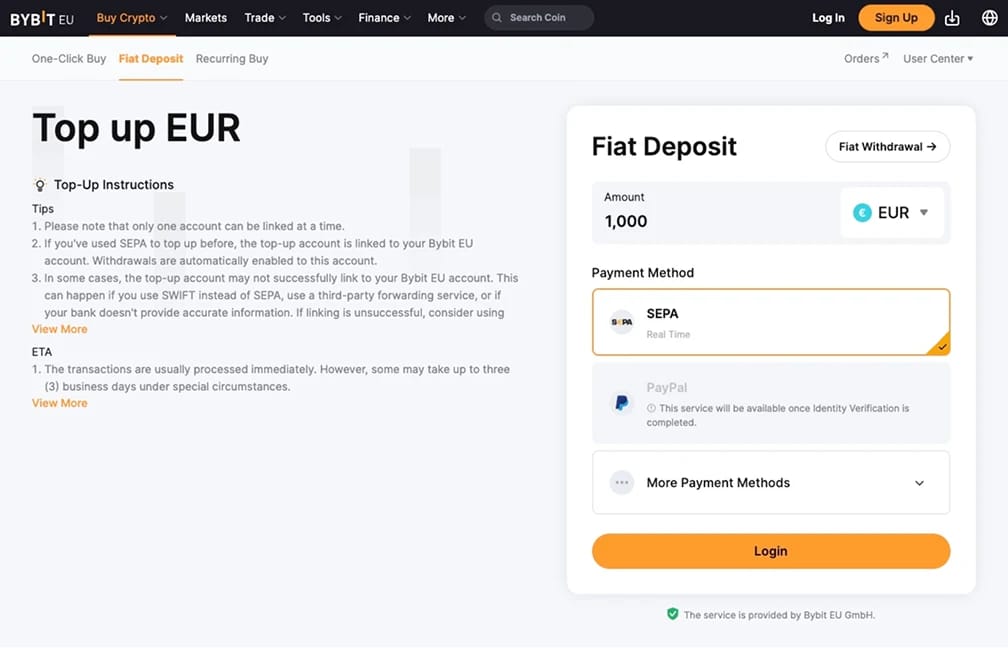
Bybit leads our Estonian ranking largely because of its dedicated European platform. Estonian accounts operate on bybit.eu under Bybit EU GmbH. Austria’s Financial Market Authority (FMA) granted the company crypto-asset service provider authorization in May 2025, allowing it to operate across the European Economic Area, including Estonia. Bybit also ranks second globally for both spot and futures trading.
Pricing is a major advantage, offering some of the lowest fees on this list. Spot orders incur a flat 0.1% fee, whether adding or removing liquidity, with further discounts for users with high trading volumes. SEPA and SEPA Instant deposits from Estonian bank accounts are free. The platform lists 2,600+ cryptocurrencies and supports copy trading, grid and DCA bots, Earn products, a Web3 wallet, and demo trading.
Estonian customers also gain a tax advantage from the Austrian authorization. Bybit EU appears in the ESMA register, so the Estonian Tax and Customs Board treats coins purchased there as financial assets. Losses can reduce taxable gains, while qualifying holdings can use the investment account deferral discussed in our tax section. Our Bybit review examines the broader product range.
Pros
- Flat 0.1% spot pricing across 2,600+ cryptocurrencies undercuts nearly every licensed competitor with a comparable catalog.
- Free SEPA and SEPA Instant deposits mean euros from LHV, Swedbank, or SEB accounts typically arrive within minutes.
- Regular Proof of Reserves reports audited by Hacken confirm that reserves fully match client assets.
Cons
- Perpetual futures are unavailable on the EU platform because Bybit EU lacks the required MiFID II permission.
- The interface does not support Estonian, leaving English or Russian as the practical choices for Baltic users.
- Roughly $1.5 billion was stolen from the global exchange in February 2025. Clients received full reimbursement, and the EU entity operates separately, but the incident still weighs on the brand’s security record.
2. Kraken
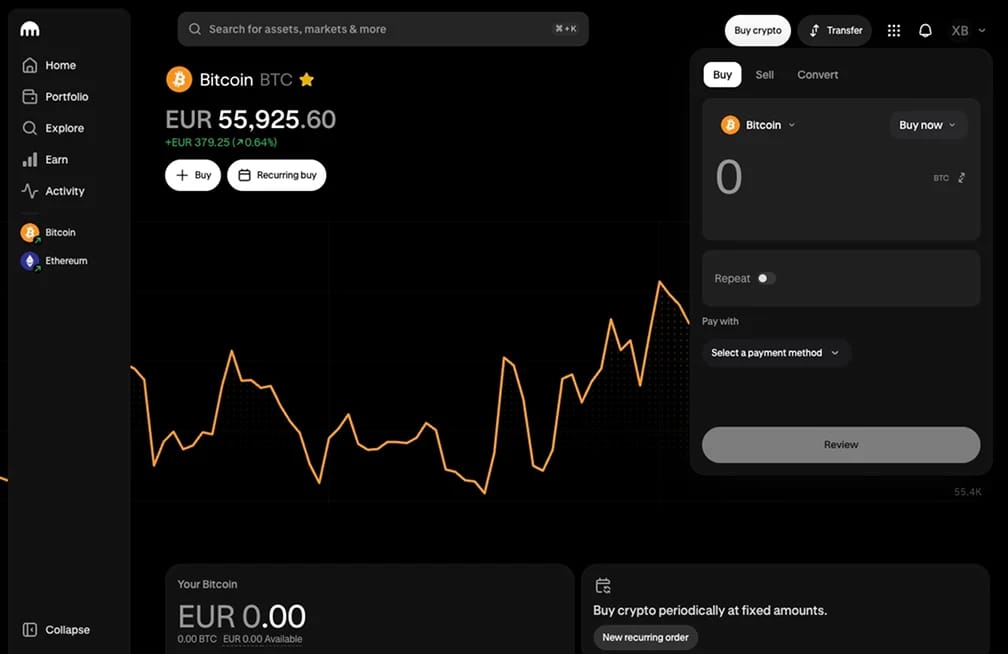
Kraken has operated since 2011 without a major security breach, something no other platform in this ranking can claim. Its European entity holds MiCA authorization from the Central Bank of Ireland, which is passported into Estonia. Kraken also publishes Proof of Reserves attestations more frequently than any licensed competitor. Our Kraken review offers deeper insight into the exchange’s security measures and history.
Futures give Kraken an edge no other platform here matches, because MiCA covers spot and custody but not derivatives. Kraken closed that gap by offering EEA clients regulated futures through its Cyprus entity, an investment firm supervised by CySEC under MiFID II. Estonian users who pass an eligibility assessment can trade perpetual and fixed maturity contracts across 150+ markets.
Users can choose between two interfaces. The standard app is built for straightforward euro purchases. Kraken Pro adds professional charting and a wider selection of order types, together with margin of up to 5x and some of Europe’s deepest EUR order books. Pro fees begin at 0.25% for makers and 0.40% for takers, then decline as trading volume rises. Staking rewards are available across many assets without mandatory lock-ups.
Pros
- Kraken has maintained a clean security record since 2011, supported by frequent and independently verified Proof of Reserves.
- Kraken Pro offers 600+ cryptocurrencies, deep euro liquidity, and advanced order types at base fees of 0.25% / 0.40%.
- Free SEPA and SEPA Instant deposits settle the same day from all major Estonian banks.
Cons
- Instant Buy on the standard app costs several times more than placing the equivalent order through Kraken Pro.
- Separate interfaces and balances can confuse newcomers who are unsure where their funds are held.
- Estonian is unavailable across both the interface and support channels.
3. OKX
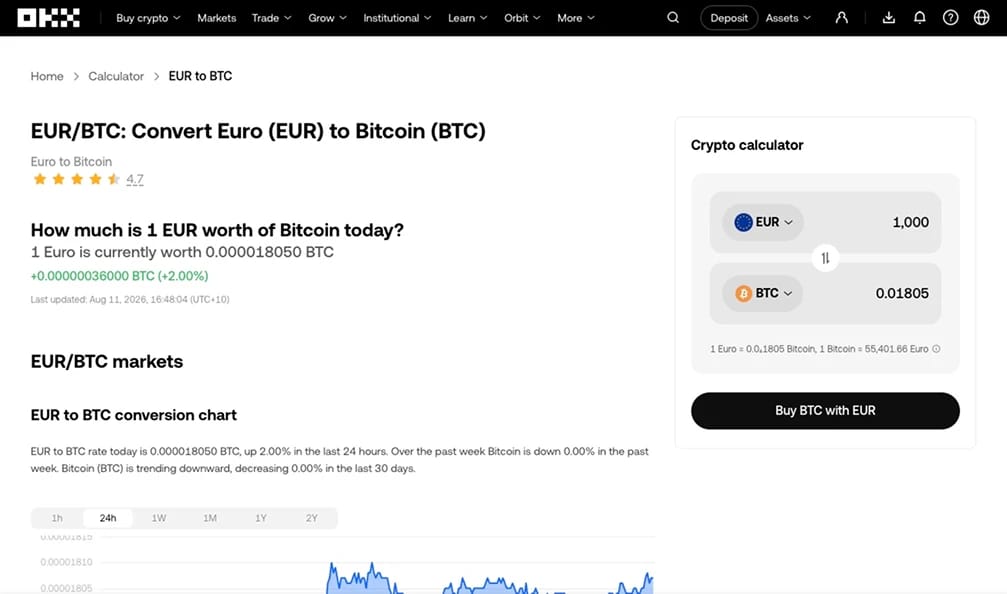
OKX has the lowest order book fees available to Estonian users. Base pricing starts at 0.08% for maker orders and 0.10% for takers. Its Malta entity received authorization from the Malta Financial Services Authority in January 2025, making it one of the first crypto companies approved under MiCA. Monthly zk-STARK Proof of Reserves reports have been published since late 2022.
Its Web3 features distinguish OKX from the other exchanges listed here. The integrated wallet supports more than 100 blockchain networks. A DEX aggregator searches decentralized markets for the best available swap price. Users can keep tokens in self-custody, access DeFi applications, and transfer assets across chains using the same app that holds their regulated euro balance.
The volume of features creates a steeper learning curve. OKX combines an exchange and wallet with an NFT marketplace and Earn products, so newcomers may need time to understand the interface. Identity checks are also extensive, and larger accounts may receive source-of-funds questions. We recommend visiting our OKX review, which explains each section of the platform.
Pros
- Base fees of 0.08% for makers and 0.10% for takers beat every other MiCA-authorized exchange available in Estonia.
- The integrated Web3 wallet supports 100+ networks and includes a DEX aggregator for finding on-chain swap prices.
- Monthly zk-STARK Proof of Reserves reports establish one of the industry’s strongest transparency standards.
Cons
- Combining centralized trading, self-custody, and DeFi in one app produces a steep learning curve for first-time buyers.
- The interface, help center, and live chat provide no Estonian-language support.
- Card and mobile wallet purchases use third-party processors whose markups exceed the advertised trading fee.
4. Coinbase
Coinbase provides the simplest introduction for Estonians opening their first crypto account. As a Nasdaq-listed company, it publishes quarterly financial disclosures that private exchanges do not match. The group’s MiCA authorization was issued by Luxembourg’s financial regulator, the CSSF. It serves over 120 million registered users worldwide, making it the second-largest exchange by user base.
Registration takes only a few minutes. The app explains each step from account creation to an initial Bitcoin purchase without requiring much knowledge of crypto terminology. SEPA deposits are free, while Learning Rewards distributes small amounts of crypto for completing short lessons. Staking for Solana, Ethereum, and other supported assets is built into the account, with rewards credited automatically.
Convenience carries a substantial price. Standard purchases can cost up to 1.49%, while cards reach 3.99%, with spreads added to both. Coinbase Advanced cuts these charges sharply but sits behind a toggle and requires users to trade from a chart. We recommend moving to Advanced once the basic interface becomes familiar. Users can read our Coinbase review, which contains the full fee tables and feature comparisons.
Pros
- A Nasdaq listing and audited public financial statements provide corporate transparency that no other exchange in this ranking matches.
- The onboarding process can take a complete beginner from registration to an initial purchase within minutes.
- Free SEPA deposits complement in-app staking and Learning Rewards for passive investors.
Cons
- Standard-buy charges of up to 1.49% and card fees reaching 3.99% make Coinbase the most expensive platform listed here.
- Its catalog of roughly 250 cryptocurrencies is considerably smaller than those of Bybit and OKX.
- Many casual users never find Coinbase Advanced because the lower-cost interface is hidden behind a toggle.
.webp)
5. Bitpanda
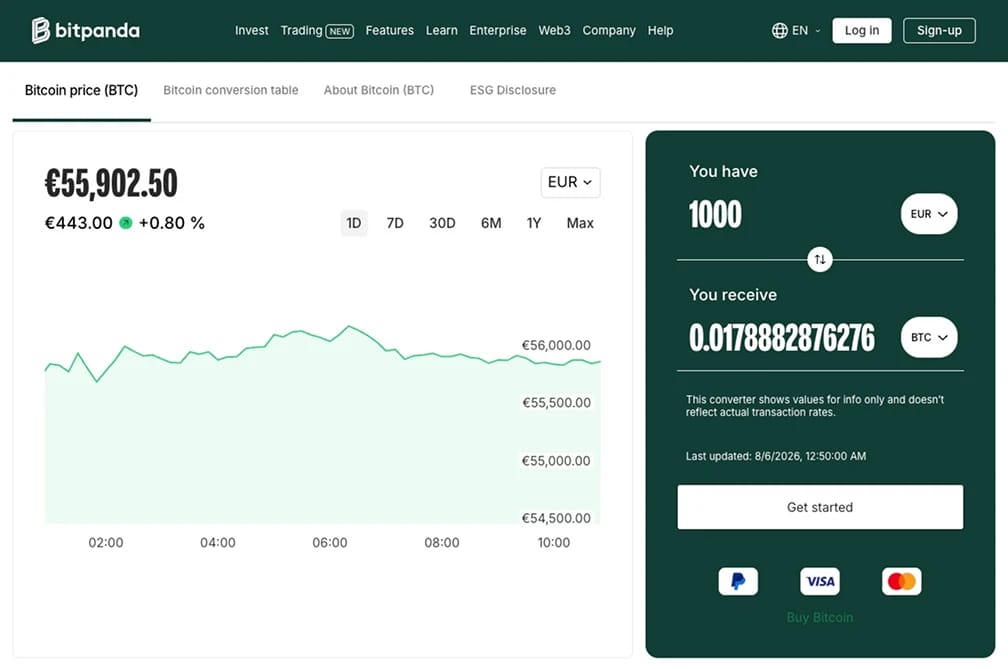
Bitpanda is the multi-asset choice for Estonians who want crypto, shares, and precious metals under one login. Founded in Vienna in 2014, the company has more than 7 million users. It also holds three separate MiCA authorizations, issued by Germany’s BaFin, Malta’s MFSA, and Austria’s FMA. No other platform in this ranking has an equivalent regulatory footprint across Europe.
One account provides access to 600+ cryptocurrencies, as well as fractional equities, ETFs, commodities, and crypto indices. Savings plans can collect euros by SEPA direct debit each week or month, automating cost averaging into Bitcoin or an entire index. The Bitpanda Card converts holdings into euros when used at a Visa terminal. Standard SEPA transfers and cards are available for one-off deposits.
Pricing is the main drawback compared with order book exchanges. Trading costs of 1% to 1.49% are included in the quoted price rather than appearing as a separate fee, making the actual cost harder to assess. Austria’s FMA also fined Bitpanda 70,000 euros in August 2026 for a late whitepaper filing. The amount was modest, but it remains the first binding MiCA penalty on record. Our Bitpanda countries guide explains availability in each market.
Pros
- Bitpanda holds three MiCA authorizations from BaFin, the MFSA, and the FMA, alongside MiFID II and e-money permissions across the group.
- A single account supports crypto, fractional stocks and ETFs, precious metals, and indices, with automated savings plans funded by SEPA direct debit.
- The Bitpanda Card converts crypto balances into euros for spending at any Visa terminal.
Cons
- Costs of 1% to 1.49% are built into quoted prices and are far above the order book fees charged by Bybit, OKX, or Kraken.
- Trading is limited to spot markets, with no futures, margin, or advanced order types.
- The August 2026 FMA fine for late whitepaper filing, though small, was the first binding MiCA penalty imposed on any platform.
6. LHV Pank
LHV Pank fills the local position left vacant by Coinmetro’s collapse, backed by a much stronger legal foundation than a startup exchange. LHV is a supervised Estonian credit institution and can provide crypto services under Finantsinspektsioon oversight through MiCA’s notification regime for banks. It introduced in-app trading in 2021, before any other Baltic bank.
Crypto trading sits inside the same LHV app used for salary accounts. Bitstamp, one of Europe’s longest-running exchanges, executes each order, while BitGo holds client coins in custody. Trades cost a flat 0.5%, and the minimum purchase is 20 euros. The bank also produces pre-filled tax declaration data for each instrument, removing much of the spreadsheet work normally required for EMTA filings.
The limitations become apparent for serious traders. LHV supports Bitcoin, Ethereum, and a selected group of large-cap tokens rather than thousands of pairs. Market execution is the only available order type, and a 0.5% charge accumulates quickly with regular activity. Existing LHV customers building long-term positions may still find the convenience difficult to match.
Pros
- Crypto appears alongside regular banking and investments in a single Estonian app, with no transfers to an external platform required.
- Bitstamp handles execution, and BitGo provides custody, placing client assets with established, regulated infrastructure providers.
- Pre-filled declaration data for each instrument reduces EMTA tax filing to a few clicks.
Cons
- The selected asset list excludes thousands of smaller tokens available through Bybit, OKX, or Kraken.
- Each transaction costs 0.5%, five times Bybit’s spot fee, and is expensive for frequent traders.
- Charting, limit orders, staking, and other exchange tools are unavailable because the service is built for straightforward buying and holding.
.webp)
How to Choose a Crypto Exchange in Estonia
Choosing an Estonian crypto exchange now begins with checking its registration. Since the July deadline, licensing has become a legal boundary rather than one factor among many.
- Confirm the exchange’s legal name: Search the ESMA register for the exact legal entity named in your account terms. A group may hold authorization in one region but not another. Our guide to the best MiCA-licensed crypto exchanges tracks each approval.
- Treat unlicensed platforms as exits in progress: ESMA instructed every unauthorized provider to wind down its EU business. More than 1,700 platforms have restricted or ended European access since July, exposing remaining accounts to deposit freezes and forced offboarding.
- Watch for migration scams: European regulators have warned about fraudsters impersonating exchanges and supervisors. Fake notices often direct users to move funds onto lookalike platforms. Before sending money, check migration emails against the company’s official domain and the ESMA register.
- Weigh the tax status of the venue: EMTA permits loss deductions and investment account deferral only for crypto bought through MiCA-authorized providers. Offshore platforms remain subject to the former regime, under which profitable trades are taxed but losses cannot be deducted.
- Check the euro path from your bank: Every exchange above accepts free SEPA transfers. Bybit, Kraken, and Coinbase also support SEPA Instant, allowing deposits from Estonian accounts to clear in seconds in many cases. Cards are widely accepted but carry processor fees, making them better suited to small or urgent purchases.
Crypto and Bitcoin Regulation in Estonia
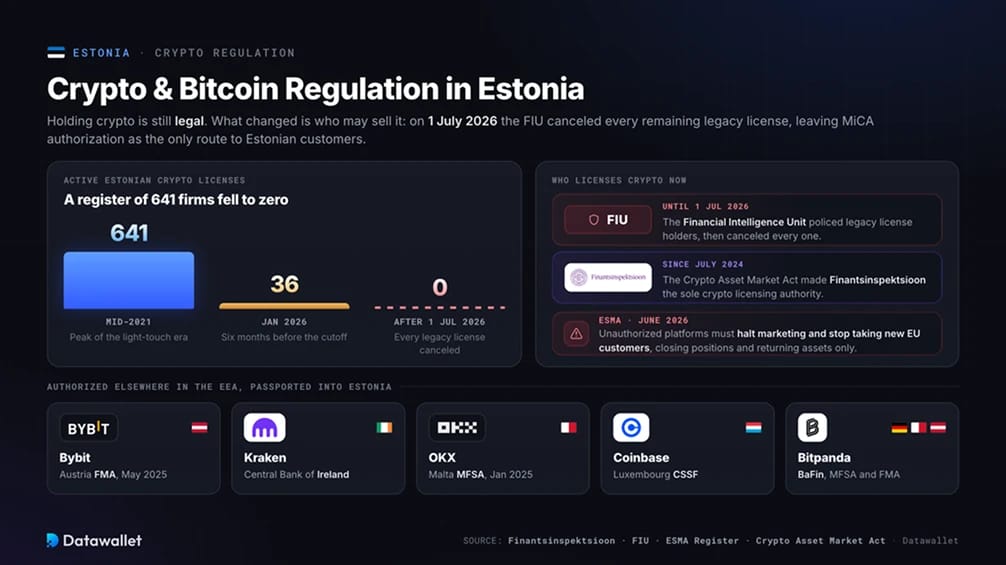
Holding crypto remains legal in Estonia. The rules governing which companies may sell it changed this year. Here is a quick breakdown:
- Supervision moved to Finantsinspektsioon: The Crypto Asset Market Act, effective since July 2024, made Finantsinspektsioon Estonia’s sole licensing authority for crypto-asset service providers. The FIU continued supervising legacy license holders until the transition ended.
- The old license era ended on 1 July: Estonia used MiCA’s maximum 18-month transition. When it expired, the FIU canceled every remaining legacy crypto license. There were 641 active licenses in mid-2021 and 36 at the beginning of 2026. None remained after the final cutoff.
- Passported platforms cover the retail market: Bybit in Austria, Bitpanda in three EU countries, Kraken in Ireland, OKX in Malta, and Coinbase in Luxembourg reach Estonian customers under authorizations issued elsewhere in the EEA. MiCA extends those permissions automatically across member states.
- Unauthorized providers must leave: ESMA’s June statement instructed unauthorized platforms to stop accepting new EU customers and halt marketing. Activity must be limited to closing positions and returning assets.
How Does Estonia Tax Crypto?
Estonia taxes crypto profits as personal income. Rules introduced this year give users of licensed platforms treatment that few other countries have adopted.
- A flat 22% on gains: The income tax rate remains 22% in 2026 after parliament canceled the planned increase to 24%. Taxable gains are calculated for each transaction by subtracting documented purchase costs from the sale price. Taxpayers may use FIFO or the weighted average method.
- A universal basic exemption arrived: Beginning in January, every resident receives a tax-free allowance of 700 euros per month, or 8,400 euros annually, regardless of income. This replaces the former system under which the allowance declined as earnings increased.
- Platform choice now changes your tax bill: According to EMTA’s crypto-asset guidance, coins purchased through a MiCA-authorized provider qualify as financial assets. Losses may offset gains, and eligible holdings can use the investment account system to defer tax until withdrawal.
- The tax return knows your exchange: EMTA added 141 MiCA-authorized foreign platforms to a drop-down menu in its income tax return. Taxpayers must now identify the venue they used. Filing opens on 15 February and closes on 30 April.
- Companies keep the famous 0%: Estonian companies pay no tax on retained or reinvested crypto gains. Tax becomes due only when profits are distributed, at 22/78 of the net dividend. Converting crypto into euros remains exempt from VAT.
- Reporting has gone automatic: DAC8 extends automatic EU tax-data sharing to crypto from 2026. CARF, the OECD framework for crypto-account reporting, applies alongside it. Licensed platforms must report client transaction information to EMTA, with the first international data exchanges scheduled for 2027.
This overview provides general information, not tax advice. Confirm complex positions with EMTA or a qualified adviser.
.webp)
Cryptocurrency Adoption in Estonia
Estonia’s crypto market is modest by user numbers but unusually developed in its supporting infrastructure. That balance suits a country of 1.4 million people whose international reputation rests partly on digital government.
- The user base is small but steady: Statista Market Insights estimates around 63,000 crypto users in Estonia, equal to roughly 5% of the population. Annual market revenue sits in the low single-digit millions of dollars. EU surveys have produced higher ownership estimates, closer to one person in ten.
- A bank became the mainstream gateway: By adding crypto trading to its banking app, LHV placed the asset class before more than 350,000 customers without requiring them to open exchange accounts. Few countries have a comparable distribution channel.
- The company register tells the real story: Estonia once had more registered crypto firms than any other EU country, reaching 641 active licenses at the 2021 peak. Their reduction to a handful of MiCA-era authorizations reflects a deliberate shift from quantity to substance after the sector’s early reputational problems.
- E-Residency keeps the pipeline open: Founders still use Estonia’s digital residency program to establish companies and pursue crypto authorizations. The 0% tax on retained profits also keeps the jurisdiction attractive to Web3 startups despite tighter supervision.
Comparisons with other markets are available on our crypto adoption statistics page.
.webp)
How to Buy Bitcoin in Estonia
Buying Bitcoin in Estonia can take less than 30 minutes when your documents are ready. The cheapest route combines a free SEPA deposit with a limit order on the spot market.
- Open an account with an authorized platform: Bybit offers the strongest overall package, while Coinbase provides the easiest introduction. Existing LHV customers do not need to create another account. Whatever platform you choose, verify its legal entity in the ESMA register.
- Verify your identity: Most exchanges can complete verification within minutes using a passport or ID card and a selfie check. Some accept Smart-ID or Mobile-ID. E-residents can generally use their digital ID card, although the proof of address must correspond with their country of residence.
- Deposit euros by SEPA: Transfers from LHV, Swedbank, SEB, Coop Pank, or Luminor are free at every exchange listed above. With SEPA Instant, the balance often arrives before the banking app is closed. Estonian banks routinely process transfers to licensed platforms, although a large initial payment may trigger a source-of-funds check.
- Place a limit order on BTC/EUR: Using the order book avoids the instant-buy spread, which can exceed the trading fee. Enter the euro amount and chosen price, then confirm the order.
- Decide where the Bitcoin lives: Keeping funds on an exchange may suit active traders. Long-term holdings are better suited to self-custody under the owner’s keys. Our best crypto wallets guide compares hardware and software products.
Selling follows the same process in reverse, with euros withdrawn by SEPA to the bank account used for funding.
Final Thoughts
Bybit wins this ranking because it concedes the least, pairing the lowest fees at scale with full MiCA authorization and fast euro funding. Kraken offers the only regulated futures in this lineup, OKX suits Web3 users, Coinbase is the simplest choice for beginners, and Bitpanda is for the diversified investor, while LHV Pank gives Estonians a systemically supervised domestic bank that sells Bitcoin within its own app.
Estonia’s crypto market no longer operates within a regulatory gray area. Platforms either appear in the ESMA register or must wind down. Tax rules reinforce the same divide by reserving loss deductions and tax deferral for authorized providers. Using a compliant exchange is no longer simply a preference; it is the only rational choice.
Before committing a large amount, complete a small test cycle. Deposit a modest sum, buy and sell, then withdraw the proceeds to your bank. This provides a direct measure of the platform’s total cost and processing time. Readers in neighboring markets can also compare our guide to the best crypto exchanges in Finland.
Our Methodology
Only platforms with full MiCA authorization still able to serve Estonia once the 1 July 2026 cutoff passed made it into testing, alongside LHV Pank under its banking notification. We then put every qualifying platform through six checks:
- Trust score: A Datawallet rating out of 5 that weighs who supervises the platform, how it discloses reserves, how past incidents were handled, and how long it has held client money without failure.
- Authorization checks: We matched every operating entity against the ESMA register and Finantsinspektsioon's records, then confirmed which regulated crypto-asset services its permission covers.
- Funding in euros: We deposited by SEPA and SEPA Instant from an Estonian bank account, timed when balances became tradable, and withdrew back to the same account.
- Real trading cost: A live euro order for Bitcoin went through every platform, and we totaled its end-to-end cost covering deposit fees, trading commission, instant-buy markups, and the withdrawal charge.
- Tax standing with EMTA: Whether purchases through the platform preserve loss deduction and investment account eligibility under Estonia's financial asset rules.
- Estonian relevance: Language coverage, behavior with LHV, Swedbank, and SEB transfers, Smart-ID or Mobile-ID support at verification, and any local presence.
Testing wrapped up in August 2026, with the transition period already closed, and we rechecked every authorization just before this guide went live. Read our full editorial methodology for how we research and fact-check.
.webp)