




Compare the Top Crypto Exchanges for API Trading
1. OKX
OKX takes first place because its v5 API treats automation as the primary product. One specification covers spot, margin, perpetuals (futures with no expiry date), and options, so a strategy written for BTC/USDT spot needs only a category parameter changed to trade the perpetual. Base fees of 0.08% maker and 0.10% taker on spot are the lowest headline rates among the majors, and makers at the top VIP tiers earn a rebate on every filled order.
The rate limit design rewards clean execution. Each sub-account carries its own bucket of up to 1,000 order and amend requests per two seconds, and accounts at VIP 5 and above earn higher ceilings based on their seven-day fill ratio, reaching 10,000 requests per two seconds at the top tier. Splitting strategies across sub-accounts is an accepted pattern, colocation clients, who host servers next to the exchange's engine, receive multiplied limits, and a demo environment lets us break things without risking capital. The April tier adjustment also lowered the entry bar, and VIP 1 is now reachable at $5 million in futures volume.
OKX Europe was among the first platforms authorised under MiCA through Malta's MFSA in January 2025, and the exchange re-entered the United States in April 2025 after settling with the Department of Justice for roughly $505 million over its earlier unlicensed years. That settlement is the blemish on the record, and retail perpetuals remain unavailable in the UK and Australia. Our OKX review covers the wider platform.
Pros
- Unified specification: One API surface spans spot, margin, perpetuals, and options, cutting integration work for multi-product strategies.
- Earned throughput: Fill-ratio based rate limit increases give well-behaved bots up to ten times the default order ceiling.
- Regulated reach: MiCA authorisation in Malta and a licensed US relaunch let one codebase serve traders on both sides of the Atlantic.
Cons
- Enforcement history: The $505 million DOJ settlement over pre-2025 US access still weighs on the compliance record.
- Product gaps by region: Retail perpetuals are unavailable in the UK and Australia, and Canada is not served at all.
- Sparse per-copy risk tools: Sub-account isolation is strong, but granular per-strategy loss caps must be built client-side.
2. Bybit
Bybit earns second on the strength of its V5 API, which folds spot, derivatives, and options into one set of endpoints backed by the Unified Trading Account, where a single pool of collateral backs positions across products. Perpetual fees of 0.02% maker and 0.055% taker at the base tier are among the cheapest anywhere, and official SDKs in Python, TypeScript, Java, Go, and .NET remove the signature and timestamp bugs that stall most first integrations. A persistent testnet mirrors production closely enough that we promoted code from paper to live without rewriting a line.
For serious throughput, Bybit's institutional rate limit framework introduced a pooled ceiling that scales to 60,000 transactions per second per product line, shared across every sub-account under one institution. Retail keys get endpoint-specific budgets with limit headers on every response, and RSA key pairs are supported for teams whose security policy forbids shared secrets. During one volatile session, WebSocket order updates arrived faster than the REST confirmations for the same executed orders.
The record demands honesty about February 2025, when attackers drained roughly $1.5 billion in ETH through a compromised third-party signing interface, the largest exchange theft to date. Bybit covered every client balance from its own funds, kept withdrawals open throughout, and has published monthly proof-of-reserves attestations since. The sharper constraint is geography, because Bybit does not serve the US, UK, or Canada, and its MiCA-licensed EU entity offers spot without derivatives. Our Bybit review has the detail.
Pros
- One spec, every product: V5 endpoints cover spot, perpetuals, and options against a single cross-margin account.
- Institutional throughput: Pooled rate limits up to 60,000 TPS per product line scale across sub-account structures.
- Crisis credibility: All client losses from the February 2025 theft were absorbed by the exchange while withdrawals stayed open.
Cons
- Closed markets: No access for US, UK, or Canadian traders, so strategies built here cannot follow you into those jurisdictions.
- EEA product ceiling: Bybit EU's Austrian authorisation covers spot services only, leaving European bots without perpetuals.
- Tightening limits: Endpoint budgets have been trimmed this year, including the transaction log query dropping from 50 to 30 requests per second.
3. Kraken
Kraken is the venue we point to when a strategy has to run inside a regulated perimeter without giving up serious plumbing. It is the only exchange on this list offering REST, WebSocket, and FIX 4.4 across both its spot and derivatives engines from one account. Every API user receives the same Level 3 market data, the feed showing each individual order rather than aggregated price levels, regardless of tier. For latency work, connectivity options run from AWS London at around 2 milliseconds down to direct colocation at Equinix London near 200 microseconds.
The trading rate limits use a per-pair points model rather than a raw request counter. Placing, amending, and cancelling orders adds points, resting orders decay them back, and the decay rate rises with verification tier, which penalises spammy quote-and-cancel behaviour while leaving market making untouched. Base Kraken Pro fees of 0.25% maker and 0.40% taker are higher than the offshore venues, though they compress steeply with volume, and the published schedule reaches 0% maker at the top tiers.
Proof-of-reserves attestations date back to 2014, no client funds have been lost to a platform breach since 2011, and the entity map covers most markets that matter, including the US outside New York and Maine, CFTC-regulated futures through the NinjaTrader acquisition, and a MiCA authorisation from the Central Bank of Ireland. Our Kraken review examines the full platform.
Pros
- Three protocols, one account: REST, WebSocket, and FIX 4.4 across spot and derivatives, with Level 3 book data for every tier.
- Sub-millisecond options: Equinix London colocation near 200 microseconds serves the most latency-sensitive strategies.
- Cleanest record here: Proof of reserves since 2014 and no client funds lost to a breach in fifteen years of operation.
Cons
- Higher entry fees: The 0.25% and 0.40% base rates cost several times more than offshore rivals until volume discounts arrive.
- Points maths required: The per-pair decay model takes real study before a high-cancel strategy can be sized safely.
- US geography gaps: New York and Maine residents cannot open accounts, and some assets stay restricted by state.
4. Binance
Binance remains the reference venue for raw market microstructure. Its order books are the deepest in crypto, which keeps slippage, the gap between quoted and executed price, lower on aggressive orders than anywhere else, and its data infrastructure has pulled ahead of most rivals. The SBE market data streams deliver binary-encoded updates with microsecond timestamps, refreshed every 25 milliseconds since a May upgrade, while FIX endpoints handle both order entry and market data for firms that want session-level guarantees. Ed25519 keys, a weight-based limiter, and a full spot testnet round out an engineering-first offering.
Costs stay competitive at 0.1% spot, dropping to 0.075% paid in BNB, with perpetual makers at 0.02%. For strategies that depend on where an order sits in the queue, the pairing of order book depth and 25 millisecond binary data explains why many quant desks keep a Binance connector maintained even when most volume executes elsewhere.
Access is the problem. Binance missed MiCA authorisation and began winding down its EEA service from 1 July, US residents are limited to the thinner Binance.US product, and the $4.3 billion Department of Justice settlement from 2023 still colours the institutional picture. A bot built on Binance today needs an exit plan by jurisdiction. Our Binance review tracks the rebuild.
Pros
- Deepest liquidity: Slippage on large aggressive orders is consistently the lowest we measured across the six venues.
- Binary data feeds: SBE streams with microsecond timestamps at 25 millisecond cadence suit latency-sensitive models.
- Mature tooling: FIX order entry, Ed25519 keys, and a persistent spot testnet cover the full development cycle.
Cons
- Shrinking legal map: The EEA wind-down after the missed MiCA licence removes one of the world's largest trader bases.
- US limitations: Only the separate Binance.US product serves Americans, with a fraction of the global feature set.
- Compliance overhang: The 2023 DOJ settlement keeps some institutional counterparties cautious about concentration risk.
5. Coinbase
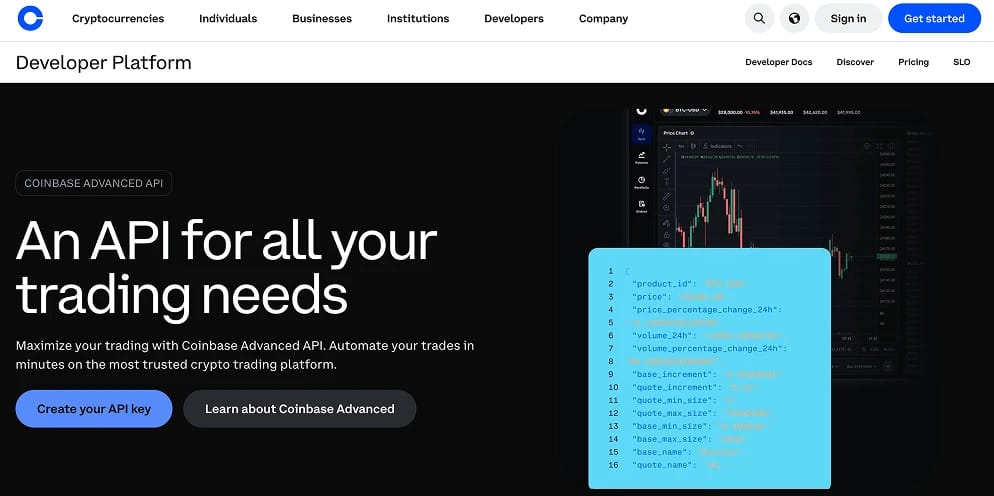
Coinbase is the venue for automation that must survive a compliance review. The institutional Exchange API pairs REST and WebSocket access with FIX 5.0 connectivity for both order entry and market data, including a Level 3 order-by-order feed that acknowledges your client order IDs before matching, so a strategy always knows which resting orders in the book are its own. FIX order entry runs one connection per key without the request-per-second caps applied to REST, and sessions reset each Saturday.
The regulatory position has no equal among crypto-native venues. Coinbase sits in the S&P 500, holds a New York BitLicense, won conditional approval for a national trust charter from the OCC in April, and cleared its CFTC-registered futures arm to carry global derivatives onshore. That shortens counterparty review for any regulated fund, and euro-side coverage runs through a MiCA authorisation in Luxembourg.
Price is the trade-off. Coinbase Advanced opens at 0.40% maker and 0.60% taker, the highest base rates on this list, and while the institutional Exchange schedule compresses with volume, casual algorithmic traders will pay more per executed order than anywhere else here. The asset list is also curated conservatively, so long-tail strategies need a second venue. Our Coinbase review weighs the full picture.
Pros
- FIX with L3 acknowledgements: Order-by-order data plus pre-match acks give precise self-identification in the book.
- Deepest US credentials: S&P 500 membership, a BitLicense, and OCC conditional trust approval satisfy strict counterparty reviews.
- All-states coverage: The only venue here serving every US state, New York included.
Cons
- Highest base fees: 0.40% and 0.60% starting rates on Advanced cost multiples of the offshore alternatives.
- Curated catalogue: Conservative listings rule out most long-tail and newly launched tokens.
- Split API surfaces: Retail Advanced Trade and institutional Exchange run on separate specifications, complicating a shared codebase.
6. Bitget
Bitget earns its slot as the venue where automation and social trading meet. Beyond standard REST and WebSocket endpoints for spot and perpetuals at 0.1% and 0.02% maker respectively, its API exposes one of the industry's largest copy trading networks, letting developers build against strategy data from over 130,000 elite traders. Grid and DCA bots can be created and managed programmatically, which suits teams productising strategies rather than only running them.
Execution quality held up in our testing on majors, with perpetual orders landing close to quoted prices during normal sessions, and the February proof-of-reserves attestation showed reserves at 169% of client liabilities alongside a protection fund above $400 million. WebSocket coverage spans public order books and private order updates with sensible reconnection semantics.
The gap is regulatory. Bitget operates without licences in the major Western markets, so US, UK, and EEA-based traders fall outside any local protection, and disclosure practices trail the venues above it. Depth also thins beyond the top pairs, widening slippage where bot traders probe for edge. Our Bitget review covers the wider platform.
Pros
- Copy and bot endpoints: Programmatic access to grid bots and a 130,000-strong elite trader network is unique at this scale.
- Verified reserves: A 169% reserve ratio and a $400 million protection fund back the custody side.
- Cheap derivatives: 0.02% perpetual maker fees match the best base rates on this list.
Cons
- Licence gap: No authorisation in the US, UK, or EEA leaves traders in those markets without local recourse.
- Shallower mid-caps: Order book depth beyond the majors trails OKX and Bybit noticeably.
- Lighter disclosure: Corporate transparency and audit cadence sit below the regulated venues here.
What Is API Trading on a Crypto Exchange?
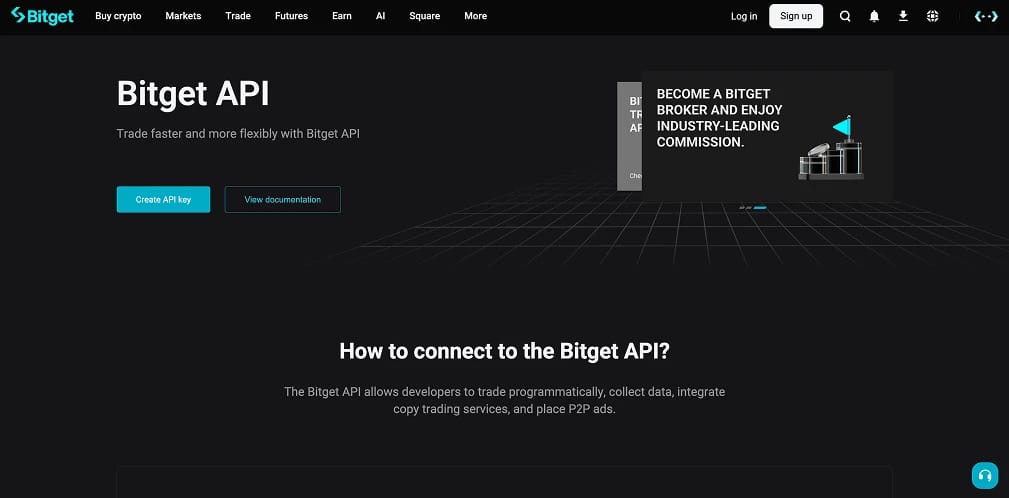
API trading means connecting your own software directly to an exchange's matching engine, the system that pairs buy and sell orders, instead of clicking through its website or app. The exchange publishes a set of endpoints, your code authenticates with cryptographic keys, and from that point orders, cancellations, balance queries, and market data all move programmatically around the clock.
Three connection types dominate. REST endpoints handle request-and-response tasks such as placing an order or checking a balance. WebSocket connections stream live order books, trades, and private execution updates over a persistent link, removing the delay of repeated polling. FIX, the messaging standard used across traditional finance, adds session-level guarantees like sequenced delivery and is offered by Kraken, Binance, and Coinbase for institutional order traffic.
The practical appeal is consistency. A bot executes the same logic at 3am on a Sunday, applies position sizing without hesitation, and reacts to price in milliseconds. The practical risk is the same consistency, because a bug repeats itself just as tirelessly, so every serious venue provides a test environment and we treat one as mandatory before live capital.
How to Choose a Crypto Exchange for API Trading
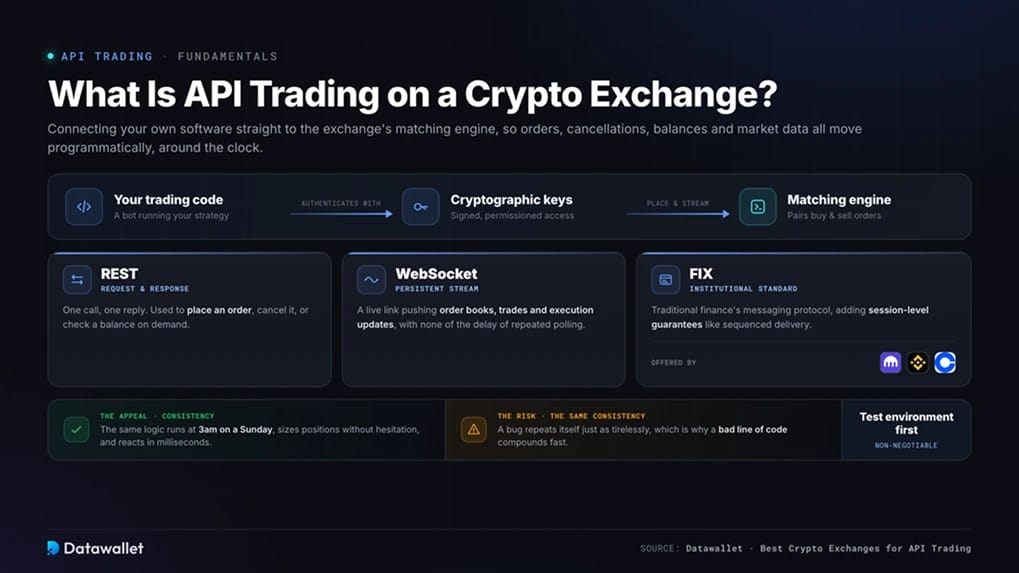
Choosing an exchange for API trading means confirming the venue can legally serve you, reading the rate limit model before writing code, pricing the fee schedule at your real volume, and checking that the development environment will not fight you.
- Confirm legal access before anything else: Your jurisdiction decides the shortlist. US traders are choosing between Coinbase, Kraken, and OKX's phased relaunch, EEA traders need a MiCA-authorised entity, and UK residents lose retail perpetuals almost everywhere. Check the exchange's own restricted-country list rather than a forum post, and note that our OKX restricted countries and Bybit restricted countries pages track the current maps.
- Read the rate limit model like a specification: Kraken meters points per currency pair with tier-based decay, Binance weighs each endpoint against a global budget, and OKX scales order ceilings with your fill ratio. Each model favours a different style of strategy, and a market maker that thrives under one can be throttled under another.
- Price fees at your actual volume, both sides: Maker rebates at high tiers can turn fee expense into fee income, while a taker-heavy strategy pays the widest spread in the schedule. Our guide to maker and taker fees explains the mechanics, and perpetual strategies must also budget for funding payments, which we track live on our funding rates page.
- Demand a real test environment: Bybit's testnet, OKX's demo mode, and Binance's spot testnet mirror production APIs closely. A venue that only offers live trading for testing is asking you to debug with your own money.
- Audit the security controls on keys: IP allowlisting, granular permissions that separate reading from trading from withdrawing, and support for RSA or Ed25519 keys should all be present. A key that can withdraw funds should never exist on a trading server.
Regulation and Market Access for API Traders
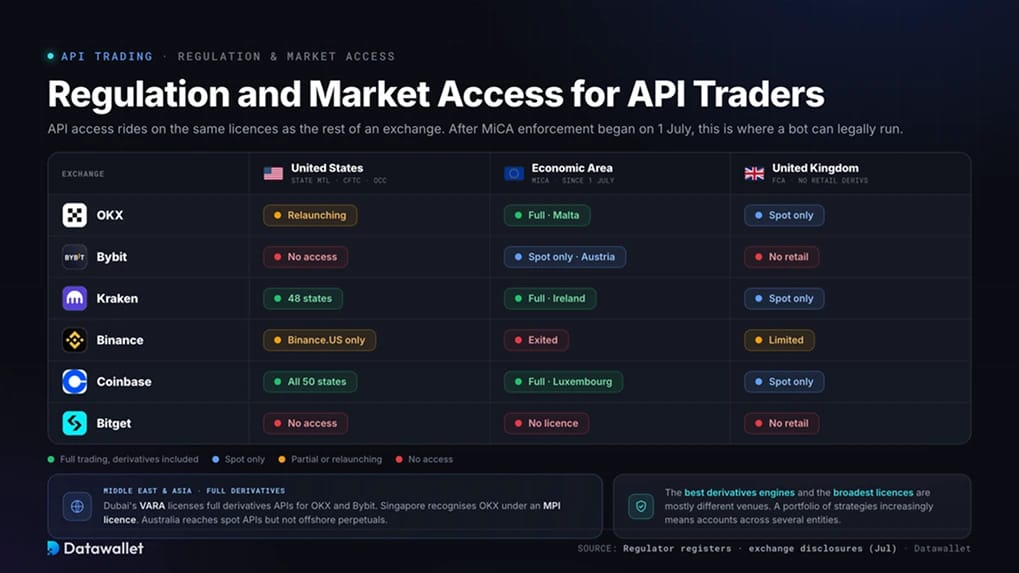
API access rides on the same licences as the rest of an exchange, and the map redrew itself over the past eighteen months.
- United States: Coinbase serves all fifty states under a BitLicense and conditional OCC trust approval, Kraken serves every state except New York and Maine with CFTC-regulated futures attached, and OKX has been rolling out nationwide from its San Jose headquarters since April 2025. Bybit and Bitget do not accept US clients, and Binance appears only through the restricted Binance.US product. Our best crypto exchanges in the USA guide covers the domestic field.
- European Economic Area: Since MiCA's transition period closed on 1 July, only authorised crypto-asset service providers can serve EEA residents. OKX passports from Malta, Kraken from Ireland, and Coinbase from Luxembourg with full trading services, while Bybit EU's Austrian authorisation covers spot only and Binance dropped out of the bloc entirely. Our MiCA-licensed exchanges guide tracks the register.
- United Kingdom: The FCA's regime keeps retail derivatives off-limits across the board, so UK-based bots run spot strategies on registered venues such as Kraken and Coinbase, while Bybit does not serve UK retail at all.
- Middle East and Asia: Dubai's VARA has licensed both OKX and Bybit, making the UAE one of the few places where full derivatives APIs operate under local supervision. Singapore recognises OKX under a Major Payment Institution licence, while Bybit remains restricted there, and Australian retail traders can reach spot APIs but not offshore perpetuals.
The venues with the best derivatives engines and the venues with the broadest licences are mostly different venues, so a portfolio of strategies increasingly means accounts across several entities.
Funding an API Trading Account
How you fund an account splits on whether the exchange can hold your currency at all. The licensed venues accept bank money directly, and the offshore venues only accept crypto.
Kraken, Coinbase, and OKX's US entity take bank deposits directly, covering ACH bank transfers and wires in the United States, SEPA in the euro area, and Faster Payments in the UK, mostly free. Bybit and Bitget have no Western banking partners, so accounts there are funded with stablecoins instead, usually USDT sent over a low-fee network such as Tron.
Some banks handle exchange transfers better than others, so many traders send money through Revolut or Wise first, which our guides to buying crypto with Revolut and buying crypto with Wise cover. Once funded, give each strategy its own sub-account and API keys so one bug or rate limit ban cannot touch the others. Every venue in our top four offers sub-accounts.
Can Bots Trade Onchain Instead?
Yes, and the boundary is thinning. Decentralised perpetuals venues expose their own APIs and signing schemes, letting bots trade from self-custodied wallets without an account or KYC file, and the most liquid of them now clears volume that rivals mid-tier centralised exchanges. Our overview of Hyperliquid explains the largest example, and our decentralised perpetuals exchanges guide compares the field.
The trade-offs mirror the custody model. Onchain venues remove exchange counterparty risk and geographic gatekeeping, while adding smart contract risk, shallower order books outside the majors, and an operational security burden that shifts onto the key holder. Many systematic desks now run both, using centralised APIs for depth and onchain venues for markets the licensed world cannot list.
Risks of API Trading in Crypto
Automation removes hesitation from execution and from mistakes in equal measure. These are the failure patterns we weight most heavily.
- Key compromise: A leaked API key with trade permissions can be drained through wash trades against an attacker's account even when withdrawals are disabled. IP allowlisting and least-privilege permissions are not optional.
- Rate limit bans: Exceeding limits during volatility, when your bot most wants to act, can lock order placement for seconds or minutes. Build header monitoring and backoff before you build alpha.
- Silent feed gaps: A WebSocket that reconnects without replaying missed messages leaves your order book state wrong and your bot trading on fiction. Sequence number checking is the fix.
- Venue failure: The February 2025 Bybit theft proved that even a top-three exchange can lose over a billion dollars in minutes. Position limits per venue belong in the risk model alongside limits per trade.
- Regulatory migration: Entity changes like the recent EEA transitions can force account migrations that invalidate keys mid-strategy. Watch exchange announcements the way you watch the market.
- Overfitted confidence: A backtest is a hypothesis. Testnets verify the code, small live sizing verifies the idea, and neither step can be skipped.
Final Thoughts
OKX wins on the completeness of its automation offer, pairing the lowest headline fees among the majors with a rate limit design that rewards disciplined execution and a licence map that now spans Malta and San Jose. Bybit runs it close with the strongest pure derivatives engine and the industry's most battle-tested crisis response, held back only by the markets it cannot enter. Kraken is the choice when the regulator's opinion matters as much as the engineer's, and it is the only venue here offering FIX and colocation inside that perimeter.
The deeper shift this year is that venue selection has become a legal question first and a technical one second. MiCA enforcement, Binance's EEA exit, and OKX's American return mean the best API for your strategy may be unavailable to your entity, and multi-venue architecture has moved from optimisation to necessity.
Whichever venue you choose, connect to the test environment first, run your strategy at the smallest order sizes against live order books for a week, and measure your real execution quality against the fees you modelled. The gap between those two numbers will tell you more about the exchange than any documentation page.
Our Methodology
We opened and verified accounts on each exchange, generated API keys with least-privilege permissions, and connected identical execution scripts to every venue's REST and WebSocket interfaces. Where FIX, colocation, or demo environments were offered, we evaluated those separately. Each platform scored across six criteria.
- Trust Score: Our proprietary rating out of 5, weighting regulatory standing, reserve transparency, security history, longevity, and how each venue handled its worst public incident.
- API Design and Documentation: Assessed specification consistency across products, documentation accuracy against observed behaviour, SDK quality, and versioning discipline.
- Rate Limits and Throughput: Mapped each limiter model, tested behaviour at and beyond the published ceilings, and verified header reporting and recovery times.
- Execution Quality: Placed matched limit and market orders on BTC, ETH, and one mid-cap pair per venue, measuring slippage, execution speed, and WebSocket confirmation timing against REST.
- Market Access and Licensing: Verified each operating entity, its licences, and its restricted-country list against regulator registers and official disclosures.
- Fees at Volume: Modelled all-in costs for a maker-weighted and a taker-weighted strategy at three volume tiers, including funding payments on perpetual positions.
We excluded venues without a documented public API, without a test environment or equivalent, or with unresolved solvency questions. Testing ran from April through July, and we rechecked every licensing status after MiCA enforcement began on 1 July.