







Compare Top Crypto Exchanges in Malta
1. Kraken
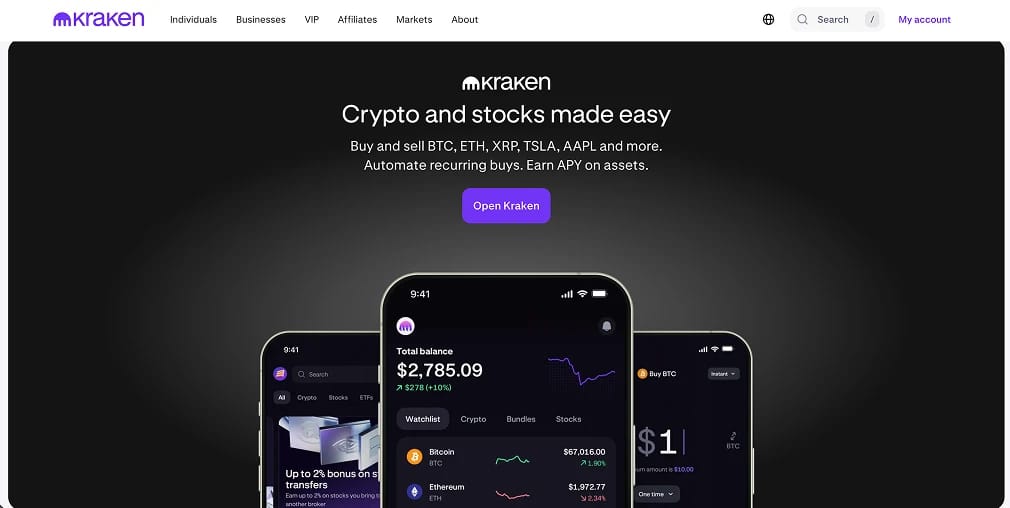
Kraken leads our Malta rankings with euro funding that clears without drama and a custody record no rival matches. Its European arm Payward Europe Solutions holds a MiCA licence from the Central Bank of Ireland, granted on 25 June 2025 and passported to Malta, sitting alongside the group's e-money and MiFID permissions. SEPA deposits cost nothing, and a SEPA Instant transfer we sent from a Revolut euro account was ready to trade in under a minute.
The fee gap between Kraken's two interfaces decides what you pay. Kraken Pro starts at 0.25% for makers and 0.40% for takers with volume discounts beyond that, while the Instant Buy screen quotes a price carrying close to 1% in fees before the spread. Over 450 assets trade against liquid EUR pairs, the exchange has published proof-of-reserves audits since 2014, and its custody record is free of breaches. Staking on the major coins is open to Maltese accounts.
Withdrawals aimed at a BOV or HSBC Malta account can be rejected under those banks' crypto policies, so we kept a Revolut IBAN as the landing spot for euro cash-outs. Card deposits also cost upwards of 3.7%, an avoidable expense given free SEPA. Our Kraken review covers the full platform.
Pros
- SEPA and SEPA Instant deposits are free, and transfers from fintech accounts clear in under a minute.
- Base fees of 0.25% and 0.40% on Kraken Pro beat every spread-priced platform available in Malta.
- A proof-of-reserves programme running since 2014 and a custody record with zero breach losses.
- MiCA authorisation from the Central Bank of Ireland plus group e-money and MiFID permissions.
- xStocks puts more than 100 tokenised US stocks and ETFs beside crypto for eligible EU clients.
Cons
- Card deposits cost upwards of 3.7%, leaving SEPA as the only sensible funding option.
- Withdrawals aimed at BOV or HSBC Malta accounts can be rejected by the receiving bank.
- Smaller altcoins trade mainly against USD, adding a conversion step for EUR holders.
2. Coinbase
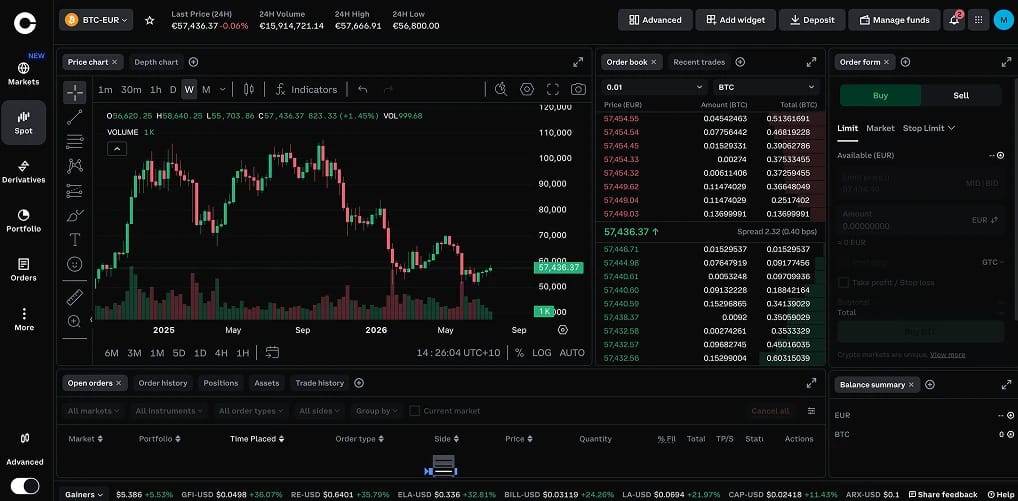
Coinbase offers Maltese beginners the softest landing on this list, backed by a company more transparent than any crypto-native rival. Its EU entity, Coinbase Luxembourg, received a MiCA licence from Luxembourg's CSSF regulator in June 2025, the first granted to a US exchange, and S&P 500 membership obliges it to open its books to shareholders every quarter. There is no Coinbase charge on SEPA deposits or withdrawals, and euros we moved in from a Wise account became tradable within a few minutes.
The simple buy screen wraps a spread and a transaction fee into each quote, whereas Coinbase Advanced exposes a genuine order book where entry-tier makers pay 0.40% and takers 0.60%. Moving between the two takes a tap and costs nothing, a distinction our Coinbase fees guide prices in detail. Maltese accounts can access roughly 250 assets, USDC gives euro holders a regulated dollar-pegged option, and staking covers a handful of majors.
Coinbase suits a first-time Maltese buyer who values brand safety over the last basis point. An active trader will pay more here than on Kraken Pro or OKX, and the altcoin catalogue trails the crypto-native venues. Our Coinbase review weighs the full trade-off.
Pros
- SEPA funding is free in both directions and deposits become tradable within minutes.
- S&P 500 membership brings quarterly audited disclosure on top of the MiCA licence.
- Coinbase Advanced swaps the spread-heavy simple screen for a proper order book inside the same app.
Cons
- Entry-tier Advanced fees of 0.40% and 0.60% exceed Kraken Pro and OKX.
- The default buy screen is among the most expensive ways to purchase Bitcoin in Malta.
- Fewer assets than the crypto-native platforms on this list.
3. OKX
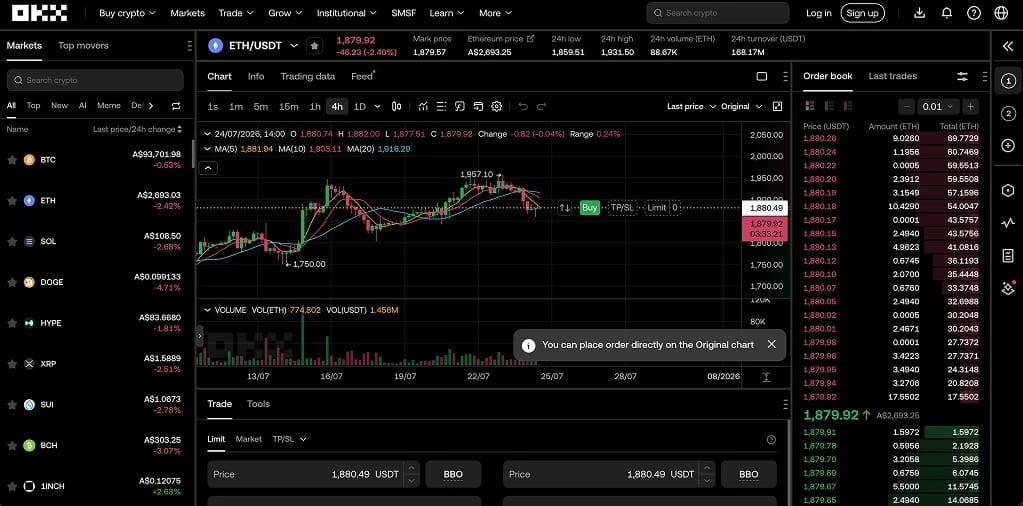
OKX is the only global heavyweight here regulated from Malta itself. OKX Europe Limited received its MiCA licence from the MFSA on 27 January 2025, among the first granted to any major exchange, and later added a MiFID II authorisation for derivatives and a payment institution licence for its card product. For a Maltese customer, the exchange answers to the regulator down the road in Birkirkara rather than one abroad.
Nothing on this list beats it on price. Makers pay 0.08% and takers 0.10% on spot, roughly a third of Kraken Pro's base tier, SEPA and SEPA Instant deposits carry no charge, and majors pair directly against euros. A Web3 wallet covering more than 100 networks sits inside the same account, connecting the licensed exchange to decentralised markets, and since late 2022 OKX has published a Merkle-tree reserve report each month so users can confirm their balances are fully backed.
Maltese authorities fined the group's local entity just over €1 million in April 2025 for historic anti-money-laundering shortcomings, and ESMA's peer review of the MFSA later questioned how one CASP authorisation was assessed. The licence stands, remediation is underway, and our OKX review tracks the platform in full.
Pros
- Spot fees of 0.08% maker and 0.10% taker, the lowest of any exchange serving Malta.
- Licensed directly by the MFSA, with MiFID II derivatives and payment permissions added since.
- Monthly reserve reports and a built-in Web3 wallet extend the core exchange.
Cons
- A seven-figure Maltese AML penalty in April 2025 sits on the compliance record.
- The interface packs in enough products to overwhelm a first-time buyer.
- Support response times slow noticeably when a verification review lands.
4. eToro
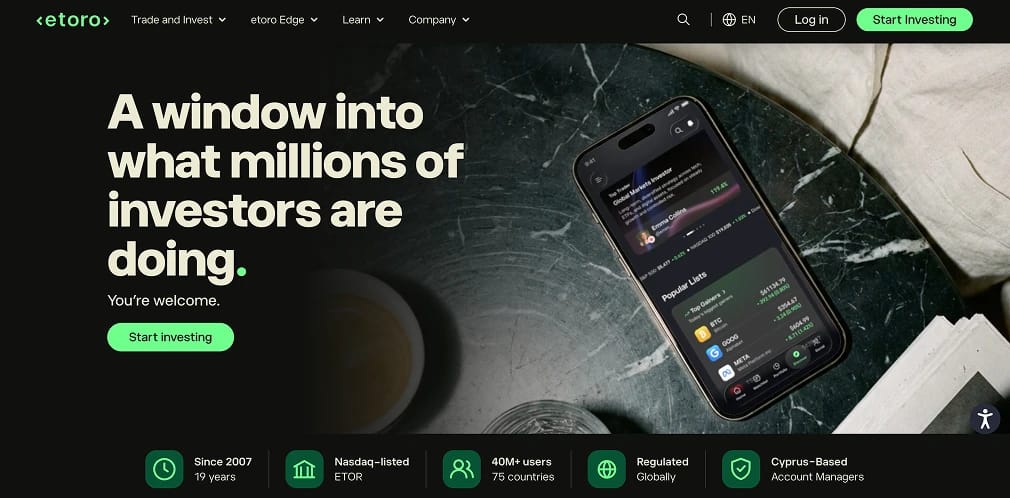
eToro solves a different problem to the exchanges above it. Crypto sits in one account beside more than 5,000 stocks and ETFs, which suits the many Maltese investors who want Bitcoin held next to their bank and iGaming shares. The company's European entity is authorised as a CASP under MiCA through Cyprus's CySEC, passported to Malta, and CopyTrader lets newcomers mirror the portfolios of vetted investors automatically.
The experience is built for people who never want to see an order book. Smart Portfolios bundle themed baskets of assets, the free demo account offers a risk-free training ground, and deposits arrive by SEPA, card, or online banking. A crypto trade costs a flat 1% plus the market spread on both entry and exit, so an in-and-out position runs past 2%, and a monthly inactivity fee begins after a year away.
Someone buying monthly and holding for years loses little to the fee, while an active trader belongs on Kraken Pro or OKX. For a mixed portfolio with crypto exposure inside one regulated account, nothing else serving Malta does the job as cleanly.
Pros
- Crypto, stocks, and ETFs in a single account with CopyTrader and Smart Portfolios.
- MiCA authorisation through CySEC passported across the EU, including Malta.
- A free demo account and the most beginner-friendly interface on this list.
Cons
- The 1% fee applies on entry and exit, before the spread, punishing frequent trading.
- An inactivity fee begins after twelve months without a login.
- Advanced charting and order types trail the dedicated trading venues.
5. Gate
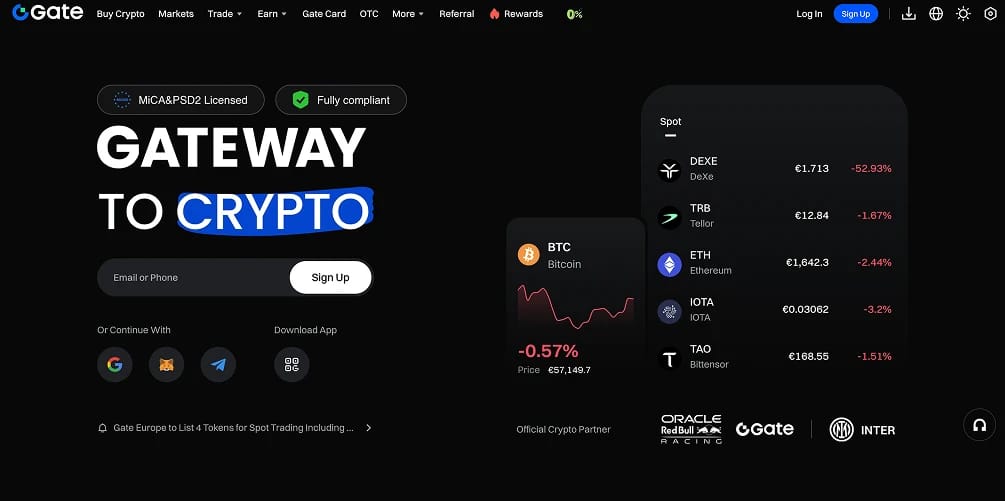
Gate is this list's altcoin specialist, and it too answers to the Maltese regulator. Its European entity secured an MFSA authorisation under MiCA, joining OKX in the island's CASP cluster, and the platform lists more than 4,200 cryptocurrencies, more than six times the selection anywhere else on this page. Traders hunting small-cap tokens before they reach the majors start here.
Spot fees start at 0.1% with discounts for paying in the GT token, SEPA, card, and Google Pay handle euro deposits, and grid and arbitrage bots automate strategies that would otherwise need constant screen time. The Startup launchpad distributes allocations in new token launches.
Breadth is also the risk. Thousands of small listings mean thin order books and rug-pull exposure at the long tail, and the interface can feel cluttered next to Kraken or Coinbase. We treat Gate as a satellite for small-cap positions rather than a primary account for savings, a judgement our Gate review explains at length.
Pros
- More than 4,200 listed cryptocurrencies, the widest selection available to Maltese users.
- MFSA authorisation under MiCA places it inside Malta's regulated cluster.
- Trading bots, a lending market, and the Startup launchpad extend the core exchange.
Cons
- Thin order books on small listings raise slippage and scam-token risk.
- Withdrawal fees on some smaller altcoins run high.
- The interface is dense and takes time to learn.
6. Bitpanda
Bitpanda is the broker option on this list, a Vienna company that has sold crypto to Europeans since 2014 and now serves more than six million users. Its regulatory file runs deeper than anyone else's here. The group holds MiCA licences from Germany's BaFin, the MFSA, and Austria's FMA, collected in that order across the framework's first months, so a Maltese customer trades on a platform the island's own regulator has vetted.
Pricing follows a broker model rather than an exchange one. The standard interface builds a premium into every quoted price, which Bitpanda's own fee disclosure puts anywhere from 0% to 2.49% per trade, while the Fusion platform gives active traders volume-tiered fees reported between 0.25% and 0.02%. The catalogue spans more than 650 cryptocurrencies beside stocks, ETFs, and precious metals, savings plans automate recurring buys from as little as one euro, and SEPA deposits carry no charge.
The convenience has edges a buyer should price in. Orders are filled by Bitpanda directly instead of matched on a public order book, the stock and ETF products are contracts tracking the underlying shares instead of the shares themselves, and a cost-conscious trader will find the standard interface expensive next to Kraken Pro or OKX. For a Maltese saver drip-feeding into crypto and metals from one app, the formula holds up well. Availability details sit in our Bitpanda countries guide.
Pros
- MiCA licences from three EU regulators, including the MFSA, on top of a decade of operating history.
- Savings plans automate recurring purchases from one euro across crypto, stocks, and metals.
- Fusion drops trading fees to a fraction of the standard interface for higher volumes.
Cons
- The built-in premium on the standard interface can reach 2.49% per trade.
- Stock and ETF products are derivative contracts, so holders never own the underlying shares.
- No public order book means pricing depth cannot be checked before an order fills.

How to Choose a Crypto Exchange in Malta
Most problems Maltese buyers hit are avoidable before the account is even open.
- Verify the CASP authorisation on an official register: Every exchange legally serving Malta after 1 July appears on ESMA's register of authorised CASPs or, for locally licensed firms, the MFSA Financial Services Register. A platform that cannot point to its entry is operating illegally in the EU.
- Learn where your bank stands on crypto first: BOV and HSBC Malta block transfers to and from crypto platforms, a stance covered in local banking guides for crypto users. Most Maltese buyers hold a Revolut or Wise euro account as the bridge between their salary account and an exchange. Our guides to buying crypto with Revolut and with HSBC cover what each institution permits.
- Fund by SEPA rather than card: Every exchange here accepts SEPA and SEPA Instant deposits free of charge, and a fintech account settles them in minutes. Cards add between 1.5% and nearly 4% purely for speed you rarely need. A €20 trial deposit confirms the whole path works before larger sums follow.
- Measure the real cost of a full trade: A tiny headline rate is meaningless when the quote hides a 2% spread. Kraken Pro, OKX, and Coinbase Advanced all display live market pricing, while simple buy screens bury their margin inside the quote. Buying and immediately selling a small amount reveals the round-trip cost on any platform.
- Plan for the Commissioner for Revenue from the first trade: Under DAC8, every EU exchange now reports user and transaction data to tax authorities automatically. Favour platforms that export tidy CSV files, maintain your own copy of every trade from the start, and read our tax section below before assuming your gains are exempt.
Crypto and Bitcoin Regulation in Malta
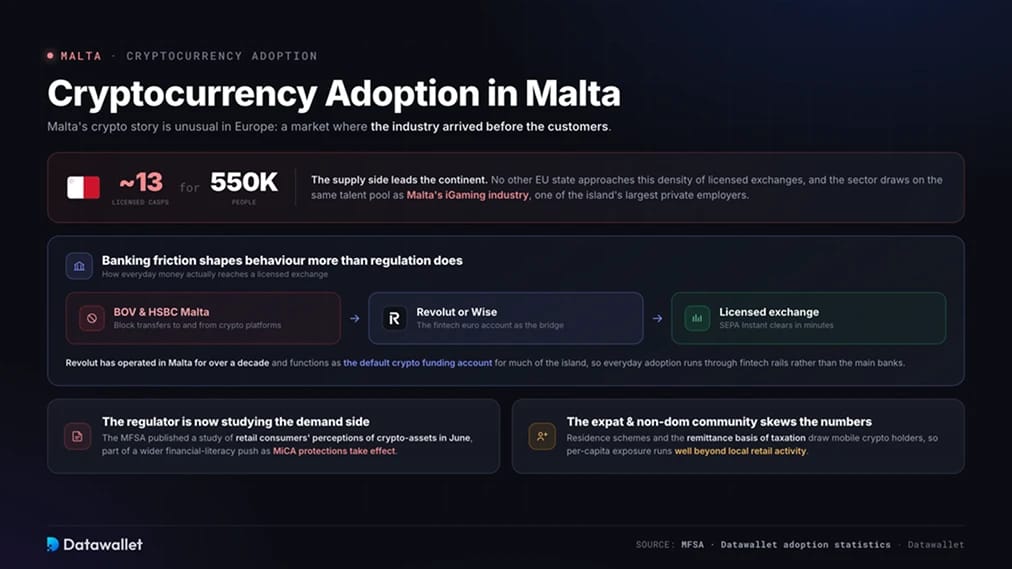
Owning and trading crypto is legal in Malta, and the rulebook governing it is now European rather than Maltese.
- The VFA Act made Malta first, in 2018: The Virtual Financial Assets Act gave Malta the EU's first full licensing framework for crypto businesses, years before other member states, and built the MFSA's supervisory experience that global exchanges now cite when choosing the island.
- MiCA replaced it through the Markets in Crypto-Assets Act: Malta implemented MiCA through Chapter 647 of its laws, applicable since 30 December 2024, with the MFSA as the competent authority for authorising and supervising CASPs and crypto issuers.
- The transition closed on 1 July: Firms holding old VFA licences had a grandfathering window to convert, and the MFSA's June letter to CEOs confirmed that any firm without CASP authorisation by the deadline must wind down while safeguarding client assets. Exchanges without a MiCA licence anywhere in the EU can no longer legally serve Maltese customers.
- Malta became a licensing hub, and drew scrutiny for it: The MFSA granted OKX its licence in January 2025 and has since authorised around 13 CASPs, including Gate, Bitpanda, Crypto.com, and Blockchain.com. ESMA's peer review in July 2025 found the authority only partially met expectations in how it assessed one CASP application, while crediting its specialised staff, and the MFSA committed to improvements.
- AML enforcement sits with the FIAU: Malta's Financial Intelligence Analysis Unit polices anti-money-laundering compliance at CASPs and has proven willing to act, including a seven-figure penalty against OKX's local entity in April 2025. Memories of the country's year on the FATF grey list, which ended in 2022, still shape how conservatively Maltese banks treat crypto money.
For users, the practical takeaway is simple. The licence question is now settled at EU level, and the register entry tells you whether an exchange belongs on the island.
How Does Malta Tax Crypto?
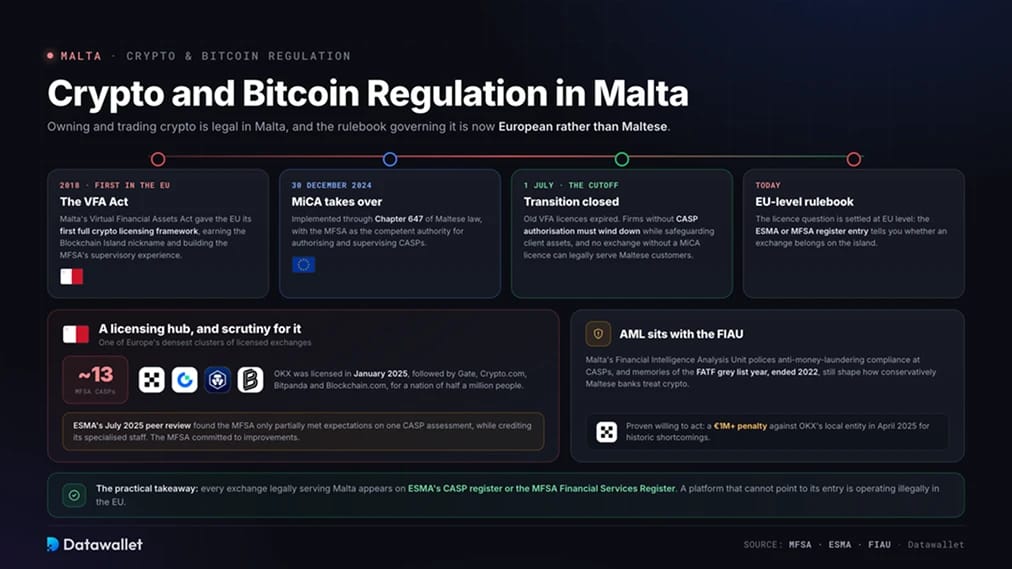
Malta has no dedicated crypto tax law. The Commissioner for Revenue instead applies existing income tax rules through guidelines issued in 2018, and the outcome depends on what you do rather than what you hold.
- Long-term holders generally pay nothing on disposal: Cryptocurrencies held as a personal, long-term store of value fall outside Malta's capital gains net, because coins are absent from the list of chargeable assets in the Income Tax Act. An individual investor who bought Bitcoin, held it, and sold years later typically owes no Maltese tax on the gain.
- Trading as an activity is income, taxed up to 35%: Frequent buying and selling with a profit motive is treated as a trade, and profits face progressive personal rates reaching 35%, or corporate rates for companies. The line between investor and trader turns on frequency, organisation, and intent, and it is the most consequential judgement in Maltese crypto tax.
- Staking, mining, and airdrops are income on receipt: Rewards are assessable at their euro value when received, and that value becomes the cost base for any later disposal.
- Non-domiciled residents use the remittance basis: Foreign-source gains kept outside Malta are generally untaxed for non-domiciled residents, one reason the island attracts crypto wealth. Minimum tax conditions apply and everything turns on individual facts, so this is territory for a Maltese tax adviser.
- DAC8 ended the reporting gap in January: EU exchanges must now collect user details and report transaction data to tax authorities automatically, and the first cross-border exchanges of that information are due next year. The Commissioner for Revenue will hold a copy of your trading history whether or not you file one.
Treat all of the above as background rather than advice, because the investor-versus-trader distinction can only be settled on your specific facts by a professional. Anyone planning to hold stablecoins can find the purchase mechanics in our guide to buying USDT in Europe.
Cryptocurrency Adoption in Malta
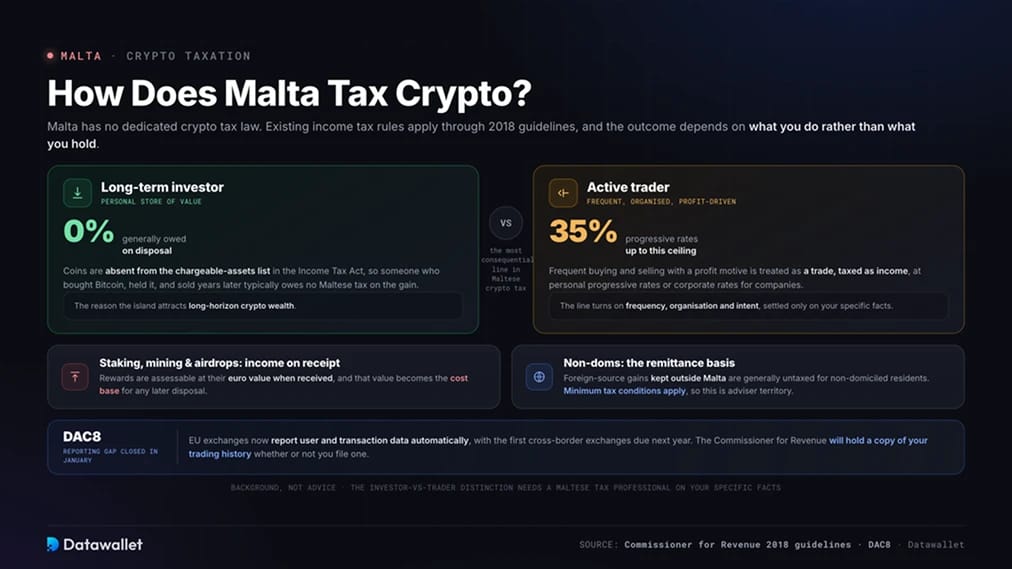
Malta's crypto story is unusual in Europe, a market where the industry arrived before the customers.
- The supply side leads the continent: Around 13 MFSA-authorised CASPs operate from an island of roughly 550,000 people, a density no other EU state approaches, and the sector draws on the same talent pool as Malta's iGaming industry, one of the island's largest private employers.
- The regulator is now studying the demand side: The MFSA published a study of retail consumers' perceptions of crypto-assets in June, tracing awareness and attitudes among Maltese consumers as MiCA protections take effect, part of a wider push on financial literacy around digital assets.
- Banking friction shapes behaviour more than regulation does: With BOV and HSBC Malta blocking exchange transfers, everyday adoption runs through fintech accounts. Revolut has operated in Malta for over a decade and functions as the default crypto funding account for much of the island, so check its crypto fee schedule before using it as more than a bridge.
- The expat and non-dom community skews the numbers: Residence schemes and the remittance basis of taxation draw internationally mobile crypto holders, so the island's per-capita exposure to digital assets runs well beyond what local retail activity alone would suggest.
Country-by-country figures live in our crypto adoption statistics hub. Malta's distinguishing feature is infrastructure built for a continent operating from a market the size of a mid-sized European city.
How to Buy Bitcoin in Malta
A Maltese buyer with documents ready can go from sign-up to holding Bitcoin inside an hour, and the cheapest version of that hour combines a free SEPA deposit from a fintech account with a limit order on a professional interface.
- Match the platform to your profile: Kraken suits most people, Coinbase eases in beginners, OKX minimises fees, and eToro places crypto beside shares. Check the ESMA or MFSA register entry for whichever you choose before creating the account.
- Verify your identity: Upload a Maltese identity card or passport and take the requested selfie. Approval usually arrives within minutes, occasionally a day if a manual review triggers, and the name you type must match the document exactly.
- Deposit euros by SEPA from an account that allows it: Revolut and Wise transfers clear near-instantly over SEPA Instant, while a payment sent from BOV or HSBC Malta is likely to bounce, so shift funds to the fintech account first. Cards charge 1.5% to 4% and deserve a pass.
- Set your price with a limit order: Setting your own BTC/EUR price on Kraken Pro, OKX, or Coinbase Advanced sidesteps the instant-buy spread, which routinely eats 1% or more of a purchase.
- Choose custody and keep records from day one: Coins can stay on a licensed exchange if you trade often, or move to self-custody for long-term holding, and our best crypto wallets guide weighs the hardware and software options. Download your transaction history regularly, since DAC8 means the tax authorities already receive the exchange's version.
Cashing out follows the same steps in reverse, and a SEPA Instant withdrawal to a fintech account lands in minutes.
Final Thoughts
Kraken finishes first because free SEPA funding, low Pro fees, and the industry's longest run of unbreached custody all sit in one account. Coinbase gives beginners a listed company to lean on, OKX wins on raw cost with a licence from the MFSA itself, eToro pairs crypto with stocks for mixed portfolios, Gate serves the altcoin hunters under a local authorisation, and Bitpanda suits the saver automating small buys across crypto and metals.
The structural picture favours Maltese users more than most Europeans realise. A licensing cluster this dense exists nowhere else in the EU, the transition deadline resolved the legality question in a single stroke, and what remains broken is domestic, a banking sector that blocks the very industry its own regulator licenses. Until BOV and HSBC Malta change course, a fintech euro account stays part of the toolkit.
Before trusting any platform with serious money, rehearse the entire cycle with €100. One SEPA deposit, one limit order, one sale, one withdrawal. Twenty minutes of rehearsal exposes the true costs and any banking snags far more reliably than a review ever could.
Readers weighing the wider region can compare our guides to the best crypto exchanges in Europe and the best MiCA-licensed crypto exchanges.
%20(1)%20(1).webp)