






Compare Crypto Exchanges Available in Poland
1. Bybit EU
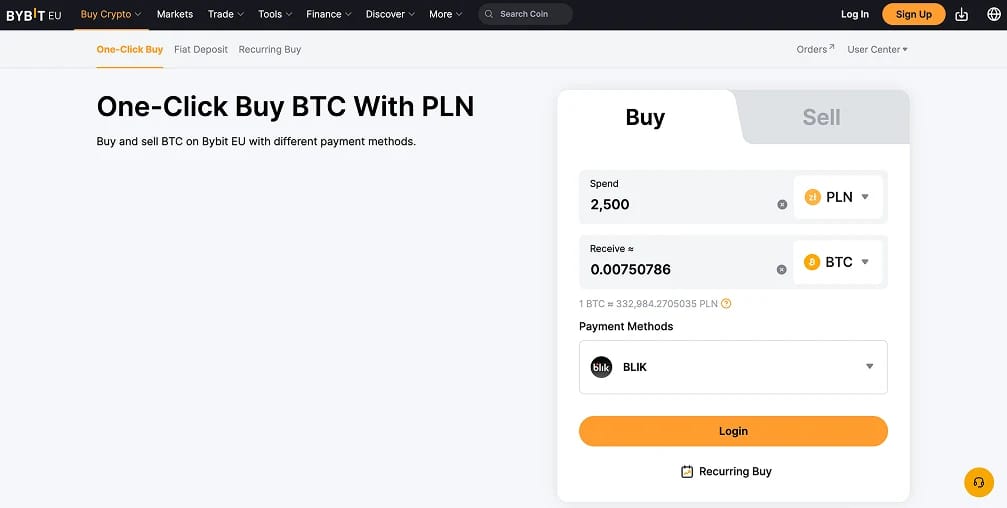
Bybit EU is the only exchange in this ranking where złoty reach an order book, the live list of buy and sell offers that determines the market price. Since 21 April, Polish residents have been able to deposit PLN by BLIK and trade BTC/PLN, ETH/PLN, SOL/PLN and USDC/PLN directly, according to Bybit EU's launch announcement. Other platforms that accept BLIK either execute the purchase at a quoted price or convert the złoty into euros first.
Bybit EU GmbH, based in Vienna, received its MiCA authorisation from Austria's FMA on 28 May 2025. The licence can be used across the European Economic Area (EEA), including Poland. Its sister company, Bybit Payments GmbH, secured an electronic money licence from the same regulator on 4 August. Chief executive Ben Zhou told CoinDesk that it will support bank-style accounts with their own account numbers (IBANs).
Our BLIK deposit from mBank arrived within seconds. A BTC/PLN limit order then completed at 0.10% without a currency conversion. The account also includes copy trading, automated trading bots, savings products and the Bybit Card. Perpetual futures stay closed to EEA users until Bybit X GmbH receives the investment firm licence it applied for in September 2025. Zhou told CoinDesk on 10 September 2026 that he expects it around November.
Our Bybit review covers the February 2025 theft of roughly $1.5 billion from the global exchange, which Bybit repaid in full.
Pros
- PLN trading pairs let a BLIK deposit buy Bitcoin without a złoty-to-euro conversion.
- MiCA authorisation and a new e-money licence, both from Austria's FMA, apply in Poland through EU passporting.
- A flat 0.10% spot fee with no maker or taker split and no conversion charge on PLN pairs.
Cons
- No perpetual futures for European accounts until the Austrian investment firm licence comes through.
- About 600 assets are listed for Europe, far fewer than on the global bybit.com app.
- Its history includes the biggest exchange hack yet, the 2025 cold wallet theft, although Bybit covered every customer loss.
2. Kraken
Kraken has the cleanest security record of any exchange serving Poland. It has operated since 2011 without a hack that cost customers funds. Its Irish company, Payward Europe Solutions Limited, received MiCA authorisation from the Central Bank of Ireland in June 2025. Eligible EEA clients can also access regulated futures through Kraken's Cypriot investment firm, a product Bybit EU cannot yet offer.
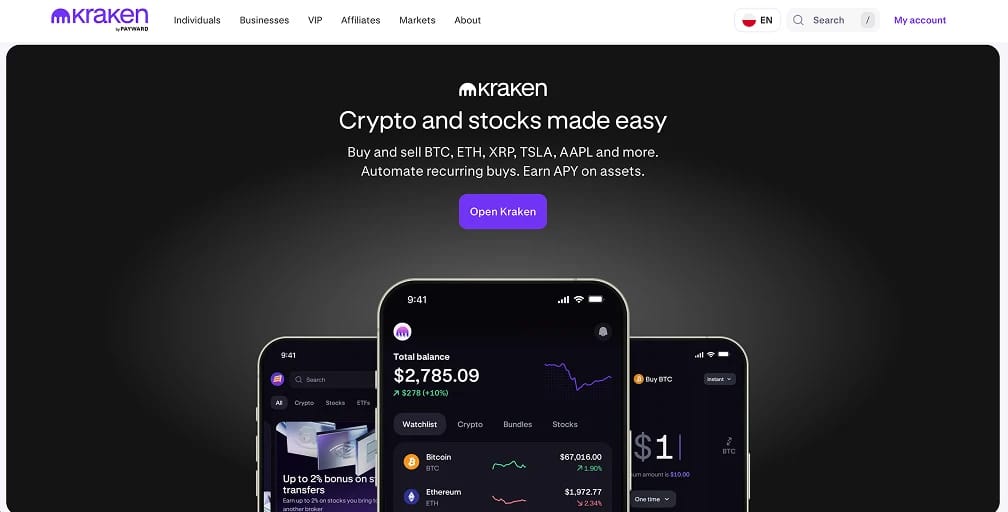
Kraken's Polish buy page accepts BLIK and Przelewy24 for Instant Buy purchases from 10 zł. That works well for a first test, though the quoted price includes both a fee and a spread, the gap between buying and selling prices. Kraken does not hold a złoty balance. For larger deposits, the cheaper route is a free SEPA transfer in euros, listed in Kraken's funding table with a €1 minimum. Our SEPA Instant transfer from Revolut arrived within seconds.
Fees for small accounts increased on 9 July. Kraken Pro now starts at 0.40% maker and 0.80% taker. Holding the equivalent of $20,000 on the platform or trading $10,000 a month reduces those rates to 0.22% and 0.38%, according to Kraken's cross-platform fee tiers. A maker order rests on the order book and costs less than a taker order that executes immediately, as our maker and taker fees guide explains. Our Kraken review covers every tier.
Pros
- Irish MiCA authorisation, plus a Cyprus-supervised company for regulated futures.
- A breach-free record since 2011, backed by regular Proof of Reserves reports that check customer balances are covered.
- BLIK and Przelewy24 for small Instant Buy purchases, with free SEPA for larger deposits.
Cons
- Entry-tier Kraken Pro fees of 0.40% and 0.80% are the highest order book rates here for accounts under $20,000.
- No złoty wallet or PLN trading pairs, so every larger deposit passes through euros.
- Opening futures means a second application with suitability questions.
3. Bitpanda
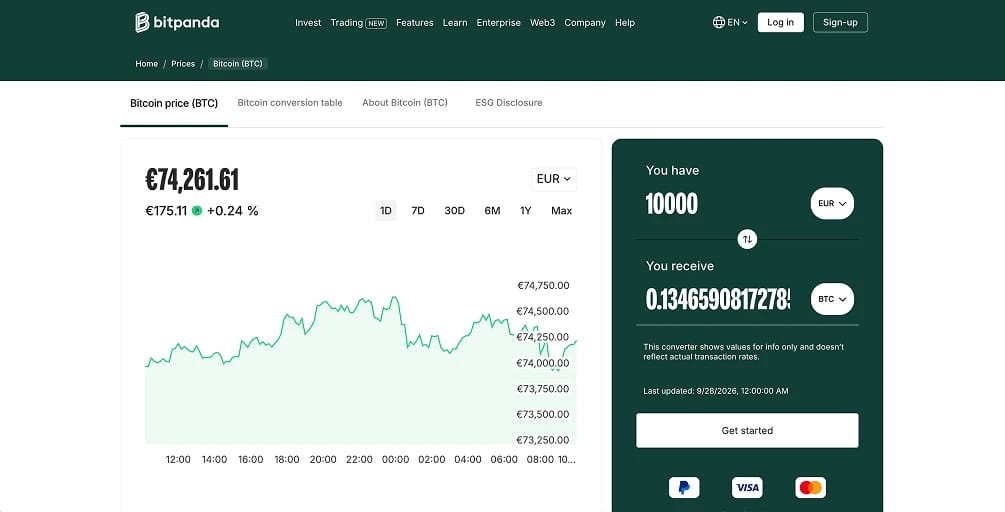
Bitpanda treats the złoty as a full account currency. Users can top up by BLIK and buy crypto, fractional shares, ETFs or precious metals directly from a PLN wallet. The Vienna company holds MiCA authorisations from regulators in Austria, Germany and Malta, and its app is available in Polish.
Its savings plans suit investors who want to put in a fixed amount each payday. Bitpanda's helpdesk sets a 45 zł minimum per purchase, whether the plan runs daily, weekly or monthly. Our BLIK top-up from PKO BP appeared in the złoty wallet immediately. Buying 500 zł of Bitcoin from the same screen took under a minute.
Instant purchases carry a markup of up to 1.49%, many times the cost of a 0.10% order on Bybit EU's BTC/PLN pair. There is no order book in the standard app, so users cannot choose their own execution price. Our Bitpanda countries guide lists the products available to Polish residents.
Pros
- A złoty wallet with BLIK top-ups, so PLN never has to become euros before a purchase.
- Savings plans from 45 zł covering crypto, shares, ETFs and metals in one account.
- MiCA authorisations in three EU countries and a Polish-language app.
Cons
- Markups of up to 1.49% make Bitpanda one of the costliest ways to buy on this list.
- You cannot set a limit price or trade on margin in the standard app.
- Active traders will outgrow the product range quickly.
4. Coinbase
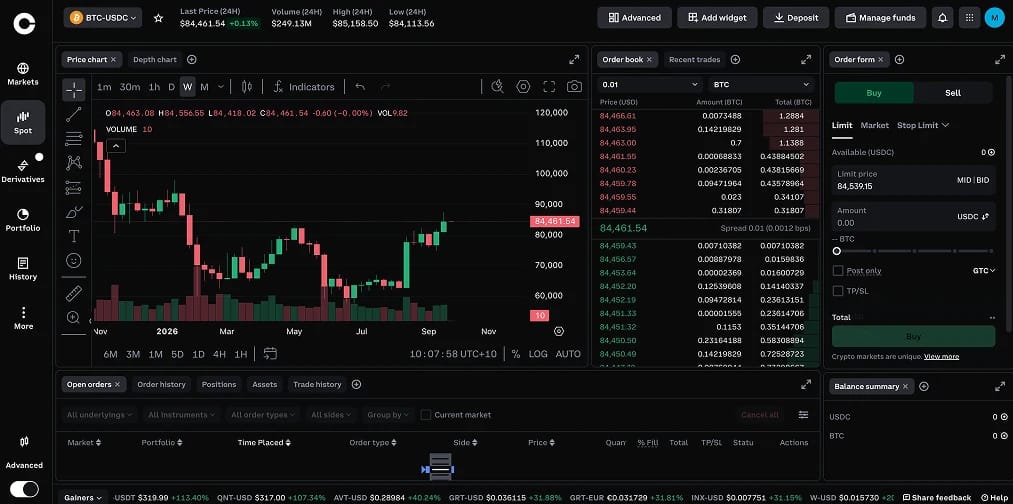
Coinbase gave us the simplest BLIK purchase of the six. BLIK payments were added to the app in December 2025 through payment processor PPRO. Enter the six-digit code, confirm the payment in your banking app and the coins appear. EEA customers use Coinbase's Luxembourg company, which received MiCA authorisation from Luxembourg's regulator, the CSSF, in June 2025.
The one-tap purchase adds a fee and spread to each quote. Advanced Trade instead uses an order book, with fees starting at 0.40% maker and 0.60% taker, but there are no złoty pairs. We used BLIK for a 200 zł test and switched to euros for larger amounts. Our Coinbase fees guide explains the pricing on both screens.
Coinbase is also the only exchange here that publishes audited quarterly accounts as a Nasdaq-listed company. In November 2025, the Central Bank of Ireland imposed a penalty of about €21.5 million on Coinbase Europe Limited after a monitoring fault left a large share of transactions unchecked for money laundering. Its catalogue of about 250 assets is narrower than Bybit EU's or Gate's. Our Coinbase review has the full assessment.
Pros
- One-tap BLIK purchases in the app, the gentlest start for a complete beginner.
- Luxembourg MiCA authorisation and audited public accounts through the Nasdaq listing.
- Advanced Trade gives cheaper order book pricing once you fund in euros.
Cons
- BLIK purchases carry a fee and spread well above order book rates.
- Advanced Trade fees of 0.40% and 0.60% trail Bybit EU and OKX.
- The 2025 Irish fine sits on the group's European compliance record.
5. OKX
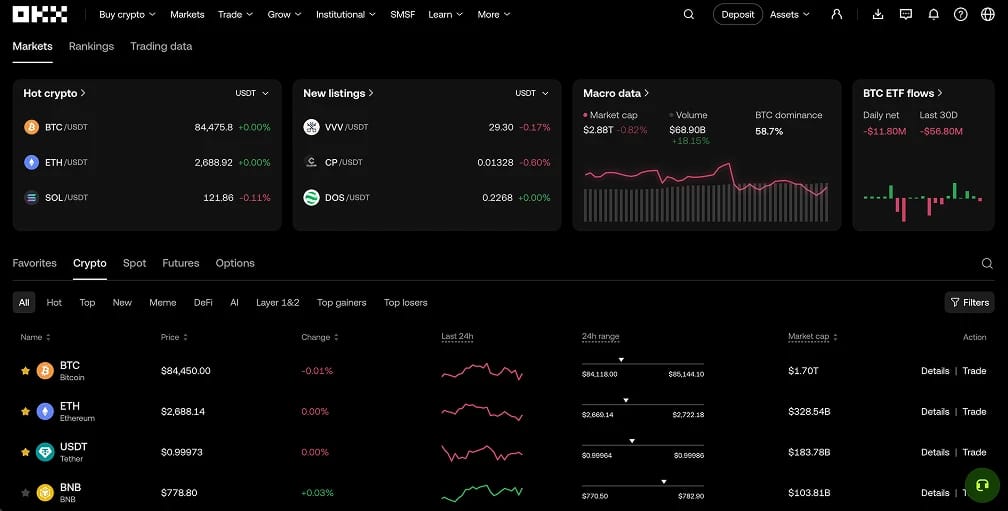
OKX has the lowest base order book fees in this ranking: 0.08% for makers and 0.10% for takers before volume discounts. OKX Europe Ltd has held MiCA authorisation from Malta's financial regulator, the MFSA, since January 2025. The group also holds a Maltese investment firm licence under MiFID II, the EU rulebook for regulated derivatives.
BLIK is available through payment company ZEN.COM, but only for instant purchases. OKX's help page states that there is no PLN order book. Instead, złoty are converted to euros to price the purchase, with the BLIK processing fee shown before confirmation. Withdrawals are available only in euros. We tested a 300 zł BLIK Bitcoin purchase, then deposited euros by SEPA to trade at the 0.08% maker rate.
The app also includes a self-custody wallet covering more than 100 networks, allowing users to move coins into their own control without installing separate software. Malta's Financial Intelligence Analysis Unit penalised OKX's Maltese entity roughly €1.1 million in April 2025 over historical anti-money-laundering gaps. A July 2025 ESMA peer review later criticised how the MFSA had handled crypto authorisations. Our OKX review weighs that history.
Pros
- Entry pricing of 0.08% for makers and 0.10% for takers undercuts every other order book we tested.
- A single supervisor in Malta oversees both its crypto services and its derivatives licence.
- A built-in self-custody wallet for moving assets off the exchange.
Cons
- BLIK only buys at a converted euro price, and złoty cannot be withdrawn.
- Its compliance file includes the 2025 Maltese penalty.
- Keeping the custodial account and the self-custody wallet in one app invites costly mix-ups.
6. Gate
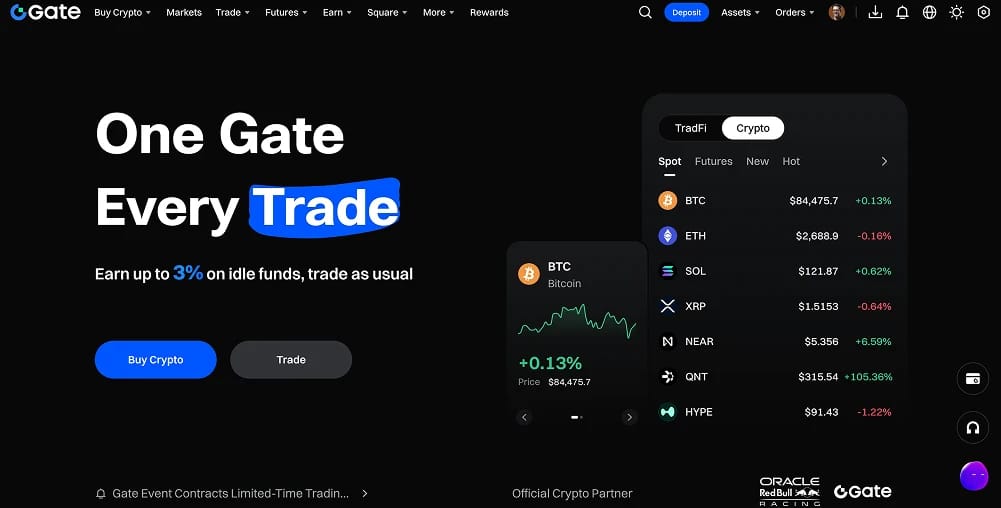
Gate lists more than 1,000 tokens on its European platform, the widest catalogue offered to Polish residents by any MiCA-authorised exchange. Gate Technology Ltd received authorisation from Malta's MFSA in September 2025, including permission to operate a trading platform. Newer tokens tend to appear on Gate well before Kraken or Coinbase.
There is no BLIK or złoty support. Gate accepts SEPA deposits in euros and cards. Our workaround was to buy USDC with złoty on Bybit EU, then transfer it to Gate over a low-fee network. Poland does not tax crypto-to-crypto swaps, although stablecoins regulated as e-money under MiCA sit in a grey area worth discussing with a tax adviser. Our USDC explainer compares the networks.
Spot fees start at 0.10% for both makers and takers, with discounts available to holders of Gate's GT token. Most volume is concentrated in a few hundred popular pairs. On one small token we tested, the spread cost more than the commission. Promotions also crowd the menus. Our Gate review explains the discount tiers.
Pros
- More than 1,000 tokens, the broadest licensed selection available in Poland.
- Its Maltese licence covers running a full trading venue, a permission Bybit EU's authorisation does not include.
- Fees from 0.10% with further GT discounts.
Cons
- No BLIK or złoty deposits, so funding needs euros or a transfer from another exchange.
- Spreads on small tokens can wipe out the fee advantage.
- Promotional clutter slows beginners down.
How to Choose a Crypto Exchange in Poland
Every platform here holds a MiCA authorisation from outside Poland. The practical differences come down to currency support, bank limits and total cost.
- Trace the licence to a named company: The authorisation belongs to a specific legal entity, so start by checking the company named in the terms of service. Search it on ESMA's MiCA register, then check the KNF's public warning list for Polish enforcement notices. Zondacrypto, the former BitBay, held only an Estonian anti-money-laundering licence when it froze withdrawals. Our guide to MiCA-licensed crypto exchanges lists verified platforms.
- Decide between złoty and euro funding: Bybit EU lets BLIK deposits trade on PLN pairs, while Bitpanda holds them in a złoty wallet. Kraken, Coinbase and OKX instead convert złoty within an Instant Buy price. For euros, open a foreign-currency account (rachunek walutowy) at your bank or use a multi-currency app. Our guides to buying crypto with Revolut and buying crypto with Wise cover the conversion and SEPA steps.
- Check your bank's limits and transfer speed: Polish banks apply a separate limit to BLIK internet payments, and a low default is the usual reason larger deposits fail. Under the EU Instant Payments Regulation, Polish banks do not have to send instant euro transfers until 9 July 2027. A standard SEPA transfer can therefore take a business day.
- Add up the whole purchase and sale: Include the spread, currency conversion and withdrawal fee alongside the trading commission. On a 1,000 zł purchase and sale, the costliest instant purchase we tested was roughly 28 zł more expensive than Bybit EU's PLN order book.
- Keep records from the first trade: Exchanges now collect your PESEL (national identification number) and tax residence for DAC8, the EU directive that sends crypto transaction data to tax authorities. Export every purchase with its złoty value each quarter because unused PIT-38 costs carry forward for years.
Crypto and Bitcoin Regulation in Poland
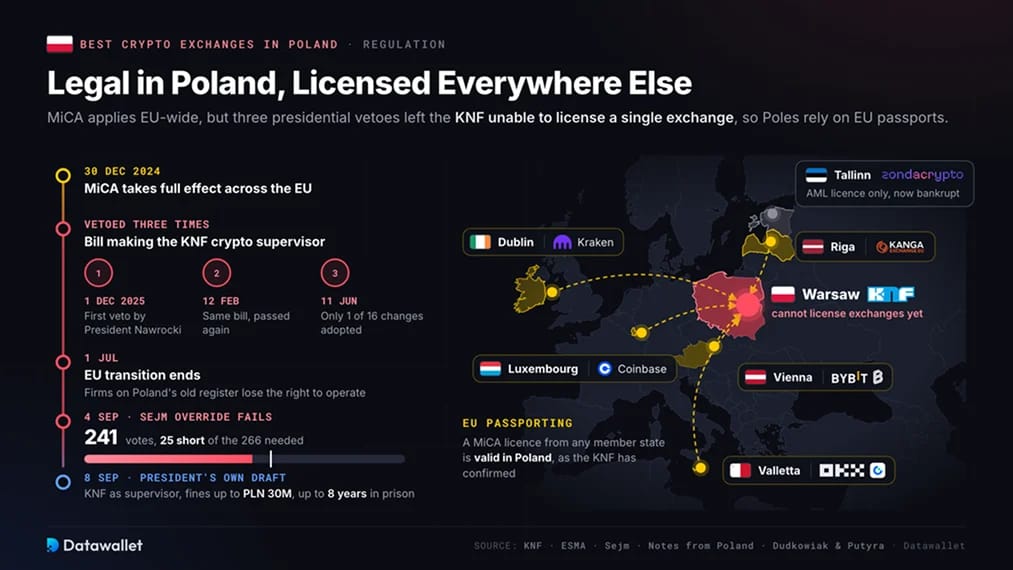
Buying, holding and trading crypto is legal in Poland, but no Polish authority can currently license the exchanges you use. MiCA applies directly across the EU, yet each member state must pass a law appointing the authority that approves exchanges. Poland has not done so. The KNF confirmed in a formal statement that providers licensed in other member states may continue serving Polish residents.
- 30 December 2024: MiCA took full effect. Exchanges on Poland's virtual currency register, kept by the tax chamber in Katowice, could continue under national anti-money-laundering rules during a transitional period.
- 1 December 2025: President Karol Nawrocki vetoed the Crypto-Asset Market Act, which would have made the KNF the sector's supervisor. Critics said its powers to block websites and freeze accounts went beyond EU requirements.
- 12 February 2026: Nawrocki vetoed a second, unchanged version after both chambers of parliament passed it again.
- 11 June 2026: Nawrocki vetoed a third version, saying lawmakers had adopted only one of the 16 changes his office proposed.
- 1 July 2026: The EU-wide transitional period ended. The KNF had warned that domestic firms on the old register would lose the right to operate and that no Polish law could extend the deadline.
- 4 September 2026: The Sejm voted 241 to 198 to override the veto, short of the 266 votes a three-fifths majority required.
- 8 September 2026: The President sent his own draft to the Sejm. It keeps the KNF as supervisor, with fines of up to PLN 30 million or 5% of annual revenue. Unlicensed operation could bring eight years in prison, according to law firm Dudkowiak & Putyra.
Licences issued in Vienna, Dublin or Valletta therefore have full legal effect in Poland through passporting, the EU right to use one member state's authorisation across the bloc. Polish-founded firms had to obtain licences elsewhere. Kanga received a MiCA licence from the Bank of Latvia in June, but Kanga Exchange EU currently offers only account opening and custody, with PLN trading promised later. Binance withdrew its Greek application and stopped EU trading on 1 July, which our Binance restricted countries page tracks.
Zondacrypto illustrates the cost of the old system. Once Poland's largest exchange, it stopped withdrawals and went offline in April. Estonia's financial intelligence unit revoked its licence on 29 June, and a Tallinn court declared operator BB Trade Estonia OÜ bankrupt on 27 August. Customers must file claims with the Estonian trustee by 27 October, according to Estonian law firm Lepmets & Nõges. Prosecutors in Katowice are also pursuing a criminal case.
How Is Crypto Taxed in Poland?
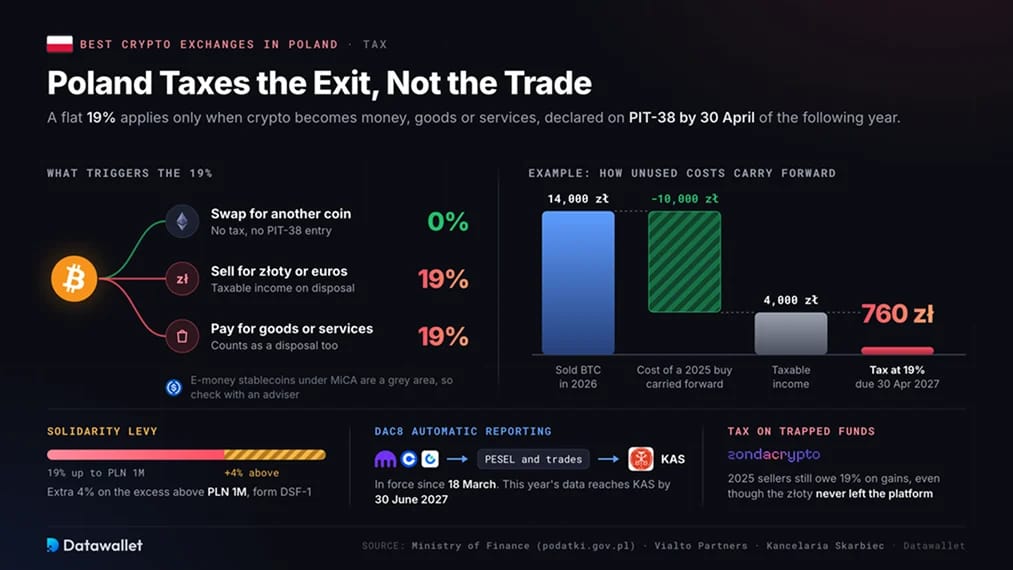
Polish tax is due only when crypto becomes money, goods or services. The flat rate has remained 19% since 2019, making the system simpler than most in the EU.
- A flat 19% on disposals: Selling crypto for złoty or another currency, or paying for goods and services with it, creates income taxed at 19%. You report it on PIT-38 by 30 April of the following year, as the Ministry of Finance's tax portal explains.
- No tax on crypto-to-crypto swaps: Exchanging Bitcoin for Ether or any other virtual currency is neither taxed nor reported. The gain waits until you convert to money.
- File even in a year with no sales: Purchase costs go on PIT-38 for the year you pay them. Unused costs roll into later years with no expiry, although crypto results cannot offset gains on shares.
- The solidarity levy above one million: Annual income above PLN 1 million, crypto gains included, attracts an extra 4% on the excess, declared separately on form DSF-1.
- Automatic reporting has started: Poland's DAC8 act took effect on 18 March. Exchanges will send this year's transaction data to the National Revenue Administration (KAS) by 30 June 2027, as Vialto Partners outlines.
Tax can still fall due when the money is trapped. Zondacrypto customers who sold crypto on the platform in 2025 owe 19% on those gains even if they never received the złoty, as Kancelaria Skarbiec has pointed out. This is general information, so ask a doradca podatkowy about anything beyond simple buying and selling.
Cryptocurrency Adoption in Poland
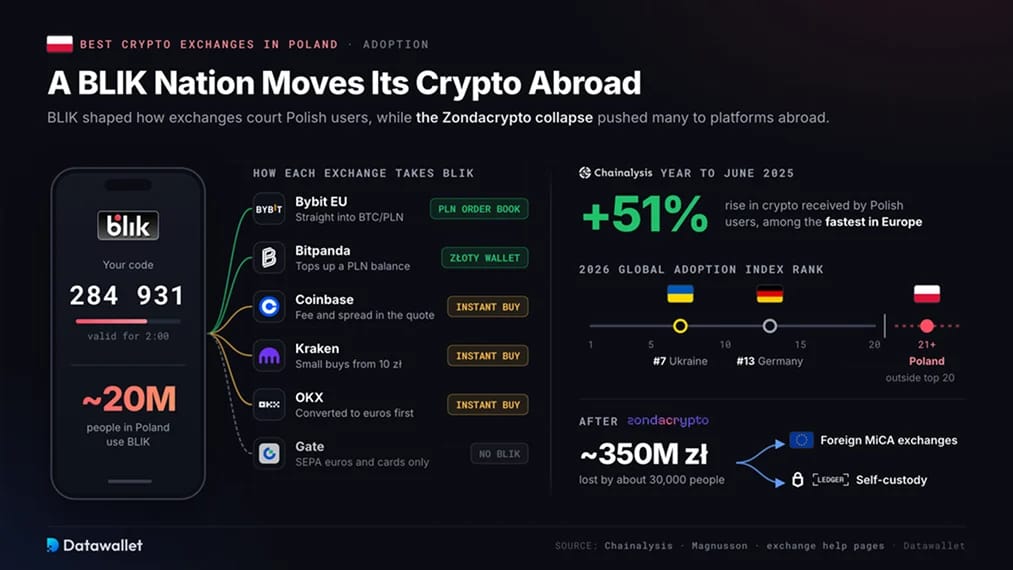
Poland combines a large retail crypto market with some of Europe's most digital payment habits. Around 20 million people use BLIK, generating a six-digit payment code directly inside their banking app. That familiarity helps explain why Bybit EU, Coinbase, OKX, Kraken and Bitpanda have all added BLIK for Polish customers.
Chainalysis measured a 51% increase in crypto received by Polish users in the year to June 2025, one of Europe's fastest growth rates, driven by grassroots use and remittances. Its 2026 global adoption index, published on 23 September, placed Poland outside the top 20. Neighbouring Ukraine ranked seventh and Germany thirteenth.
The Zondacrypto failure has also changed user behaviour. Losses are estimated at around 350 million zł across some 30,000 people, according to Magnusson. Many Polish users have since shifted to foreign licensed exchanges or self-custody. Our crypto adoption statistics page compares Poland with other markets.
How to Buy Bitcoin in Poland
Using BLIK to fund a PLN order book is the cheapest dependable way to buy Bitcoin in Poland. With your ID card ready, the first purchase takes around half an hour.
- Open a Bybit EU account: Register on Bybit EU and select Poland as your country of residence. Kraken suits long-term holders who fund in euros, while Bitpanda suits monthly savers.
- Pass the ID and tax residence checks: Upload your dowód osobisty or passport, then complete the selfie check. Expect a tax residence form asking for your PESEL, which exchanges now collect for DAC8 reporting.
- Deposit złoty by BLIK: Select PLN and BLIK, generate a code in your banking app and enter it within two minutes. If you plan a larger deposit, raise your bank's BLIK internet-payment limit first.
- Buy with a limit order on BTC/PLN: Open the spot market, choose the maximum price you are willing to pay and confirm the order. The fee remains 0.10%, while the limit order prevents you from paying above your chosen price. The live market is on our Bitcoin price page.
- Withdraw savings to self-custody: Move long-term holdings to a wallet whose private keys you control, compared in our best crypto wallets guide. Record the złoty cost of every purchase for PIT-38.
To cash out, sell through the same market and withdraw to a bank account in your own name. Each sale into money is a taxable disposal, so keep the date and złoty amount.
Final Thoughts
Bybit EU ranks first because a Polish BLIK payment can move directly into a złoty order book at 0.10%, under an Austrian MiCA authorisation. Kraken follows for its security record and regulated futures. Bitpanda stands out for złoty savings plans, Coinbase for its straightforward BLIK purchase flow, OKX for the lowest base fees and Gate for the widest token list.
Poland's legal position remains unsettled. The KNF still cannot license exchanges, the President's new draft only reached the Sejm on 8 September, and legislative work could continue into next year. Until a law passes, the protection that matters is a foreign MiCA licence confirmed on ESMA's register.
Test a small BLIK deposit and withdrawal before sending a larger amount. Keep long-term coins in self-custody and export your records every quarter. For neighbouring markets, see our guides to the best crypto exchanges in the Czech Republic, Germany and Lithuania, or our Europe-wide ranking.
Our Methodology
We assessed each platform as a Polish resident would use it in September, after the MiCA transitional period ended and the third veto survived.
- Trust score: Ratings out of 5 reflect who supervises each platform and for which services, its incident history, reserve reporting and years in operation.
- Licence verification: We identified each contracting entity from the user agreement, confirmed its MiCA entry with ESMA and searched the KNF warning list.
- Złoty and euro funding: We paid by BLIK from mBank and PKO BP accounts and sent euros by SEPA from Revolut, timing every credit and withdrawal.
- Round-trip cost: We bought Bitcoin and sold it again on each platform, totalling commissions, spreads, currency conversion and withdrawal charges.
- Products for European accounts: We counted only what a verified Polish account can use, from listed assets and derivatives to savings plans and wallets.
- Polish relevance: We weighted PLN trading pairs and wallets, BLIK support, Polish-language apps and how easily each export feeds a PIT-38 return.
Our last test transactions went through in mid-September, and every licence was checked again before publication. Our editorial methodology sets out the full verification process.
%20(1).webp)