







Compare Top Portuguese Crypto Exchanges
1. Bybit
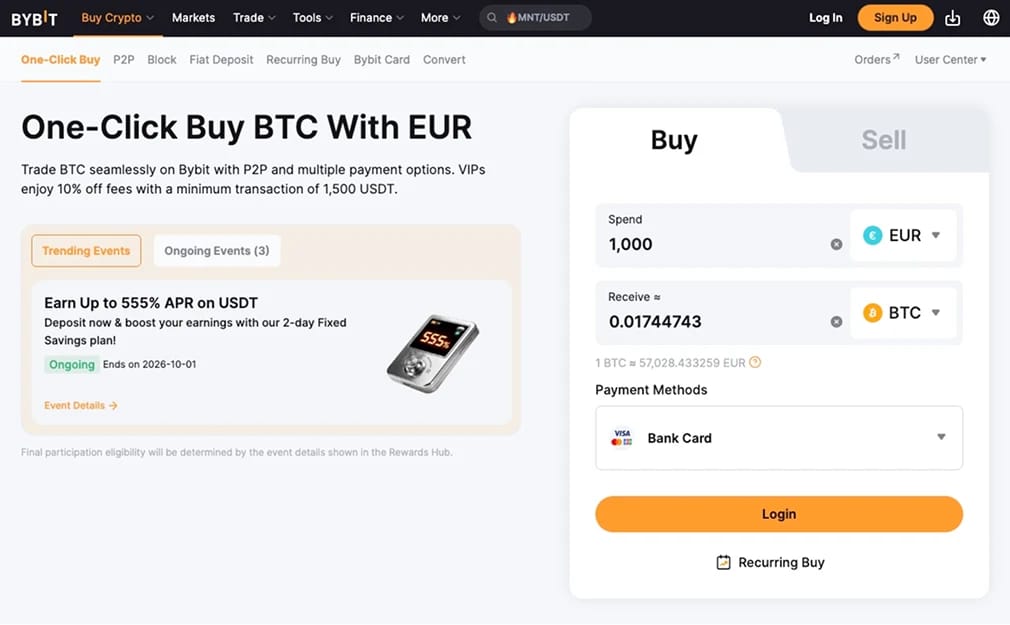
Bybit leads in Portugal because nothing else a resident can open offers the same breadth behind a real EU license. Portuguese users trade on the dedicated bybit.eu platform, run by Bybit EU GmbH, which the Austrian FMA authorized as a CASP on 28 May 2025. Under MiCA's passporting rules, a single authorization covers all EEA markets, including Portugal, so the platform is subject to an EU supervisor.
The EU app covers 2,800+ assets in EUR and USDC pairs, spot margin up to 10x, Bybit Earn, crypto loans, copy trading, and the Bybit Card, all at a flat 0.1% spot fee. We funded with a SEPA Instant transfer from a Portuguese account and had a tradable balance inside a couple of minutes, well under what a card top-up would have cost in spread. Perpetual futures and options remain on the global site and are off-limits to EU residents.
A couple of points to weigh. The EU spot selection is smaller relative to the global platform, so a handful of newer small caps are absent, and the margin screen sits close enough to the spot that a beginner can wander into leverage without meaning to. That said, the user interface is multilingual and available in Portuguese and 10 other languages, simplifying access for residents. The wider product set is covered in our Bybit review.
Pros
- A fully MiCA-licensed EU entity passported into Portugal, funding in euros over SEPA Instant.
- 2,800+ assets at a flat 0.1% spot fee, the cheapest of the regulated mainstream names here.
- Spot margin to 10x, Earn, copy trading, crypto loans, and the Bybit Card in one app.
Cons
- No perpetual futures or options for EU residents, spot and margin only.
- The EU listing is narrower than Bybit's global platform.
- The margin entry sits one tap away from spot, which can tempt newcomers into taking on leverage.
2. Kraken
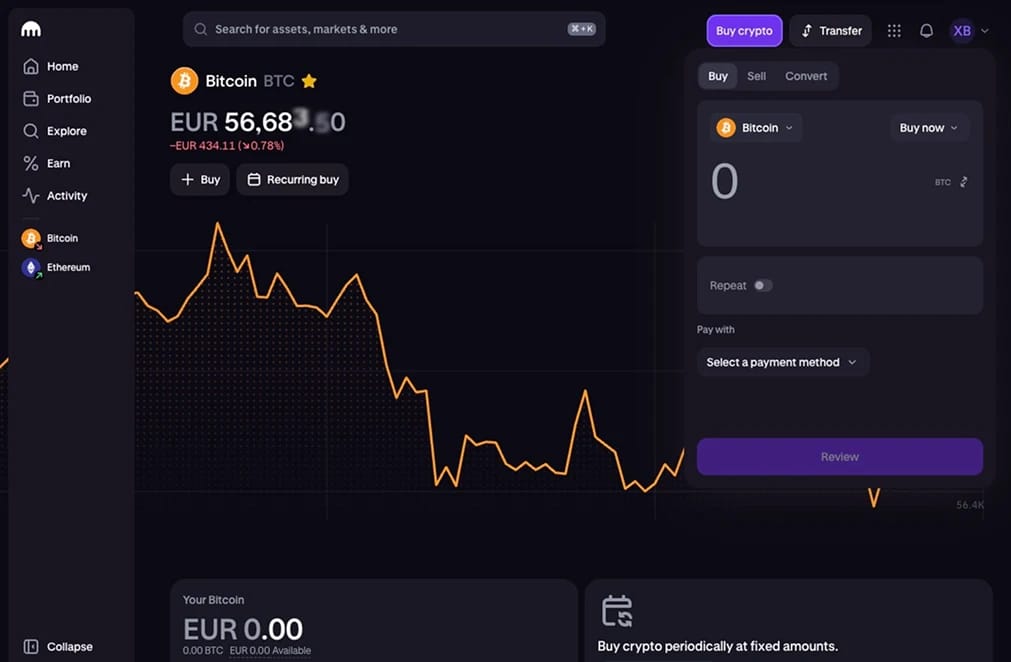
Kraken is where we point Portuguese users who value custody safety over a long coin list. Trading since 2011 with no major breach, it publishes Proof-of-Reserves audits that confirm client balances are held 1:1 and keeps the bulk of assets in cold storage. For anyone leaving real money on an exchange rather than a hardware wallet, that track record does most of the talking. More details about the security sit in o our Kraken review.
Kraken serves EU clients as a MiCA-authorized provider, with its European operations run through Ireland, and euro funding has always been its comfort zone. A SEPA Instant transfer from a Portuguese bank cleared the same day in our test, after which Kraken Pro brought pricing down to roughly 0.40% maker and 0.80% taker at entry volume across 475+ assets, with staking and an OTC desk for larger tickets.
The limitation is reach. Kraken lists conservatively, so trending small caps tend to arrive late or not at all, and the casual instant-buy screen carries a 1.5% spread that the Pro interface removes entirely. For a long-term holder building toward Portugal's 365-day exemption, that conservatism is closer to a feature than a flaw, since the plan is to buy majors and sit still.
Pros
- Fourteen years of operation with no major security incident.
- 1:1 Proof-of-Reserves, cold storage, and an OTC desk for size.
- SEPA Instant euro deposits from Portuguese banks settle quickly.
Cons
- A cautious listing policy means fewer altcoins than the larger venues here.
- The instant-buy screen hides a spread that only Kraken Pro avoids.
- Staking availability on some assets shifts with EU rule changes.
3. Coinbase
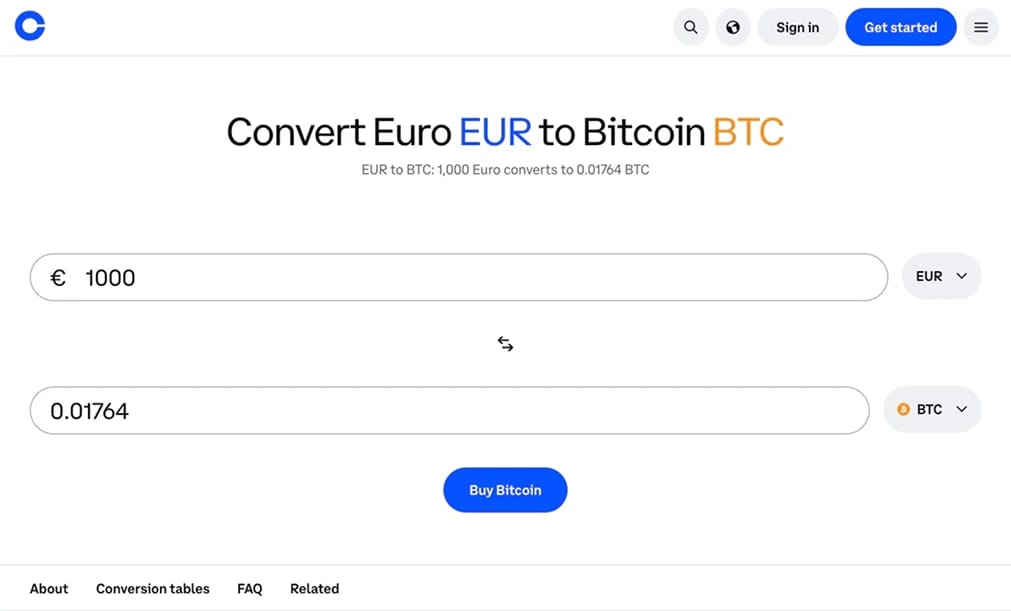
Coinbase brings something no rival here can match: the accountability of a listed public company. It trades on NASDAQ under the ticker COIN and files audited results with the SEC each quarter, making its solvency the most externally scrutinized in the sector. In June 2025, it became the first US exchange to secure a MiCA CASP license, held by Luxembourg's CSSF, so EU users are subject to the same framework as European platforms.
Funding runs over SEPA and cards, though the one-tap buy screen prices in a markup that Advanced Trade strips out. Switch across, and taker fees fall toward 0.60% on 250+ assets, alongside staking and one of the deepest USDC ecosystems anywhere, which suits Portugal's stablecoin-heavy nomad crowd. We cover the fee tiers in full in our Coinbase review.
The trade-offs are specific. The asset menu is the shortest among the global names on this list; the default buy screen is expensive until you move to Advanced Trade; and euro depth is thinner than on platforms purpose-built for the EU. It works best as a security-first second account or a USDC hub rather than a primary euro on-ramp.
Pros
- A NASDAQ listing brings quarterly audited financials and SEC oversight.
- MiCA-licensed via Luxembourg, with a clean custody history.
- Advanced Trade fees drop well below the headline simple-buy rate.
Cons
- 250+ assets are the narrowest selection of the global exchanges here.
- The one-click buy screen is among the priciest entry points until you switch tabs.
- Euro support is lighter than on the EU-native platforms.
4. Bitpanda
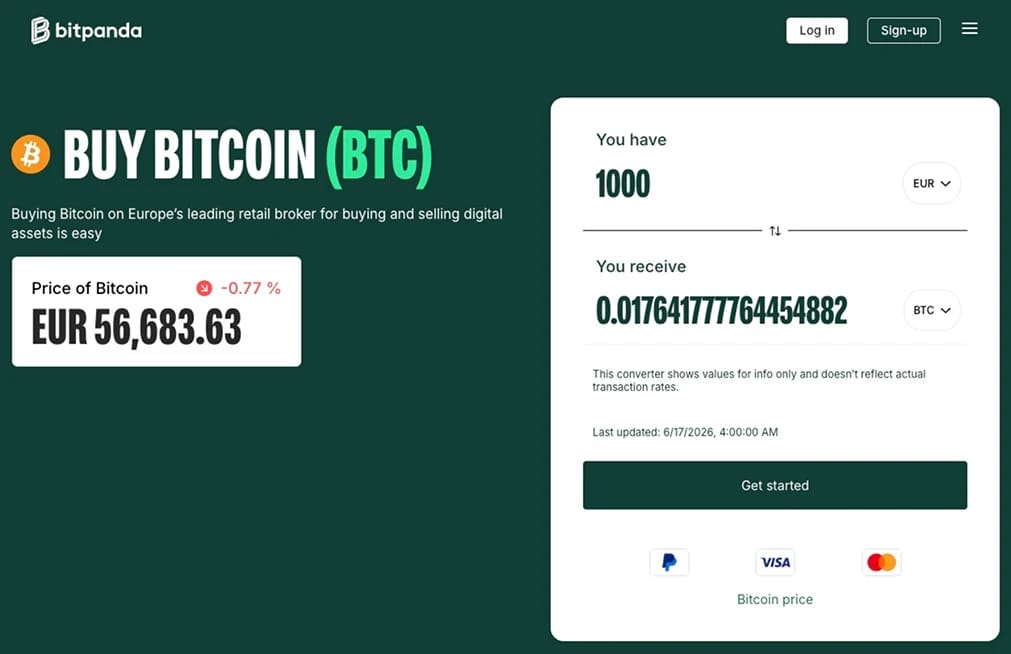
Bitpanda is the app a lot of first-time buyers in Portugal reach for, and the reasons stack up quickly. The Vienna firm holds a full MiCA CASP authorization from the Austrian FMA and ships a polished, Portuguese-language interface that treats crypto as one holding among several. Beyond 600+ coins, it carries fractional stocks and ETFs, precious metals, and recurring savings plans, all managed from a single account.
Euro funding is where its consumer roots show. We topped up by SEPA Instant and traded within a minute. The platform also accepts cards, Apple Pay, Google Pay, and Multibanco references through its payment partners, the kind of local rail Portuguese users already trust for paying utility bills. Country-by-country availability is listed on our Bitpanda countries page.
Cost is the obvious catch. Standard buy and sell orders include a spread of around 1.49%, more than 10 times the 0.1% order-book fee on Bybit. On a 50 EUR monthly plan that barely registers; on a 5,000 EUR lump sum, it stings, so size your usage to match. The stock and ETF products are also derivative contracts rather than direct share ownership, which is worth keeping in mind before treating them as equities.
Pros
- MiCA-licensed, with crypto, stocks, ETFs, and metals in one regulated account.
- SEPA Instant, card, Apple Pay, and Multibanco funding with a clean Portuguese app.
- Recurring savings plans suit euro-cost averaging into majors.
Cons
- The 1.49% spread is the most expensive pricing on this list.
- Stocks and ETFs are derivative contracts, not direct ownership.
- Spread-based pricing is less transparent than an open order book.
5. Binance
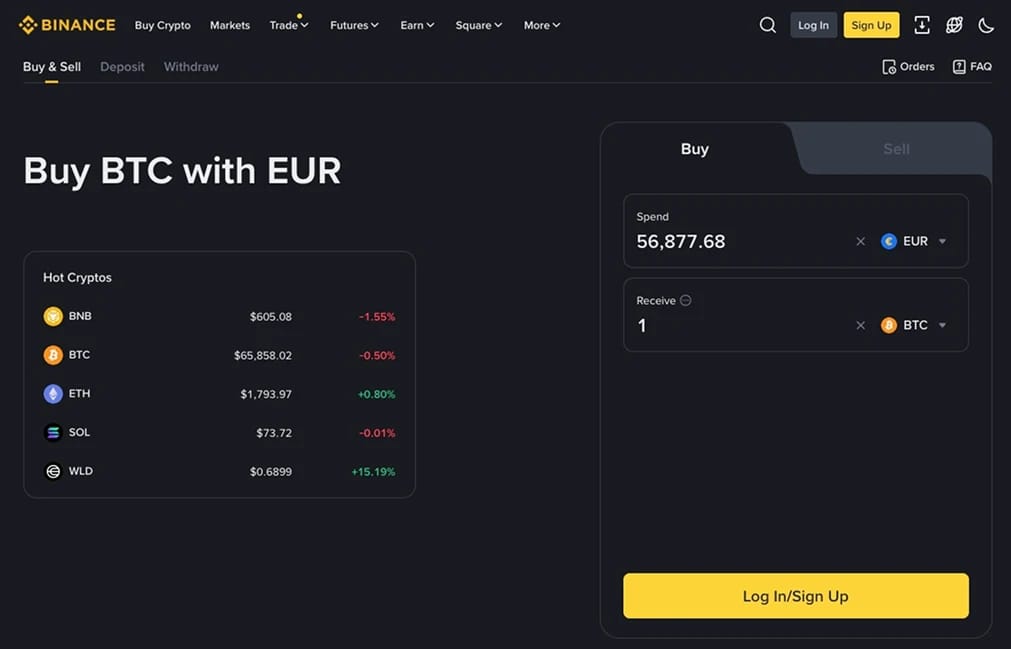
Binance still offers the deepest order books that an investor in Portugal can access, which matters most to anyone moving size. It is the world’s largest exchange, serving over 320 million clients across Portugal and 160+ countries. Large fills on BTC and ETH barely nudge the price, 500+ assets trade from 0.1% before BNB discounts, and Earn, Launchpool, and Auto-Invest cover the passive side. On just liquidity, nothing smaller competes.
The exchange secured a full MiCA CASP authorization through its French entity, supervised by the AMF, and that passport now covers EU members, including Portugal. Euro funding works over SEPA, cards, and a busy P2P desk, and our SEPA transfer from a Portuguese bank arrived without a flag. The fee tiers are unpacked in our Binance review.
The familiar caveats remain. The 2023 US settlement is still the heaviest compliance mark in the industry; MiCA rules have stripped some tokens and stablecoin features from EEA accounts, and the app's sheer feature count is a lot for a first purchase. Keep your own matching records, because under DAC8 the tax office receives provider data regardless of what you log.
Pros
- The deepest spot liquidity of any platform available in Portugal.
- A full MiCA passport via its French entity covering EU residents.
- A broad Earn suite with Launchpool and a long-running SAFU fund.
Cons
- The 2023 US settlement still casts a shadow over its compliance record.
- MiCA compliance has removed some tokens and stablecoin features for EEA users.
- The interface packs in enough products to overwhelm a beginner.
6. Gate
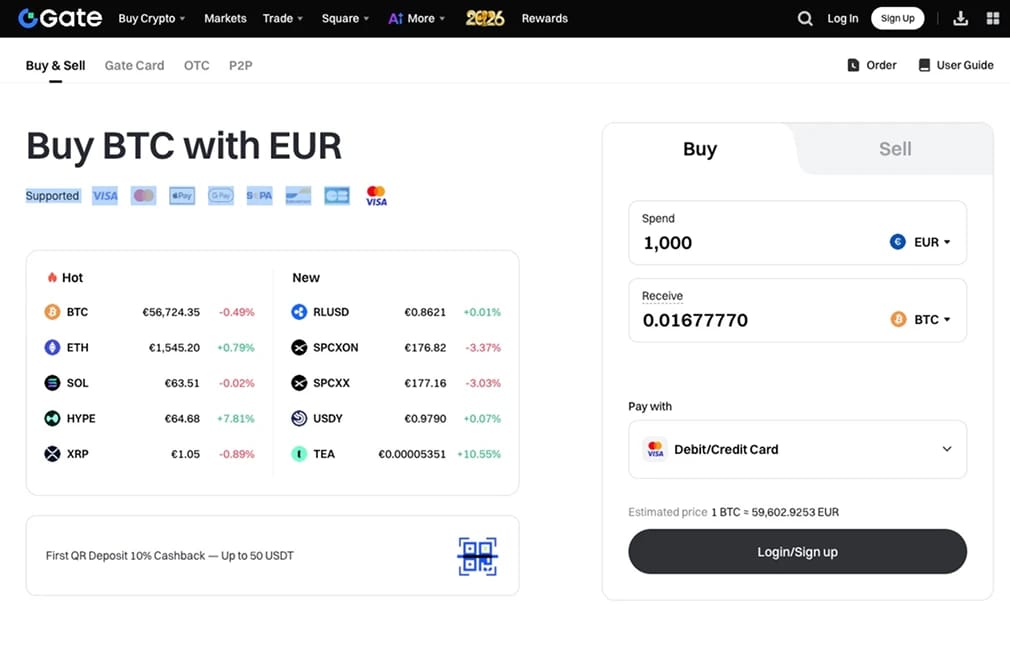
Gate earns its spot on range alone. With 3,800+ listed assets, it has the widest catalog on this list by a clear margin, including small caps, fresh listings, and pre-market tokens that the conservative venues here will not touch for months, if ever. For the Portuguese trader hunting the long tail rather than stacking majors, no other regulated option comes close on breadth. The wider product set is in our Gate review.
The European picture became clearer recently. Gate Technology Ltd, the group's Malta arm known as Gate Europe, secured a MiCA license from the MFSA in late 2025 and added a PSD2 payment institution license in February 2026. Euro funding runs over SEPA, alongside cards, a P2P desk, and crypto deposits. Spot fees start around 0.1% for standard users, with further discounts for GT token holders, plus futures, copy trading, grid bots, and a Launchpad.
Two facts shape how to use it. Gate is licensed via Malta rather than by a Portuguese home regulator, so it lacks the standing of an FMA or CSSF-supervised name, and while it reports a healthy reserve ratio today, it has weathered security incidents in the past. Treat it as a second account for breadth rather than your primary store, and remember that the vast catalog includes thin, speculative tokens that demand careful position sizing.
Pros
- 3,800+ assets, the widest selection of any platform in this guide.
- MiCA-licensed via Malta with a PSD2 payment license added in 2026.
- Around 0.1% spot fees with further GT token and volume discounts.
Cons
- Licensed via Malta, so no Portuguese home regulator standing.
- A long tail of thin, speculative small caps that demand caution.
- A patchier security history than the cleaner records on this list.
How to Choose a Crypto Exchange in Portugal
Funding rarely decides things in a euro country. The Portuguese choice turns on regulation, on how each platform handles your records, and on protecting the holding period that makes long-term gains tax-free. Four checks we apply:
- Confirm the MiCA license: Bybit (FMA, Austria), Kraken (Ireland), Coinbase (Luxembourg), Binance (France), Gate (Malta), and Bitpanda (Austria) all hold CASP authorizations that passport into Portugal. After the 1 July 2026 deadline, any platform on a legacy registration drops out, so confirm the entity you join is the licensed one.
- Send a small test transfer first: SEPA Instant from Santander, Millennium BCP, Caixa Geral de Depósitos, or Novo Banco reaches regulated exchanges in seconds, and many residents use Revolut or Wise instead. Send a small amount and confirm it clears before scaling up.
- Consider the tax exemptions: Gains on crypto sold after 365 days are exempt, but swapping one token for another generally restarts that clock. If the exemption is the goal, fewer trades and clean majors beat constant rotation, and a small card purchase is enough to test a platform first.
- Match the platform to what you do: Long-term holders fit Kraken plus a hardware wallet, beginners and savers fit Bitpanda, active traders fit Bybit, USDC-heavy users fit Coinbase, and altcoin hunters fit Gate.
Crypto and Bitcoin Regulation in Portugal
Portugal regulates crypto through the EU framework, applied locally by two supervisors working in tandem. The points that matter:
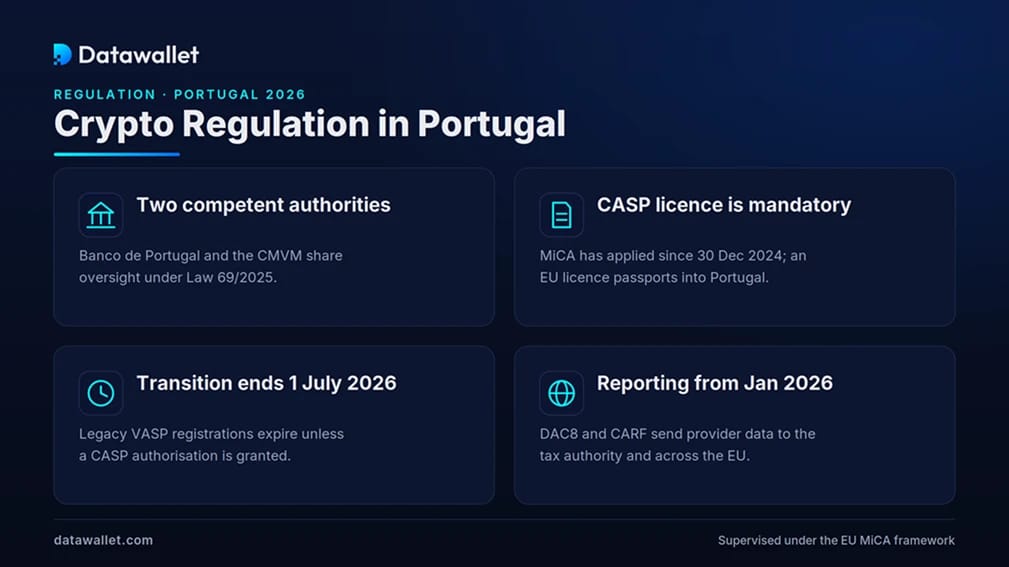
- Two competent authorities. Law No 69/2025 of 22 November 2025 designated the Banco de Portugal and the CMVM as the national authorities under MiCA. The Banco de Portugal handles authorization, prudential supervision, and AML, while the CMVM oversees conduct of business, market integrity, and market abuse.
- CASP authorization is mandatory. Since MiCA took full effect on 30 December 2024, providing crypto-asset services to Portuguese clients requires a CASP authorization. A license from any EU member state passports across the bloc, which is why the platforms here serve Portugal without a separate Portuguese permit.
- A transition window closes in mid-2026. Firms registered with the Banco de Portugal under the old Virtual Asset Service Provider regime before 30 December 2024 may keep operating until 1 July 2026, or until their CASP application is approved or refused. The central bank stopped accepting new VASP registrations once MiCA took over.
- Reporting arrived in 2026. From 1 January 2026, Portugal applies the OECD Crypto-Asset Reporting Framework alongside the EU's DAC8 directive, so licensed providers report client transaction data to the tax authority, which then shares it across member states. An activity that once felt private is no longer hidden from Finanças.
Using any of these platforms is legal for residents. The distinction now is that a MiCA-licensed CASP answers to an EU regulator, whereas an unlicensed offshore venue owes nothing to Portuguese users.
How Does Finanças Tax Crypto?
Portugal's tax treatment, reshaped by the 2023 State Budget and administered by the Autoridade Tributária (Finanças), is generous to patient investors and unforgiving to anyone who forgets to file. The rules for private individuals:
- A 28% rate on short-term gains. Selling crypto for euros within 365 days of buying it produces a capital gain taxed at a flat 28% under Category G. Losses can offset short-term gains in the same year.
- Long-term gains are exempt. Hold a non-security token for 365 days or more before selling, and the gain is free of capital gains tax. This single rule is the reason Portugal still ranks among the most investor-friendly markets in the EU.
- Swaps reset the clock. Exchanging one crypto for another is generally not taxed at the moment of the swap when the consideration is itself crypto, but it restarts the 365-day holding period on the new asset.
- Passive income and professional activity differ. Staking, lending, and similar yields are treated as capital income under Category E and taxed at 28% regardless of holding period. Income from professional or business-scale crypto activity falls under Category B at progressive rates ranging from 14.5% to 53% and may be subject to social security.
Reporting runs on the Modelo 3 return, with taxable short-term disposals on Anexo G and exempt long-term disposals on Anexo G1. Even fully exempt gains must be declared. The filing window on the Portal das Finanças is from 1 April to 30 June, with any tax due by 31 August, and records should be kept for years.
This is general information rather than tax advice, so confirm your position with a Portuguese contabilista. For how this compares globally, see our guide to the best low-tax crypto countries.
Cryptocurrency Adoption in Portugal
Portugal punches above its size in influence, even with modest household ownership. The figures and the ecosystem tell different stories:
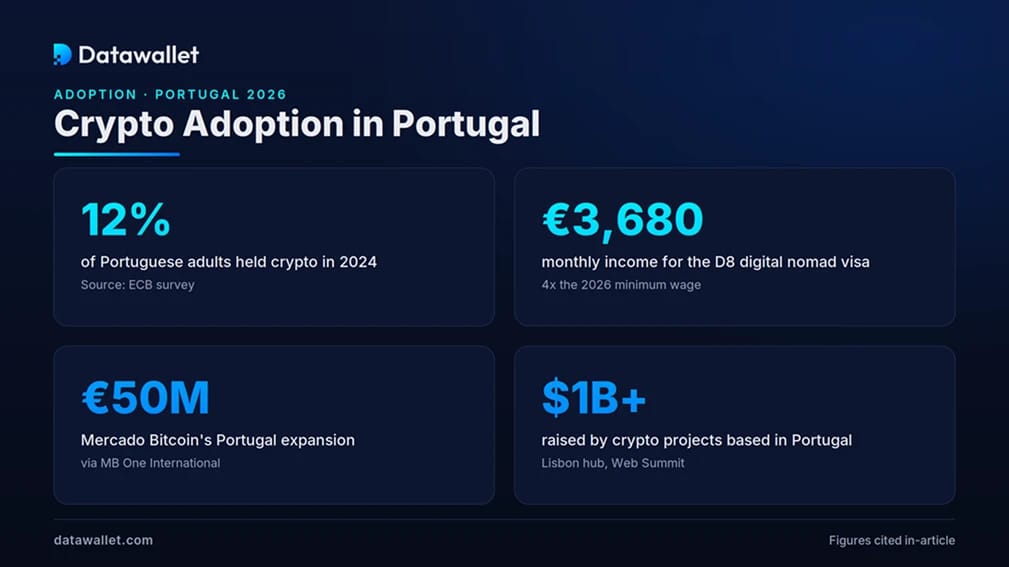
- A measured ownership base. A European Central Bank survey put crypto ownership near 12% of Portuguese adults in 2024, most citing investment over payments. That trails some emerging markets but holds steady for Western Europe.
- Lisbon as a founder magnet. The annual Web Summit anchors a Web3 scene that has drawn founders like Ethena's Guy Young and Immunefi's Mitchell Amador to live here, with locally based projects raising well over a billion dollars. The capital's climate, cost, and connectivity keep the talent arriving.
- Policy-driven inflows. The D8 digital nomad visa, which requires a monthly income of four times the minimum wage (€3,680 in 2026), has drawn a young, on-chain population that treats stablecoins and self-custody as routine. Crypto-friendly taxation did much of the early recruiting.
- Institutional interest is building. Brazil's Mercado Bitcoin committed 50 million euros to expand in Portugal via its MB One International service, treating the market as a European entry point rather than a side bet.
Bitcoin stays the most widely held asset, followed by Ethereum, Solana, and XRP. With MiCA supervision and CARF reporting in force, the likely path is steadier, better-documented growth rather than a retail rush. The wider numbers sit on our crypto adoption statistics page.
How to Buy Bitcoin in Portugal
The clean approach pairs cheap euro funding with records that hold up at filing time and a strategy that respects the holding clock. The sequence we use:
- Pick your venue by need: Long-term holders use Kraken, beginners and savers use Bitpanda, active traders use Bybit, and altcoin hunters use Gate.
- Clear KYC with Portuguese documents: A Cartão de Cidadão or a passport, plus a selfie, verified within hours on every platform we tested. Enter your name exactly as printed.
- Fund in euros: Send a SEPA Instant transfer from Santander, Millennium BCP, Caixa Geral de Depósitos, or Novo Banco for near-instant settlement, or use a card or Multibanco where supported. Keep the confirmation, since it anchors your acquisition cost.
- Buy BTC with a limit order: On the order-book screen, place a limit order on the BTC/EUR pair rather than using the instant-buy tab, which prices through a spread of 1% or more.
- Move long-term holdings to self-custody: Anything you are not actively trading belongs in a wallet you control, which also supports holding past the 365-day mark for the tax exemption. Our best crypto wallets guide covers hardware and software options.
Exiting reverses the path: sell into euros, withdraw via SEPA to your Portuguese account, and declare the disposal on the Modelo 3, using Anexo G or G1 depending on how long you held it.
Final Thoughts
Portugal offers a rare combination: a clear EU framework now anchored by two named supervisors, a tax regime that exempts gains on coins held for more than a year, and euro funding that arrives via SEPA without friction.
Bybit leads on overall capability behind a real EU license, Kraken wins on custody safety and suits the patient holder, Coinbase brings public-company accountability, Bitpanda is the cleanest first account, Binance holds the deepest liquidity, and Gate offers the widest asset selection.
For the wider regional picture, our guide to the best crypto exchanges in Europe covers the rest of the MiCA-regulated market.
Our Methodology
We assessed each platform by repeating the steps a Portuguese resident takes in practice: registering with a Cartão de Cidadão or passport, funding by SEPA Instant, card, and Multibanco from local rails, and executing spot trades. Six criteria shaped the rankings:
- Trust Score: A 5-point rating weighing MiCA licensing, security history, reserve transparency, and years of operation.
- Euro Funding Access: How cheaply and reliably euros move in and out, tested across SEPA Instant, cards, and Multibanco or MB WAY, where partners support them.
- Fees: Headline maker and taker rates plus the all-in cost of a funded round trip, including spreads and card markups.
- Regulatory Standing: Whether the platform holds a MiCA CASP authorization that passports into Portugal and which authority supervises it.
- Tax Practicality: How well each platform's records hold up as acquisition-cost and holding-period evidence under Category G rules.
- Local Usability: App performance, KYC friction with Portuguese documents, and the quality of the euro exit path.
Regulatory standing and tax practicality carried more weight than raw coin counts, because in a euro country where funding is easy, the cleanest platform is the one with a real license and records that keep you square with Finanças. Testing ran from March to June 2026.
.webp)