

Compare Top Swedish Crypto Exchanges
1. Bybit EU
Bybit EU leads because it survived the licensing cull with its product depth mostly intact. The Vienna-based entity, Bybit EU GmbH, received its MiCA authorization from Austria's FMA in May 2025 and passports across the EEA, Sweden included. Behind that license sit 600+ cryptocurrencies, spot margin up to 10x, Earn products, trading bots, demo trading, and the Bybit Card, all at a flat 0.10% spot fee.
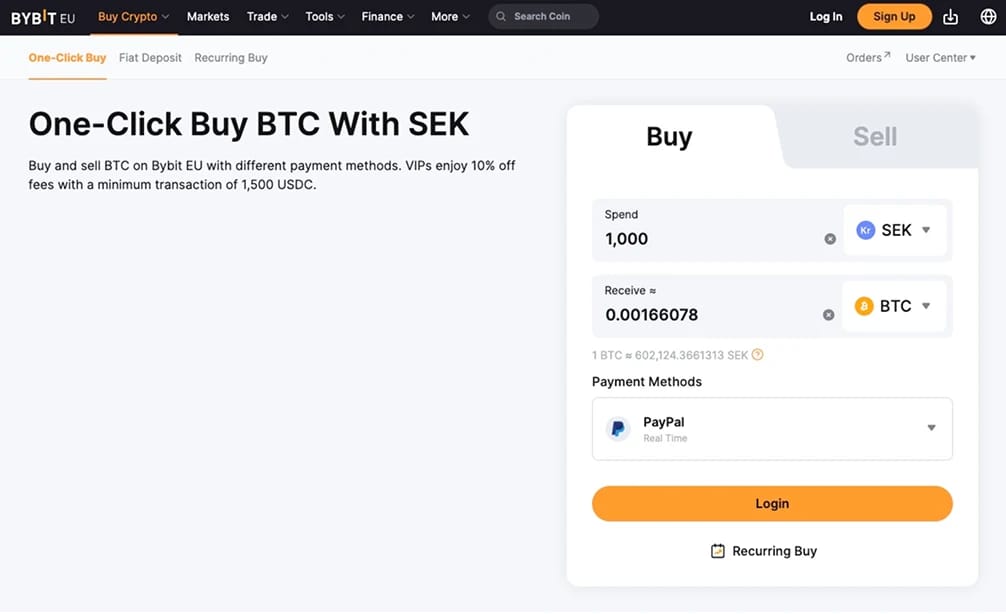
Funding is where Bybit EU pulled ahead this year. It accepts SEK deposits directly via PayPal, card, Apple Pay, and Google Pay, as well as SEPA in euros. We deposited kronor via PayPal for free, with Bybit waiving its deposit fee under the PayPal integration launch, and the balance was credited to our Funding Account instantly. No other global venue here lets a Swede skip the SEK-to-EUR bank conversion entirely.
Two compliance points shape the experience. Bybit EU is a separate account from global Bybit, so migrating users must complete fresh KYC, and the perpetual futures the brand is famous for are not offered to EEA retail under this license. USDT is also gone, replaced by MiCA-compliant stablecoins, since Tether never sought EU authorization. The wider platform is covered in our Bybit review.
Pros
- Full MiCA CASP license from Austria's FMA, valid in Sweden past the July 2026 cutover.
- 600+ assets at a flat 0.10% spot fee, the best-value large catalog here.
- Features include Earn, spot margin to 10x, a demo account, trading bots, and the Bybit Card.
Cons
- No perpetual futures for EEA retail until further authorization lands.
- Fee-free PayPal deposits are a launch promotion, so check the rate before large top-ups.
- The February 2025 hack remains on its record, even though users were made whole.
2. Kraken
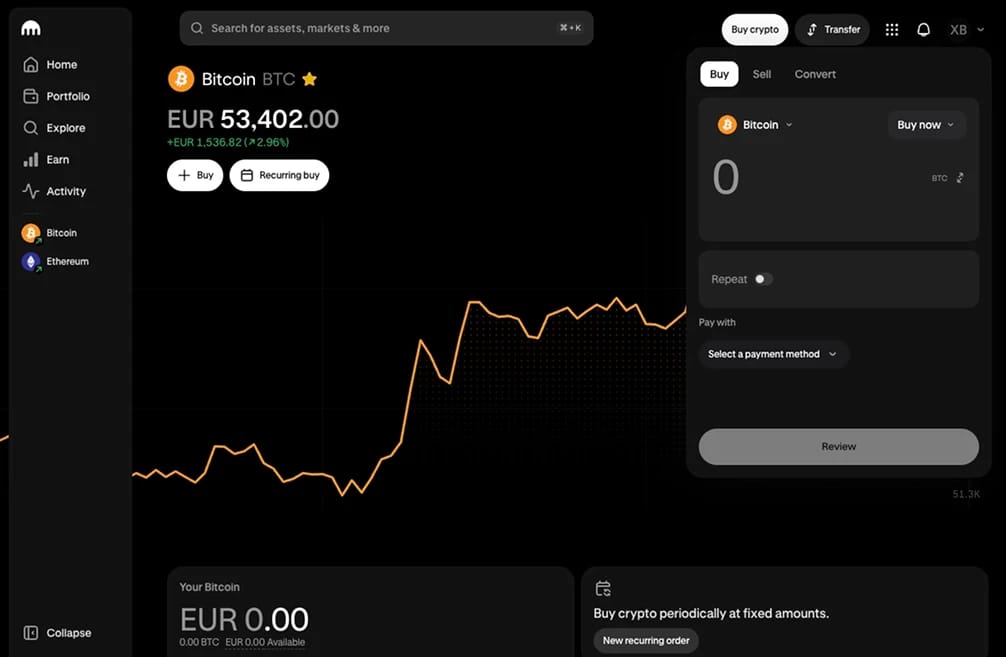
Kraken is the platform we point Swedish investors toward when custody credibility matters more than the last basis point. It holds its MiCA license from the Central Bank of Ireland, granted in June 2025, alongside a MiFID license for derivatives, and has published proof-of-reserves attestations since 2014, longer than anyone else on this list. It has never been subject to a cyber attack or security incident.
The euro rails are the practical draw. SEPA and SEPA Instant deposits are free, which matters in Sweden because the bank conversion from kronor already has a spread, so a free deposit keeps the total down. Once funded, 600+ assets can be traded against some of the deepest euro books in Europe, with staking on major coins. Pro fees start at 0.25% maker and 0.40% taker before volume discounts, above OKX, Gate, and Bybit EU.
Kraken Pro is more screen than a first-time buyer needs, and there is no Swish or SEK path, so a Swede without patience for a bank transfer will find Safello faster to start on. For anyone holding size, the Irish supervision and audit trail justify the fee gap. To learn more about the features, security, and fees, visit our Kraken review.
Pros
- MiCA license from the Central Bank of Ireland plus MiFID cover for derivatives.
- Proof-of-reserves history dating back to 2014, the longest in the industry.
- Free SEPA and SEPA Instant euro deposits with deep euro order books.
Cons
- Spot fees of 0.25% and 0.40% run above OKX, Gate, and Bybit EU.
- No SEK or Swish rail, so funding always includes a currency conversion.
- The Pro interface is heavier than a casual buyer needs.
3. Safello
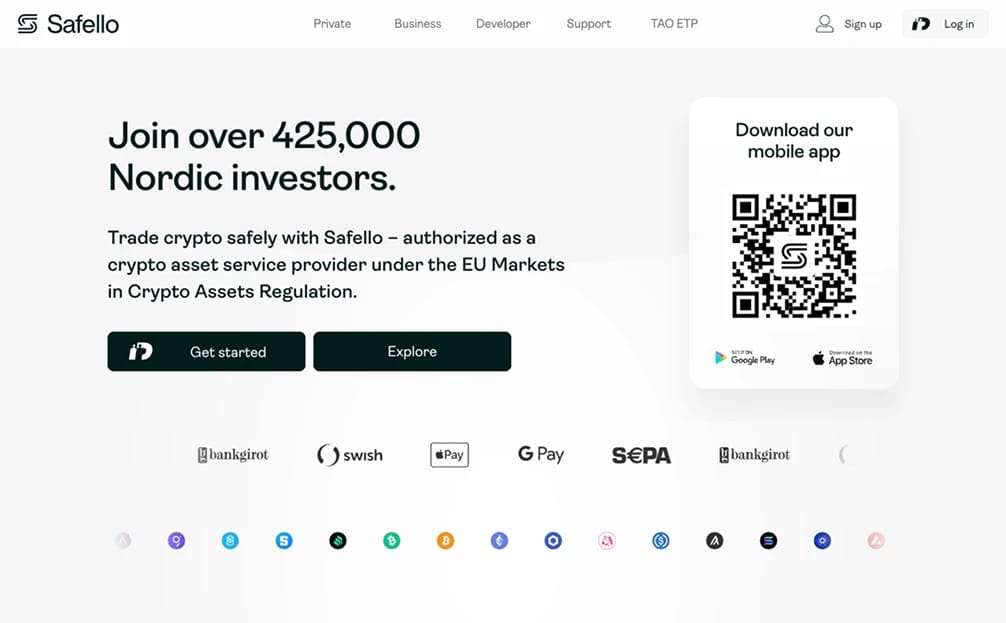
Safello is the platform built around how Swedes already move money, and after July 2026, it carries weight beyond convenience. Founded in Stockholm in 2013 and listed on Nasdaq First North since 2021, it became the first Swedish company to receive a CASP license from Finansinspektionen, so it is the only exchange here answering directly to the Swedish regulator.
Funding is where it wins outright. You log in with BankID and pay in kronor through Swish, Bankgiro, Klarna, or SEPA, with no euro conversion at all. Our Swish deposit landed in under a minute, the fastest fiat-to-crypto path we tested in this market. Custody runs on Fireblocks' multi-party computation, and the company holds a framework agreement with the Swedish Economic Crime Authority for its exchange services.
The trade-off is scope and price. The list covers 20 or so majors; fees run brokerage-style from 0.49% on Auto-Save purchases to 0.99% on swaps, with a 35 SEK minimum; and there is no margin or advanced order book. Treat it as the clean SEK on-ramp and the account your Swedish bank never questions, then pair it with a bigger venue once you outgrow the majors.
Pros
- First Swedish CASP license, supervised directly by Finansinspektionen.
- Kronor in and out through Swish, Bankgiro, Klarna, and SEPA with BankID login.
- A decade-plus of local operation and a Nasdaq First North listing for transparency.
Cons
- Around 20 assets, narrow next to every global venue here.
- Brokerage pricing up to 0.99% costs more than order-book fees.
- Spot only, with no margin, futures, or advanced order types.
4. Coinbase
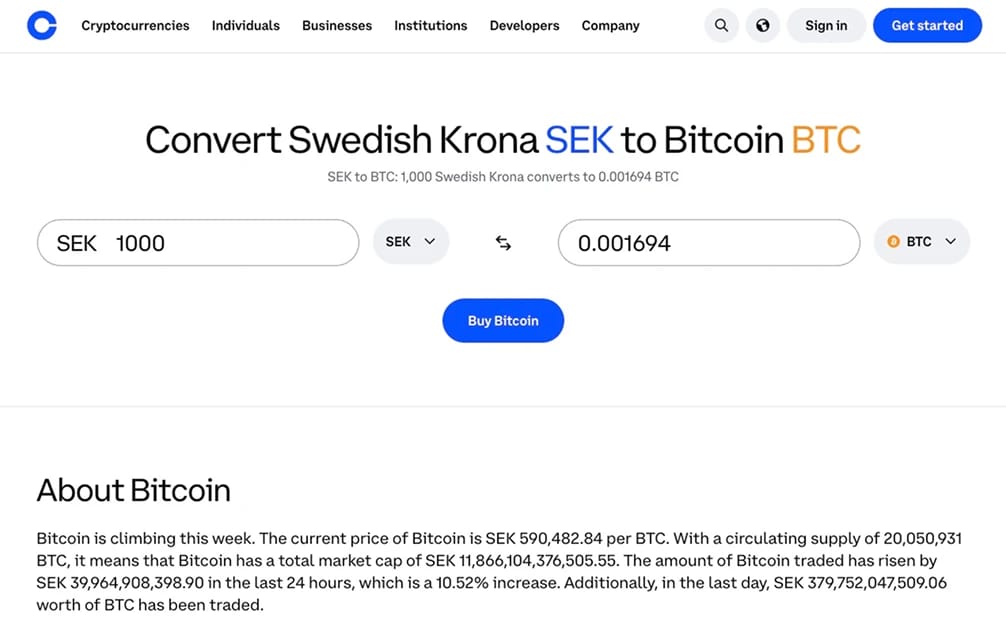
Coinbase is the pick for a Swede who wants the regulatory question answered by a household name. It runs its European business through Coinbase Luxembourg S.A. under a MiCA license from the CSSF, and as a Nasdaq-listed company, it publishes audited financials, a level of disclosure no crypto-native rival matches.
The app is the gentlest introduction on this list. Simple buys work with a Swedish card in kronor or a euro balance funded by SEPA, recurring purchases automate a savings habit, and USDC support gives a compliant stablecoin home now that USDT has left licensed EU exchanges. Onboarding with a passport was cleared in minutes when we tested it, with the interface available in Swedish.
Cost is the catch. Simple buys carry a spread plus fees that stack up quickly, and Coinbase Advanced, where fees start near 0.40% maker and 0.60% taker at entry tiers, hides behind a mode switch most beginners never find. Buy through Advanced from day one, and the platform prices fairly. More details can be found in our Coinbase review.
Pros
- MiCA license via Luxembourg's CSSF plus the transparency of a Nasdaq-listed company.
- The most approachable app here, with Swedish-language support and recurring buys.
- USDC gives a MiCA-compliant stablecoin balance for parking value between trades.
Cons
- Simple-buy pricing is the most expensive path on this list.
- Entry-tier Advanced fees still trail OKX, Gate, and Bybit EU on cost.
- The asset list is more conservative than the crypto-native venues.
5. Gate
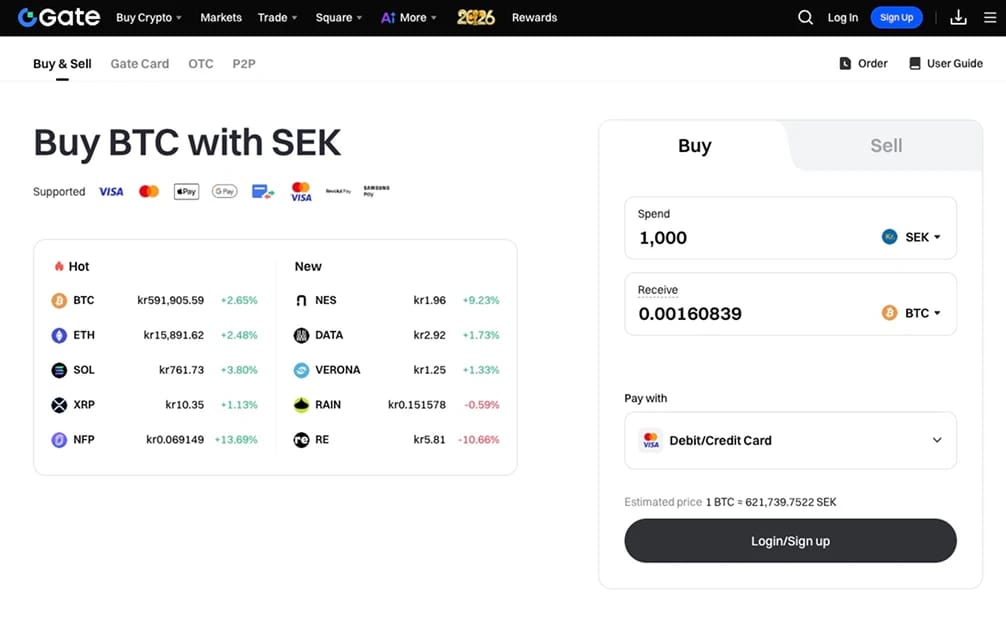
Gate is where Swedish altcoin hunters end up once the majors stop being enough. The global platform lists 3,800+ cryptocurrencies, by far the widest selection of any licensed operator serving Sweden, and its Malta entity, Gate Technology Ltd, received a MiCA license from the MFSA in autumn 2025 covering exchange and custody, with a PSD2 payment license added in February 2026.
Pricing and transparency both hold up. Spot fees of 0.09% maker and 0.10% taker sit alongside a zk-SNARK proof-of-reserves program showing backing above 100%, an AA security rating, and ISO 27001 certification. Funding from Sweden works through SEPA in euros or by card, and our transfer from a Nordea account was converted and arrived the following business day.
Approach it with eyes open. The compliant EU front-end trims some of the global long tail; many small listings are thin and volatile by nature, and Gate's history includes an alleged undisclosed 2018 breach that keeps its trust standing a notch below the cleanest records here. Our Gate review and our deeper look at whether Gate is safe and legit weigh both sides.
Pros
- 3,800+ listed cryptocurrencies, the widest catalog available to Swedish users.
- MiCA license via Malta's MFSA plus a PSD2 payment license from 2026.
- Low 0.09% and 0.10% spot fees with zk-SNARK proof-of-reserves above 100%.
Cons
- The long tail is full of thin, high-risk tokens that punish careless entries.
- An alleged undisclosed 2018 breach still shadows its trust record.
- Some global listings do not carry over to the compliant EU front-end.
6. OKX
OKX is the value and on-chain play among the licensed survivors. Spot fees of 0.08% maker and 0.10% taker are the lowest of the major venues serving Sweden, and it publishes monthly proof-of-reserves with Merkle-tree self-verification. Its MiCA license comes from Malta's MFSA, and it has courted users leaving unlicensed platforms with a migration bonus of up to 8% on transferred deposits.
Beyond the exchange sits the strongest Web3 stack here. The non-custodial OKX Wallet spans 100+ chains with a built-in DEX aggregator, so a Swedish user can move from regulated spot into DeFi without a second app. Funding runs through SEPA in euros or by card, with our transfer from an SEB account converting and landing the next morning.
ESMA's 2025 peer review questioned the rigor of Malta's authorizations, so the license is valid and passportable but sits below Irish or Luxembourg supervision in reputation, a downside that Gate shares. The platform's breadth also makes it easy for a beginner to wander into unforgiving territory. Our OKX review covers the full product set.
Pros
- Lowest spot fees of the major licensed venues are at 0.08% and 0.10%.
- Monthly Merkle-tree proof-of-reserves and a MiCA license via Malta.
- Web3 wallet across 100+ chains with a DEX aggregator built in.
Cons
- Malta's supervisory reputation trails Ireland and Luxembourg after ESMA's review.
- Product depth can overwhelm someone who only wants to buy and hold.
- No SEK balance, so kronor convert to euros on deposit.
How to Choose a Crypto Exchange in Sweden
After the July 2026 cutover, the choice starts with the license and ends with your bank. Run these five checks before moving real kronor.
- Verify licensing: A CASP authorization belongs to a legal entity, such as Bybit EU GmbH or Gate Technology Ltd, and ESMA's public register lists every one. If the entity serving your account is not on it, the platform cannot lawfully take your business, as the Binance case just demonstrated.
- Check SEK and EUR deposit methods: Safello takes Swish and Bankgiro in kronor, and Bybit EU accepts SEK through PayPal and card. Kraken, Coinbase, Gate, and OKX hold euros, so your SEK converts at your bank's rate on the way in. For larger amounts, converting through Wise or Revolut before the SEPA leg usually beats the bank spread.
- Confirm your bank tolerates the transfer: Swedish banks apply strict AML screening and some flag or query payments to crypto platforms. Transfers to established licensed venues clear most reliably; guides for Swedbank, SEB, and Nordea cover what each bank permits.
- Check if your desired assets are supported: USDT is gone from licensed EU venues because Tether never sought authorization, with USDC and euro stablecoins taking its place. If a specific token matters to you, confirm it trades on the compliant front-end before funding, especially on long-tail venues like Gate.
- Plan for the K4 from the first trade: Every disposal must be declared to Skatteverket, and from 2026, exchanges will report your data there automatically under DAC8. Pick a platform with clean export tools and save every statement.
Crypto and Bitcoin Regulation in Sweden
Crypto is legal in Sweden and regulated under the EU's MiCA framework, with Finansinspektionen as the competent authority. The Riksbank does not recognize crypto as legal tender, but holding, trading, and paying by mutual agreement are all lawful.
The market Swedes trade in today was shaped by a short chain of dates.
- January 2020: Amendments to the Currency Exchange Act brought crypto firms into Sweden's AML regime, establishing the registration system under which Binance Nordics AB later registered in January 2023.
- 30 December 2024: MiCA's CASP rules took direct effect across the EU. New providers needed authorization from Finansinspektionen, while firms already registered entered a transition window to apply.
- 2025: The passported licenses arrived. Bybit EU won its CASP authorization in Austria in May, Kraken in Ireland and Coinbase in Luxembourg in June, and Gate and OKX through Malta, while Safello became the first Swedish company granted a CASP license by FI.
- 1 January 2026: The EU's DAC8 rules took effect, requiring exchanges serving Swedish users to report transaction data to tax authorities, including Skatteverket.
- 24 June 2026: Binance withdrew its MiCA application in Greece after resistance from reviewing regulators, days before the deadline.
- 1 July 2026: The transition window closed. Roughly 210 CASPs cleared the bar EU-wide out of more than 1,000 legacy registrations, and unlicensed platforms, including Binance, lost the right to serve Swedish users.
Supervision now runs through a single register. A CASP authorized anywhere in the EEA passports into Sweden, FI charges applicants by processing time plus a minimum supervisory fee of SEK 150,000 per year, Stockholm-based Trijo awaits its decision, and Norway's Firi is passporting in on a fresh Norwegian license.
The Riksbank is watching rather than issuing. The e-krona project completed its technical phase in 2023, and the Payments Report 2026 proposed a legislative inquiry so a digital krona could launch if the ECB's digital euro, estimated for 2029, makes one necessary.
How is Crypto Taxed in Sweden?
Sweden taxes crypto strictly. Skatteverket treats coins as assets rather than currency, and every disposal is a taxable event.
- A flat 30% on gains: Selling for SEK, swapping one coin for another, and paying for goods all count as disposals taxed at 30%, with no tax-free threshold. Gains are declared on Section D of the K4 form with your annual return, filed between mid-March and 2 May.
- Losses only count at 70%: A capital loss offsets gains at 70% of its value, so a year that nets to zero in cash can still produce a tax bill. Gains and losses must be reported on separate lines per asset. Where deductions push you into an overall capital deficit, a tax reduction of 30% applies up to SEK 100,000 and 21% beyond it.
- One cost-basis method is allowed: Skatteverket requires the average cost method, genomsnittsmetoden, calculated per asset in kronor. Exchange exports plus a tax tool make this manageable; reconstructing years of trades by hand does not.
- Rewards are taxed separately: Staking and lending rewards are taxed as interest income at 30% on their SEK value when received, while mining is taxed as income. Losing coins to a hack or lost keys is not deductible under current guidance.
- Reporting became automatic: From 1 January 2026, the EU's DAC8 rules require exchanges serving Swedish users to report transaction data to tax authorities, so Skatteverket increasingly sees your trades before you declare them. An ISK account cannot hold coins directly, which is why many Swedes hold crypto ETPs there instead and accept the tracking burden only for direct holdings.
Keep SEK-denominated records of every disposal, its date, and the platform it ran through. None of this is tax advice, and edge cases like DeFi deserve a Swedish tax adviser.
.webp)
Cryptocurrency Adoption in Sweden
Sweden's adoption pattern is shaped by the most cashless economy in Europe, deep institutional trust, and a preference for regulated wrappers over raw coins.
- Ownership is meaningful but measured: Recent surveys put ownership at 1.1 million people, roughly 13% of the population, with close to half of holders under 30. Sweden sits mid-table globally on the Chainalysis adoption index, well behind emerging-market leaders, because nobody here needs crypto to escape a failing currency.
- The ETP culture is the local twist: Swedes have traded Bitcoin exposure on Nasdaq Stockholm through exchange-traded products for a decade, and banks have leaned in, with Nordea now offering CoinShares crypto ETPs to retail clients. ETPs fit inside an ISK with automated tax reporting, which pulls a share of demand away from direct exchange accounts.
- Payment culture works against spending crypto: With Swish used by more than 80% of the population and BankID by nearly every adult, kronor already move instantly and for free, so crypto adoption here runs on investment rather than payments.
The broader global picture sits on our crypto adoption statistics page. What stands out in Sweden is the gap MiCA is starting to close between a population comfortable with regulated crypto exposure and a direct-exchange market that lagged neighboring Norway.
.webp)
How to Buy Bitcoin in Sweden
Buying BTC in Sweden is straightforward once you pick your funding path. Here is the process we used.
- Pick a licensed venue for your funding style: Safello for kronor through Swish with BankID, or Bybit EU and Kraken for depth and lower fees in euros. Confirm the entity holds a live CASP authorization before depositing.
- Clear KYC with BankID or a passport: Swedish platforms verify through BankID in minutes. Global venues take a passport or national ID plus a selfie, and details entered exactly as printed avoid the usual verification stall.
- Fund in SEK or convert to EUR: Swish lands instantly on Safello, and PayPal, card, and mobile-wallet deposits credit SEK on Bybit EU in seconds. For the euro-only venues, send SEPA from your Swedish bank and accept the conversion spread, or convert kronor first and send euros for a tighter rate.
- Buy BTC with a limit order: Skip the instant-buy button where an order book exists and place a limit order on BTC/EUR, which usually prices better than a one-tap purchase.
- Decide where the BTC lives: Active traders can leave it on the exchange under MiCA's segregation rules. Long-term holders should withdraw to self-custody, checking the address and network first. Our best crypto wallets guide covers hardware and software options.
Selling reverses the path. Sell through a licensed exchange, withdraw kronor or euros to your bank, and record the SEK value and date of every disposal for the K4.
Final Thoughts
For most Swedes, start with Bybit EU, which pairs a large licensed catalog and flat 0.10% fees with a MiCA license that survived the July cutover.
Kraken is the call for audited custody and deep euro books, Safello for kronor through Swish under a Swedish licence, and Coinbase for the gentlest first account. Gate serves the altcoin crowd with 3,800+ listings, while OKX takes the fee-sensitive and on-chain users.
Watch the register, not the brand. Binance's exit proved that size buys no exemption from MiCA, and the platforms worth your kronor are the ones a European regulator can reach. A sensible Swedish setup in 2026 is one SEK-native account, a licensed exchange, and clean records with Skatteverket.
For the neighboring markets, our guide to the best crypto exchanges in Europe maps the wider region. Before committing real money, run a small loop. Buy 1,000 kronor worth of BTC, sell it back, and measure the round-trip cost through your bank. Ten minutes of testing beats any review, this one included.
Our Methodology
We evaluated the exchanges accessible from Sweden by opening accounts, completing KYC with BankID and a passport, funding via Swish, Bankgiro, card, and SEPA, trading, and withdrawing funds. Each platform scored across six criteria.
- Trust Score: Our proprietary rating out of 5, weighting MiCA authorization and the issuing regulator, custody and reserve transparency, security history, platform longevity, and audit coverage.
- Sweden Funding Methods: Confirmed Swish, Bankgiro, Klarna, card, and SEPA support, measuring settlement speed, conversion spreads on SEK, and withdrawal costs back to Swedish accounts.
- Regulatory Standing: Verified each platform's CASP entity against the ESMA register and Finansinspektionen's records, the dividing line in this market since 1 July 2026.
- Security Track Record: Reviewed breach history, custody arrangements, reserve disclosure cadence, and protections such as 2FA and withdrawal whitelists.
- Assets and Liquidity: Placed market and limit orders on BTC/EUR or BTC/SEK, ETH pairs, and at least one mid-cap to measure spread, depth, and fill quality.
- Fee Structure: Compare maker and taker fees, funding costs including the SEK-to-EUR conversion, and the all-in cost of a kronor round trip.
We excluded platforms without MiCA authorization, including Binance following its July 2026 suspension, and those with no workable funding path from Sweden. Testing ran from April to July 2026, with licensing statuses rechecked after 1 July.