







Top Telegram Trading Bots Compared
We evaluated more than 20 bots and terminals this cycle, funding real wallets and measuring fill prices, snipe success, and total round-trip cost against DefiLlama protocol data. Platforms with opaque fee schedules, custodial key handling, or sharply declining volume were filtered out before final scoring.
The comparison below shows how the surviving leaders differ on the metrics that actually determine profitability:
1. Banana Gun
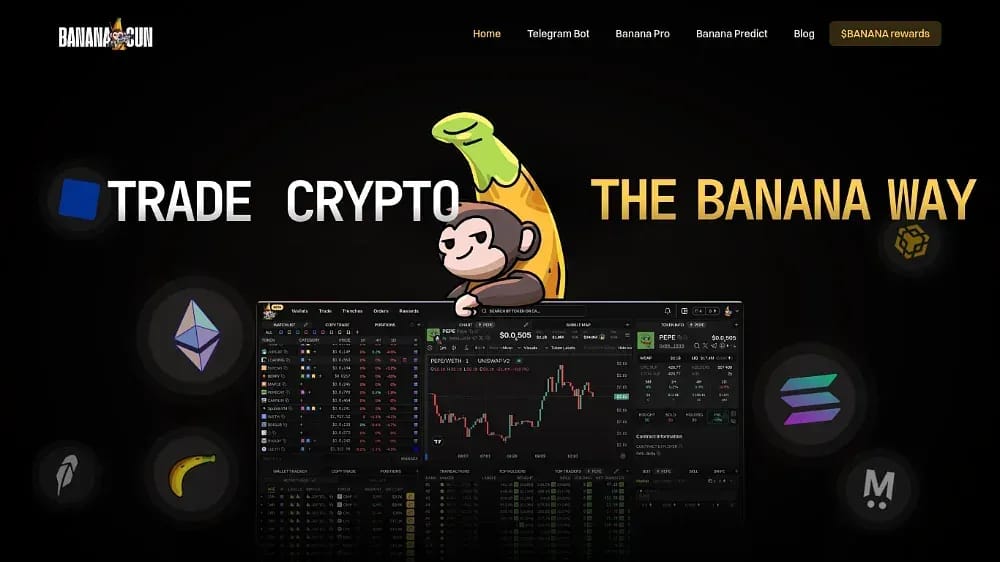
Banana Gun is the best Telegram trading bot in 2026, combining the widest usable chain coverage with the strongest fee economics in the category. It has processed $16.09 billion in cumulative volume across 25.3 million trades from roughly 1.3 million registered users.
March 2026 brought the change that sealed its lead: a unified five-chain Telegram session spanning Ethereum, Solana, BNB Chain, Base, and MegaETH, replacing the old one-bot-per-chain setup. Running snipes across two chains simultaneously, we found the single-session workflow removed the wallet juggling that slows every competitor.
Fees are genuinely differentiated at 0.5% on Ethereum manual buys, half the flat 1% every rival charges, and its referral programme returns 10% of fees from invited users. The First Bundle or Fail setting drives an 88% first-block snipe rate, and 40% of trading fees flow to $BANANA holders every four hours.
Pros
- Unified sessions: One Telegram session covers five chains with synchronized wallets, eliminating the separate installs rivals still require.
- Lower ETH fees: Manual Ethereum buys cost 0.5% against the category-standard 1%, with free stablecoin swaps on EVM chains.
- Real revenue share: Holders of 50 or more $BANANA receive 40% of protocol fees automatically, with no staking or lock-up.
Cons
- Snipe pricing: Auto-sniping still costs the full 1%, so launch hunters see no discount versus competing bots.
- Token dependency: The revenue share requires holding $BANANA, exposing users to token price risk alongside trading risk.
- Complexity creep: Five-chain support and deep preset configuration make initial onboarding noticeably slower than minimalist alternatives such as BonkBot or Photon.
2. Trojan
Trojan commands the deepest Solana volume of any Telegram-native bot, with roughly $24 billion in lifetime volume built almost entirely on that one network. For traders who live on Solana, that concentration translates into consistently deep routing and reliably tight fills.
Its feature set covers copy trading, DCA schedules, limit orders, and sniper functionality, with simple and advanced modes serving different experience levels. Configuring DCA ladders during a volatile session, we appreciated that advanced mode exposes slippage and priority fee controls without burying them.
Trojan's fee structure rewards volume harder than most, starting at a 1% fee per transaction and falling toward an effective 0.5% through tier three referral rebates. The trade-off is scope, since the promised web terminal and multi-chain expansion were still not live as of mid-2026, leaving non-Solana traders needing a second tool.
Pros
- Deepest Solana volume: Around $24 billion lifetime volume delivers dependable routing and fills across Solana DEX venues.
- Aggressive rebates: Tier three referral rebates cut the effective rate toward 0.5%, among the lowest for active traders.
- Complete toolkit: Copy trading, DCA, limit orders, and sniping all sit inside one interface with MEV protection.
Cons
- Solana only: No practical multi-chain support, so Ethereum or BNB Chain traders must run a second bot entirely.
- No web terminal: The announced browser interface remained unlaunched through mid-2026, limiting analytical depth during live sessions.
- Rebate complexity: Reaching the lowest effective fees requires referral tiers that casual traders will never realistically hit.

3. Axiom
Axiom is the professional's choice, a desktop-first terminal with a Telegram companion that became the fastest Y Combinator company to reach $100 million in revenue. It has processed over $20.5 billion in volume and at its peak captured more than half of all Solana bot trading.
Execution is its calling card, processing orders in under 0.4 seconds using colocated nodes and routing designed to blunt front-running. Running Pulse against live launches, we saw viable tokens surface noticeably earlier than on chat-only alternatives, filtered by liquidity, sniper share, and holder concentration.
The tiered fee model runs from 0.95% at Wood down to 0.75% at Champion, with cashback paid in SOL. Axiom also routes Hyperliquid perpetuals up to 50x leverage, though 2026 data-privacy allegations mean its trust score sits below the strongest performers.
Pros
- Fastest execution: Sub-0.4 second order processing via colocated nodes beats a full Solana block, which matters enormously for competitive launch sniping.
- Superior discovery: Pulse filters launches by liquidity, holder concentration, and sniper share for a genuine research edge.
- Perps access: Native Hyperliquid routing adds perpetual futures at up to 50x leverage alongside standard spot memecoin trading in one interface.
Cons
- Desktop-first: The Telegram bot handles alerts and quick trades only, so the real product demands a browser.
- Privacy concerns: Data-privacy allegations surfaced in 2026, and independent reviewers have marked down its trust rating accordingly.
- Declining share: Market share slipped from above 50% toward 44% as mobile-native rivals grew faster through 2026.
4. Maestro
Maestro remains the veteran multi-chain option, listing more than ten supported networks, the widest raw coverage of any Telegram bot. With $12.8 billion lifetime volume and roughly 573,000 users, it trades scale for reach into chains competitors simply do not serve.
Its tooling is genuinely deep, offering auto-sniping, multi-wallet execution across simultaneous addresses, trailing stop losses, and anti-rug protection. Testing it across three chains, we found the workflow consistent, and private keys are AES encrypted with optional 2FA on sensitive actions.
The cost model is where it stumbles. Maestro layers a monthly subscription on top of per-trade fees, and advanced copy trading across ten wallets requires a premium tier near $200 monthly. With no web terminal and no unified session, that pricing is hard to justify unless you specifically need its obscure chains.
Pros
- Widest chain reach: Over ten supported networks cover chains that Banana Gun, Trojan, and BonkBot ignore entirely.
- Deep power tools: Multi-wallet execution, trailing stop losses, and anti-rug checks genuinely suit traders running several complex strategies simultaneously across chains.
- Private transfers: Houdini Swap integration enables cross-chain asset movement with meaningfully better privacy than routing through standard public bridge infrastructure.
Cons
- Subscription stacking: Monthly fees sit on top of the 1% per trade, billing you before a single order executes.
- No web terminal: Everything runs through Telegram alone, capping analytical depth against hybrid competitors during fast-moving and volatile trading sessions.
- Unpublished metrics: Maestro discloses no first-block snipe rate or anti-rug success data, making performance claims hard to verify.
5. GMGN
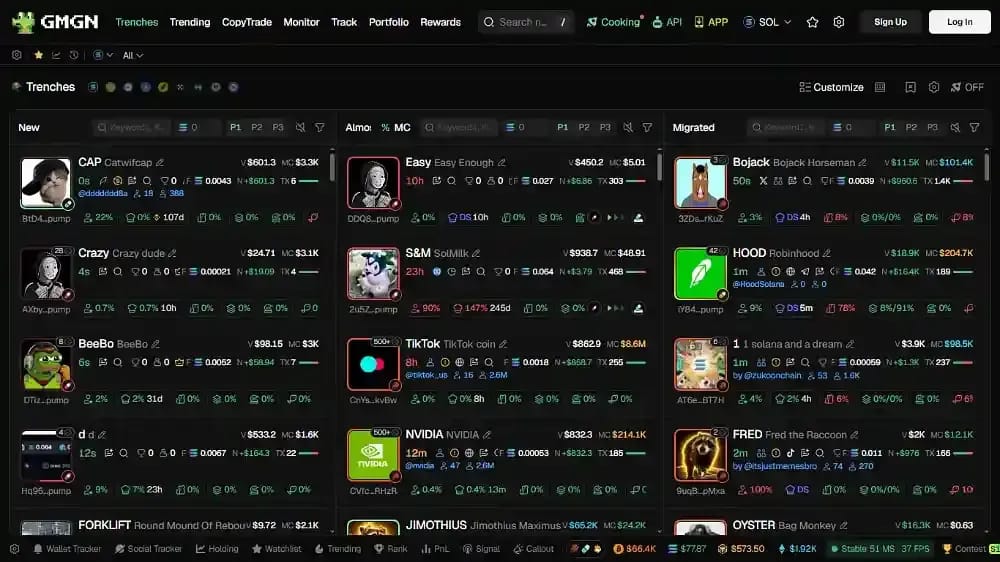
GMGN approaches trading from discovery first, having built its reputation on wallet intelligence long before execution. Its feed surfaces smart money activity and token momentum across six chains, letting traders see exactly what profitable addresses are accumulating before committing any capital themselves.
Copy trading is the standout feature, mirroring up to ten wallets simultaneously with configurable buy amounts, per-position take-profit and stop-loss triggers, and auto-sell rules. Tracking several wallets during testing, we found the automation reliable, though profitable addresses remain far harder to identify than the interface suggests.
GMGN charges a flat 1% with no volume discount programme, which makes it relatively expensive for high-frequency traders. Its MEV protection and pre-trade simulation are also less developed than Banana Gun's stack, so it functions best as a research layer that happens to execute rather than a pure speed tool.
Pros
- Best wallet tracking: Smart money feeds across six chains surface accumulation patterns before tokens appear on mainstream radars.
- Robust copy trading: Mirror up to ten wallets with per-position TP/SL and configurable sizing on every copied trade.
- Multi-chain discovery: Six-chain coverage makes it genuinely useful for traders rotating capital between Solana and the major EVM ecosystems regularly.
Cons
- No fee discounts: A flat 1% with no volume tiers makes it costly for anyone trading frequently at size.
- Weaker protection: MEV defences and pre-trade simulation both trail the dedicated safety stacks that Banana Gun has built for its users.
- Research-led design: Execution feels secondary to discovery throughout, so pure launch snipers will consistently find faster and sharper tools elsewhere.
6. BonkBot
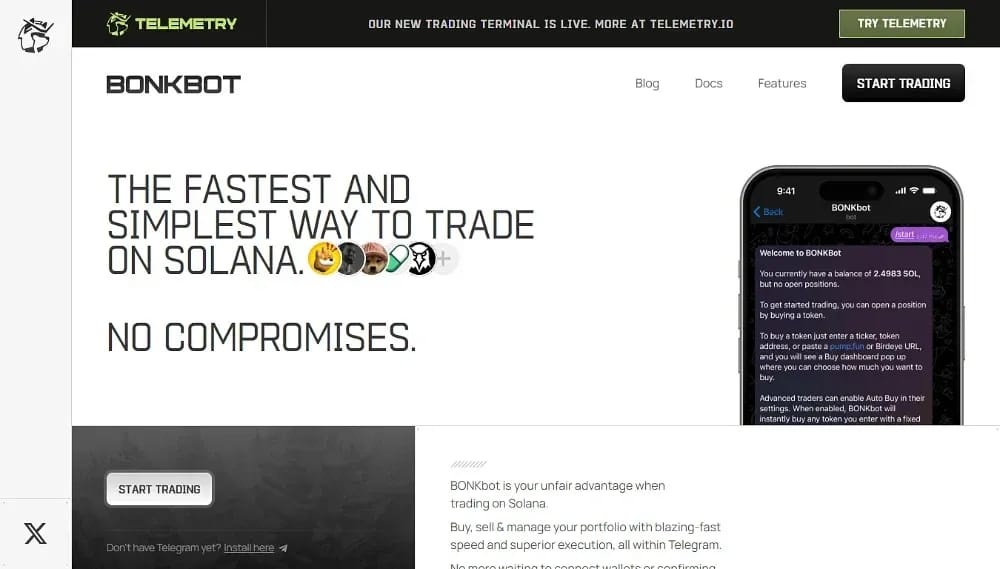
BonkBot is the simplest way into Solana trading, deliberately minimal in a category otherwise racing toward complexity. With around $13.8 billion in lifetime volume and over 519,000 registered users, it proves that stripped-back execution still commands a very large audience.
Routing runs through the Jupiter aggregator, which reliably finds competitive pricing across Solana venues, and DCA functionality automates periodic entries without configuration. Onboarding took us under two minutes, and pasting a contract address executes immediately, which is exactly the point for traders who already know what they want.
Its tokenomics are unusual and worth understanding: 100% of platform fees buy BONK, with 10% of that permanently burned. The flat 1% transaction fee never discounts by volume, and the feature set omits sniping filters, pre-trade simulation, and any cross-chain reach.
Pros
- Fastest onboarding: Setup takes minutes with a minimal command set, making it the easiest entry point available.
- Reliable routing: Jupiter aggregator integration secures competitive pricing across every major Solana DEX without requiring any manual configuration from users.
- Deflationary model: All platform fees buy BONK and burn a portion, tying bot usage directly to token supply.
Cons
- No volume discounts: The flat 1% never falls, making BonkBot expensive for active traders at meaningful size.
- Missing safety tools: No sniping filter stack and no pre-trade simulation leaves users considerably more exposed to honeypot contracts and rugs.
- Solana exclusive: Zero cross-chain reach means any trader working across multiple networks needs a second bot installed from day one.
7. Photon
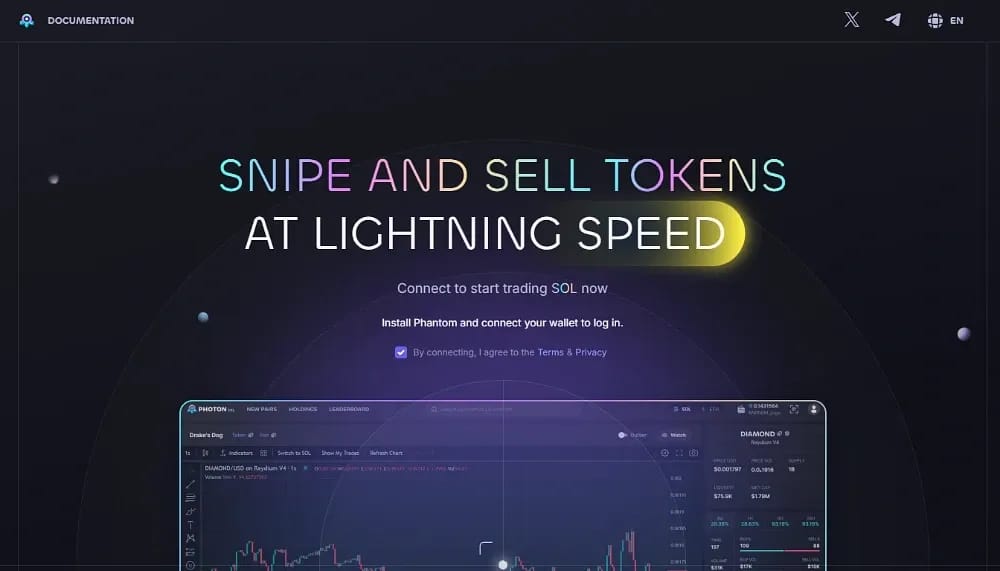
Photon closes our list as a browser-based Solana terminal with a long track record, having processed over $45 billion in trading volume. Using it alongside the chat bots, we found it competes on execution speed and charting quality rather than pure convenience.
Its interface integrates candles, holder distribution, developer history, and MEV alerts into a single panel, which makes evaluating a token faster than switching between tabs. Priority-fee boosted transactions typically fill in the same or next block, and Jito MEV protection meaningfully reduces sandwich risk on larger orders.
Photon's challenge is competitive erosion, with market share falling from above 30% in early 2025 to under 10% as Axiom and mobile-native apps captured flow. Base fees start around 0.9% to 1%, and as a Solana-exclusive terminal it offers nothing for traders working across EVM chains.
Pros
- Excellent charting: Candles, holders, developer data, and MEV alerts consolidate into one panel for faster token evaluation.
- Fast fills: Priority-fee boosted routing typically lands orders in the same or next block during normal conditions.
- Jito protection: Built-in MEV defence noticeably reduces sandwich attack losses on larger orders and thinly traded pairs during volatile launches.
Cons
- Losing ground: Market share collapsed from above 30% to under 10% as newer terminals captured trader flow.
- Solana only: No multi-chain support whatsoever, limiting Photon strictly to traders who operate entirely within the Solana ecosystem.
- Browser dependent: Being web-first removes the mobile chat convenience that defines this category, requiring a desktop for the full experience.
What is a Telegram Crypto Trading Bot?
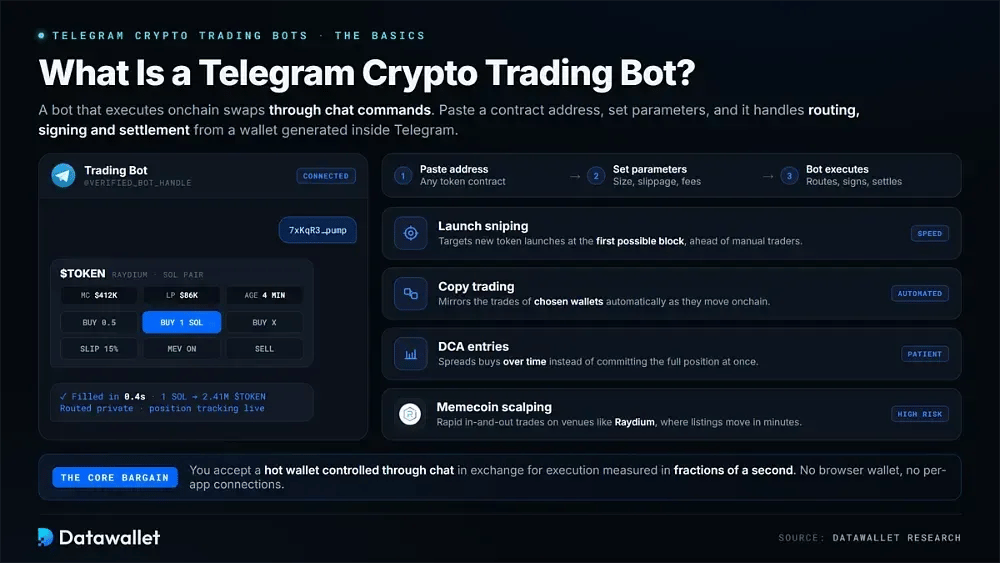
A Telegram crypto trading bot executes onchain swaps on decentralized exchanges through chat commands, removing the need to connect a browser wallet to each application. Users paste a contract address, set parameters, and the bot handles routing, signing, and settlement automatically.
Each bot generates a wallet inside Telegram that you fund directly, then trades execute from that address. This design trades some security for speed, which is the core bargain of the category: you accept a hot wallet controlled through chat in exchange for execution measured in fractions of a second.
Modern bots go far beyond simple swaps in practice. Sniping targets new token launches at the first possible block, copy trading mirrors chosen wallets automatically, DCA spreads entries over time, and many bots now scalp memecoins on platforms like Raydium.
The category has also blurred at the edges. Several leading platforms now pair a Telegram interface with a full browser terminal sharing the same wallets, and traders increasingly use both surfaces depending on whether they are researching at a desk or reacting on a phone.
How to Use a Telegram Trading Bot
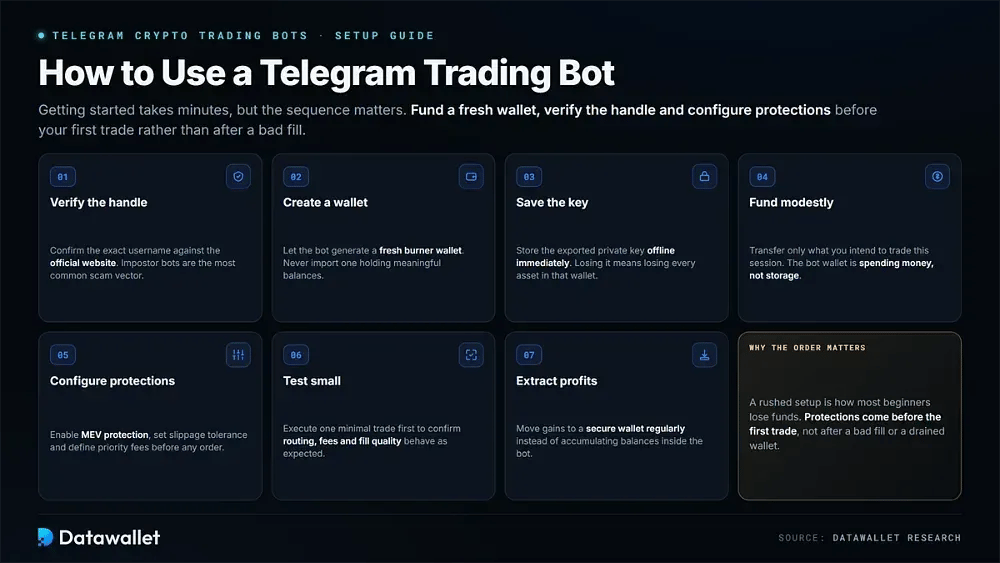
Getting started takes minutes, but the sequence matters because a rushed setup is how most beginners lose funds. Fund a fresh wallet, verify the official bot handle, and configure protections before your first trade rather than after a bad fill.
Follow these steps to start trading safely with any Telegram bot:
- Verify the handle: Confirm the exact bot username against the project's official website, since impostor bots are the most common scam vector.
- Create a wallet: Let the bot generate a fresh burner wallet rather than importing one holding meaningful balances or long-term positions.
- Save the key: Store the exported private key offline immediately, because losing it means losing every asset in that wallet.
- Fund modestly: Transfer only what you intend to trade this session, treating the bot wallet as spending money rather than storage.
- Configure protections: Enable MEV protection, set slippage tolerance, and define priority fees before placing any order at all.
- Test small: Execute one minimal trade first to confirm routing, fees, and fill quality behave the way you expect.
- Extract profits: Move gains to a secure crypto wallet regularly instead of accumulating balances inside the bot.
Are Telegram Trading Bots Safe?
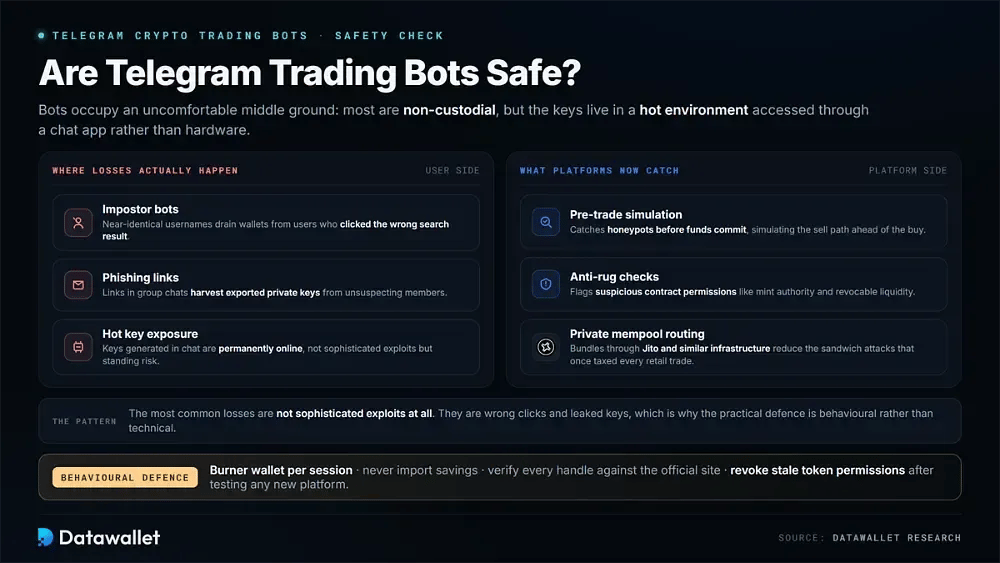
Telegram bots occupy an uncomfortable middle ground between convenience and custody risk. Most leading platforms are non-custodial in the sense that keys are generated for you, but those keys live in a hot environment accessed through a chat application rather than hardware.
The most common losses are not sophisticated exploits at all. Impostor bots with near-identical usernames drain wallets from users who clicked the wrong search result, while phishing links in group chats harvest exported private keys, a pattern documented across Solana bundle risk analysis.
Platform-level protections have improved considerably over the past year. Pre-trade simulation now catches honeypots before funds commit, anti-rug checks flag suspicious contract permissions, and private mempool routing through Jito or similar infrastructure reduces the sandwich attacks that once quietly taxed every retail trade.
The practical defence remains behavioural rather than technical. Use a dedicated burner wallet for each session, never import an address holding real savings, verify every bot handle against the official website, and revoke stale token permissions after testing any new platform.
How to Choose a Telegram Trading Bot
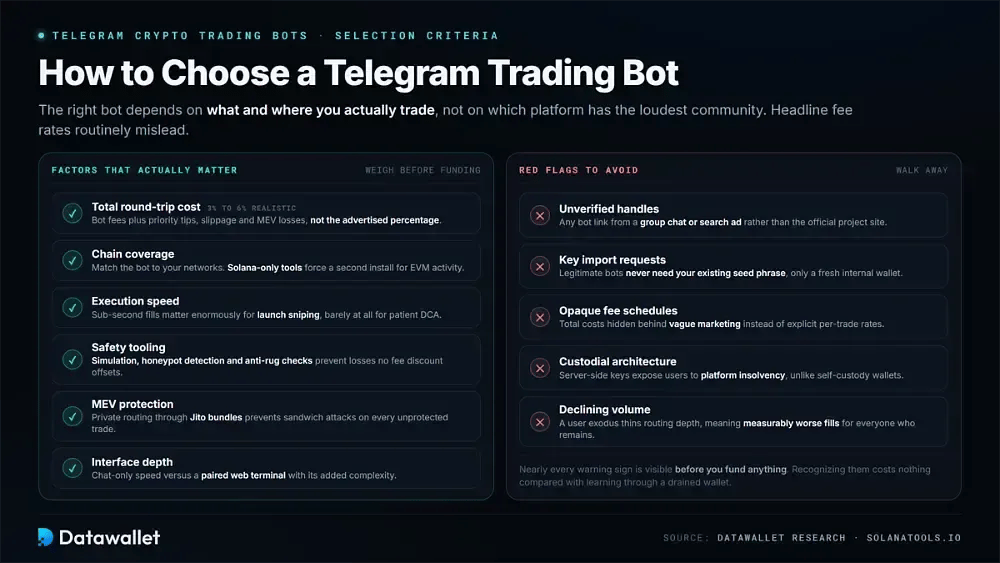
The right bot depends far more on what and where you actually trade than on which platform has the loudest community, as independent fee comparisons across 14 Solana bots show. Chain coverage, fees, and execution speed matter in different proportions by strategy.
Factors That Actually Matter
Headline fee rates dominate most comparisons, but they routinely mislead because the advertised percentage is only one component of what a round trip actually costs you in practice.
Weigh these factors before committing capital to any platform:
- Total round-trip cost: Combine bot fees, priority tips, slippage, and MEV losses, which realistically reach 3% to 6% per round trip.
- Chain coverage: Match the bot to the networks you actually trade, since Solana-only tools force a second install for EVM activity.
- Execution speed: Sub-second fills matter enormously for launch sniping and barely at all for patient DCA accumulation.
- Safety tooling: Pre-trade simulation, honeypot detection, and anti-rug checks prevent losses that no fee discount could offset.
- MEV protection: Private routing through Jito bundles prevents sandwich attacks that silently erode every unprotected trade you place.
- Interface depth: Decide whether chat-only speed suits you or whether a paired web terminal is worth the added complexity.
Red Flags to Avoid
Some warning signs reliably precede losses, and nearly all are visible before you fund anything. Recognizing them costs nothing compared with learning through a drained wallet.
Walk away whenever you encounter any of these signals:
- Unverified handles: Any bot link from a group chat or search ad rather than the official project site.
- Key import requests: Legitimate bots never need your existing seed phrase, only a freshly generated internal wallet.
- Opaque fee schedules: Platforms that hide total costs behind vague marketing rather than publishing explicit per-trade rates.
- Custodial architecture: Bots holding keys server-side expose users to platform insolvency, unlike a self-custody crypto wallet you control.
- Declining volume: Shrinking activity signals a user exodus, and thinning routing depth means measurably worse fills for everyone who remains.
Decentralized Trading Bots Statistics
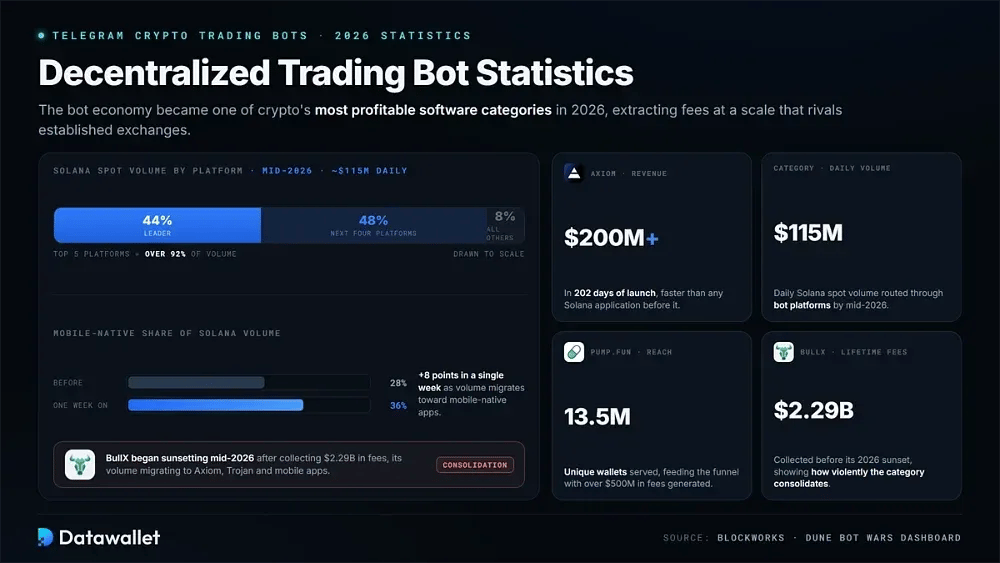
The bot economy became one of crypto's most profitable software categories in 2026, extracting fees at a scale that rivals established exchanges. Axiom alone generated over $200 million in revenue within 202 days of launch, faster than any Solana application before it.
Volume concentration is extreme. Five platforms accounted for over 92% of Solana spot trading volume by mid-2026, with daily category volume around $115 million and the leader taking roughly 44% of that flow, according to Blockworks data cited in industry rankings.
The category is also consolidating violently. BullX began sunsetting in mid-2026 after collecting $2.29 billion in fees, with its volume migrating to Axiom, Trojan, and mobile apps. Meanwhile mobile-native platforms grew from 28% to 36% of Solana volume in a single week.
Launch activity still feeds the entire machine from the top of the funnel. Pump.fun has now processed trades for over 13.5 million unique wallets and generated more than $500 million in fees, a flow tracked publicly through Dune's bot wars dashboard alongside every competing platform.
The 2026 Shift From Chat to Terminal
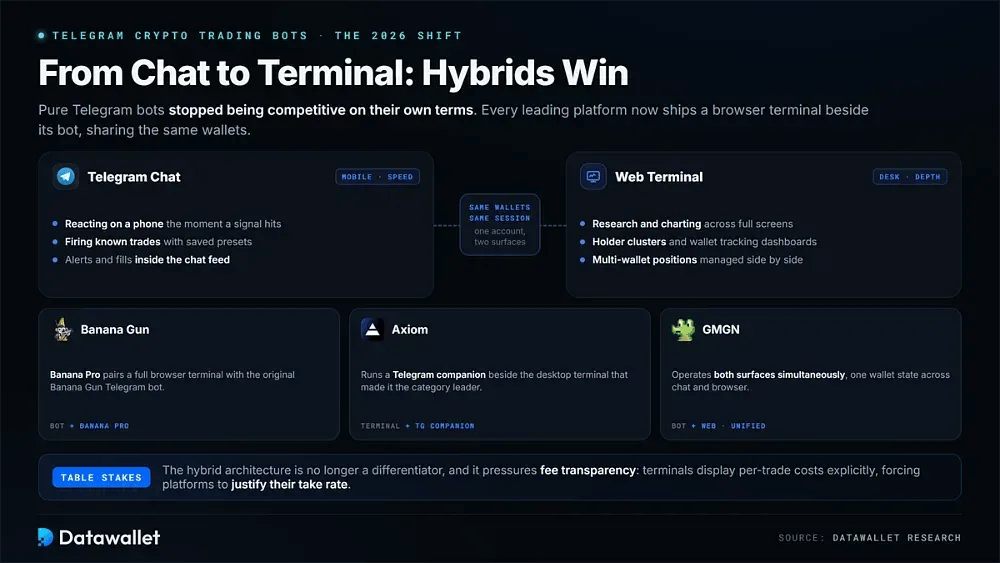
The defining structural change this year is that pure Telegram bots stopped being competitive on their own terms. Traders now expect holder cluster visualization, copy trade dashboards, and multi-wallet position management, none of which fit comfortably inside a narrow chat window.
Why Hybrid Platforms Are Winning
Every leading platform now ships a browser terminal alongside its Telegram interface, sharing the same wallets and session state. Banana Pro pairs with the Banana Gun bot, Axiom runs a Telegram companion beside its desktop terminal, and GMGN operates both surfaces simultaneously.
This architecture quickly became table stakes rather than a genuine differentiator. Chat remains superior for reacting on mobile and firing known trades, while terminals win for research, charting, and tracking profitable wallets, so traders simply use whichever surface fits the moment.
The pressure this dynamic creates lands squarely on fee transparency. Web terminals display per-trade costs explicitly, which forces platforms competing on execution quality to justify their take rate rather than relying on the opacity that a chat interface naturally provides.
Fee Compression and Revenue Sharing
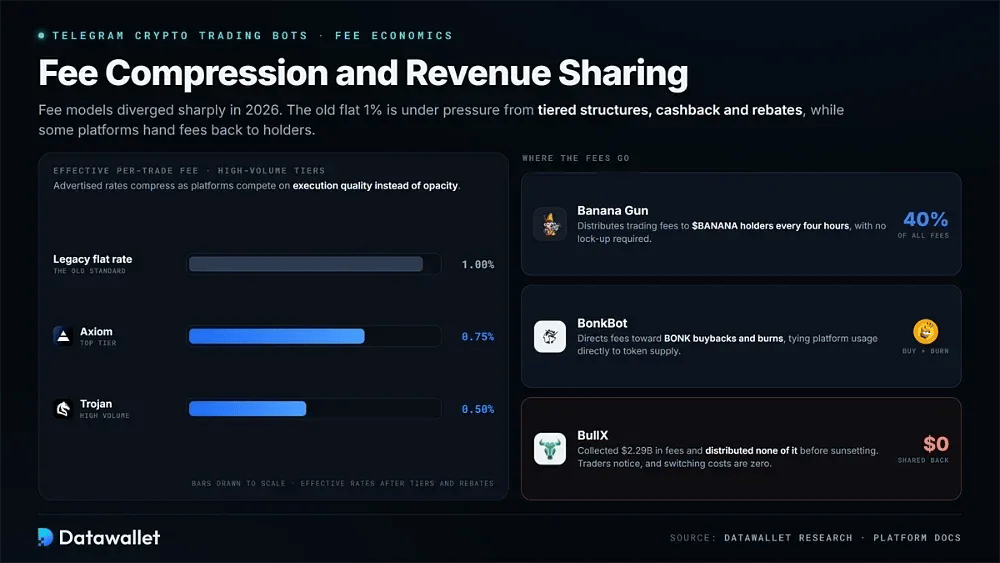
Fee models diverged sharply during the course of 2026. The old flat 1% is now under genuine pressure from tiered structures, cashback programmes, and referral rebates, with effective rates for high-volume traders reaching 0.5% at Trojan and 0.75% at Axiom's top tier.
Revenue sharing is the more interesting development here. Banana Gun distributes 40% of all trading fees to $BANANA holders every four hours with no lock-up, while BonkBot directs its fees toward BONK buybacks and burns, tying platform usage directly to token supply.
Not every platform chose to follow that path. BullX collected a reported $2.29 billion in fees and distributed none of it before sunsetting, a contrast traders increasingly notice when deciding where to route volume in a category where switching costs are effectively zero.
Risks of Using Telegram Trading Bots
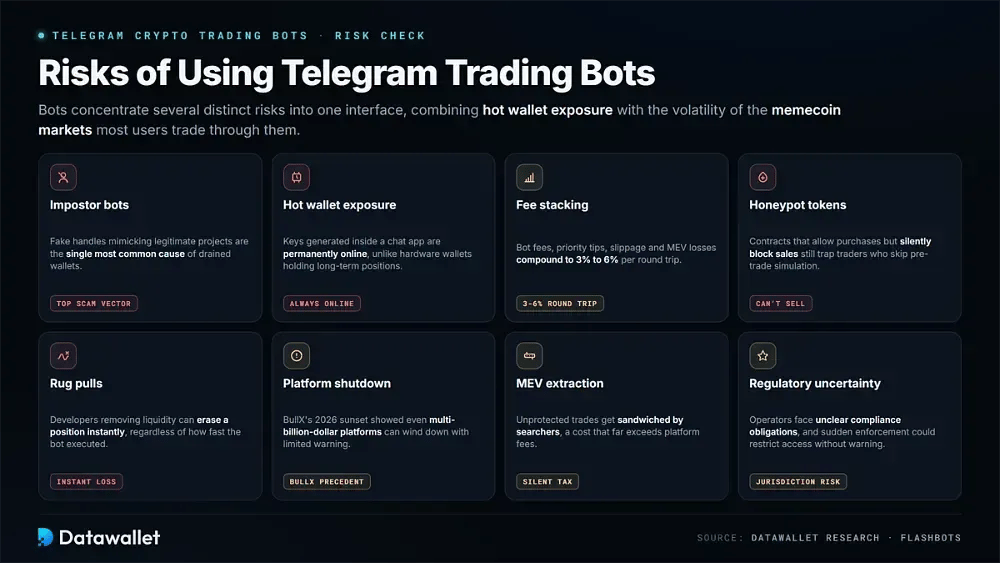
Bots concentrate several distinct risks into one interface, combining hot wallet exposure with the volatility of the memecoin markets most users trade through them.
Consider each of these risks before funding any bot wallet:
- Impostor bots: Fake handles mimicking legitimate projects are the single most common cause of drained wallets in this category.
- Hot wallet exposure: Keys generated inside a chat application are permanently online, unlike hardware wallets holding long-term positions.
- Fee stacking: Bot fees, priority tips, slippage, and MEV losses compound to 3% to 6% per round trip.
- Honeypot tokens: Contracts that allow purchases but silently block sales still trap traders who skip pre-trade simulation before committing funds.
- Rug pulls: Developers removing liquidity can erase a position instantly, regardless of how quickly the bot executed.
- Platform shutdown: BullX's 2026 sunset demonstrated that even multi-billion-dollar platforms can wind down operations with relatively limited warning to users.
- MEV extraction: Unprotected trades get sandwiched by searchers, a cost tracked publicly on MEV dashboards and far exceeding platform fees.
- Regulatory uncertainty: Bot operators face unclear compliance obligations across jurisdictions, and sudden enforcement action could restrict access without meaningful advance warning.
Final Thoughts
Telegram trading bots delivered on their promise of collapsing complex onchain execution into a chat command, but the category matured past pure convenience in 2026. The winners now compete on execution quality, fee transparency, and safety tooling rather than novelty.
Banana Gun earns our top position for unified multi-chain sessions, genuinely lower Ethereum fees, and the only meaningful revenue share in the category. Trojan owns Solana volume, Axiom serves professionals who want a real terminal, and BonkBot remains the cleanest entry point.
Whichever you choose, the discipline matters more than the tool. Trade from burner wallets funded with what you can afford to lose, verify every handle against official sources, enable MEV protection by default, and withdraw profits to a hardware wallet regularly.
Our Methodology
We evaluated each platform by completing the full trader journey with real capital: verifying official handles, generating wallets, funding modestly, executing manual buys and snipes across Solana and EVM chains, testing copy trading, and measuring actual fill quality against quoted prices.
Six criteria shaped the final ranking, weighted toward what determines real trading outcomes:
- Execution quality: We measured fill prices against quoted rates, timing snipes and swaps during both calm and congested network conditions.
- True cost: We calculated round-trip expense including platform fees, priority tips, slippage, and MEV losses against published fee schedules.
- Chain coverage: We tested how many networks each bot genuinely supports well, distinguishing real depth from long marketing lists.
- Safety tooling: We assessed pre-trade simulation, honeypot detection, anti-rug checks, MEV protection, and how keys are handled.
- Feature depth: We compared copy trading, DCA, limit orders, multi-wallet execution, and discovery tools across every platform.
- Platform health: We tracked volume trends, market share direction, and fee distribution to identify platforms losing momentum.
Bot volumes and fee structures shift rapidly as platforms compete, consolidate, and occasionally shut down, so our testing cycle ran from March through July 2026, with every figure cross-checked against Dune dashboards, DefiLlama protocol data, and each platform's own published documentation.





%20(1)%20(1).webp)
