



BloFin vs MEXC: Overview
Matt Hu established BloFin in 2019, and its perpetual futures platform opened in January 2023. Registered in the Cayman Islands, the exchange trades under the slogan "Where Whales Are Made" and lists 500+ USDT-margined perpetual contracts alongside around 400 spot assets. CoinGecko shows daily futures turnover near $1 billion and open interest above $900 million in mid-2026.
Our BloFin account was live within minutes because Level 0 only requires an email address. The Unified Trading Account draws spot and perpetual positions from a single collateral balance, TradingView charting sits inside the order screen, and our test withdrawal under the 20,000 USDT daily cap cleared without a manual review.
MEXC arrived a year earlier, in 2018, under a Seychelles registration, and now reports more than 40 million users across 170+ countries. Scale defines it. The catalog exceeds 3,000 spot assets and 1,400 perpetual pairs, supported by Launchpad, Kickstarter, Airdrop+, pre-market trading, and the DEX+ aggregator for on-chain tokens.
MEXC felt different from the first session. New listings and reward campaigns dominate the interface; our BTC perpetual limit order filled at the 0% maker rate, and the platform slowed us only once, when a withdrawal paused for an automated risk screen. That pause previews the biggest question about MEXC, which is covered in the security section.
The table below compares the two.
BloFin vs MEXC: Features
Both exchanges run the same core of perpetuals, spot, copy trading, bots, and Earn products. The difference is emphasis. BloFin concentrates on the futures terminal and keeps everything around it lean. MEXC builds any product that helps a user reach a new token before other venues list it.
BloFin Products
BloFin structures the platform around derivatives, and its supporting products serve that purpose rather than compete with it.
- Perpetual Futures: The core offering spans 500+ USDT-margined contracts, USDC-margined and Coin-margined lines added in 2025, and up to 150x leverage on BTC and ETH.
- Unified Trading Account: Spot balances, perpetual margin, and bonuses draw from one pool. According to BloFin's company history, it was the fourth major exchange to ship the feature.
- Spot Trading: Around 400 assets with a slower, more selective listing pace than MEXC. It suits holding collateral more than hunting for new tokens.
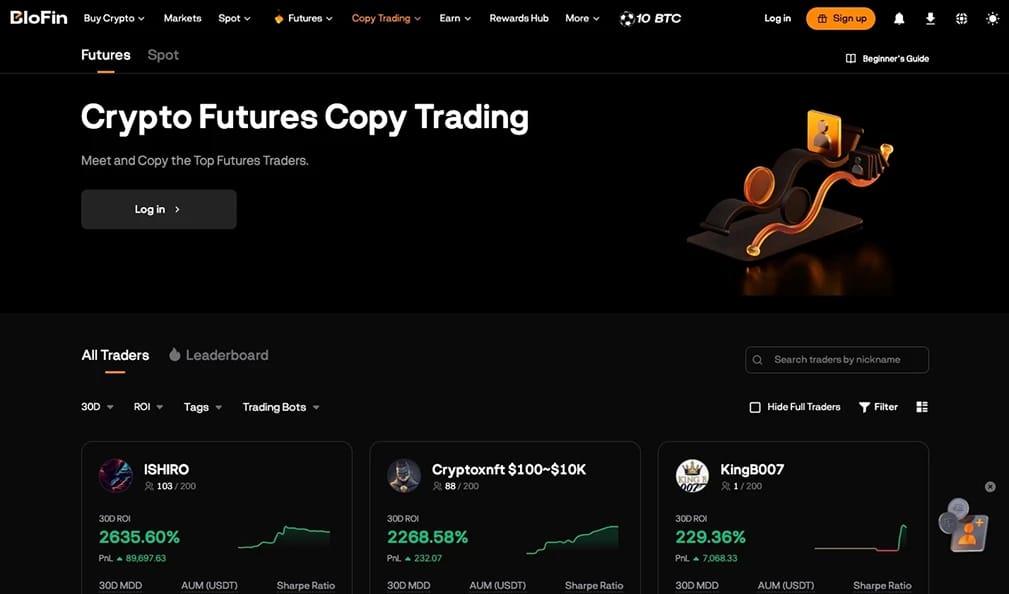
- Copy Trading: Followers can mirror several master traders at once and set take-profit and stop-loss controls at the individual order level.
- Trading Bots: Grid strategies, TWAP execution for splitting large orders, and a signal bot that executes alerts from TradingView.
- Earn: Flexible and fixed savings on majors and stablecoins. Yields are modest, and the range is thinner than larger exchanges offer.
- Demo Trading: A simulated account for testing leverage and order types before risking real capital.
- BloFin Wallet and Card: A standalone non-custodial wallet released in late 2025 for EVM chains, alongside a Mastercard spending card in supported regions.
MEXC Products
MEXC organizes everything around early access. Most of its product list either surfaces new tokens or rewards users for engaging with them.
- Spot Trading: More than 3,000 assets, and new tokens often appear days after launch, before larger venues finish reviewing them. Listing speed rather than curation is the selling point.
- Perpetual Futures: 1,400+ USDT-margined and Coin-margined pairs form the widest derivatives selection among centralized venues, and MEXC advertises up to 500x on select contracts.
- Pre-Market Trading: Positions open before the official listing and settle once trading goes live, accepting pricing risk in exchange for early entry.
- Launchpad and Kickstarter: MX token holders commit their balance to new projects and receive allocations or airdrops. These events remain the main practical reason to hold MX.
- Airdrop+: A campaign hub that pays token rewards and futures vouchers for completing deposit and volume tasks tied to fresh listings.
- DEX+: An aggregator that lets users trade on-chain tokens from inside the MEXC account, reaching assets the exchange has not centrally listed.
- Copy Trade and Bots: Futures copy trading with public leaderboards plus grid automation. The toolset is functional rather than market-leading.
- Earn and Loans: Flexible savings, fixed terms, and collateralized borrowing cover the passive products.
%201.webp)
BloFin vs MEXC: Security
Neither exchange has lost customer funds to an attacker. The question that separates them concerns access to your own account. MEXC spent much of the past year answering public criticism over frozen balances, while BloFin's record stayed quiet.
BloFin Security Measures and History
- Custody: Client assets sit with Fireblocks under MPC key management, transaction monitoring runs through Chainalysis, and the platform holds ISO 27001 certification.
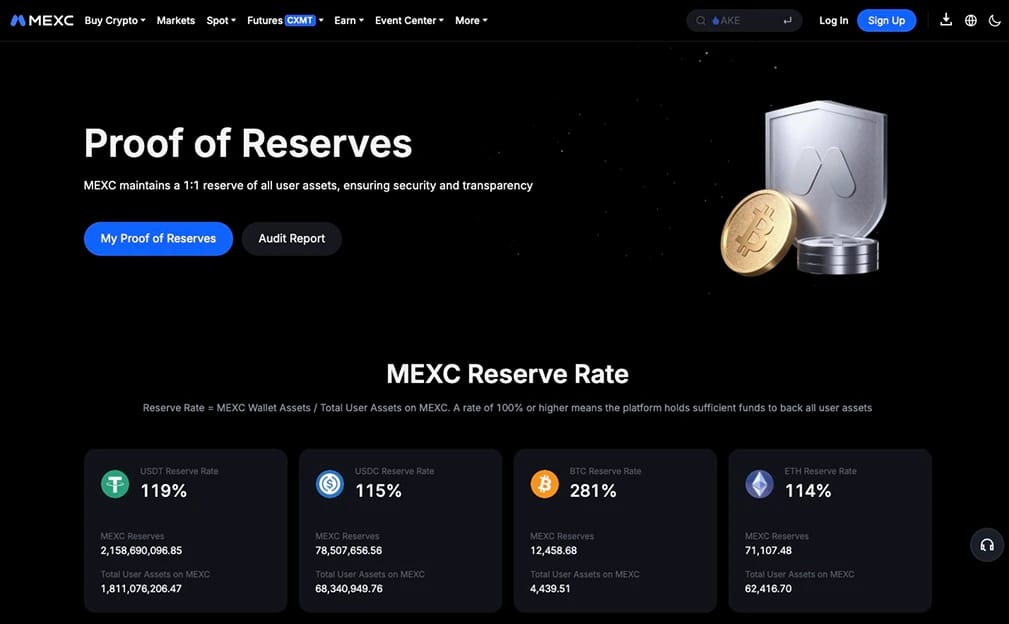
- Proof of Reserves: BloFin publishes Merkle-tree reserve reports showing user balances backed at a 1:1 ratio.
- Account controls: 2FA, passkeys, anti-phishing codes, and withdrawal address whitelists cover the standard set, and we enabled all of them before depositing.
- Incident history: No breach since launch. User complaints center on support response times and bonus conditions rather than blocked withdrawals, the distinction that matters most in this comparison.
MEXC Security Measures and History
- Proof of Reserves: Hacken audits MEXC's Merkle-tree reserve reports every month, and recent publications put Bitcoin backing at roughly 295% and major stablecoins above 110%.
- Guardian Fund: MEXC maintains a $100 million protection fund set aside for security incidents.
- Account controls: 2FA, anti-phishing codes, withdrawal whitelists, and device management match the industry baseline.
- Incident history: No hacker has ever taken customer funds from MEXC. In July 2025, the exchange locked about $3.15 million held by the trader known as The White Whale after flagging his order speed as automated trading. The case became a public campaign; on-chain investigator ZachXBT took it up, and the money was returned in full after MEXC's Chief Strategy Officer apologized publicly.
MEXC's reforms are real progress, and its reserve ratios rank among the strongest published anywhere. Even so, freeze complaints have continued into 2026, and the review process remains unpredictable. BloFin holds smaller reserves and a shorter history, but its users have not faced a comparable pattern of locked accounts.
BloFin vs MEXC: Regulation and KYC
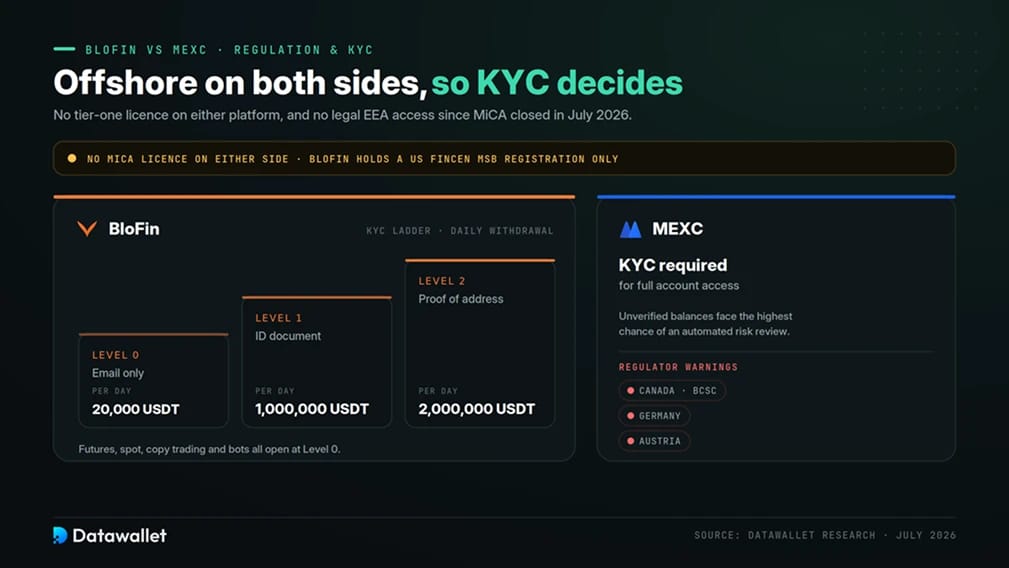
This matchup differs from most we cover because neither side holds a serious license. Both operate offshore, both lost legal EEA access when MiCA's transition period ended, and both appear in our no-KYC crypto exchanges guide. The decision rests on verification policy and restricted-country lists rather than regulatory standing.
BloFin's Position
- Registrations: A US FinCEN MSB registration covers anti-money-laundering reporting. It is not a supervisory license, and BloFin holds no authorization from a tier-one regulator.
- KYC policy: This is BloFin's clearest advantage. Level 0 requires only an email address and still opens futures, spot, copy trading, and bots, capped at 20,000 USDT in daily withdrawals. Submitting an ID raises the cap to 1 million USDT, and proof of address lifts it to 2 million USDT.
- Restrictions: Access is blocked in more than 40 jurisdictions, including the US, India, Canada, and China. The current list sits in our BloFin restricted countries guide.
MEXC's Position
- Registrations: A Seychelles corporate registration with no tier-one license attached. Regulators in Canada, Germany, and Austria have published notices warning residents that MEXC holds no authorization in their markets.
- KYC policy: Full functionality requires identity verification. Unverified accounts have limited crypto-only access with reduced withdrawal caps and face the highest risk of an automated review.
- Restrictions: The prohibited list covers the UK, US, Hong Kong, Singapore, Canada, and mainland China, among others, and it keeps changing as enforcement spreads. Check our MEXC available countries page before registering.
Traders avoiding identity checks should note the difference in intent. BloFin offers document-free trading as a designed product tier. MEXC tolerates unverified use while steering users toward verification, and unverified balances are the most exposed to its risk-control system.
BloFin vs MEXC: Fees
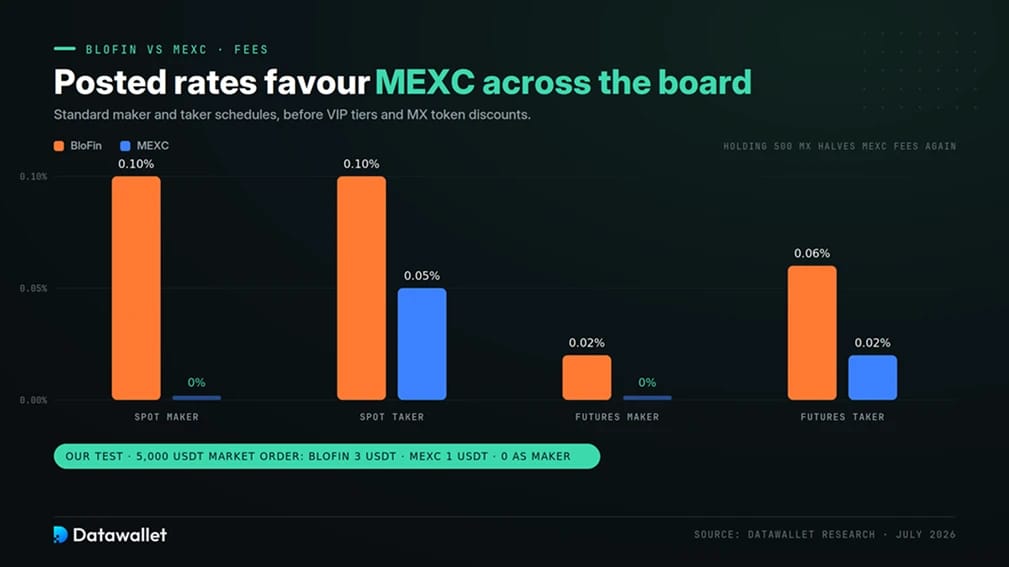
MEXC holds the price advantage, and the margin is wide enough to shape strategy for active traders. Posted rates are only part of the cost, since spreads on thin pairs return some savings to the market. Our maker vs taker fees guide explains why order type decides the rate you pay.
Spot Trading Fees
- BloFin: A flat 0.10% for makers and takers on the standard schedule, falling through VIP tiers set by 30-day volume or account balance. There is no native token and no token discount.
- MEXC: The base schedule charges 0% for makers and 0.05% for takers; recurring campaigns remove the taker fee on selected pairs; and accounts holding 500+ MX receive a 50% reduction. Our MEXC fees guide covers the full schedule.
Futures Fees
- BloFin: 0.02% maker and 0.06% taker at the entry tier, dropping toward zero maker rates at the highest VIP levels.
- MEXC: Standard perpetual pricing of 0% for makers and 0.02% for takers, the lowest published rates among major exchanges.
Our trading note: We placed a 5,000 USDT market order on BTC perpetuals on each venue. BloFin charged 3 USDT at its 0.06% taker rate, MEXC charged 1 USDT at 0.02%, and the same position opened as a limit order on MEXC cost nothing. Both filled close to the quoted price, so on a liquid pair, the fee gap was a genuine saving.
For a futures trader with meaningful monthly volume, MEXC's schedule compounds into a real cost advantage. BloFin prices competitively against most large exchanges but cannot match a standing 0% maker rate.
BloFin vs MEXC: Futures Trading
Derivatives are the main product on both platforms, so this section provides a comparison for most readers. Here is how the two compare within the wider field of crypto futures exchanges.
Available Markets
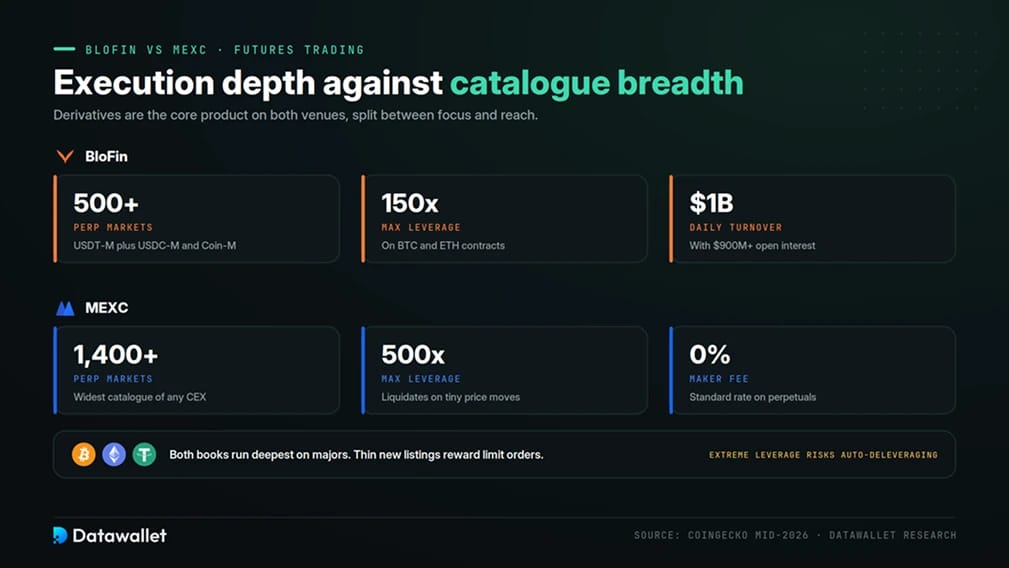
- BloFin: 500+ USDT-margined perpetuals plus USDC-margined and Coin-margined contracts, at up to 150x on BTC and ETH. The selection favors established assets, and new contracts arrive after review rather than immediately.
- MEXC: 1,400+ perpetual pairs, a wider set than any other centralized venue, and leverage reaches 500x on selected contracts. Nearly every token with an active market gains a MEXC perpetual quickly.
Execution and Liquidity
- BloFin: Depth is strongest on the major pairs, where most of its roughly $1 billion in daily futures turnover concentrates. Our BTC orders filled cleanly, and slippage only became visible on smaller contracts.
- MEXC: Liquidity on majors and established altcoins is deeper than BloFin's, backed by far higher total volume. On freshly listed pairs, the order books thin quickly, so limit orders and small position sizes are sensible defaults.
Leverage and Risk Controls
- BloFin: Isolated margin, cross margin, and hedge mode are all supported, and tiered leverage limits reduce maximum exposure as position size grows. The 150x ceiling applies only to the most liquid contracts.
- MEXC: The same margin modes apply, plus multi-asset collateral for USDT-margined positions. The 500x headline deserves caution, since extreme leverage liquidates on very small price moves and positions can be reduced by the exchange itself, as our auto-deleveraging guide explains.
MEXC wins this section on breadth, liquidity, and cost. BloFin remains stronger when the priority is trading majors at size without verification, since its full derivatives stack operates at KYC Level 0.
Final Thoughts
MEXC keeps the overall verdict. Its 3,000+ token catalog, standing 0% maker fees, deep liquidity, and audited reserves give it more of what most traders measure an exchange by. The 2025 freeze controversy was a genuine failure, and the public apology, returned funds, and new appeals channel show a platform correcting itself rather than ignoring the problem.
For traders seeking perpetuals on major assets without identity documents, BloFin is the better fit. It uses Fireblocks for custody and has not drawn the same pattern of withdrawal complaints as MEXC. Its limits are a smaller catalog, thinner books beyond majors, and higher posted fees.
A reasonable split is to match the platform to the balance. Keep a verified MEXC account for fee-sensitive volume and early listings, hold only working capital there, and turn to BloFin when privacy or withdrawal reliability outweighs price.
Before scaling either account, confirm a small deposit and withdrawal, enable all security controls, and read our MEXC review.