



What Are MEXC's Trading Fees?
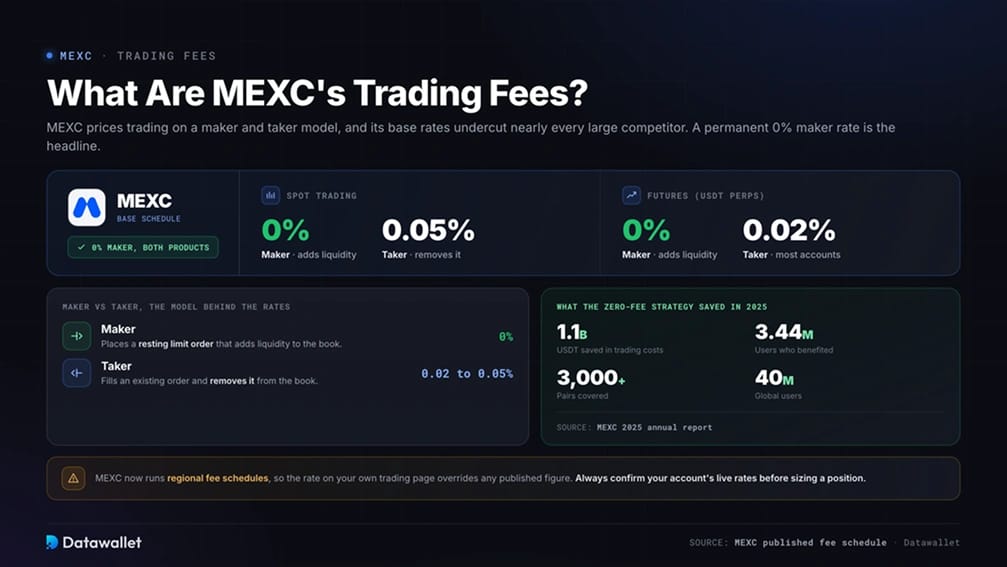
MEXC prices trading through a maker and taker model, and its base rates undercut nearly every large competitor. The published schedule sets spot trading at 0% for makers and 0.05% for takers, while standard futures rates sit at 0% for makers and 0.02% for takers.
A maker places a limit order that rests on the order book and adds liquidity, while a taker fills an existing order and removes it. Most exchanges charge both sides, so a permanent 0% maker rate on spot and futures is unusual, as we cover in our guide to maker vs taker fees.
Low fees are central to how MEXC competes. The exchange reported that its zero-fee strategy saved 3.44 million users a combined 1.1 billion USDT in trading costs across more than 3,000 pairs during 2025, per its annual report. That aggression helped it record some of the strongest net capital inflows among major exchanges tracked by DeFiLlama.
MEXC has moved to regional fee schedules, so the rate shown on your own trading page overrides any published figure. Always confirm your account's live rates before sizing a position.
MEXC Spot Trading Fees
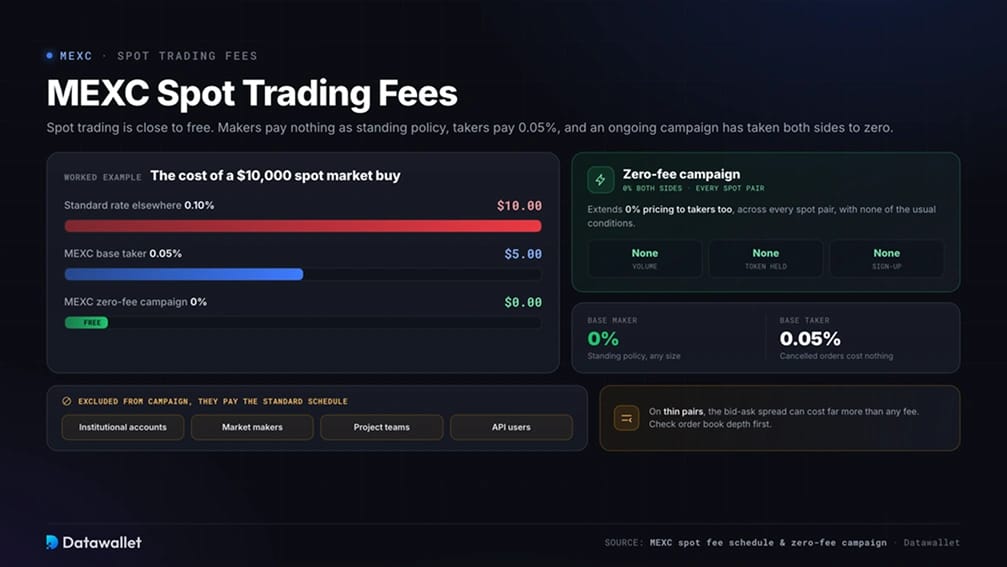
Spot trading on MEXC is close to free for most users. The base schedule charges makers nothing and takers 0.05%, and the exchange's ongoing zero-fee campaign has extended 0% pricing to both sides of every spot pair, with no volume threshold, token holding, or registration required.
The taker rate matters most when the campaign pricing does not apply to your account or pair. At 0.05%, a $10,000 market buy costs $5, which is half the 0.1% standard rate charged by most large competitors. Cancelled and unfilled orders incur no charge.
The spot fee structure works as follows:
- Maker orders: Charged 0% as a standing policy, so limit orders that rest on the order book cost nothing to fill regardless of trade size or account level.
- Taker orders: Charged 0.05% at the published base rate, reduced to 0% on pairs covered by the platform-wide zero-fee campaign.
- Exclusions: Institutional accounts, market makers, project teams, and API users do not qualify for campaign pricing and pay the standard schedule instead.
- Thin pairs: On smaller listings among MEXC's 3,000+ tokens, the bid-ask spread can cost far more than any explicit fee, so check order book depth before trading.
MEXC Futures Trading Fees
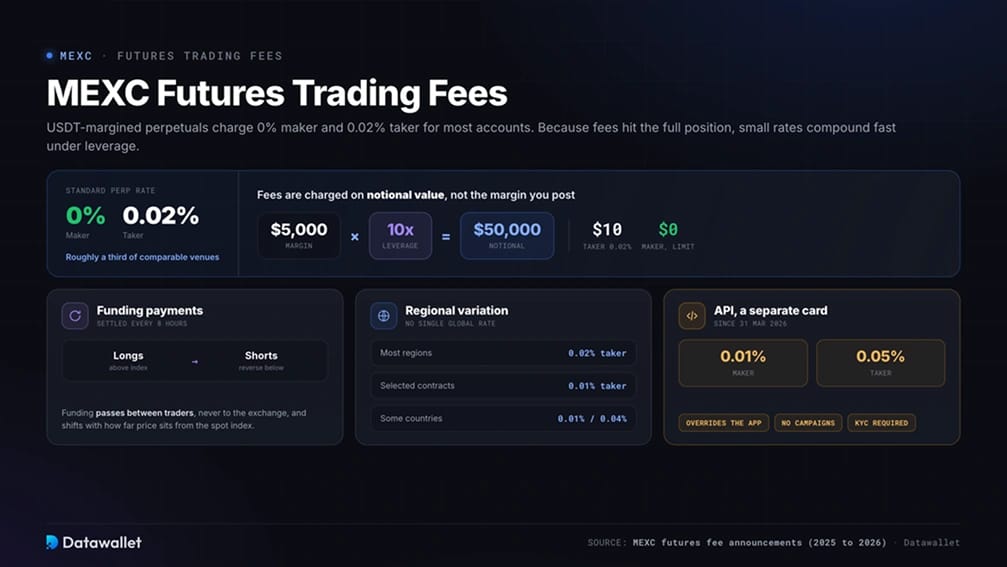
MEXC prices futures almost as aggressively as spot. Standard USDT-margined perpetual contracts charge makers 0% and takers 0.02% for most accounts, roughly a third of the taker rate on comparable venues.
Because futures fees are calculated on the full position value rather than the margin posted, small rate differences compound quickly under leverage. A 10x leveraged position built from $5,000 of margin represents $50,000 of notional value, so the taker fee on entry is $10 at 0.02% and nothing if you enter with a resting limit order.
Perpetuals also carry funding payments, which pass between traders rather than to the exchange. MEXC settles funding every 8 hours, with longs paying shorts when the contract trades above the spot index and the reverse when it trades below. You can compare live rates across venues with our funding rates tracker.
Regional Fee Variation
MEXC no longer runs one global futures schedule. Beginning with a BTC contract adjustment in February 2025, the exchange started tailoring taker rates by country, and a series of further adjustments through 2025 extended the practice across more regions and pairs.
The gap between regions is now wide. Some markets keep the 0.02% taker rate, others pay 0.01% on selected contracts, and users in certain countries have been moved to 0.01% maker and 0.04% taker schedules, per MEXC's trading fee announcements. The fee page inside your account remains the only authoritative source for what you will pay.
API Trading Fees
Traders running bots or algorithmic strategies face a separate schedule. Since 31 March 2026, futures orders placed through the MEXC API are charged 0.01% for makers and 0.05% for takers, and these rates override whatever the web or app displays, per the exchange's API announcements.
The carve-out reverses the platform's usual advantage for automated traders. An account that pays 0% maker and 0.01% taker in the app can pay five times the taker rate on identical orders sent through the API, and API users are excluded from zero-fee campaign pricing. Futures API keys also require completed KYC verification.
How to Reduce MEXC Fees
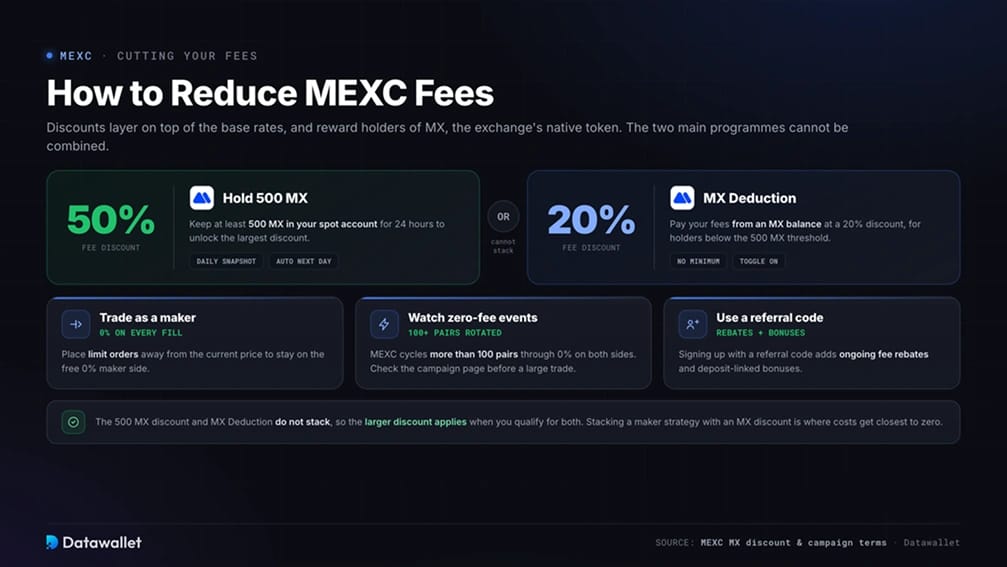
MEXC layers several discount mechanisms on top of its base rates, and they reward holders of MX, the exchange's native token. The two main programmes cannot be combined, so the larger discount applies when you qualify for both.
The main ways to cut your fees are:
- Hold 500 MX: Keeping at least 500 MX in your spot account for 24 hours, confirmed by daily snapshots, unlocks a 50% discount on trading fees, activating automatically the following day.
- MX Deduction: Enabling the deduction feature pays your fees from an MX balance at a 20% discount, useful for smaller holders who sit below the 500 MX threshold.
- Trade as a maker: Placing limit orders away from the current price keeps you on the 0% maker side of the schedule, so those orders trade free.
- Watch zero-fee events: MEXC rotates more than 100 futures and spot pairs through 0% pricing on both sides, so checking the campaign page before a large trade can eliminate taker costs.
- Use a referral code: Signing up with a MEXC referral code adds ongoing fee rebates and deposit-linked bonuses on top of the standard schedule.
MEXC Deposit and Withdrawal Fees
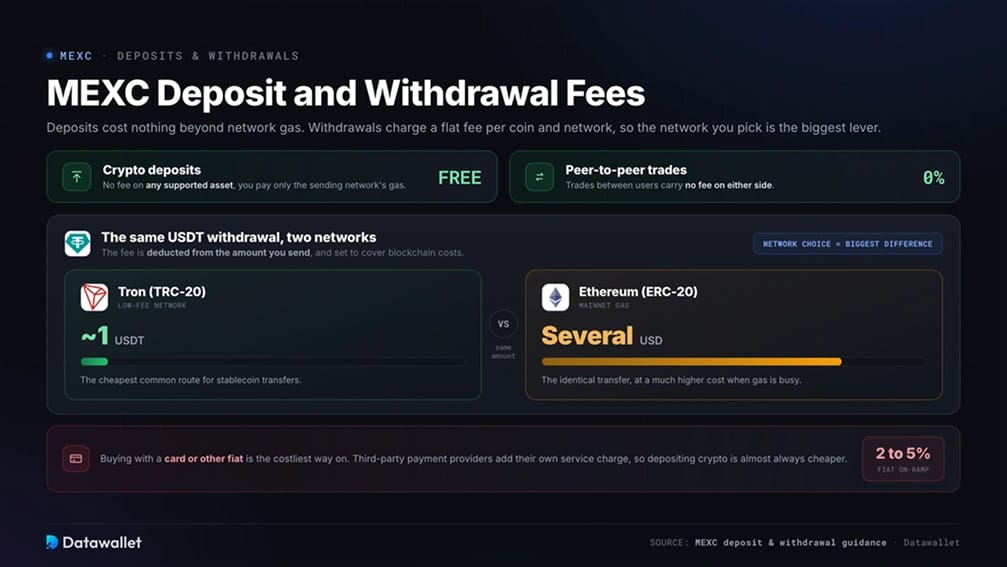
Moving crypto onto MEXC costs nothing beyond the sending network's own gas. The exchange charges no deposit fees on any supported asset, and peer-to-peer trades between users also carry 0% fees on both sides.
Withdrawals follow the industry-standard model of a flat fee per coin and network, set to cover blockchain costs. The fee is deducted from the amount you send, and choosing the right network makes the biggest difference. A USDT withdrawal costs roughly 1 USDT on TRC-20, while the same transfer on Ethereum can cost several dollars, a gap we explain in our TRC-20 USDT guide.
Buying with fiat is the costliest way onto the platform. Card purchases and other fiat deposits run through third-party payment providers whose service charges typically land between 2% and 5%, per MEXC's own guidance. Depositing crypto from another exchange or wallet is almost always cheaper than buying with a card.
How MEXC Fees Compare to Other Exchanges
MEXC's base schedule sits below the standard retail rates at every large competitor, and the gap is widest on the maker side. The comparison below uses published entry-tier rates before token discounts or VIP levels, which favour high-volume traders on other venues.
Here is how the standard schedules line up:
The rate advantage holds even before discounts, though fees are only one part of venue choice. Liquidity depth, listing quality, and withdrawal reliability all shape real trading costs, which is why our Bybit vs MEXC comparison and our ranking of the best low-fee crypto exchanges weigh more than the published schedule.
The Real Cost of Trading on MEXC
Zero-fee pricing is a customer acquisition strategy, and understanding how MEXC funds it explains where the remaining costs sit. The exchange monetises futures taker fees, regional schedules, API trading, spreads on thin listings, and the trading activity that low headline rates attract.
The most serious non-fee cost has been account access. In July 2025, MEXC froze roughly $3.15 million belonging to a pseudonymous trader known as the White Whale after its risk engine flagged his order activity, and the dispute escalated until the exchange publicly apologised and returned the funds in November 2025 following pressure from onchain investigator ZachXBT. Other traders raised similar freeze complaints during and after the episode.
MEXC responded by rebuilding its risk-control framework, adding independent expert oversight, faster appeal channels, and phased reopening of API access, per its annual report. The campaign terms still state that triggering risk control suspends zero-fee benefits until the restriction lifts, so profitable high-frequency traders should weigh that operational risk alongside the fee savings. Our MEXC review covers the platform's security and custody record in more depth.
Availability is the final constraint. MEXC does not serve the United States, the United Kingdom, or Canada, and full KYC verification is now required for trading access, as we detail in our guide to MEXC's available countries.
Final Thoughts
MEXC delivers on its low-fee reputation for the trades most users make. Zero maker fees across spot and futures, a 0.02% standard futures taker rate, and rolling zero-fee campaigns leave very little for a manual retail trader to pay beyond funding and withdrawal costs.
The structure has grown more complicated than the marketing suggests. Regional schedules, a separate and higher API rate card, campaign exclusions, and discount rules mean the fee page inside your own account is the only number that counts.
We would treat the fee savings as real but conditional. Traders who use limit orders, hold 500 MX, and withdraw over cheap networks can trade at near-zero cost, while anyone running large or automated strategies should factor in the API schedule and the platform's history of risk-control freezes before committing serious capital.