
How to Bridge to Monad (Fees & Best Platforms)
Summary: deBridge offers the most reliable solution for bridging to Monad, providing deep liquidity, efficient routing, and consistently low fees across many supported chains.
Connect your wallet, select source chain and Monad, choose your token and amount, review the quote, approve, and confirm the transfer to receive assets within 2 minutes.
%201.svg)
Best Monad Bridge - deBridge
deBridge is the best bridge for Monad, enabling fast low-cost transfers with billions in processed cross-chain volume across 30+ blockchain networks.
Supported Testnet Chains
Monad, Ethereum, Arbitrum, Optimism, BNB Chain & more
Fees
WETH, USDC, USDT & other major blue-chip assets
Supported Assets
Multiple independent audits from Halborn, Zokyo & Immunefi
Can I Bridge to Monad?
Yes, you can bridge to Monad via multiple audited cross-chain protocols live today. Monad now connects directly to Ethereum and Solana through its native bridge and Portal-powered routing.
Monad’s own ecosystem is also reachable through third-party bridge aggregators and interoperability layers. deBridge, Jumper, and Stargate already support routes into Monad from EVM chains.
Monad’s native bridges, powered by Wormhole and Axelar, links Ethereum and Solana liquidity into Monad. It uses Wormhole’s NTT standard plus Axelar message passing to move assets like MON and ETH.

How to Bridge to Monad (Any Chain)
Bridging to Monad from almost any chain is easiest through deBridge, a cross-chain liquidity protocol connecting 30+ ecosystems. It aggregates multiple routes and venues, often improving effective pricing and reducing slippage when sending assets into Monad.
Follow these steps to bridge from any chain.
- Connect your wallet: Connect a supported crypto wallet to deBridge, ensuring it holds exactly the tokens you intend to bridge today.
- Select chains: Select your current source chain, then choose Monad as destination network inside the main bridge chain selector panel.
- Choose token and amount: Pick the token you want bridged and enter an amount respecting minimums, per-route limits, and available liquidity indicators.
- Review quote and route: Review quoted fees, arrival time, and routing path, ensuring they align with your slippage tolerance and risk preferences.
- Approve and send: Approve token spending in your wallet, then confirm the bridge transaction after verifying network, address, gas, and nonce.
- Confirm on Monad: After on-chain confirmations, switch your wallet to Monad and verify bridged tokens display correctly within your portfolio balances.
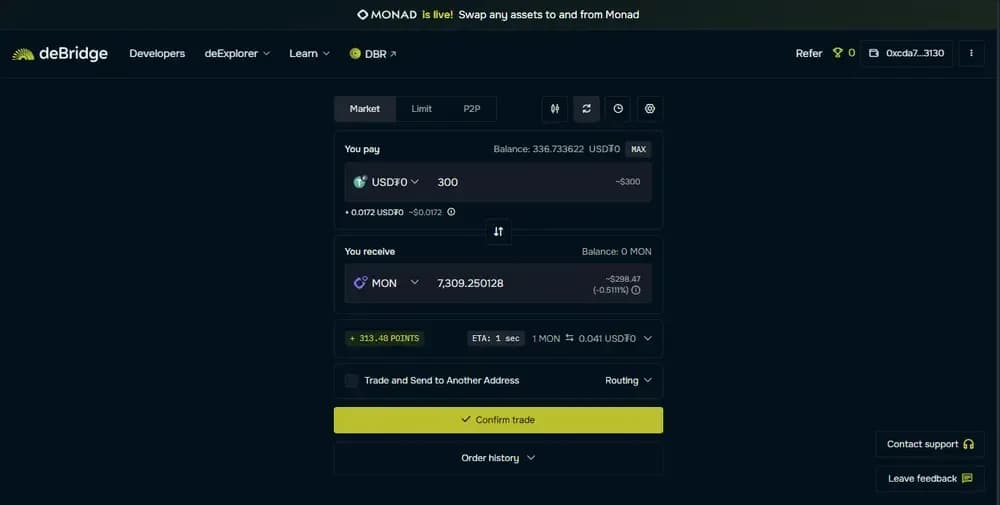
What Are the Monad Bridging Fees?
Monad bridging costs include gas on both chains plus protocol and aggregator bridge fees. Monad’s own gas is cheap, so Ethereum or source-chain fees usually dominate overall costs.
deBridge typically charges a flat gas component plus about 0.04% variable protocol fee. Stargate often takes roughly 0.06%, while LI.FI adds around 0.12% routing spread for integrated partners.
Portal and the Monad Native Bridge mainly charge gas plus modest protocol fees per route. User transfers usually cost between 0.1% and 0.6%, depending on token, route, and conditions.
Best Monad Bridges Compared
Several well-established bridges support Monad today, each balancing security assumptions, supported assets, incentive programs, and overall user experience metrics differently.
Use this table to compare leading Monad bridges:
Monad Bridge Risks
Bridging to Monad introduces several layered risks spanning smart contracts, economic mechanisms, oracle infrastructure, and straightforward user mistakes.
Consider these key Monad bridge risks before transferring:
- Smart contract risk: Bugs or misconfigurations in bridge smart contracts can enable fund theft, token mis-accounting, or permanent lockups across connected chains.
- Liquidity and routing risk: Insufficient liquidity, paused pools, or overloaded relayers may cause long delays, failed transfers, or forced unfavorable pricing routes.
- Market and MEV risk: Large transfers can attract MEV, sandwiches, or oracle manipulation, sometimes substantially worsening realized execution prices versus quoted expectations.
- User and phishing risk: Copying wrong addresses, choosing fake bridges, or signing malicious approvals often leads to irreversible asset loss for users.
- Regulatory and asset risk: Regulatory actions against specific assets, stablecoins, or jurisdictions might impact bridge availability, KYC requirements, or downstream DeFi access.
About Monad
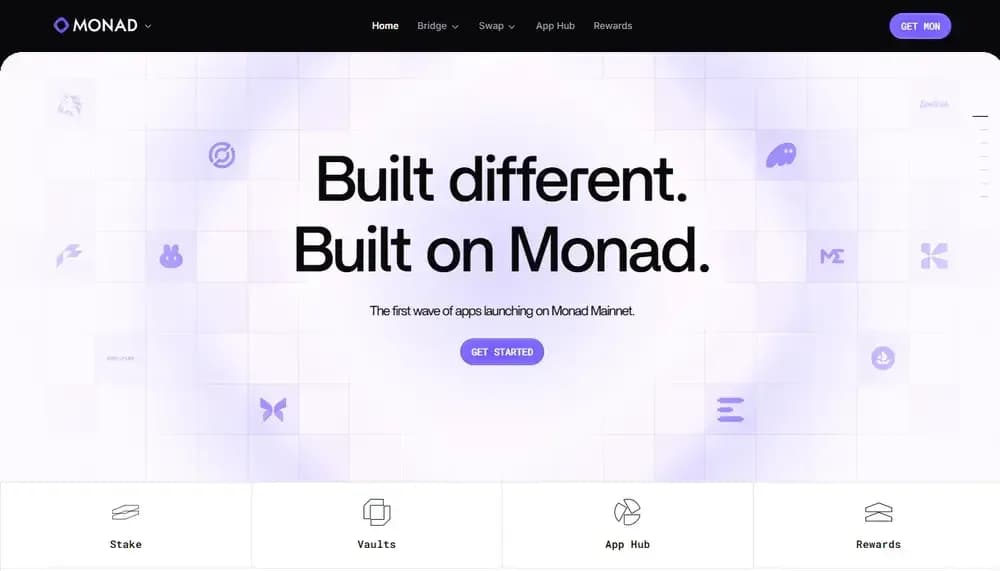
Monad is a high-performance, EVM-compatible Layer-1 blockchain targeting roughly 10,000 transactions per second with sub-second finality. It uses optimistic parallel execution and deep pipeline optimizations so many EVM transactions execute concurrently without sacrificing determinism.
Designed for Ethereum developers, Monad keeps bytecode-level compatibility, meaning existing Solidity contracts and tooling work without modification. Fast block times, low fees, and a growing validator set aim to support DeFi and high-frequency applications.
Final Thoughts
Now that you understand Monad bridging, you can select routes, compare fees, and better calibrate transfers to your risk tolerance. Start with small test transactions, confirm arrivals on Monad, then progressively increase position sizes as your operational confidence grows safely.
With funds now available on Monad, explore DeFi protocols, liquidity pools, and on-chain games that benefit from faster execution significantly. Continue monitoring bridge ecosystems, fee structures, and new integrations so you can regularly reroute capital toward the most efficient options.
Frequently asked questions


%2520(1).webp)
