



Can I Buy Bitcoin with Paytm?
Yes, through Paytm UPI. After the RBI restricted Paytm Payments Bank, the app moved its payments onto partner banks under a Third-Party Application Provider model, so your handle now ends in @ptaxis, @pthdfc, @ptsbi or @ptyes and the rupees leave your linked savings account. The Paytm Wallet cannot fund an exchange, and Paytm Money lists no crypto, which leaves this as the route.
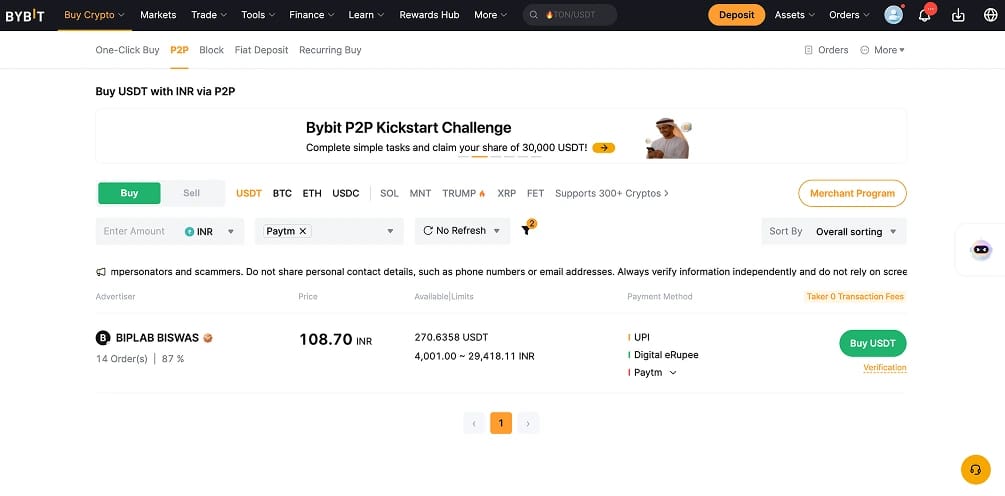
In practice you open an account at an FIU-registered exchange, pay an INR seller from the Paytm app, and buy there. I have funded Bybit this way twice this year from a @ptaxis handle through P2P, with no block beyond the usual confirmation on a larger payment.
One grey area matters first. The NPCI has never formally cleared UPI for crypto purchases, which is why offshore platforms route rupees through P2P sellers rather than a merchant gateway. A payment to an individual seller clears where one tagged to a crypto merchant can fail.
How to Buy Crypto with Paytm
The best way to buy crypto with Paytm is a P2P trade over UPI on Bybit, where you pay a verified seller from your Paytm app and they release USDT or BTC to your wallet. Paying a person rather than a crypto merchant is what gets the rupees through where a direct deposit can fail.
- Create an account: Sign up on Bybit and complete KYC with your PAN and Aadhaar. Verification must clear before P2P or trading opens.
- Open P2P and pick a seller: Go to Buy Crypto > P2P Trading, choose USDT or BTC, and filter sellers by UPI. The receiving name must match the account behind your Paytm handle.
- Check your limit: Paytm UPI caps near ₹1,00,000 per transaction, set by the partner bank behind your handle, not Paytm. For larger buys, IMPS runs up to ₹2,00,000 per day from the same account.
- Pay and confirm: Place the order, pay the seller from the Paytm app using the exact name and reference, then mark it paid. The seller releases the crypto once the rupees land, usually within minutes.
- Buy your asset: If you bought USDT, open the spot market, search your pair, and order. On anything sizeable I use a limit order, since the one-click quote carries a wider spread than the 0.10% spot fee.
Fees, Tax and Transfer Limits for Paytm Users
Your real cost has three parts: the Paytm transfer, the exchange fee, and the tax. The third is the one people underestimate.
Paytm transfer costs and limits
- Paytm UPI: Free and instant. The ceiling near ₹1,00,000 per transaction is set by the partner bank that issued your handle, so a @ptaxis and a @ptsbi user can differ.
- IMPS: Real-time, up to ₹2,00,000 per day from the same linked account, for when a single transfer is too small for the order.
- Paytm Wallet: Not usable. A prepaid instrument cannot fund an exchange, and top-ups are restricted as Paytm Payments Bank winds down.
- AML checks: Your underlying bank, not Paytm, runs PMLA reporting. A first or large transfer can draw a source-of-funds query, cleared quickly by exchange statements and your ITR.
Tax and the 1% TDS
- 30% on gains: Profit on any virtual digital asset is taxed at a flat 30% under Section 115BBH, plus 4% cess, with no concession for holding longer.
- No loss offset: A loss on one coin cannot offset a gain on another or be carried forward, and only your cost of acquisition is deductible.
- 1% TDS: A 1% tax is withheld at source under Section 194S. Indian exchanges deduct it for you; Bybit, being offshore, does not, so the buyer must deduct and deposit it on P2P trades.
- Reporting: Declare everything under Schedule VDA in ITR-2 or ITR-3. The Income Tax Act 2025, in force from 1 April 2026, keeps this framework intact and adds penalties for reporting failures.
Bybit fees
- P2P deposit: No platform fee. You pay only the rate agreed with the seller.
- Spot trading: 0.10% maker and taker at the standard tier.
- Crypto withdrawal: Network fee only. USDT on Tron (TRC-20) is usually around a dollar.
A free P2P deposit and 0.10% spot keep the exchange leg cheap. The 30% tax and 1% TDS, not the trading fee, are where the real cost of Indian crypto sits.
Best Exchanges for Paytm Users
Indian users have a mix of offshore and home-grown platforms, all FIU-registered. The deciding factor is whether the platform withholds your 1% TDS or leaves that filing to you.
Paytm Cryptocurrency Policy
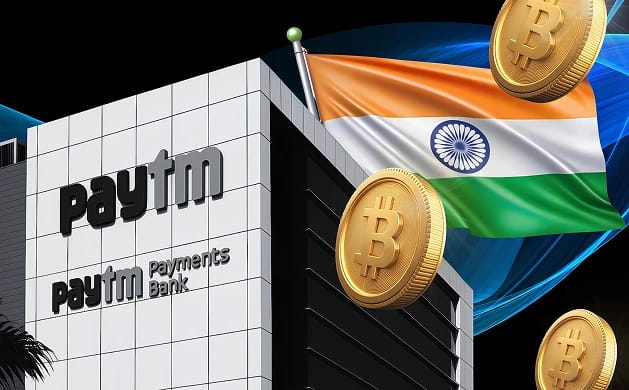
Paytm, meaning One97 Communications, offers no crypto product or custody, and its broking arm Paytm Money covers shares and mutual funds only. It is a payments rail you point at an exchange, not a venue. After the RBI barred Paytm Payments Bank from fresh deposits in 2024 and cancelled its licence from 24 April 2026, payments continued through partner banks. Those are Axis, HDFC, SBI and YES, so a Paytm user's experience mirrors a customer of one of them, which our guides on Axis Bank and HDFC Bank cover from the bank side.
India's wider position is steady: crypto is legal to hold and trade, but is not legal tender and sits outside any SEBI-style investor protection. Banking access turned on the RBI's 2018 circular being struck down by the Supreme Court in March 2020. Oversight now runs through FIU-IND, which Bybit registered with in 2025 after a ₹9.27 crore penalty and short suspension before restoring full app access.
About Paytm
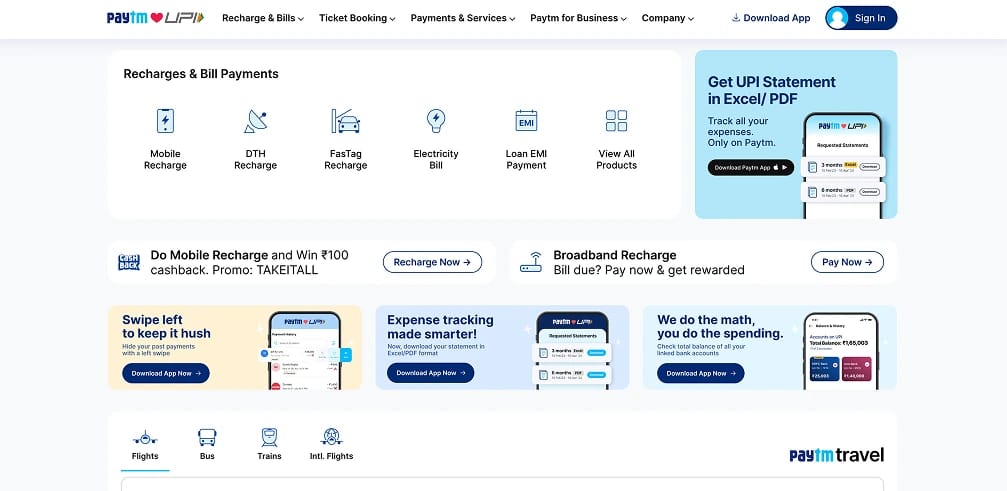
Paytm is the brand of One97 Communications Limited, a Noida-based payments company listed on the BSE and NSE since 2021. It popularised QR payments, the soundbox and mobile wallets, and remains one of India's most used payment apps. For everyday use it is a UPI app over a linked bank account, running on a multi-bank TPAP arrangement with Axis, HDFC, SBI and YES behind the @ptaxis, @pthdfc, @ptsbi and @ptyes handles. It also runs Paytm Money for SEBI-regulated investing, plus bill payments, FASTag and merchant services.
Paytm Payments Bank, the licensed entity the group was associated with, ceased banking after the 2026 licence cancellation and is being wound down. None of Paytm's retail products include cryptocurrency.
Bottom Line
Buying Bitcoin with Paytm runs entirely through Paytm UPI. It rides on a partner bank, P2P or IMPS is the reliable INR method, and your limits come from the bank behind your handle. The Wallet does not fund exchanges, and Paytm Payments Bank is gone.
Bybit is our pick for most Paytm users on cost and asset range, with 0.10% spot and free P2P deposits. If you would rather the 1% TDS be withheld inside India, a domestic exchange like CoinDCX is cleaner, at a higher fee. Either way, the 30% tax and Schedule VDA filing still apply.