




Can I Buy Bitcoin with RBC?
Yes, either as a fund or as coins you hold yourself. Inside RBC, the only option is the fund. Spot Bitcoin and Ether ETFs listed on the Toronto Stock Exchange trade through RBC Direct Investing like any other ticker, and Canada listed the world's first spot Bitcoin ETF in February 2021. A fund gives you price exposure with management fees attached and no coins you can move to your own wallet.
Owning the asset itself means funding a registered exchange from your RBC chequing account. RBC does not stop Interac e-Transfers or wires to platforms that hold Canadian registration, and our test deposits from an RBC Advantage Banking account reached Coinbase without a block. The realistic venues are the best crypto exchanges in Canada, all now under securities regulation.
RBC retains discretion to end a banking relationship it considers outside its risk tolerance, and in 2025 it closed the accounts of an Alberta lawyer after two $1,000 e-Transfers to the Bitcoin platform Shakepay. Cases like this are rare, but they explain why we keep transfer records and answer any RBC verification call directly.
How to Buy Crypto with RBC
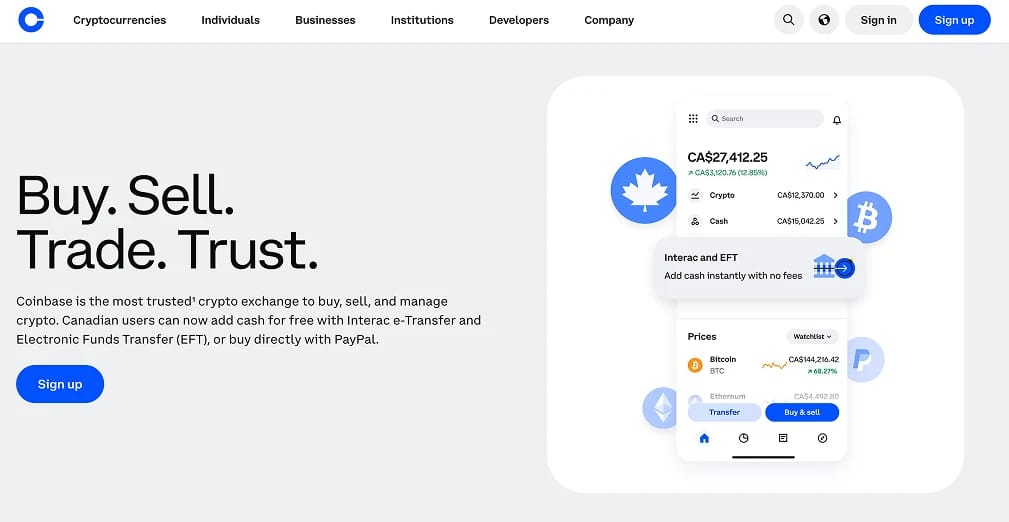
An Interac e-Transfer from RBC to Coinbase is the cheapest and fastest method we have found. Deposits are free, land within minutes through Coinbase's partnership with Peoples Trust, and settle into an account regulated by the same provincial bodies that oversee your brokerage.
Steps to buy crypto with RBC:
- Create an account: Sign up on Coinbase and complete KYC with a driver's licence or passport. The legal name on your Coinbase profile must match your RBC account exactly, since a mismatch bounces Interac deposits automatically.
- Start the deposit inside Coinbase: Open Cash Balance > Add Cash > Interac e-Transfer and enter the CAD amount, between $2 and $10,000 per transaction. Coinbase then hands you over to complete the payment from your bank.
- Check your RBC limits: RBC caps e-Transfers at $10,000 per day through the RBC Mobile app once your identity is verified, and the bank states this ceiling cannot be changed. Your per-transfer cap shows under Daily Transaction Limits in online banking, and anything larger needs a wire.
- Approve and clear the fraud check: Sign in to RBC to release the transfer. Because the payment is initiated inside Coinbase, RBC's fraud team occasionally flags the first one, and ours only cleared after we confirmed the deposit was genuine in the app. Later transfers arrived in minutes without a prompt.
- Buy crypto: Once the CAD balance shows, toggle to Advanced Trade and place a limit order on your pair. The one-tap buy on the standard screen carries a spread and a higher fee, so past a small test purchase we always trade on the order book instead.
Fees and Transfer Limits for RBC Customers
Sending money from RBC costs nothing when set up correctly. What varies is your daily ceiling and your Coinbase pricing tier.
RBC costs and limits
- Interac e-Transfer: Free on Canadian dollar personal accounts, with 999 free transfers per month before a $1.00 charge applies. Sending caps at $10,000 per day via the mobile app after identity verification, and many accounts default to $3,000 per transfer.
- Wire transfer: The practical option above the e-Transfer ceiling. RBC charges a flat outgoing fee, and Coinbase adds $30 CAD on incoming wires below $10,000 while waiving it above that mark, so wires only make sense for five-figure amounts.
- Debit card: RBC Virtual Visa Debit works on card gateways, but the exchange side charges 3.99%. We use it for nothing beyond a first $20 test.
- Credit cards: RBC prohibits crypto purchases on all of its credit cards, with no case-by-case exceptions of the kind TD sometimes grants.
- AML checks: RBC reports to FINTRAC under Canada's proceeds of crime legislation, so a large or unusual first transfer can draw a source-of-funds question. Exchange statements and your tax filings settle these quickly.
Coinbase fees
- Interac e-Transfer deposit: Free, usually credited within minutes.
- EFT deposit: Free, settling in 1 to 3 business days.
- Simple trades: Roughly 1.49% plus a spread inside the quote. Convenient, and dearer than the order book.
- Advanced Trade: 0.40% maker and 0.60% taker at the entry tier, falling with 30-day volume. This is where we place every order beyond a test.
- Coinbase One: A monthly subscription that removes fees on simple trades, which starts paying for itself if you buy weekly.
- Crypto withdrawal: Network fee only. Moving USDC on a low-cost chain costs cents.
- CAD back to RBC: EFT to your chequing account, typically 1 to 3 business days.
A free Interac deposit paired with 0.40% on the order book keeps the all-in cost of a $1,000 Bitcoin purchase near four dollars, a fraction of what the same buy costs through a card gateway or a fund's annual management fee.
Best Exchanges for RBC Customers
Every platform below holds Canadian registration, which since the securities regulators' crackdown is the first test before wiring money anywhere. Our full Coinbase review covers the recommended pick in depth.
RBC Cryptocurrency Policy
RBC offers no retail crypto trading, custody, or wallet product, and its public materials frame digital assets as a fraud and volatility risk rather than a product line. The credit card ban follows that logic, stopping purchases of a volatile asset with borrowed money. Peers take the same broad stance, which is why our guides to TD, Scotiabank and CIBC all point Canadians at the same registered-exchange path.
What changed is the regulation of the exchanges themselves. The Canadian Securities Administrators forced every platform serving Canadians to sign binding undertakings and register as dealers, and Coinbase became the first international exchange to complete that registration in April 2024, under a decision signed by the Ontario Securities Commission. Kraken followed a year later. Binance, OKX and Bybit left the country rather than accept the terms.
Registration carries conditions an RBC customer feels directly. Tether trading has been suspended for Canadian users since August 2023 because regulators approved only USDC among stablecoins, a restriction covered in our guide to buying USDT in Canada. In most provinces outside Alberta, British Columbia, Manitoba and Quebec, retail buyers also face a rolling 12-month purchase limit of $30,000 on smaller altcoins, though Bitcoin, Ether, Solana, USDC, Litecoin and Bitcoin Cash carry no cap.
Tax reporting has tightened as well. Canada implemented the OECD's Crypto-Asset Reporting Framework through Income Tax Act amendments effective 1 January 2026, so registered exchanges now collect and report client transaction data to the CRA, with the first filings due in 2027. The CRA already taxes disposals as capital gains or business income, and exchange records make that activity visible.
About RBC
Royal Bank of Canada is the country's largest bank by market capitalisation, founded in Halifax in 1864 and headquartered in Toronto, serving more than 17 million clients worldwide. Its March 2024 acquisition of HSBC Canada folded that bank's domestic customers into the RBC network.
Personal customers bank through the RBC Mobile app and RBC Online Banking, with a product line spanning the Advantage Banking chequing account, Avion credit cards, Visa Debit, mortgages, and investing through RBC Direct Investing and the robo-adviser RBC InvestEase. Interac e-Transfer, bill payments and wires move money out of the account, the same tools used to fund an exchange.
The bank is federally supervised by the Office of the Superintendent of Financial Institutions, with its brokerage arms regulated by CIRO.
Bottom Line
Buying Bitcoin as an RBC customer runs smoothly once the setup is right. Keep each Interac e-Transfer inside the fixed $10,000 daily ceiling, make sure your Coinbase profile carries the exact legal name on your RBC account, and treat a first-transfer fraud prompt as routine rather than a rejection.
Coinbase earns our recommendation because its approvals mirror what RBC's compliance team wants to see, a CSA dealer registration covering every province plus FINTRAC oversight, wrapped around free Interac deposits and 0.40% order-book pricing. Wealthsimple is the all-Canadian alternative if you would rather hold coins beside your stocks in a CIRO dealer, at a higher fee per trade.