







Can I Buy USDT in Australia?
Yes. USDT is legal to own and trade in Australia, and the local market is among the most competitive anywhere. Any business exchanging dollars for crypto must be registered with AUSTRAC as a Digital Currency Exchange under the AML/CTF Act 2006. Registration covers identity checks, transaction monitoring, and suspicious matter reporting rather than product approval.
Adoption runs deep. The 2026 Independent Reserve Cryptocurrency Index found 33% of Australians hold or have held crypto, the highest reading in the survey's history. The Corporations Amendment (Digital Assets Framework) Bill 2025 cleared both houses on 1 April and will require exchanges and custodians to hold an Australian Financial Services Licence once the regime commences in April 2027.
Until then, the AUSTRAC register is your first filter. Kraken, CoinSpot, Swyftx, Independent Reserve, and OKX all appear on it, as does every venue in the table below. An offshore platform without Australian registration leaves you no AFCA recourse if a withdrawal stalls.
How to Buy Tether (USDT) in Australia
The setup we use is a verified Kraken account funded by PayID from an Australian bank account in your own name. Your bank shapes the experience more than the exchange does. CommBank caps payments it identifies as going to crypto exchanges at $10,000 per calendar month and holds some transfers for up to 24 hours, and the other majors run their own controls. Our CommBank and Westpac guides cover each bank's policy.
Steps to buy USDT on Kraken in Australia:
- Create and verify your account. Sign up at Kraken and complete KYC with an Australian passport, driver licence, or photo card, plus proof of address from the last three months. Verification typically clears the same day.
- Generate your PayID deposit details. Open the deposit screen, select AUD, and choose PayID. Kraken issues a unique PayID email address to add as a payee in your banking app. The minimum deposit is $5, and the sending account must match your Kraken account name.
- Send a small test, then the balance. A first payment to a new payee can sit in a bank security hold for a day or two, so start with $20. When we sent two deposits of identical size on the same afternoon, the second was held for review, so vary the cents on repeat transfers.
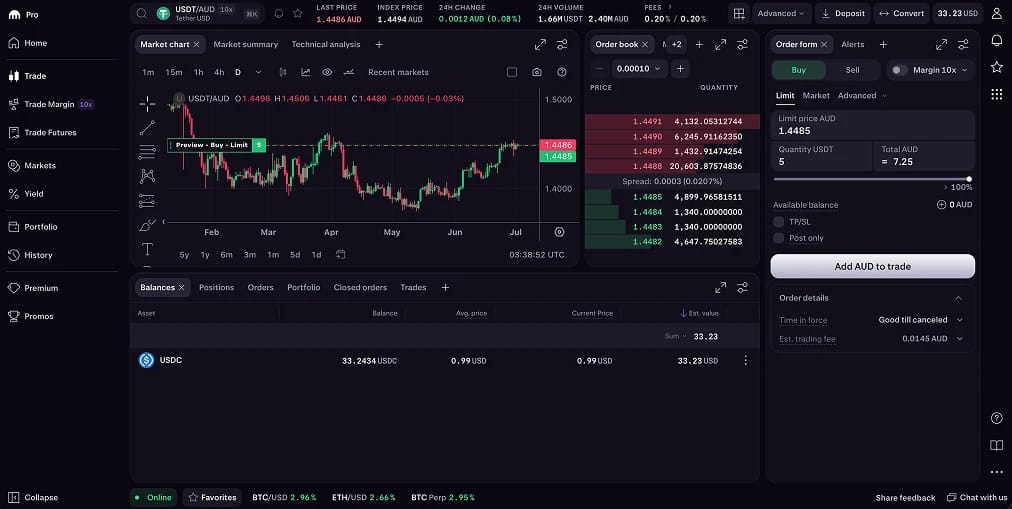
- Buy USDT on Kraken Pro. Open the USDT/AUD order book, enter your amount, and place a limit or market order. Pro fees start at 0.16% maker and 0.26% taker, far below Instant Buy once its spread is counted.
- Withdraw to self-custody for long-term holdings. Tron (TRC-20) keeps transfer costs near a dollar, Solana is cheaper still, and Ethereum (ERC-20) suits DeFi destinations if you accept the gas.
Because Tether tracks the US dollar, one USDT costs roughly A$1.50 at recent AUD/USD levels rather than A$1, and its local price moves with the exchange rate daily.
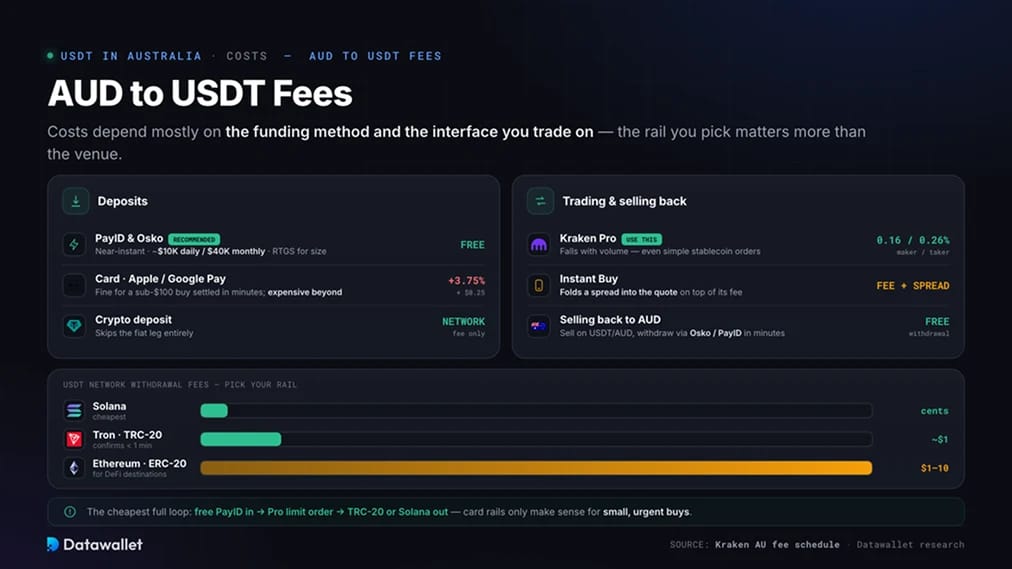
AUD to USDT Fees
Costs depend mostly on the funding method and the interface you trade on.
Deposits
- PayID and Osko (recommended): Free on Kraken and near-instant once the payee is established. Standard verified accounts start around $10,000 daily and $40,000 monthly on this rail, with RTGS available for larger transfers.
- Card, Apple Pay, and Google Pay: An extra 3.75% plus $0.25 on top of standard fees. Defensible for a sub-$100 buy settled in minutes, expensive beyond that.
- Crypto deposit: Sending USDT or another asset from an external wallet skips the fiat leg and costs only the network fee.
Trading and withdrawals
- Kraken Pro versus Instant Buy: Pro runs 0.16% maker and 0.26% taker at the base tier and falls with volume. Instant Buy folds a spread into the quote on top of its fee, so we place even simple stablecoin orders through the Pro book.
- USDT network fees: TRC-20 withdrawals cost about a dollar and confirm in under a minute. Solana transfers cost cents. ERC-20 tracks Ethereum gas and can run from one dollar to ten.
- Selling back to AUD: Sell on the USDT/AUD book, then withdraw over Osko or PayID for free, usually within minutes.
Our roundup of the best USDT exchanges compares fee structures across global venues.
Best USDT Exchanges in Australia
The table ranks the top crypto exchanges in Australia for buying Tether, weighted on AUD funding, fees, liquidity, and regulatory standing. Every venue sits on the AUSTRAC register and takes dollars directly, which removes several global names that only accept crypto deposits or P2P from Australians.
Kraken leads for its native USDT/AUD book, deep global liquidity, and low Pro fees. CoinSpot and Swyftx suit buyers wanting a homegrown platform with broad coin coverage, OKX rewards active traders at scale, and Independent Reserve fits SMSF investors and anyone moving size through its OTC desk.
Regulatory Status of USDT in Australia
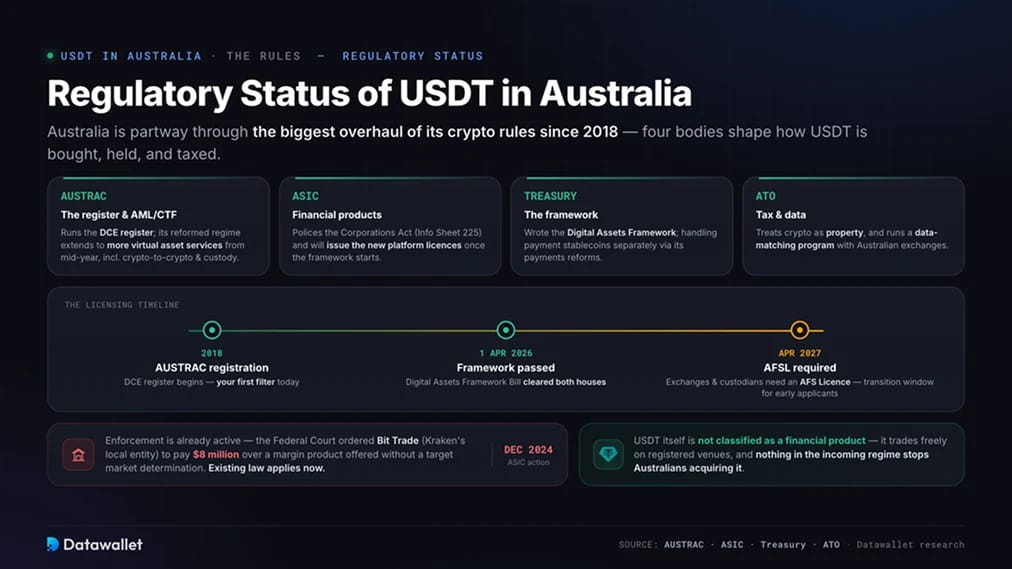
Australia is partway through the biggest overhaul of its crypto rules since AUSTRAC registration began in 2018. Four bodies shape how USDT is bought, held, and taxed:
- AUSTRAC: Runs the Digital Currency Exchange register and enforces AML/CTF obligations. Its reformed regime extends to more virtual asset services from mid-year, including crypto-to-crypto platforms and custody providers.
- ASIC: Polices financial products under the Corporations Act, with Information Sheet 225 setting out when a crypto offering crosses that line, and will issue the new platform licences once the framework starts.
- Treasury: Wrote the Digital Assets Framework legislation and is handling payment stablecoins separately through its payments reforms.
- ATO: Treats crypto assets as property for tax purposes and runs a data-matching program with Australian exchanges.
The new framework regulates the platforms holding your USDT rather than the token itself, so custody standards, disclosure, and dispute resolution obligations land on exchanges from April 2027, with a transition window for firms that lodge licence applications early.
Enforcement has not waited for the new law. ASIC action over a margin product offered without a target market determination saw the Federal Court order Bit Trade to pay an $8 million penalty in December 2024. USDT itself is not classified as a financial product, trades freely on registered venues, and faces no restriction under the incoming regime.
Tax Implications of USDT in Australia
Stablecoins catch out more Australian investors than any other asset, usually because a flat USD price gets mistaken for a flat tax position.
- USDT is a CGT asset. The ATO treats crypto assets as property rather than foreign currency, and a CGT event occurs when you sell for dollars, swap, spend, or gift. Buying USDT with AUD is only an acquisition, so the purchase itself is not taxed.
- Swapping into or out of USDT is a disposal. Selling Bitcoin into Tether triggers a CGT event on the Bitcoin at its market value that day, even though no dollars touch your bank account. This is where stablecoin traders most often slip.
- There is no tax-free CGT allowance. Australia adds net capital gains straight to your assessable income at your marginal rate. Holding an asset for more than 12 months earns the 50% CGT discount.
- A pegged price still produces AUD gains and losses. One USDT is worth whatever the AUD/USD rate says that day, so a stablecoin balance quietly accrues small gains or losses as the currency moves. Record each disposal in Australian dollars.
- The ATO already has your data. Its data-matching program collects account and transaction records from designated service providers, including AUSTRAC-registered exchanges. The financial year ends 30 June, so every swap since 1 July belongs in the current return.
💡 For active users: Kraken and the other registered venues export full CSV histories that plug into Australian crypto tax software. If your USDT turnover is high or nearing business scale, a registered tax agent familiar with crypto is money well spent. This is general information rather than tax advice.
Why Australians Hold USDT
Demand in Australia is driven by access rather than currency distress. A few uses keep recurring.
- A US dollar position without a US dollar account. Opening a USD account at an Australian bank means paperwork and fees most people skip. USDT gives the same exposure in one trade, useful when you have a view on the Aussie dollar. The exposure cuts both ways, since a strengthening AUD erodes the balance in local terms.
- The base pair for everything. Most of the global market quotes against Tether, which circulates at a scale covered in our USDT statistics page. Australian traders hold it as dry powder, rotating between assets without a round trip through dollars and bank rails.
- Settlement that ignores banking hours. Bank transfers respect business days and monthly crypto caps. A funded USDT balance moves at any hour for under a dollar on TRC-20, so active traders top up once and stay in stablecoins between positions.
- Yield on idle dollars. Earn products on USDT across the market quote mid-single-digit rates on flexible terms. The income is assessable and platform risk is real, but it beats a balance sitting flat.
Final Thoughts
Kraken is the answer we keep coming back to for buying USDT in Australia.
Bit Trade Pty Ltd holds AUSTRAC registration as both a Digital Currency Exchange and an Independent Remittance Dealer, the group offers derivatives to wholesale clients through an AFSL holder (Beaufort Fiduciaries, AFSL 545124), and AFCA membership gives retail users a formal complaints channel. Add free PayID deposits and a native USDT/AUD order book, and no rival matches the full package. Our Kraken review covers the platform in depth.
One caveat. The $8 million penalty against Bit Trade over its margin extension product shows the local entity has had a compliance failure, even though the spot exchange was never in question. Keep only trading capital on any exchange, and move long-term holdings into a USDT wallet you control.
.webp)