







Can I Buy USDT in Hong Kong?
Yes. Tether is legal to buy, hold, and sell for Hong Kong residents, though not every venue is open to you. Two regulators carve up the space: the SFC licenses VATPs under the AMLO regime live since June 2023, and the HKMA supervises fiat-referenced stablecoin issuers under the Stablecoins Ordinance.
The 12 SFC-licensed VATPs can only list HKMA-licensed stablecoins for retail. Tether has not applied, so USDT trading on these platforms requires professional investor status: HK$8 million in liquid assets, or HK$40 million for trust corporations. Most residents trade offshore.
When we tested from a Standard Chartered USD account, Kraken's compliance check cleared in a day and the SWIFT credit settled 30 hours later. The USDT/USD pair absorbed five-figure orders at one tick of slippage. OKX took the same wire but routed via a Singapore correspondent, adding a day in transit.
How to Buy Tether USDT in Hong Kong
If you already hold a USD account at HSBC, Standard Chartered, BOCHK, or Citi (standard for premier tier customers), funding Kraken is quick. Plan one to two business days from registration to filled order, with the SWIFT credit doing most of the waiting.
- Create your account: Sign up at Kraken with email and password, then complete KYC using your HKID or passport plus a recent utility bill or bank statement. Intermediate verification unlocks USD funding within hours.
- Generate the wire details: In the Funding tab, select USD and choose SWIFT via Bank Frick, Kraken's Liechtenstein correspondent. Save the beneficiary name, account number, SWIFT/BIC, and the AA reference code from Kraken.
- Send the wire: From HSBC HK Internet Banking, BOCHK iGTB, or Standard Chartered Online Banking, initiate an outward USD telegraphic transfer and paste the AA reference in the message field. HK banks charge HK$60 to HK$250 per outward USD wire, branch transactions at the higher end.
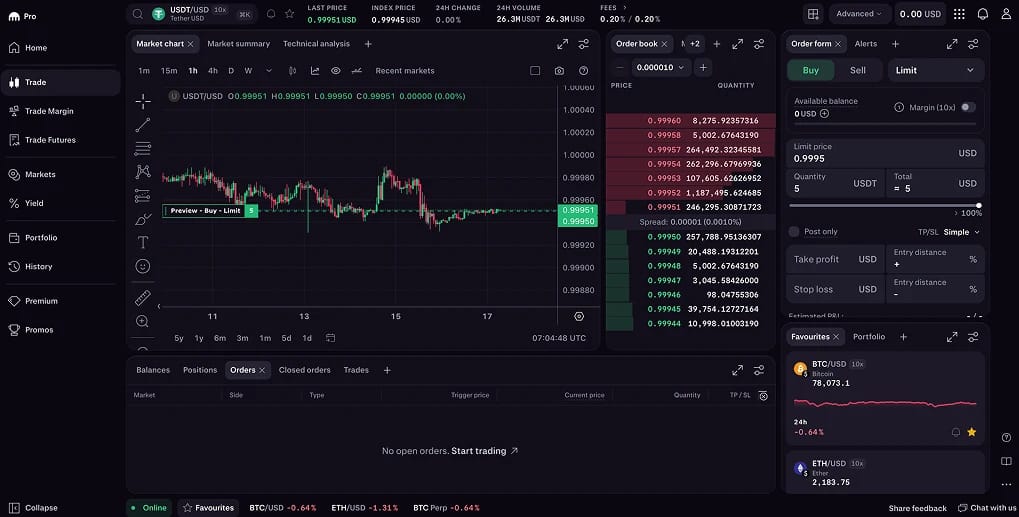
- Buy USDT: Once the funds settle, open Kraken Pro, pull up USDT/USD, and place a limit order near US$0.9998 to US$1.0002. The order fills against deep liquidity and the USDT lands ready for withdrawal.
HKD to USDT Fees
Buying USDT from an HKD balance has three cost layers: FX conversion at your bank, the SWIFT wire, and the trading fee on Kraken.
- FX conversion (HKD to USD): HK banks quote a retail spread over the interbank HKD/USD rate. HSBC and Standard Chartered run 30 to 60 pips (0.3% to 0.6%), while ZA Bank and WeLab Bank sit tighter at 10 to 20 pips. A multi-currency account makes this a one-off cost.
- Deposits: Bank Frick charges US$0 to US$5 to receive a SWIFT wire for Kraken. Your HK bank's outward TT fee is the bigger line: HK$60 via BOCHK online up to HK$200+ at an HSBC branch. Correspondent banks can clip another US$15 to US$30 in transit.
- Trading: Kraken's stablecoin and FX fee schedule opens at 0.20% maker / 0.20% taker under US$50,000 of 30-day volume, tapering to zero at VIP tiers. Kraken+ waives fees on up to US$10,000 monthly volume in major fiat.
- Withdrawals: Tron (TRC-20) costs ~1 USDT and settles in under a minute, the default for exchange transfers. Ethereum (ERC-20) runs 5 to 15 USDT depending on gas, standard for DeFi. USD SWIFT back to HK costs US$4 to US$35.
Best USDT Exchanges in Hong Kong
Several offshore platforms serve Hong Kong residents buying USDT with USD. The comparison below weighs trading fees, regulatory status, liquidity depth, and what works from an HK bank account. For a broader look at platforms available locally, see our Hong Kong exchange guide.
Hong Kong Cryptocurrency Policy and Stablecoin Ordinance
Hong Kong's crypto framework layers two regulators on purpose. Since the regime opened in June 2023, the SFC has approved 12 VATPs, with HashKey, OSL, and HKVAX leading the pack. Retail trading on these platforms is currently limited to BTC, ETH, AVAX, LINK, and any HKMA-approved stablecoins once they begin to circulate in the open market.
The Stablecoins Ordinance reshaped the rules. Any entity offering a fiat-referenced stablecoin to the HK public, including foreign issuers, needs an HKMA licence. HSBC and Anchorpoint Financial (a Standard Chartered, Animoca, and HKT joint venture) picked up the first two licences on 10 April 2026 (HKMA press release), with HKD-pegged tokens launching across H2 2026. USDT and USDC remain professional-only on SFC-licensed VATPs until that catalogue grows.
The practical read for retail: self-custody remains legal, while non-HK platforms sit outside the SFC-licensed VATP framework. Active trading on a Hong Kong VATP still runs into the professional investor threshold, which is unlikely to relax this year.
Tax Implications for USDT Trading in Hong Kong
Hong Kong has no capital gains tax, and the IRD's DIPN 39 (revised 2025) confirms that long-term personal crypto gains are not assessable. Buying USDT, holding it, and later selling for HKD or USD generally lands tax-free for retail holders.
Frequent or commercially intent trading can fail the IRD's "badges of trade" test and get reclassified as a business, which pulls profits under profits tax (8.25% on the first HK$2 million, 16.5% above). The 2025 DIPN 39 revision flagged regular DeFi activity, stablecoin arbitrage, and yield farming as likely business activity.
Hong Kong taxes only profits sourced locally, and the ING Barings precedent supports a foreign-sourced read on offshore trades. Keep seven years of records: pull Kraken trade history quarterly and log HKD or USD deposit values against your bank statements. Active strategies at scale warrant a HK tax adviser familiar with DIPN 39.
Final Thoughts
There's a real paradox for stablecoin buyers in Hong Kong. The framework here is one of Asia's most comprehensive, yet retail access to USDT specifically stays closed. Short of Tether applying for an HKMA licence (a move out of step with its global stance on stablecoin regulation), offshore remains the practical route.
Kraken stays the cleanest USD-to-USDT venue for HK residents in 2026. The stablecoin fee schedule keeps costs predictable, the USDT/USD order book is among the deepest available, and registrations across the US, UK, EU, Australia, and Canada put your funds with a counterparty that publishes proof-of-reserves and answers to multiple Tier 1 regulators.
%20(1).webp)