







Can I Buy USDT in Russia?
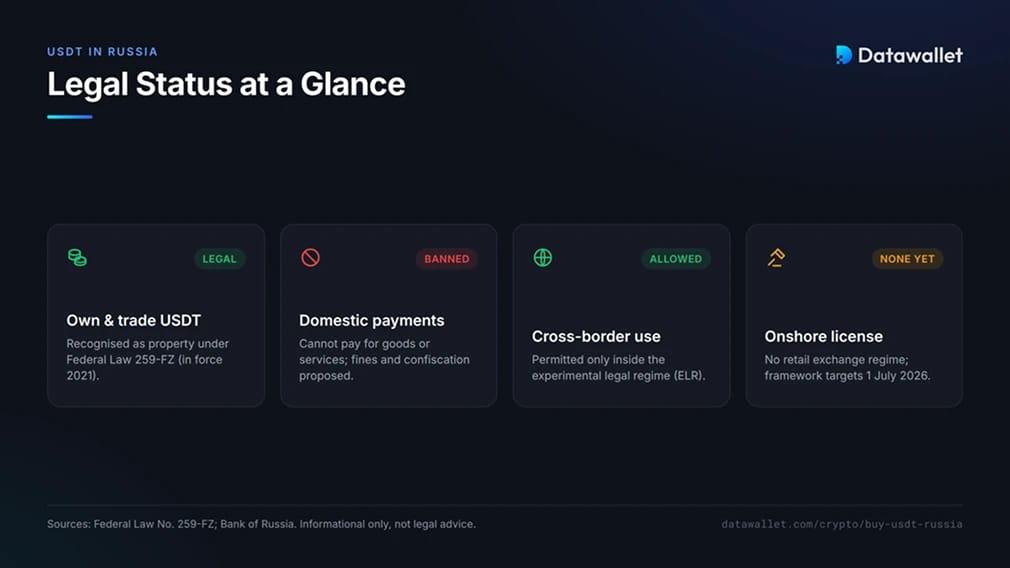
Yes. Owning and trading USDT is legal under Federal Law No. 259-FZ "On Digital Financial Assets", in force since 1 January 2021, which treats digital currency as property. Spending it on goods and services inside Russia is banned, and lawmakers have signalled fines and confiscation for anyone who tries.
There is no licensing regime for retail crypto exchanges, which shapes everything. The Bank of Russia's December 2025 framework would build a licensed market with capped retail buyers and approved intermediaries, but the legal text is not due until 1 July 2026. Until then, no platform is licensed onshore, so judge an exchange on external licensing and verifiable reserves.
Funding is the second constraint. Visa and Mastercard cut cross-border processing for Russian-issued cards in March 2022, and Russian banks are off SWIFT, which kills the one-click card buy. That leaves P2P over domestic rails, through SBP and banks like Sberbank and T-Bank, as the only realistic on-ramp.
Domestic platforms carry their own risk. Garantex, once Russia's largest exchange, halted in March 2025 after the EU sanctioned it and Tether froze about $28 million of its USDT, stranding balances, and its successor Grinex suspended operations in April 2026. Keep USDT on a globally credible venue and move it to a wallet you control, never a sanctioned domestic platform.
How to Buy Tether (USDT) in Russia
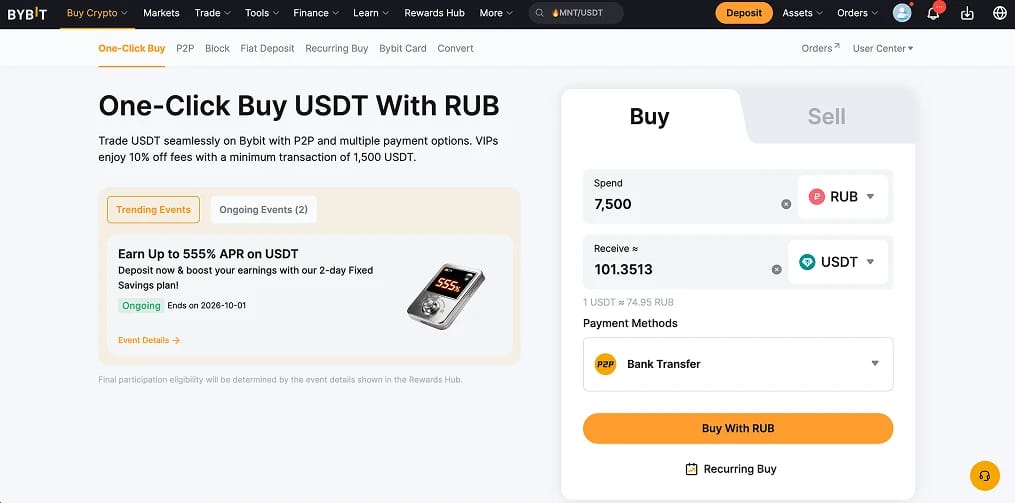
The clean setup is a Bybit account funded through P2P, with rubles sent over SBP or a direct transfer from T-Bank or Sberbank. The site opens from Russia without a VPN, KYC clears on a Russian passport, and spot, P2P, and futures are all live.
The first time I tested a T-Bank transfer, I typed "USDT" in the payment comment. My order cleared, but a friend who did the same on a larger Sberbank transfer had his card frozen for review within a week. I now leave the comment blank on every P2P payment and only send from an account in my own name, after a transfer from a family member's card got cancelled and refunded three days later.
Steps to buy USDT on Bybit in Russia:
- Create a Bybit account. Sign up at Bybit and complete KYC with your Russian passport. Verification usually clears within 20 minutes and unlocks P2P plus higher withdrawal limits. The interface and support are in Russian.
- Open the P2P market. Select Buy Crypto, then P2P Trading. Set the asset to USDT and fiat to RUB. Filter sellers by completion rate above 98% and at least 500 completed orders, then pick a payment method you already hold, such as SBP, T-Bank, or Sberbank.
- Place your order. Enter the USDT amount and confirm. The seller's USDT moves into Bybit escrow immediately and their bank details appear on the order screen. That escrow is what protects you in a dispute.
- Send RUB and confirm. Pay the exact amount through your bank app or SBP, leaving the payment note blank and sending only from an account in your own name. Mark the order paid, upload the receipt, and the seller releases USDT to your Funding Account within minutes.
Keep first orders modest. Clustered P2P transfers are exactly what Russian banks flag, so a slow, clean test beats a large opening trade.
RUB to USDT Fees
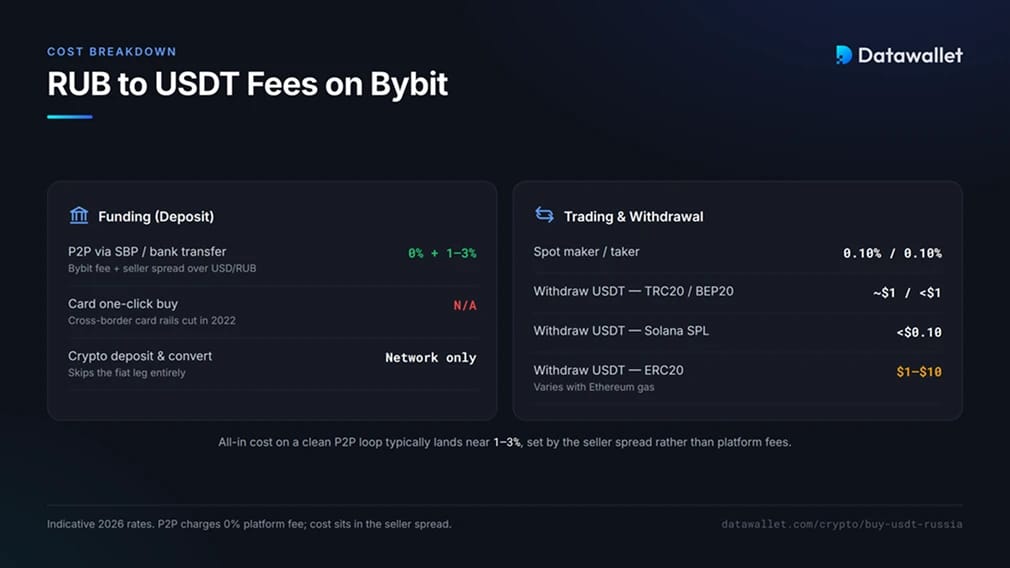
Bybit charges zero P2P fees on both sides. Your real cost is the seller's spread over the live USD/RUB rate, which runs wider here than in most markets because of sanctions friction in dollar pricing.
Deposits
- P2P via SBP or bank transfer (recommended): 0% Bybit fee. The cost is the seller's spread over the USD/RUB mid rate, typically 1% to 3% depending on the bank and time of day, with the tightest fills during weekday banking hours. SBP transfers between Russian accounts are instant and free for most retail users.
- Card one-click buy: not realistically available. Cross-border processing for Russian-issued Visa and Mastercard ended in March 2022, and foreign cards do not onboard. Russian Visa, Mastercard, and MIR cards work only for domestic transfers, which is the seller's side of a P2P trade, not Bybit's card processor.
- Crypto deposit and convert: sending USDT in from another wallet skips the fiat leg entirely. Only the network fee below applies.
Trading and Conversion
- Spot maker/taker on Bybit: 0.10%/0.10% baseline, with VIP and token-holding discounts.
- USDT withdrawal network fees: TRC20 around $1, BEP20 under $1, Solana SPL under $0.10, Arbitrum and Polygon $0.10 to $0.50, ERC20 $1 to $10 depending on Ethereum gas. Check live Ethereum costs on the Datawallet gas tracker before sending an ERC20 transfer.
Off-Ramp Back to RUB
Selling USDT back to rubles mirrors the buy side: a P2P buyer sends RUB to your bank, you confirm receipt, and Bybit releases your USDT from escrow. This is the highest-risk leg for account freezes, since incoming P2P payments from different senders are the exact signature banks screen for under 115-FZ. Keep off-ramp volumes moderate and spaced out, and never push the full amount straight onward.
Best USDT Exchanges in Russia
The table below ranks the top crypto exchanges in Russia for USDT, weighted on RUB funding access, P2P depth, fees, reserves transparency, and reliability for users on domestically issued cards.
The practical hierarchy in 2026 is Bybit for the deepest RUB P2P and the strongest licensing and reserves profile, MEXC for altcoin range and low fees, and Gate or KuCoin for broader P2P payment coverage. Verify proof of reserves and run a small test trade before sizing up.
Regulatory Status of USDT in Russia
Russia's framework rests on Law No. 259-FZ (2020) and the tax and mining laws of late 2024. Crypto is legal to own, trade, mine, and use for cross-border settlement under a controlled experiment, but banned for domestic payment.
A July 2024 law legalised crypto for cross-border trade settlement under an "experimental legal regime" (ELR), effective September, and mining was legalised that November. In March 2025 the Bank of Russia opened the ELR to limited trading by qualified investors, a state-run exchange for super-qualified investors followed in April, and the foreign-trade pilot began in September.
Five authorities share oversight:
Enforcement is the real risk. Since mid-May 2025, banks can cap monthly transfers at 100,000 rubles and block online access for any card in the CBR's dropper database, which analysts say often catches ordinary P2P traders, and a September 2025 rule lets them cap suspicious ATM withdrawals at 50,000 rubles for 48 hours. With the CBR flagging crypto exchangers as "shadow businesses," buying USDT stays legal but the banking layer is where things go wrong.
Tax Implications of USDT in Russia
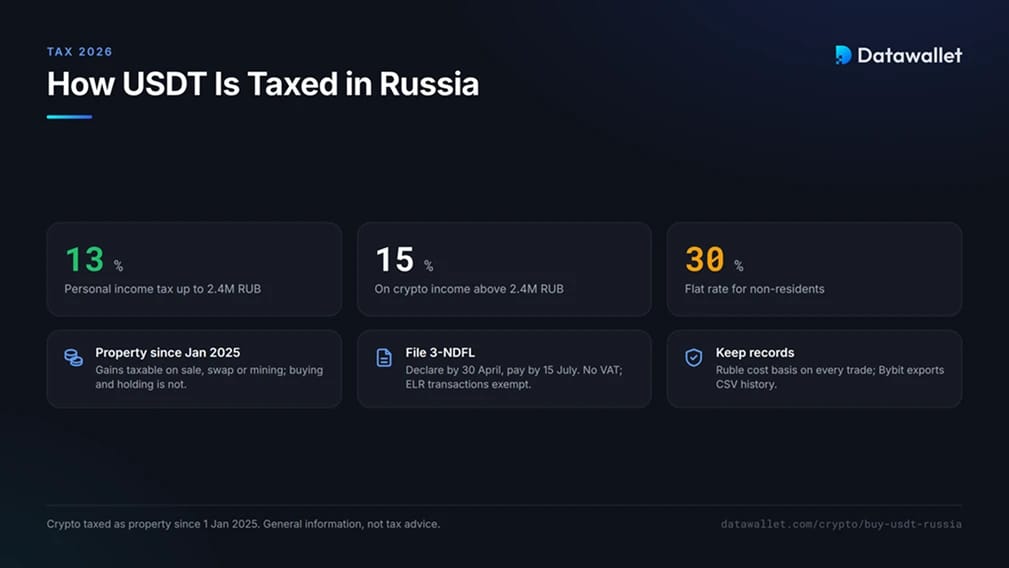
Russia recognised crypto as property in the Tax Code from 1 January 2025, so gains are taxable and reportable. The structure is defined, even if enforcement on small retail trades is still uneven.
- Personal income tax is two-tier. Individuals pay 13% on annual income up to 2.4 million rubles and 15% above that threshold, with crypto gains folded into the same base as securities income. The taxable amount is the positive difference between sale value and acquisition cost in rubles.
- Crypto is taxed when you realise a gain. Selling USDT for rubles, swapping it for another crypto, or receiving it as mining income are taxable events. Buying and holding is not.
- Mining income is taxed in kind. It is assessed at market value when the coins arrive, then again on disposal, and operators using more than 6,000 kWh per month must register and report quarterly or face fines.
- No VAT applies to crypto trades or mining, and transactions inside the ELR are exempt.
- Reporting runs through the 3-NDFL return. File by 30 April and pay by 15 July. Non-residents are assessed at a flat 30% on Russia-source income, and large-scale unreported holdings can escalate to criminal exposure.
💡 For active users: Bybit provides downloadable CSV trade history that maps onto a 3-NDFL filing. Keep ruble-denominated records of every buy, sell, and swap, track cost basis consistently, and speak to a Russian tax specialist familiar with the 2025 property rules before scaling beyond casual trading. This is general information, not tax advice.
Why Russians Use USDT
USDT demand in Russia tracks pressures the financial system handles poorly under sanctions. Which one applies to you decides whether the banking friction is worth it.
- Dollar access and ruble hedge. The ruble weakened past 100 to the dollar in late 2024, and opening a USD bank account under sanctions is slow and limited. USDT is the cheapest dollar-pegged asset a resident can hold without a foreign account, which is why local adoption skews heavily toward stablecoins over volatile crypto.
- Cross-border trade and payments. With SWIFT access cut and card networks gone, USDT has become the workhorse for moving value across borders, and the ELR gives businesses a legal channel for foreign-trade settlement. The CBR itself reported crypto flows linked to Russian residents reaching 7.3 trillion rubles, roughly $91 billion, across late 2024 and early 2025, up more than 50% on the prior period.
- Remittances. Stablecoin transfers clear faster and cheaper than the traditional rails that have narrowed for Russian senders and recipients, especially for cross-border family support.
- Trading base currency. Almost every non-RUB pair on global exchanges is quoted in USDT, so it is the entry point for trading beyond a handful of major coins.
- Yield. Centralised exchange earn products on USDT typically quote 4% to 8% APY for flexible deposits, a real-terms premium once you adjust ruble deposit rates for currency risk.
USDT mostly solves problems sanctions created, which is also why it draws scrutiny: the same rails carry legitimate users and illicit flows. A Russian buyer carries more compliance weight per trade than almost anyone else.
Final Thoughts
Bybit is the working answer for Russian USDT buyers in 2026. With no onshore licensing to lean on, the best safety proxy is a platform with deep RUB P2P, a Russian interface, monthly Hacken-audited Proof of Reserves, broad external licensing, and a record of restoring funds under stress, as it did within 72 hours of the February 2025 hack. Russians use the global platform, not the EU entity, so read those licenses as a credibility signal rather than local protection.
The playbook is simple: open a Bybit account, complete KYC, run a small first P2P trade through SBP to learn the bank mechanics, leave payment notes blank, send only from your own name, and withdraw USDT to a wallet you control. Keep ruble records for the 3-NDFL filing.
The rules should firm up over 2026 as the Bank of Russia's July framework takes shape. Until then, a globally credible venue plus disciplined P2P hygiene is the most defensible setup a Russian buyer can run.
.webp)