







Can I Buy USDT in Taiwan?
Yes. Individuals are not restricted from buying, holding, or selling USDT. Taiwan treats the token as a digital asset rather than legal tender, with regulatory obligations falling on the platforms that provide virtual asset services.
Article 6 of the Money Laundering Control Act requires these businesses to complete AML registration with the FSC before operating in Taiwan. A provider that serves customers without registration can expose its operator to up to two years in prison.
Nine companies have satisfied the requirement, including BitoPro, XREX, and Modernity Financial Technologies, the operator of MAX. Only companies incorporated in Taiwan may register, which explains why global exchanges are absent from the list. Bybit, OKX, and Binance serve Taiwanese users from offshore without a local entity or direct TWD banking channel.
When we tested the process from Taipei, the practical issue was finding a legal destination for our TWD. A registered local platform provided that entry point. From there, we could transfer stablecoins or use peer-to-peer trading to access global exchanges.
How to Buy Tether (USDT) in Taiwan
Our setup uses an FSC-registered exchange to handle the TWD deposit, followed by a Bybit account for trading. MAX stores customer TWD in a dedicated trust account at Far Eastern International Bank. BitoPro has an equivalent bank trust arrangement, meaning deposited dollars remain with a bank rather than on the exchange's balance sheet.
Steps to buy USDT in Taiwan:
- Verify on a registered local exchange: Create an account with MAX or BitoPro. Taiwanese citizens can verify with a national ID, while foreign residents need a passport and Alien Resident Certificate. You must then bind a Taiwanese bank account held in your own name. Transfers from another person's account will be rejected.
- Deposit TWD by domestic bank transfer: Your exchange will issue a personal virtual account number at its trust bank. Send TWD from the bound account using a Taiwanese e-banking app. During banking hours, the funds typically appear within minutes.
- Buy USDT on the USDT/TWD order book: USDT/TWD has the highest trading volume on both MAX and BitoPro. A limit order placed near the best ask should therefore fill quickly. Our tests found spreads of 0.1% to 0.3%, with the tightest pricing during Asian trading hours.
- Open Bybit and transfer the USDT across: Complete identity and selfie verification at Bybit, then copy the USDT deposit address for the Tron network. Withdraw from the local exchange using TRC-20. Transfers generally arrive within minutes and cost about 1 USDT.
- Trade, earn, or move to self-custody: Once the funds reach Bybit, you can access its spot markets and earn products. USDT intended for long-term storage should be moved to a USDT wallet that you control.
Bybit's P2P marketplace offers a shorter route. Sellers quote USDT against TWD, and buyers pay by domestic bank transfer. The tokens remain in escrow until the seller confirms receipt. This method avoids the local exchange step, but you are transferring money to a stranger's bank account. Check that the counterparty name matches exactly, and do not trade with sellers who ask you to include crypto-related wording in the payment notes.
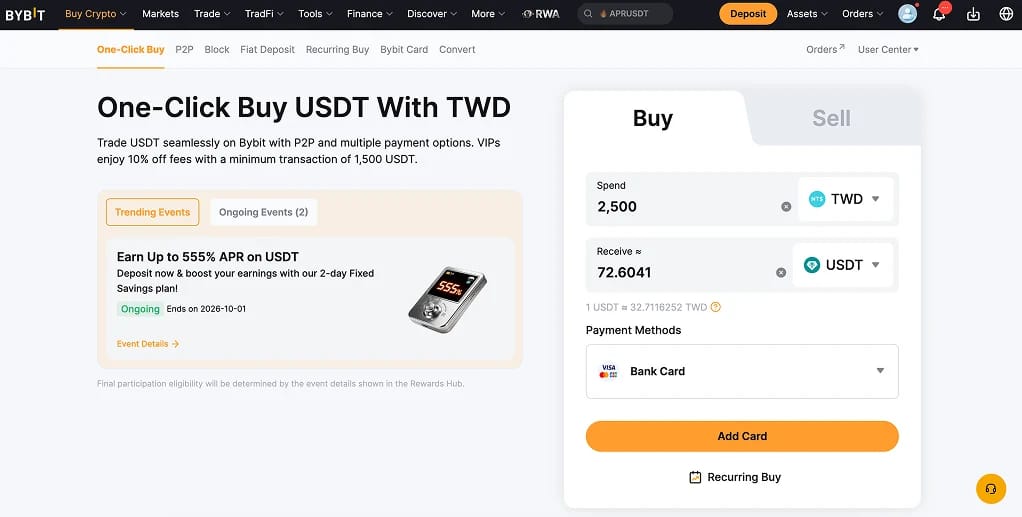
TWD to USDT Fees
The total cost consists of funding, trading, and withdrawal charges. How you deposit the TWD usually has the greatest effect on the final amount.
Deposits
- Local exchange bank transfer (recommended): The exchange does not charge for the deposit. Your bank may apply a standard interbank transfer fee of around NT$15, making this the cheapest funding method.
- Bybit P2P: Bybit charges no platform fee, but sellers build their costs into the quoted exchange rate. Compare several offers with the current MAX order book price, particularly during quieter hours when premiums tend to widen.
- Card purchases on global exchanges: Total costs are roughly 2% to 4%. Many Taiwanese card issuers also decline transactions with crypto merchants, so cards are best kept as a fallback.
Trading
- Local exchange order books: MAX charges 0.08% maker and 0.16% taker. BitoPro's base tier charges 0.1% maker and 0.2% taker. Both exchanges offer discounts to users who hold their platform tokens.
- Bybit spot: Standard maker and taker fees are both 0.10%, with lower rates available at higher volume tiers. Limit orders also avoid the extra spread that can come with instant conversion tools.
Withdrawals
- USDT off the local exchange: Tron (TRC-20) withdrawals cost about 1 USDT and usually confirm in under a minute. Ethereum (ERC-20) is suitable for DeFi destinations, although its cost varies with network gas prices. Where supported, Solana transfers cost less than US$0.10.
- Back to TWD: Sell the tokens through the USDT/TWD order book and withdraw the proceeds to your bound bank account. MAX and BitoPro each charge a small flat TWD withdrawal fee. Funds generally arrive on the same business day.
Our full round trip from TWD into USDT on MAX, across to Bybit, and back to TWD cost less than 1%, excluding market movements.
Best USDT Exchanges in Taiwan
Our ranking considers TWD access, regulatory standing, fees, and USDT liquidity for Taiwanese buyers. Those criteria place the two registered local platforms above several larger offshore exchanges. For a broader comparison, see our guide to the best crypto exchanges in Taiwan.
In practice, use a registered local exchange for inexpensive TWD deposits and withdrawals. Move the USDT to Bybit when you need deeper liquidity or a wider product range. OKX and Binance work as secondary offshore venues when a particular asset is unavailable elsewhere.
Regulatory Status of USDT in Taiwan
Taiwan is replacing its registration-based framework with a full licensing regime. Buyers should understand the roles of four authorities during the transition.
The Virtual Asset Service Act introduces seven categories of service providers, all requiring FSC licensing. Existing AML-registered firms will have a transition period to comply, while stablecoin issuers must meet reserve and audit requirements.
For users, nothing changes in practice: USDT remains freely tradable through registered exchanges and private wallets, and USDT/TWD is still the most active trading pair on MAX and BitoPro.
Bybit operates entirely under foreign licences, including authorisation in Austria under MiCA, a UAE VARA licence, and registration with India’s FIU. It is not supervised by Taiwanese regulators, and Taiwan is not on its restricted list.
Tax Implications of USDT in Taiwan
Taiwan has not introduced a crypto-specific tax law. USDT is therefore taxed under existing income tax rules, which are more favourable than many traders expect. Offshore balances create the main complication.
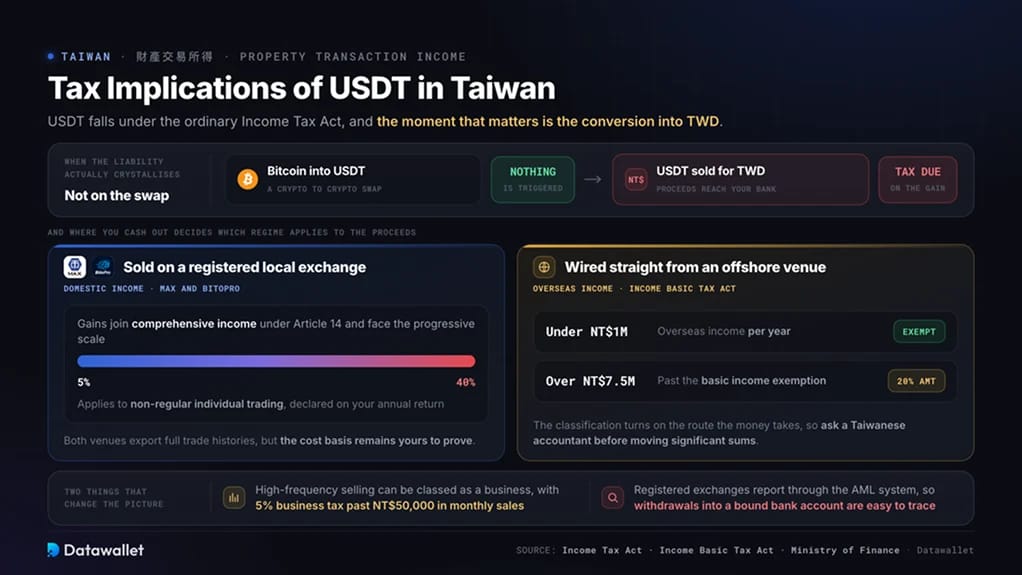
- Gains are income from property transactions: The Ministry of Finance treats profits from non-regular individual trading as property transaction income under Article 14 of the Income Tax Act. Gains form part of comprehensive income and face progressive tax rates ranging from 5% to 40%.
- Tax crystallises when crypto becomes cash: Under current practice, swapping Bitcoin into USDT triggers nothing. Tax becomes due when the assets are converted into TWD and the proceeds reach your bank account. A stablecoin balance may consequently remain untaxed for years.
- Where you cash out decides the tax regime: Proceeds sold through MAX or BitoPro count as domestic income on your comprehensive return. If the money is wired directly from an offshore exchange, it becomes overseas income under the Income Basic Tax Act. Overseas income below NT$1 million per year is exempt. Above an NT$7.5 million basic income exemption, it counts toward a 20% alternative minimum tax.
- Trading at commercial scale changes everything: Regular, high-frequency selling may be classified as a business. This introduces 5% business tax registration once monthly sales exceed NT$50,000, with profit-seeking income treatment applied to the gains.
- Enforcement is tightening: The ministry has told lawmakers that it plans to strengthen crypto audit mechanisms. Registered local exchanges already report through the AML system, making undeclared withdrawals into bound bank accounts relatively easy for the tax office to identify.
💡 For active users: Maintain TWD-denominated records for every purchase, sale, and transfer. Local exchanges provide full transaction exports, but the responsibility for establishing cost basis remains with you. Before moving significant amounts through offshore platforms, ask a Taiwanese accountant whether the proceeds will be treated as domestic or overseas income. This is general information, not tax advice.
Why Taiwanese Investors Hold USDT
Taiwan has one of the world's strongest external positions, so investors use USDT differently from buyers in weak-currency economies.
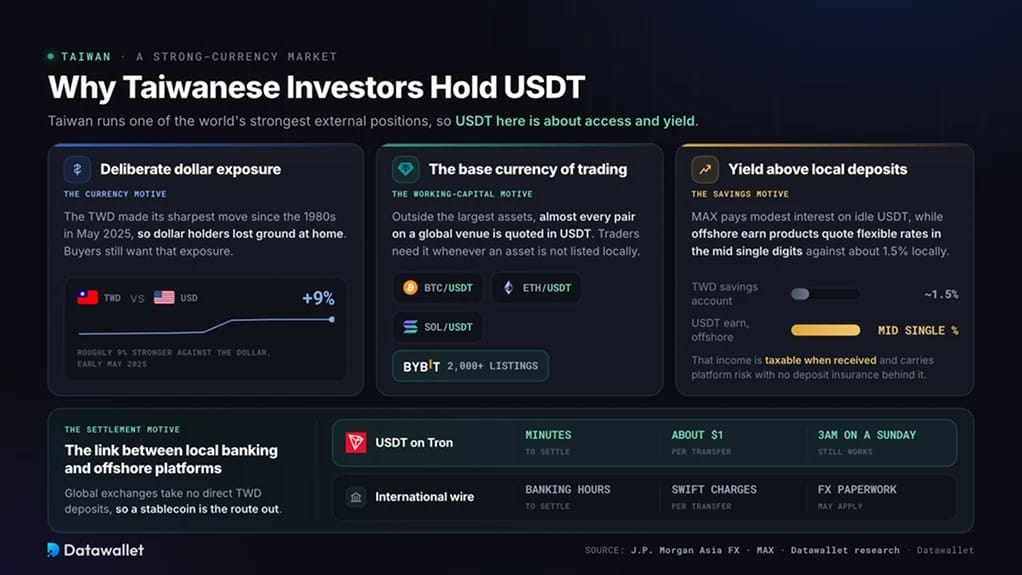
- Deliberate US dollar exposure: The TWD jumped roughly 9% against the dollar in early May 2025, marking its sharpest move since the 1980s as life insurers rushed to hedge their US holdings. USDT holders lost purchasing power in TWD terms during that move. Many buyers since then have sought precisely that dollar exposure while the local currency remains expensive.
- The base currency of global trading: Most crypto pairs outside the largest assets are quoted in USDT, at a circulating scale detailed on our Tether statistics page. Taiwanese traders need USDT as working capital when an asset is not available on MAX or BitoPro.
- The link between local banking and offshore platforms: Global exchanges do not accept direct TWD deposits, leaving USDT as the practical route between local banks and offshore markets. A TRC-20 transfer can settle at 3am on a Sunday for about one dollar. International wires must wait for banking hours and may involve SWIFT charges or foreign exchange paperwork.
- Yield above local deposit rates: MAX pays modest interest on idle USDT. Offshore earn products offer flexible rates in the mid single digits, compared with TWD savings rates of around 1.5%. That income is taxable when received and exposes the holder to platform risk. Our guide to USDT yield opportunities examines those trade-offs in detail.
The same pattern appears elsewhere in the region, but local rules differ substantially. Our guides to buying USDT in Hong Kong and Japan explain how two neighbouring regulators approach the token.
Final Thoughts
We recommend Bybit once a Taiwanese buyer has deposited TWD through a registered local exchange. This setup combines FSC-supervised, trust-held TWD funding with access to the deepest USDT markets in crypto. The incoming licensing framework does not currently disrupt that arrangement. Our complete Bybit review covers the exchange in more detail.
Bybit is accountable to regulators in Vienna, Abu Dhabi, and Dubai rather than Taipei. Any dispute with the platform would therefore be handled under foreign rules. The exchange also suffered a US$1.5 billion theft by North Korea's Lazarus Group in February 2025, yet covered every customer balance within days. That recovery still supports keeping only active trading capital on any exchange.
The next development to watch is the commencement date for the Virtual Asset Service Act. Once licensing begins, the divide between registered Taiwanese platforms and offshore exchanges could become more rigid. It could also narrow sharply if global companies apply through local entities.
Until then, a two-account setup remains the cheapest and cleanest way to convert TWD into Tether.
.webp)