



Can I Buy Tether (USDT) in Vietnam?
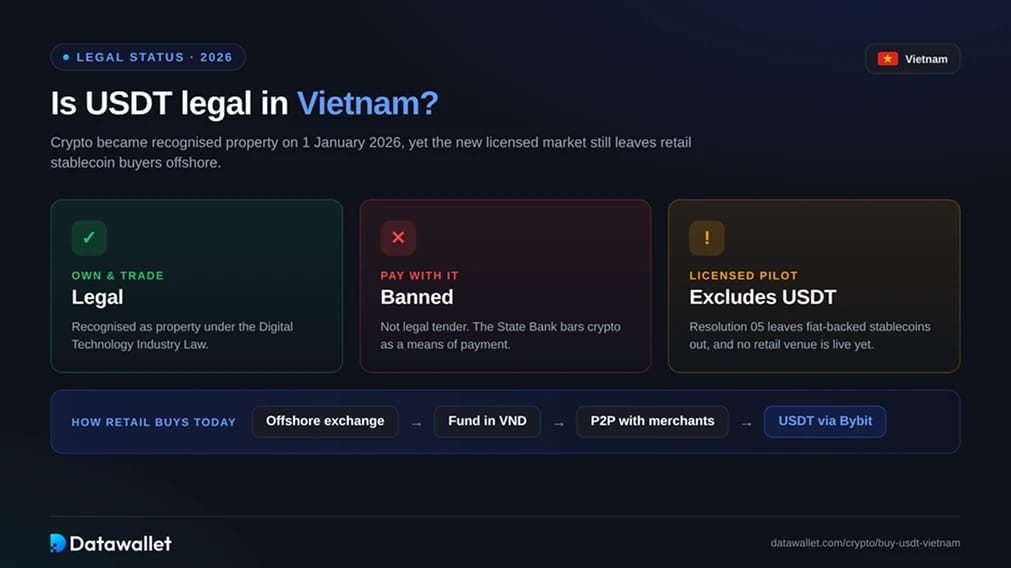
Yes. Buying, holding, and trading Tether (USDT) is legal under the Law on Digital Technology Industry, effective 1 January 2026, which recognised crypto assets as property for the first time in Vietnamese law. Crypto is not legal tender, and the State Bank of Vietnam still bans it for payments, but ownership and trading now stand on firm legal ground.
The market created by Resolution No. 05/2025/NQ-CP is a five-year pilot for licensed institutions, and its definition of a "crypto asset" excludes digital forms of fiat currency, leaving stablecoins like USDT in a grey area. The bar is steep too: about VND 10 trillion (US$400 million) in charter capital, and no more than five licensees during the pilot.
So the everyday method has not changed: open a global exchange, fund it with dong, and trade P2P with verified merchants. In my own test, the buy settled in under ten minutes. The catch is that this is on borrowed time, since Vietnam has signalled it will restrict overseas trading once domestic venues go live, giving residents six months to migrate.
How to Buy USDT in Vietnam
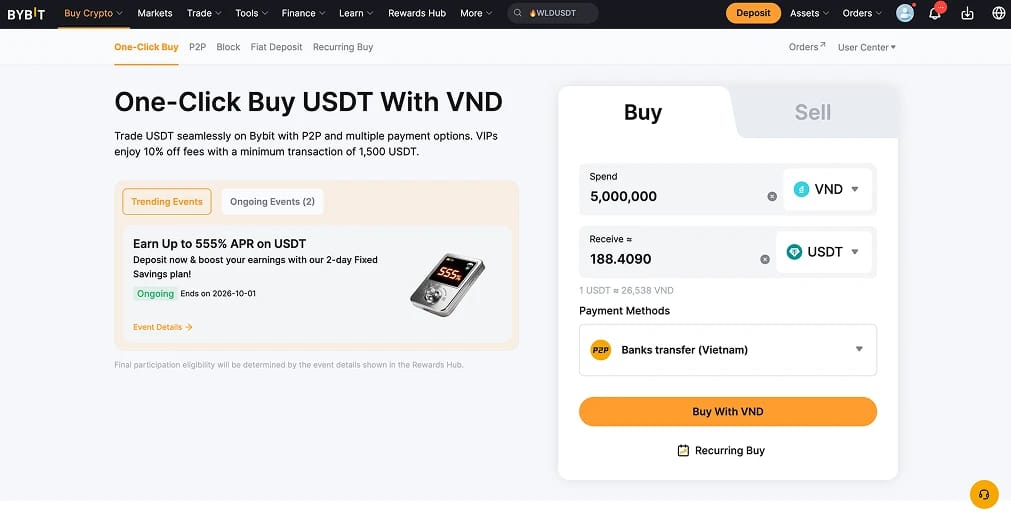
The setup is a verified Bybit account plus a Vietnamese bank account or e-wallet, buying USDT on the P2P market. Bybit runs a live USDT/VND P2P book with hundreds of merchant offers and holds both sides in escrow until each confirms.
One detail trips up newcomers: your Bybit profile name must match your bank account name exactly. Vietnamese banks reject transfers where the sender and account-holder names differ, and a mismatch is the top reason a P2P order stalls.
Steps to buy USDT on Bybit via VND P2P:
- Create and verify a Bybit account. Sign up at Bybit and complete KYC with your CCCD chip ID or passport. Verification usually clears within an hour and is required before P2P trading.
- Add a VND payment method. In P2P settings, add your bank (Vietcombank, Techcombank, MB Bank, ACB, BIDV, and VietinBank are all widely accepted) or an e-wallet like MoMo or ZaloPay, with the account name exactly as your bank holds it.
- Open the P2P market and filter. Select Buy, set the asset to USDT and currency to VND, then sort merchants by completion rate and 30-day order count. I use merchants above 98% completion with several hundred orders, which removes nearly all friction.
- Pay the merchant directly. Place the order and send the exact VND amount via VietQR or a standard Napas 24/7 transfer. Leave the reference blank or neutral, since words like "USDT" or "crypto" in the memo can get a payment flagged or held. Screenshot the confirmation.
- Confirm and receive USDT. Mark the order paid, upload your screenshot, and the merchant releases USDT to your Bybit Funding account once the dong lands, usually within minutes.
Timing note: spreads tighten when the most merchants are online, roughly Vietnamese banking hours. Late at night and on public holidays, fewer merchants are active and the rate drifts wider, so size a larger first order during the day.
VND to USDT Fees
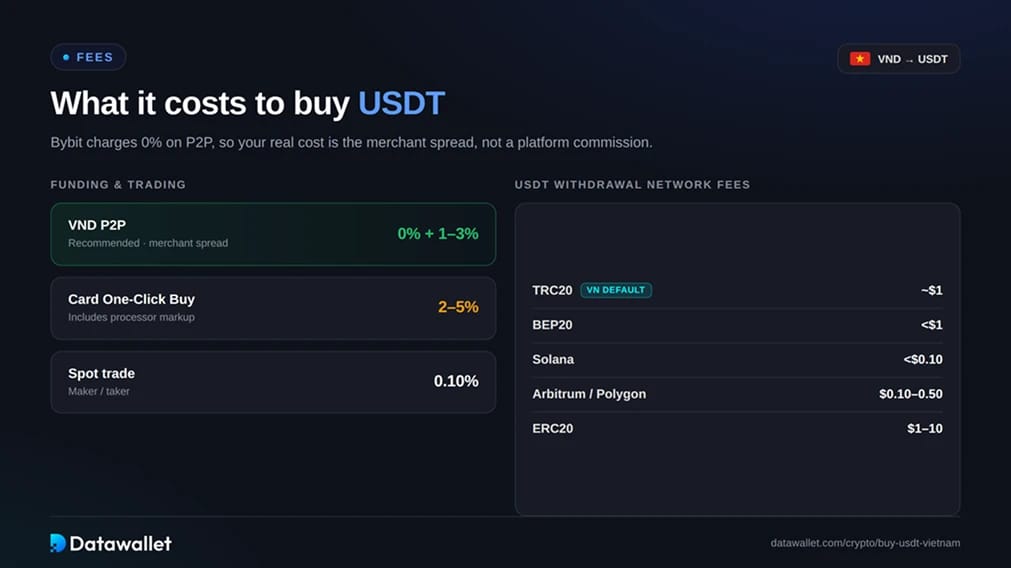
Bybit charges no P2P fee on either side, so the real cost is the merchant's spread against the live USDT rate, not a platform commission. Knowing where each cost sits keeps a round trip cheap.
Deposits and Purchases
- VND P2P (recommended): 0% Bybit fee. You absorb the merchant spread, which has run about 1% to 3% over mid-market depending on size and time of day. Most offers carry no minimum.
- One-Click Buy via card: roughly 2% to 5% all-in with the processor markup. Handy for small, fast buys, though Vietnamese card issuers sometimes decline crypto-flagged transactions.
- Crypto deposit and convert: Sending in USDT from another wallet skips the dong leg, leaving only the network fee.
Trading and Withdrawals
- Spot Maker/Taker: 0.10% / 0.10% baseline, lower with VIP tiers and fee discounts.
- USDT withdrawal network fees: TRC20 around $1, BEP20 under $1, Solana SPL under $0.10, Arbitrum and Polygon $0.10 to $0.50, ERC20 $1 to $10 depending on Ethereum gas. TRC20 is the Vietnamese default: cheap and accepted by every local merchant and recipient.
Off-Ramp Back to VND
Selling mirrors buying. You take or list a sell offer, the merchant sends VND to your bank or e-wallet, you confirm, and Bybit releases your USDT from escrow. A full round trip usually costs under 3% in spread during regular hours, well below what Vietnamese banks charge on an equivalent inbound international transfer.
Best USDT Exchanges in Vietnam
The table below ranks the top crypto exchanges in Vietnam for USDT, weighted on VND P2P liquidity, licensing credentials, fees, and operational reliability.
The 2026 hierarchy: Bybit for licensing plus clean P2P mechanics, Binance for the largest VND merchant pool and tightest spreads at scale, then OKX, Bitget, or Gate as a second venue or for a wider asset list.
Regulatory Status of USDT in Vietnam
Vietnam moved from a decade-long grey area to a defined framework almost overnight, on two instruments working together. How they treat USDT specifically matters more here than in most markets.
The Law on Digital Technology Industry recognised crypto assets as property and split them into virtual assets and crypto assets, neither including securities or digital fiat currency. Resolution No. 05/2025/NQ-CP then launched the pilot, capping foreign ownership of licensed operators at 49%, requiring foreign investors to settle through a single VND account at a licensed bank, and giving domestic investors six months from the first licence to move trading onto licensed systems.
For USDT, the definition is decisive. Because the framework excludes digital forms of fiat currency from the tradeable category, fiat-backed stablecoins are not what the licensed venues are built to handle. So the pilot, however significant, has little immediate bearing on the typical Vietnamese USDT buyer, who still transacts offshore.
Bybit's own credentials carry the weight here: a MiCA licence from Austria's Financial Market Authority passported across the EEA, the first full UAE platform-operator licence, and registrations with the AFSA in Kazakhstan, the National Bank of Georgia, and India's FIU. It also publishes monthly proof-of-reserves and recovered from a major 2025 hack with no user losses, a record no unregulated P2P venue can match.
Tax Implications of USDT in Vietnam
Vietnam's crypto tax rules are still being written, so treat them as directional.
- Pilot transactions follow securities tax rules for now. During the pilot, crypto-asset transactions are taxed under the rules for securities, meaning a transaction-based levy on each sale rather than a clean capital-gains calculation.
- A draft design has surfaced. Regulators floated a 2% VAT plus a 0.1% transaction tax on crypto trades, with detailed guidance due through 2026. Treat the rates as provisional until the implementing documents publish.
- Offshore activity is not invisible. P2P income on a global exchange is still assessable in Vietnam, and your VND transfers leave a banking trail wherever the exchange sits. Do not assume offshore trades are untraceable.
- Keep clean records. Bybit exports full trade history for filing. With the framework shifting, a tidy log of every buy, sell, and conversion is the most useful step you can take now.
A Vietnam-licensed tax adviser is worth consulting before you scale beyond casual amounts. This is general information, not tax advice.
Why Vietnamese Hold USDT
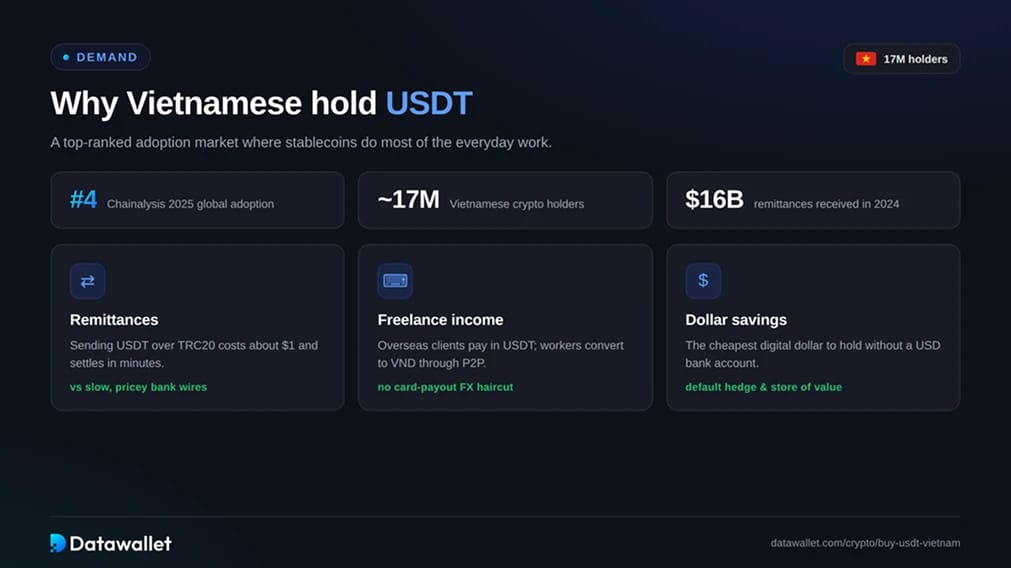
USDT demand in Vietnam runs deep and tracks three practical drivers. Vietnam ranks fourth on the Chainalysis 2025 crypto adoption index, with an estimated 17 million holders, and stablecoins do most of the work.
- Remittances. Vietnam received about US$16 billion in remittances in 2024, and a growing share moves through stablecoins. USDT over TRC20 costs roughly $1 and settles in minutes, against the slower, pricier path of a bank wire.
- Freelance and cross-border income. Vietnam has one of Southeast Asia's largest pools of freelancers and outsourced tech workers paid by overseas clients. Taking USDT and converting to VND via P2P avoids the FX haircut and delays of card payout platforms.
- Dollar access and savings. Vietnamese households have long held value in dollars. USDT is the cheapest digital dollar to hold without a USD bank account, making it a default savings and hedging tool for a mobile-banking generation.
For anyone touching one of these, the offshore Bybit P2P setup is the lowest-friction option in 2026, with the standing caveat that the ground is still shifting.
Final Thoughts
Bybit is the working answer for Vietnamese USDT buyers today. It pairs the deepest practical VND P2P liquidity within reach with the strongest international licensing record available to them, and charges nothing on P2P. Binance is the natural second venue, with the largest local merchant pool and very tight spreads at size.
The playbook: open and verify a Bybit account, add a Vietnamese bank or e-wallet with a matching name, run a small first P2P order during banking hours, and keep records for tax. Use TRC20 for cheap transfers, and never put crypto terms in your bank memo.
The wider point is that Vietnam's framework is mid-transition. The pilot is real but institutional, USDT sits outside its core scope as a fiat-backed stablecoin, and the government has flagged that offshore access will tighten once domestic venues open. None of that changes how you buy USDT today, but watch it, because the legal route a year out may differ from the one nearly everyone uses in 2026.