




What is Firedancer?
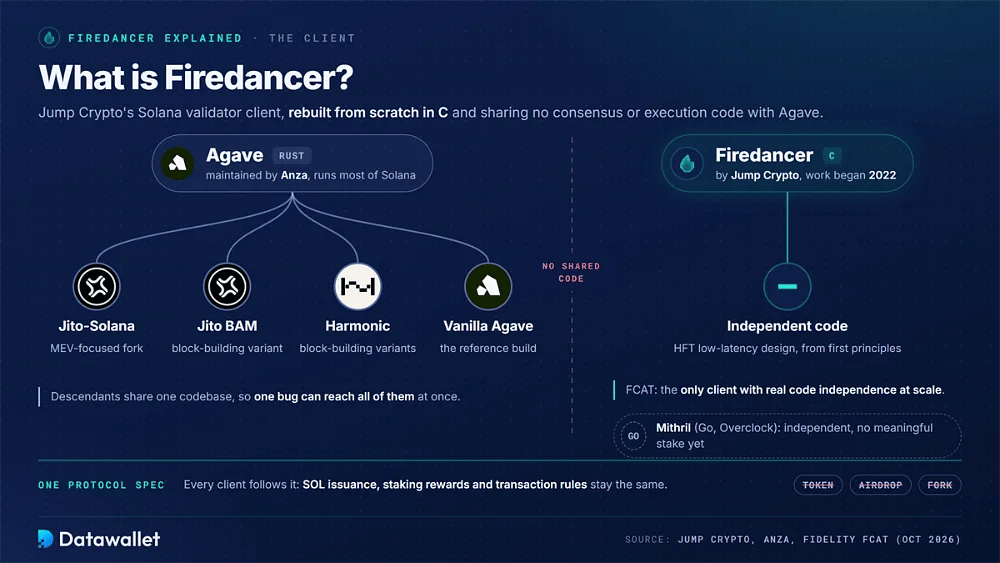
Firedancer is a validator client for Solana developed by Jump Crypto, the blockchain division of Jump Trading Group. A validator client is the software a node runs to receive transactions, execute them, build blocks and vote on the chain's state, so its design directly shapes how fast and how reliably Solana operates.
Work started in 2022 with an unusual brief. Rather than fork the existing Rust software, Jump's engineers rebuilt the validator from first principles in C, borrowing the low-latency techniques its trading desks use. The result shares no consensus or execution code with other Solana clients, which is precisely what makes it valuable.
Most of Solana still runs on descendants of Agave, the client maintained by Anza, including Jito's MEV-focused fork and Harmonic's block-building variants. Fidelity's research unit counts Firedancer as the only client offering genuine code independence at scale, with Overclock's Go-based Mithril client still lacking meaningful mainnet stake.
Firedancer is not a token, an airdrop or a protocol fork. It leaves SOL issuance, staking rewards and transaction rules untouched, because every client must follow the same protocol specification. What changes is how efficiently a validator does its job, and how independently it can fail.
How Does Firedancer Work?
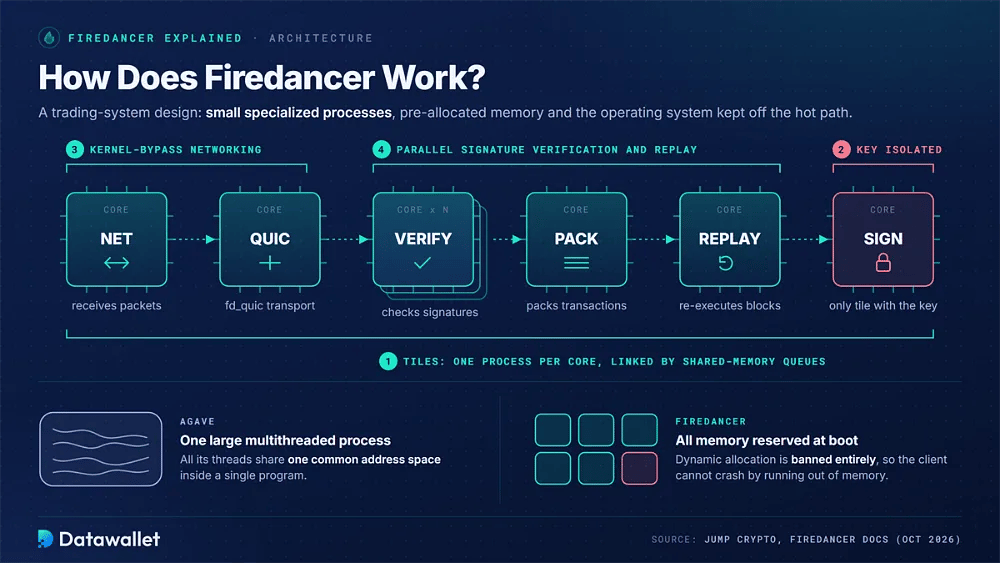
Firedancer borrows its design from high-frequency trading systems: split the work into small specialized processes, keep data in pre-allocated memory, and remove the operating system from the hot path. Four engineering choices do most of the work.
1. Tile-Based Architecture
Firedancer divides the validator into independent processes called tiles, each responsible for one stage such as receiving packets, verifying signatures, packing transactions, replaying blocks or signing. Each tile typically owns a dedicated CPU core and passes messages to its neighbors through shared-memory queues rather than locks or system calls.
All memory is reserved at boot, and Jump's security write-up notes that dynamic allocation is banned entirely. That removes a whole class of allocation bugs and means the validator cannot crash by running out of memory. Agave, by contrast, runs as one large multithreaded process sharing a common address space.
2. Sandboxed Security Model
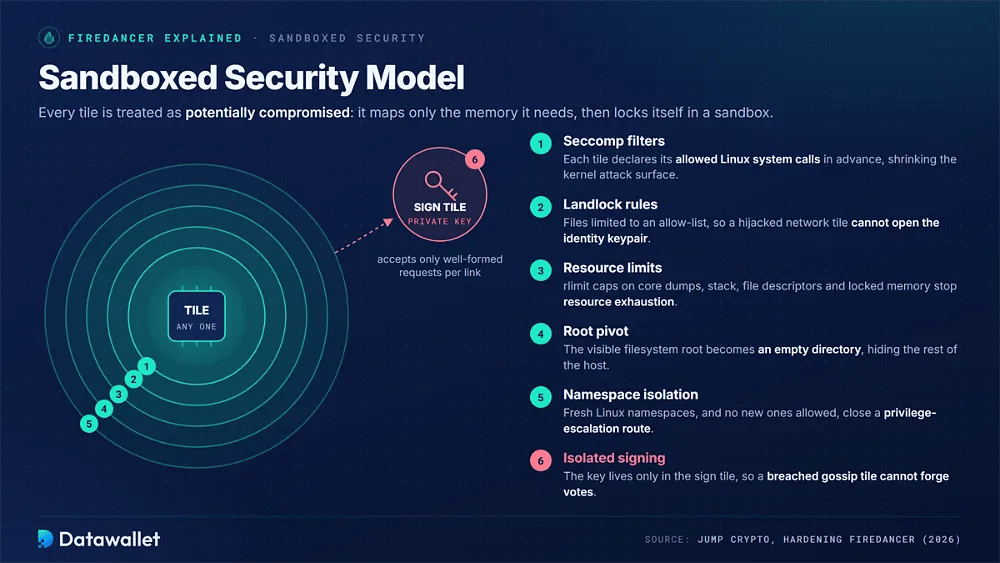
Because validators guard staked capital, Firedancer treats every tile as potentially compromised. Each process boots, maps only the memory it needs, then locks itself inside a sandbox before handling any untrusted network data from peers.
The main layers of that defense-in-depth design include:
- Seccomp filters: Every tile declares in advance which Linux system calls it may make, shrinking the kernel attack surface an intruder could reach after compromising a single component.
- Landlock rules: Filesystem access is restricted to a verified allow-list, so a hijacked networking tile cannot open sensitive files such as the validator's identity keypair on disk.
- Resource limits: Explicit rlimit caps on core dumps, stack growth, file descriptors and locked memory stop any single tile from exhausting kernel resources that other processes depend on.
- Root pivot: Each tile swaps its visible filesystem root for an empty directory, hiding the rest of the host machine and leaving nothing useful for an attacker to explore.
- Namespace isolation: Tiles run inside fresh Linux namespaces and are blocked from creating new ones, which closes off a common route to privilege escalation on shared servers.
- Isolated signing: The private key lives only in a dedicated sign tile, which accepts well-formed requests per link, so a breached gossip tile cannot forge votes or transactions.
3. Kernel-Bypass Networking
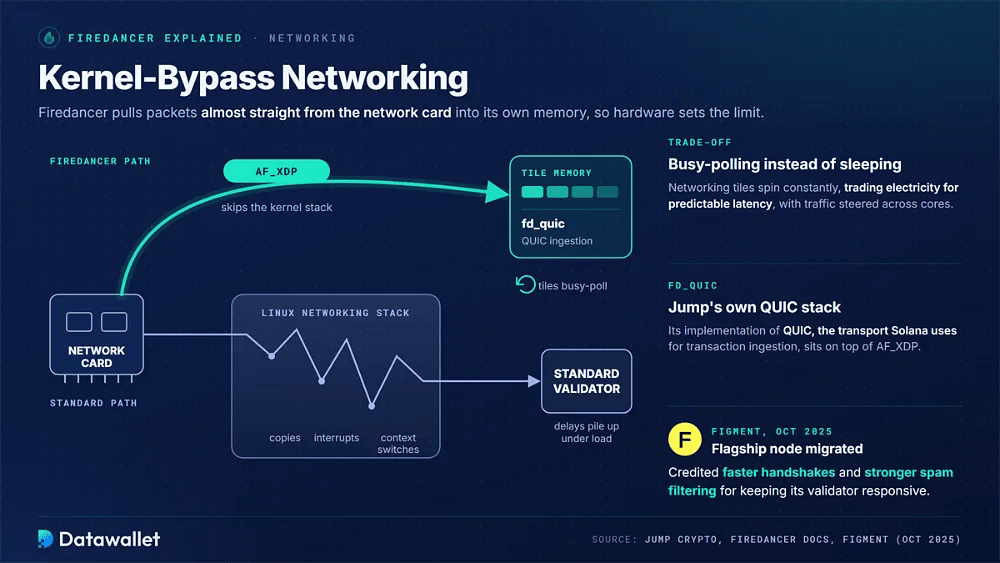
Standard validators route every packet through the Linux networking stack, which adds copies, interrupts and context switches that pile up under load. Firedancer uses AF_XDP to pull packets almost straight from the network card into its own memory, so throughput is limited by hardware rather than by software sitting in between.
On top sits fd_quic, Jump's implementation of the QUIC transport Solana uses for transaction ingestion, plus traffic steering across cores. Networking tiles busy-poll instead of sleeping, trading electricity for predictable latency. Figment credited faster handshakes and stronger spam filtering for keeping its validator responsive after migrating its flagship node to Jump's stack in October 2025.
4. Parallel Signature Verification and Replay
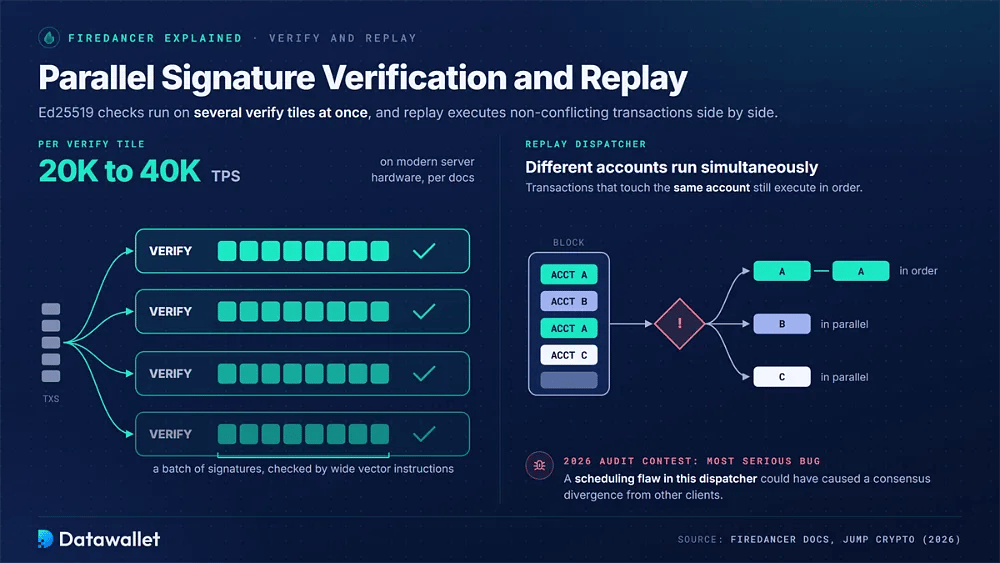
Checking Ed25519 signatures is one of the heaviest jobs a validator performs. Firedancer runs several verify tiles in parallel and uses wide vector instructions to check batches of signatures together. Its documentation estimates each verify tile handles roughly 20,000 to 40,000 transactions per second on modern server hardware.
Replay, the step where blocks are re-executed to confirm their results, is also parallelized. A dispatcher runs transactions touching different accounts simultaneously, a design that delivers speed but also produced the most serious bug in Jump's 2026 audit contest, a scheduling flaw that could have caused a consensus divergence.
Frankendancer vs Firedancer
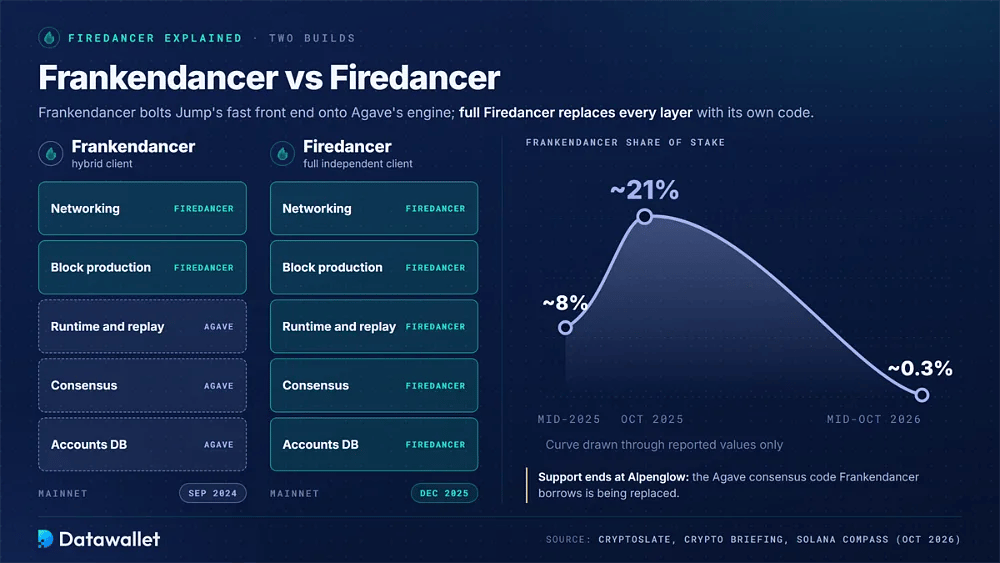
The two names are often confused. Frankendancer is a hybrid that pairs Firedancer's networking and block-production tiles with Agave's runtime and consensus code. It reached mainnet in September 2024 and let operators adopt Jump's faster front end without trusting new consensus logic, growing from roughly 8% of stake in mid-2025 to about 21% by October 2025.
Full Firedancer replaces the borrowed parts. It implements the entire pipeline, including replay, consensus and the accounts database, in Jump's own codebase, so a bug in Agave should not reach it. That separate failure domain is what Solana actually needed, and it went live on mainnet in December 2025.
Frankendancer's run is ending. Jump said it would end support for the hybrid once Alpenglow activates, because the Agave consensus code it borrows is being replaced. Solana Compass data showed Frankendancer down to about 0.3% of stake by mid-October 2026, a small fraction of its 2025 peak.
Firedancer Statistics and Trends
Firedancer enters mid-October 2026 securing roughly 15% of Solana's stake, up from under 1% at launch. The figures below draw on the latest data from Jump Crypto, Solana Compass and Fidelity's FCAT research team.
Key Firedancer adoption and security metrics as of mid-October 2026:
- Stake share: Jump says Firedancer secured about 15% of network stake in its October 16 update, making it the only independent client carrying a material share of consensus.
- Client mix: Solana Compass counted 15.8% of stake on Firedancer-family clients among the 500 largest validators on October 13: HarmonicFiredancer 7.1%, Firedancer 6.8%, FireBAM 1.6% and Frankendancer 0.3%.
- Growth curve: Full Firedancer held under 1% of staked SOL at its December 2025 launch, so reaching roughly 15% took about ten months of deliberately cautious rollout.
- Agave dominance: FCAT data shows Jito BAM and standard Jito clients together running about 63% of stake, with Harmonic variants near 24% and vanilla Agave just 1.2%.
- Validator set: Solana had 678 validators holding about 439 million staked SOL in mid-October 2026, with a Nakamoto coefficient of 18 unchanged since early August, according to Solana Compass.
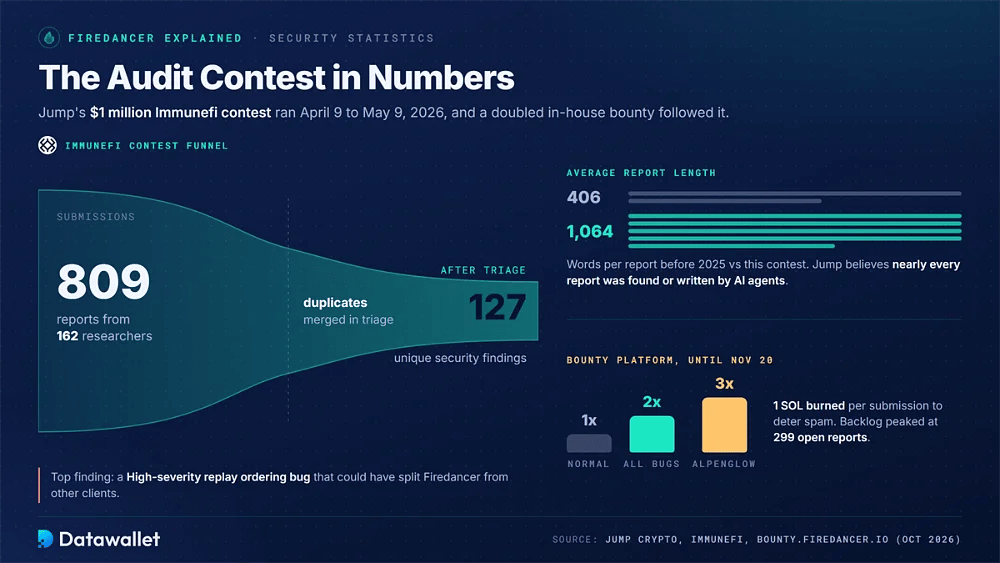
- Audit contest: Jump's $1 million Immunefi contest, run April 9 to May 9, 2026, drew 809 reports from 162 researchers and yielded 127 unique security findings.
- AI submissions: Jump believes nearly every contest report was found or written by an AI agent, pushing average report length to 1,064 words versus 406 before 2025.
- Bounty boost: Firedancer's new in-house bounty platform pays double rewards, and triple for Alpenglow-related bugs, until November 20, with a 1 SOL burn per submission to deter spam.
- Network reliability: FCAT found no reported Solana mainnet outage across two consecutive years, with average vote success near 99.7% during 2026, a sharp contrast with earlier halts.
For broader network data, see our breakdown of Solana staking statistics and trends.
The Mainnet Launch and Rollout
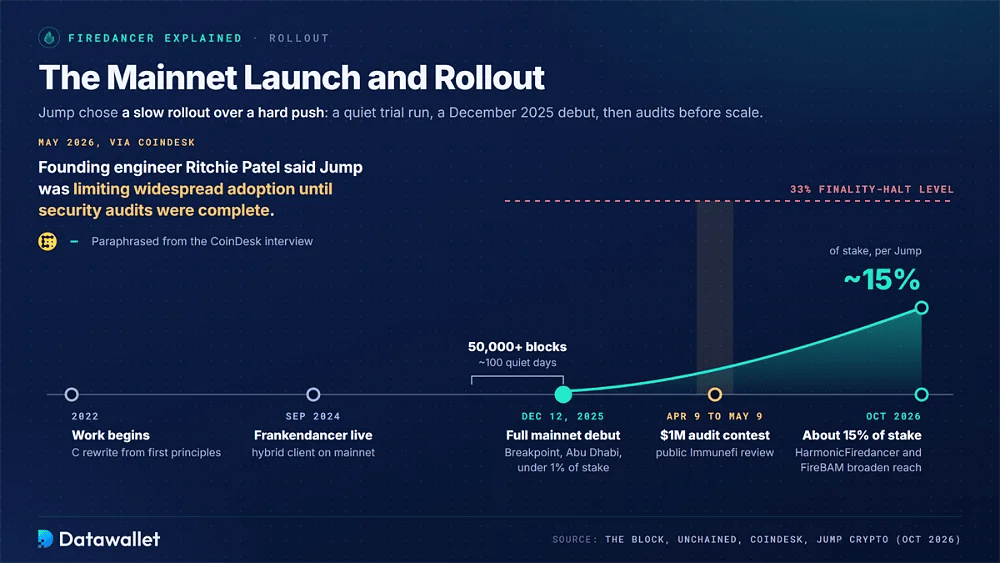
Jump announced Firedancer's full mainnet debut on December 12, 2025, at Solana Breakpoint in Abu Dhabi. Before the announcement, the client had quietly run on a small group of validators for about 100 days, producing more than 50,000 blocks without major issues, according to Unchained.
Jump then chose a slow rollout over a hard push. Founding engineer Ritchie Patel told CoinDesk in May 2026 that the team was limiting widespread adoption until security audits were complete, backed by a $1 million public audit contest that ran from April 9 to May 9.
Adoption still climbed steadily. Full Firedancer started with under 1% of staked SOL, and block-building variants such as HarmonicFiredancer and FireBAM later broadened its reach. By October 2026, Jump put its share at about 15%, a meaningful slice but far from the one-third level where a client failure could halt finality.
Firedancer and the Alpenglow Migration
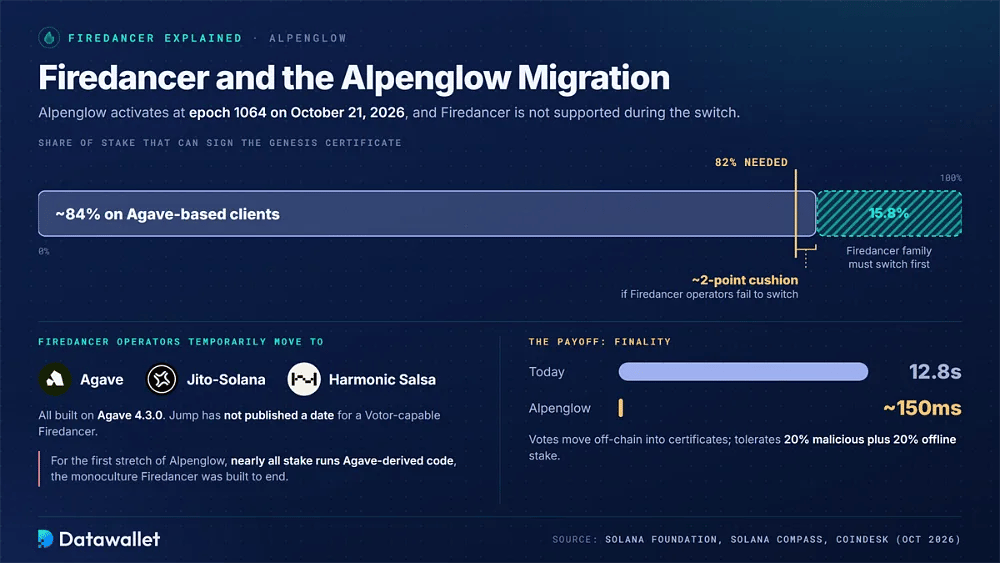
The biggest near-term story is an awkward one. Solana is scheduled to activate Alpenglow at epoch 1064 on October 21, 2026, and the Solana Foundation states plainly that Firedancer and Frankendancer are not supported during the migration. Every validator must run an Agave-based client built on Agave 4.3.0.
In practice, Firedancer operators must temporarily switch to Agave, Jito-Solana or Harmonic Salsa before activation. The handoff needs a genesis certificate signed by 82% of stake, and Solana Compass calculated that excluding the 15.8% Firedancer-family share would leave roughly 84%, a thin two-point cushion if those operators fail to switch.
The episode exposes a gap in Solana's multi-client story. For at least the first stretch of Alpenglow, nearly all stake will run Agave-derived software, the monoculture Firedancer was built to end. Jump has not published a date for a Votor-capable Firedancer release, though its tripled Alpenglow bounty suggests that work is under active review.
The payoff explains the trade-off. Alpenglow moves votes off-chain into certificates, targets finality near 150 milliseconds instead of 12.8 seconds, and tolerates 20% malicious plus 20% offline stake. Running a one-slot consensus swap on a single, heavily rehearsed codebase limits coordination risk, at the temporary cost of client diversity.
Why Client Diversity Matters
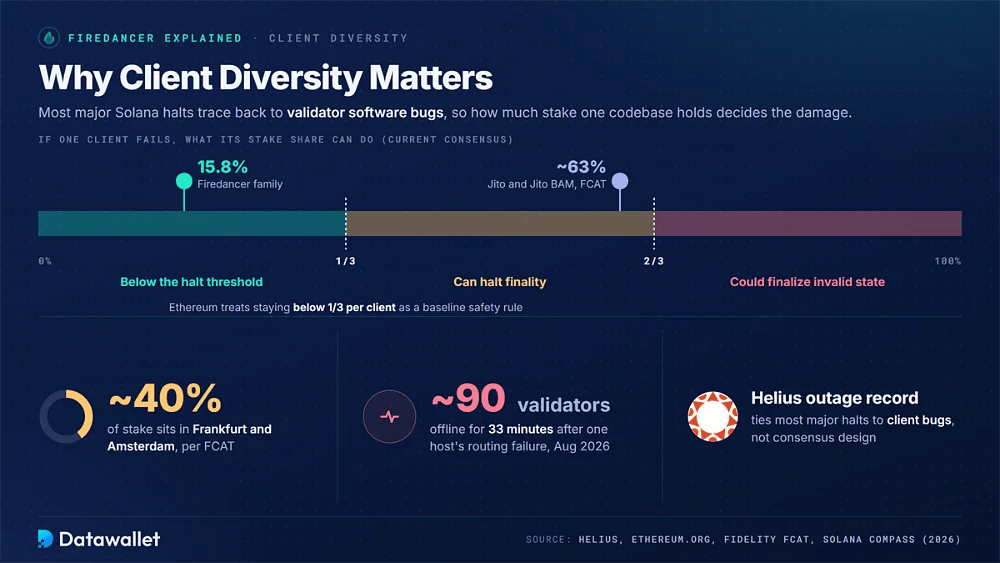
Solana's history explains the urgency. Helius' record of network outages ties most major halts to bugs in validator software rather than flaws in consensus design. When nearly every node runs related code, one defect can stop block production everywhere at once, regardless of how fast the chain is on paper.
The thresholds matter. Under Solana's current consensus, a client holding more than one-third of stake can halt finality if it fails, and above two-thirds a buggy client could finalize invalid state. Ethereum treats keeping every client below one-third as a baseline safety rule, a bar Solana remains far from meeting.
Diversity is also about where validators run. Fidelity's FCAT report found about 40% of stake in Frankfurt and Amsterdam, and an August 2026 routing failure at a single hosting provider knocked roughly 90 validators offline for 33 minutes. Software independence helps most when hosting and geography are spread too.
Institutions watch these numbers closely. Spot SOL products, including staking ETFs, and tokenized funds now depend on Solana staying live, and a credible second client answers a core question risk teams ask: what happens when the dominant software breaks? Firedancer is currently Solana's only convincing answer.
Firedancer and Solana's Roadmap
Firedancer sits at the center of several parallel upgrades that push Solana toward heavier blocks, shorter slots and quantum-resistant cryptography. Each one raises the workload a validator must absorb, which is where Jump's architecture earns its keep.
Bigger Blocks and Faster Slots
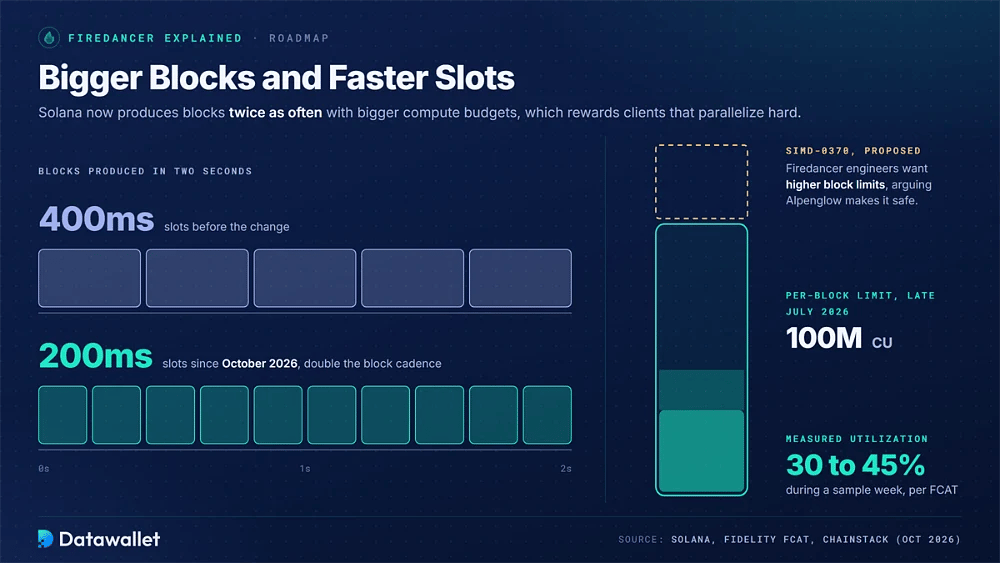
Solana completed its move from 400-millisecond to 200-millisecond slots in October 2026, doubling how often leaders produce blocks. Per-block compute limits have climbed as well, reaching 100 million compute units in late July 2026, while FCAT measured block utilization at roughly 30% to 45% during a sample week.
Firedancer engineers have argued for going further, proposing SIMD-0370 to lift block compute limits on the grounds that Alpenglow makes higher hardware scaling safe. Faster slots and bigger blocks both reward clients that parallelize aggressively, which is why many expect throughput gains to track Firedancer adoption after the migration.
Key Roadmap Milestones to Watch
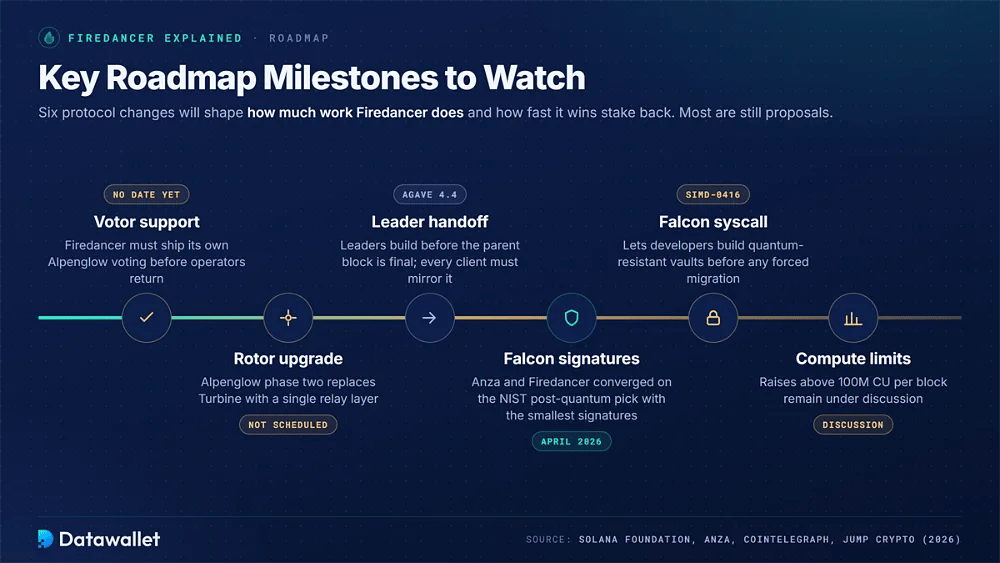
Beyond Alpenglow's first phase, several protocol changes will shape how much work Firedancer performs and how quickly it regains its stake. Most are still proposals, so timelines can slip without much warning.
The milestones most relevant to Firedancer over the next year:
- Votor support: Firedancer must ship and harden its own implementation of Alpenglow's voting protocol before operators can return, and Jump has not yet published a mainnet date.
- Rotor upgrade: Alpenglow's second phase replaces Turbine block propagation with a single relay layer, but the Solana Foundation says Rotor is not yet scheduled for any release.
- Leader handoff: Fast leader handoff in Agave 4.4 lets a leader start building before its parent block is final, adding a new behavior every client must mirror.
- Falcon signatures: In April 2026 Anza and Firedancer independently converged on Falcon, the NIST-selected post-quantum scheme with the smallest signatures, keeping bandwidth costs manageable for a high-throughput network.
- Falcon syscall: SIMD-0416 proposes adding a Falcon verification syscall to the runtime, letting developers build quantum-resistant vaults and transfers before any mandatory network-wide signature migration takes place.
- Compute limits: Further block compute increases beyond 100 million units remain under discussion, and each step raises the hardware ceiling that Firedancer's parallel design was built to exploit.
Firedancer Hardware Requirements
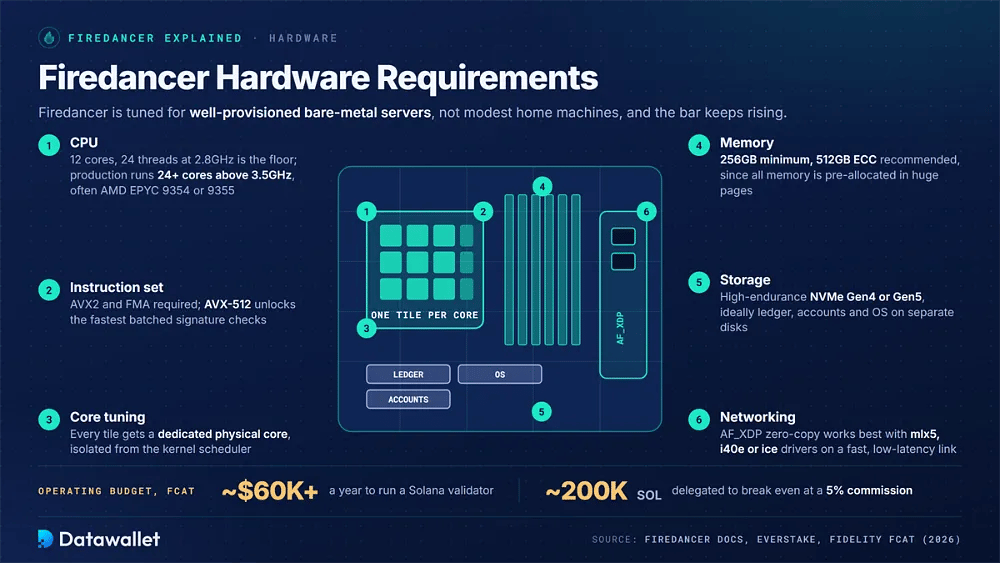
Early coverage suggested Firedancer would make validating cheaper. The opposite has happened: shorter slots and larger blocks keep raising the bar, and Firedancer is tuned for well-provisioned bare-metal servers rather than modest home machines.
A typical 2026 production profile, based on Firedancer documentation and operator benchmarks, looks like this:
- CPU: Treat a 12-core, 24-thread chip at 2.8GHz as the floor, though production operators target 24 or more cores above 3.5GHz, typically AMD EPYC 9354 or 9355 parts.
- Instruction set: The main fdctl build requires at least AVX2 and FMA support, while chips with AVX-512 unlock the fastest batched signature-verification paths Firedancer offers on modern servers.
- Memory: Firedancer documentation lists 256GB as the absolute minimum and recommends 512GB of ECC memory, partly because the client pre-allocates all memory in huge pages.
- Storage: Enterprise NVMe Gen4 or Gen5 drives with high endurance are standard, ideally with the ledger, accounts and operating system split across separate physical disks.
- Networking: Kernel-bypass networking relies on AF_XDP, which works best with supported network drivers for zero-copy mode, such as mlx5, i40e or ice on a high-bandwidth, low-latency link.
- Core tuning: Each tile needs a dedicated physical core, so operators disable hyperthread contention, isolate cores from the kernel scheduler and set affinities so nothing else competes.
- Operating budget: FCAT estimates running a Solana validator costs around $60,000 a year or more, with break-even near 200,000 delegated SOL at a 5% commission on inflation and MEV rewards.
What Firedancer Means for SOL Stakers
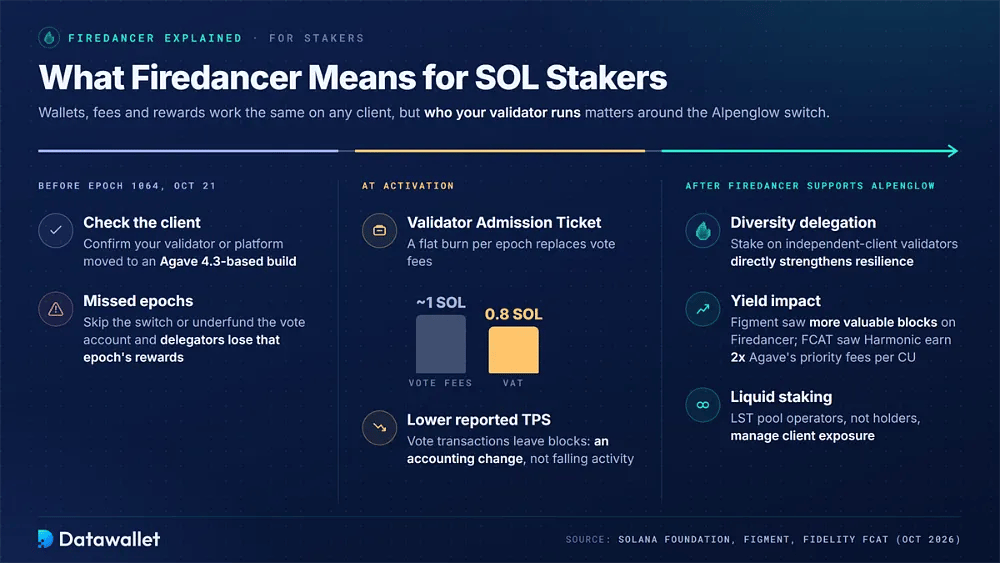
For most SOL holders, Firedancer is invisible: wallets, fees and rewards work the same whichever client a validator runs. It still matters when choosing where to delegate, especially around the Alpenglow switch.
Practical points stakers should keep in mind this quarter:
- Check clients: Ask your validator or staking platform which client it runs, and confirm it moved to an Agave 4.3-based build before epoch 1064 begins on October 21.
- Missed epochs: A validator that skips the switch or underfunds its vote account will not vote or produce blocks next epoch, and delegators lose that epoch's rewards.
- VAT fee: Alpenglow replaces roughly 1 SOL of vote fees per epoch with a flat 0.8 SOL Validator Admission Ticket, burned from each validator's vote account.
- Diversity delegation: Once Firedancer supports Alpenglow, delegating to independent-client validators directly strengthens network resilience, since stake weight decides how much consensus power each client controls across the network.
- Yield impact: Client choice affects revenue: Figment found Firedancer packed more valuable transactions per block, while FCAT showed Harmonic validators earning double plain Agave's priority fees per compute unit.
- Liquid staking: Liquid staking tokens spread deposits across many validators, so pool operators, rather than holders, manage client exposure and migration risk during upgrades like Alpenglow.
- Reported TPS: Vote transactions leave blocks at activation, so dashboards will show sharply lower transaction counts; that reflects accounting changes, not falling user activity on Solana.
Why is Jump Building Firedancer?
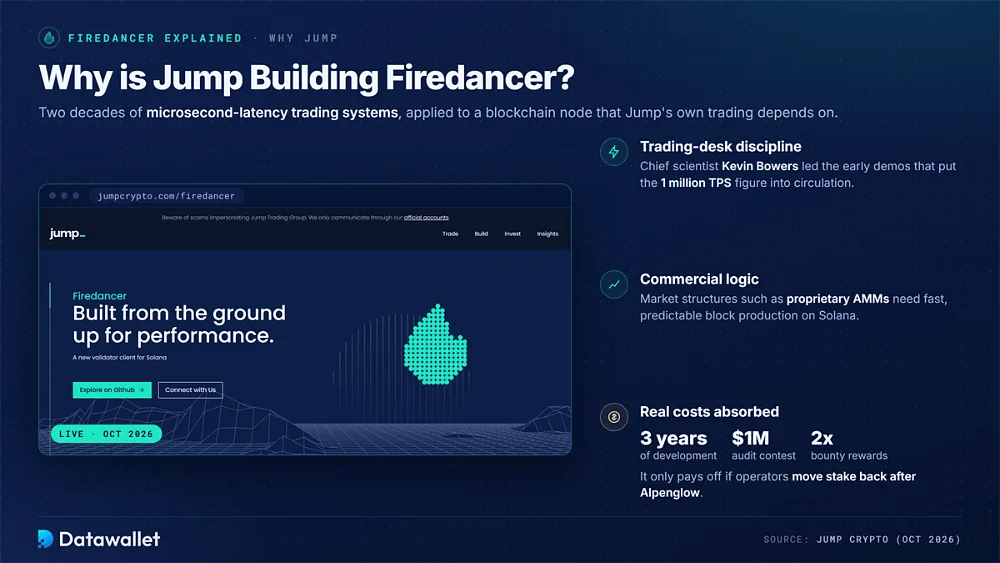
Jump's motivation traces back to its core business. Jump Trading spent two decades building systems that move enormous data volumes with microsecond latency, and Firedancer applies that discipline to a blockchain node. Chief scientist Kevin Bowers led the early throughput demonstrations that first put the 1 million TPS figure into circulation.
There is a commercial logic too. Jump is an active trading firm in crypto markets and has written publicly about Solana market structures such as proprietary AMMs, which depend on fast, predictable block production. A sturdier network improves the venue every trader, Jump included, ultimately relies on.
Jump has also absorbed real costs to get here: three years of development, a $1 million public audit contest and now an in-house bounty platform with doubled rewards. That spending only pays off if operators trust the client enough to move stake back after Alpenglow.
Risks and Open Questions
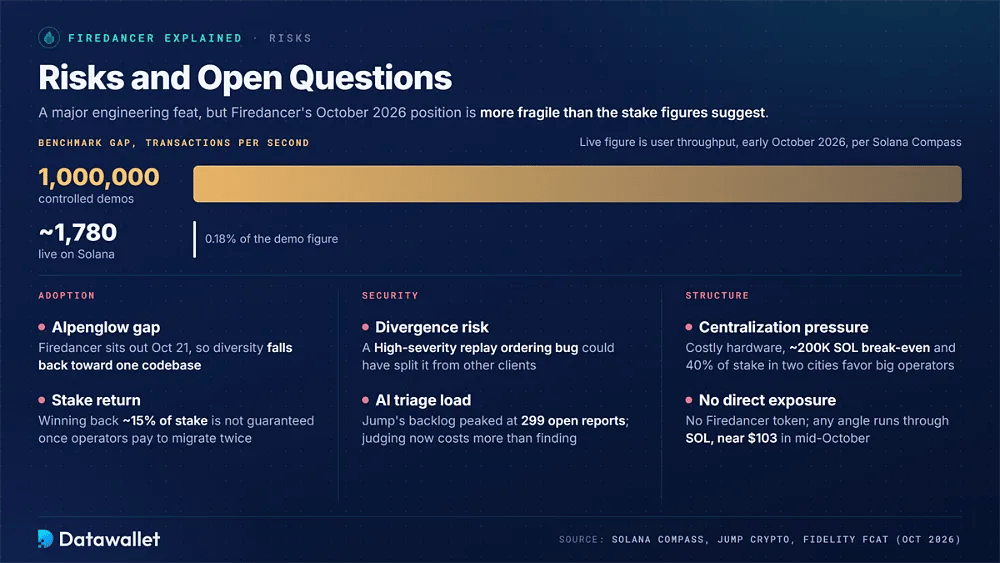
Firedancer is a major engineering achievement, but its position in October 2026 is more fragile than headline stake figures suggest. These are the issues worth tracking over the next few quarters.
The main risks and unresolved questions around Firedancer right now:
- Alpenglow gap: Firedancer sits out the October 21 migration, so Solana's client diversity temporarily falls back toward a single codebase until a Votor-capable release reaches mainnet.
- Stake return: Operators who switch to Agave may prefer to stay there, and winning back roughly 15% of stake is not guaranteed once migration costs are paid twice.
- Benchmark gap: The 1 million TPS figure comes from controlled demos, while live Solana user throughput averaged around 1,780 transactions per second in early October 2026, according to Solana Compass.
- Divergence risk: Two clients can disagree about a block's result; Jump's contest found a High-severity replay ordering bug that could have split Firedancer from other clients.
- AI triage load: AI-generated bug reports are flooding security programs, and Jump's backlog peaked at 299 open reports, showing that judging findings now costs more than discovering them.
- Centralization pressure: Demanding hardware, a roughly 200,000 SOL break-even and 40% of stake in Frankfurt and Amsterdam all favor large professional operators over smaller independent validators.
- No direct exposure: There is no Firedancer token; any investment angle runs through SOL, which traded near $103 in mid-October 2026 and remains highly volatile regardless of upgrades.
Final Thoughts
Firedancer has already changed what Solana is judged on. For years the network sold raw speed while resting on one software lineage that produced repeated outages. A genuinely independent client, now securing around 15% of stake after ten months on mainnet, is the structural fix that critics demanded.
The Alpenglow migration complicates that story. For a period, Solana will be faster and more fault-tolerant at the consensus layer while being less diverse at the client layer. How quickly Jump ships and hardens Votor support will decide whether that dip lasts weeks or stretches into 2027.
For stakers and builders, the practical lesson is to watch stake distribution, not throughput headlines. The 1 million TPS demo will keep circulating, yet the number that matters most is how much SOL runs on code that fails independently. On that measure, Firedancer remains Solana's most important upgrade.