


Can You Get Binance Testnet Tokens?
Yes. Free tBNB is available from any trusted faucet once your wallet is pointed at the BNB Smart Chain Testnet. Start by adding the testnet to MetaMask, which runs on Chain ID 97, then paste your address into a faucet and request a drip.
The token has no price and cannot be traded, since its supply is effectively unlimited. Its only job is paying gas so you can send transactions, deploy BEP-20 contracts, and interact with dApps on a network that mirrors mainnet without putting real BNB at risk.
One change worth noting in 2026 is that most reputable faucets now gate claims behind a small mainnet balance or an API key. This keeps bots from draining reserves, so a wallet with a short mainnet history claims far more smoothly than a brand-new empty one.
How to Get Testnet BNB Tokens
The official BNB Chain faucet is the primary source and dispenses the largest standard drip. It now asks you to hold a small amount of mainnet BNB as an anti-bot check, so fund your wallet with a fraction of a coin before you begin:
- Open the faucet: Head to the official testnet faucet portal and confirm the address bar reads bnbchain.org before connecting anything.
- Paste your address: Enter your BSC Testnet wallet address, making sure MetaMask is switched to Chain ID 97 rather than mainnet.
- Request the drip: Choose the tBNB option and confirm. The faucet caps each address at 0.3 tBNB every 24 hours to keep distribution fair.
- Wait for arrival: Tokens usually land within a minute or two. If nothing shows, refresh the network in MetaMask or check the BscScan testnet explorer.
Avoid firing repeat requests in quick succession, since the faucet flags rapid activity as bot behavior and will pause you. If you need a larger allocation for a serious project, teams can request bulk tBNB through the BNB Chain Discord for manual approval.
Binance Testnet Faucet Limit
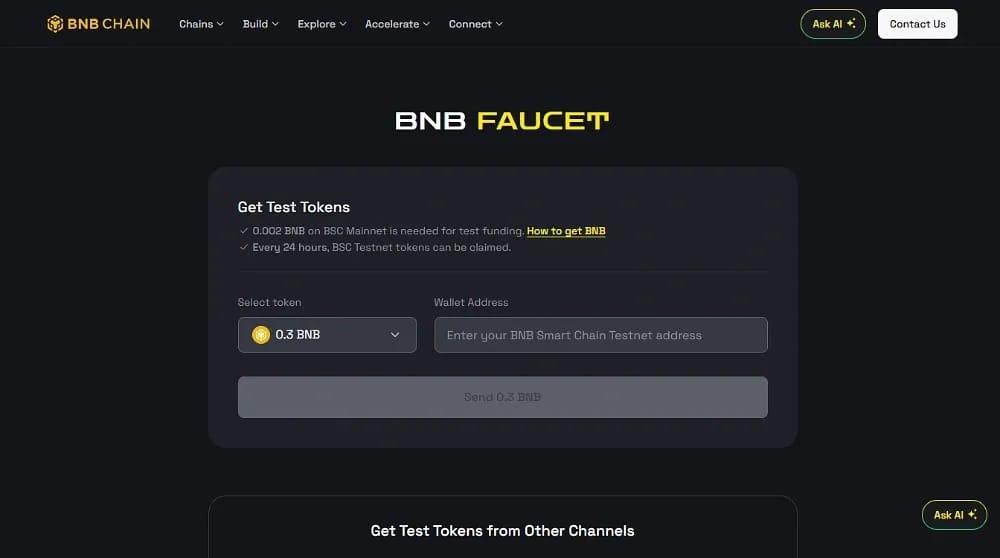
The official faucet releases up to 0.3 tBNB per address every 24 hours, the highest standard drip among BNB testnet sources. That allocation covers hundreds of simple transfers or several full contract deployments, which is enough for most testing cycles between refills.
The main requirement now is a small mainnet balance, roughly 0.002 BNB, which the faucet checks to confirm you are an active user rather than a script. Alongside the web portal, you can also claim through the official Discord bot or the Telegram support bot by sending your wallet address in a message.
If you routinely burn through the daily cap, the practical fix is to spread requests across several trusted faucets rather than hammering one. Pooling drips from two or three sources gives a development team a steadier supply for stress tests without tripping any single faucet's rate limit.
Alternative Binance Testnet Faucets
When the official faucet is dry or under maintenance, several vetted providers fill the gap. Each carries its own drip size and entry requirement, so pick the one that matches your setup:
- QuickNode: Dispenses a modest drip once every 12 hours and requires a small mainnet balance, making it a reliable backup for light, frequent testing between official claims.
- Chainstack: Offers up to 0.5 tBNB every 24 hours, the largest single allocation here, though it requires a free Chainstack API key and a 0.002 ETH mainnet balance.
- Thirdweb: Supports tBNB alongside opBNB testnet tokens through a connected wallet, useful if you are testing across both BNB Chain layers in one workflow.
- Bitbond Token Tool: Provides a low-friction option with no mainnet minimum, dispensing a small daily drip after you complete a quick profile connection.
Stick to these named sources and the ones listed in the official BNB Chain docs. Fake faucets spike after any developer surge, and a hostile page can request wallet permissions that reach your mainnet funds, so never pay for tBNB or share a recovery phrase.
What Is the BNB Smart Chain Testnet?
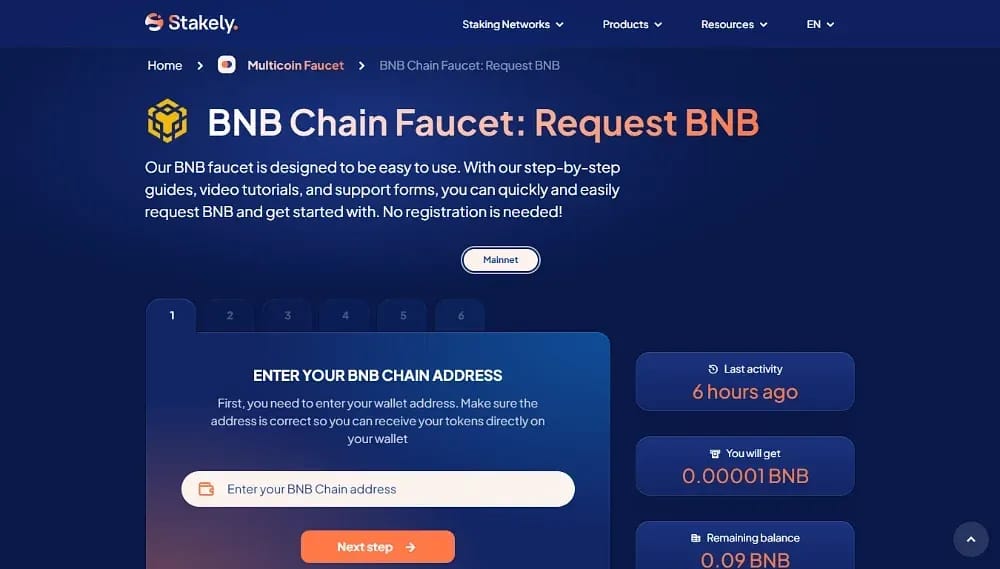
The BNB Smart Chain Testnet is a public, EVM-compatible network that mirrors mainnet on a separate ledger using valueless tBNB for gas. It runs on Chain ID 97 with roughly three-second block times and gas prices around one to five gwei, giving developers production-like conditions at zero cost.
Because it shares BNB Chain's Proof of Staked Authority design and BEP-20 token standard, a contract that behaves correctly on testnet will behave identically once deployed with real BNB. That parity is the whole point: teams catch bugs, simulate swaps, and audit deployments before a single cent is at stake.
Common uses run from deploying and testing BEP-20 tokens to rehearsing cross-chain bridge flows and running end-to-end QA against the BscScan testnet explorer. For anything heading to production, our bridge to BNB Chain guide covers moving real assets once testing wraps.
How to Fix Common Faucet Problems
Most failed claims trace back to a handful of avoidable issues rather than a broken faucet. Running through this list resolves the majority of cases before you reach for support:
- Wrong network: MetaMask must be on Chain ID 97, not BNB mainnet or another testnet, or the drip lands somewhere you cannot see it.
- No mainnet balance: The official and QuickNode faucets check for a small mainnet holding, so a completely empty wallet gets rejected as a suspected bot.
- Rate limited: Requesting too often triggers a cooldown; wait out the 24-hour window or switch to a different trusted faucet instead.
- Missing API key: Chainstack requires a free account and API key before it releases tokens, which is the usual reason its claims silently fail.
- Delayed arrival: Testnet congestion can slow delivery to several minutes, so give it time and confirm the balance on the block explorer before retrying.
- Fake faucet: If a page asks for a seed phrase or payment, close it immediately; no legitimate faucet ever needs more than your public address.
Final Thoughts
Claiming Binance testnet tokens is a fast, secure way to build and test on BNB Smart Chain without spending real money. The official BNB Chain faucet remains the first stop at 0.3 tBNB a day, with QuickNode, Chainstack, and Thirdweb ready as backups.
The one real change to plan around is the mainnet balance and API-key requirements that now gate most faucets, added to keep bots out. Keep a small amount of BNB in an active test wallet, stick to verified sources, and your tBNB supply stays reliable through every stage of development.