Login to Track Your Live Crypto Portfolio
Sign Up and Track Your Live Crypto Portfolio for Free
Forgot your password?
Charles Schwab Launches Spot Crypto Trading For Users

This article has been reviewed and verified for accuracy by our editorial team. All claims, data points and platform details are cross-referenced against primary sources.
Some links on this page are affiliate links. Datawallet may earn a commission when you sign up through them, at no extra cost to you. This never influences our editorial ratings, rankings or recommendations.
Some links on this page are affiliate links. Datawallet may earn a commission when you sign up through them, at no extra cost to you. Ratings and rankings reflect our own testing and assessment criteria.

GM. Charles Schwab began a phased rollout of spot Bitcoin and Ethereum trading for US retail clients today, marking the brokerage giant's first direct entry into digital assets after years of focusing on ETFs and equities.
Meanwhile, 21Shares launched a Hyperliquid ETF (THYP) on Nasdaq, Kelp DAO and Aave confirmed a staged restart of rsETH operations following the $292 million exploit, and the CFTC filed a brief defending its exclusive authority over prediction markets in Ohio.
Here are the details on brokerage expansion, onchain ETFs, and recovery milestones. 👇
Charles Schwab Launches Spot Crypto Trading For Users
Charles Schwab has begun rolling out Schwab Crypto accounts, letting a first cohort of eligible US retail clients trade spot Bitcoin and Ethereum alongside stocks and other holdings. The move marks the brokerage’s first direct crypto offering after years of limiting access to ETFs, equities, and related products.
The launch follows a successful internal pilot and begins with users who joined Schwab’s interest list, with broader access planned over the coming months. Chief executive Rick Wurster had signaled a phased second-quarter rollout. Schwab’s long wait reflected its insistence that clearer US rules come first.
Schwab’s entry lands in a friendlier political and regulatory climate, one year after Washington shifted toward more accommodating crypto policy. The firm has already hinted that stablecoins and prediction markets could follow. Any future prediction products, executives have said, would likely focus on financial outcomes.
The rollout nudges another mainstream brokerage deeper into digital assets just as Bitcoin traded near $78,850 and Ether near $2,242, both modestly lower. Schwab shares rose about 1% to roughly $91.18. For crypto markets, the significance lies less in price than in reach and access.
First Hyperliquid ETF Launches With $1.8 Million Volume
21Shares launched the first Hyperliquid ETF, giving investors exposure to HYPE without directly holding the token, and the fund traded $1.8 million on debut. Bloomberg analyst James Seyffart called the opening very solid. The listing arrived as altcoin fund issuers race to widen the ETF menu.
The product matters because Hyperliquid has become the largest onchain perpetuals exchange, and traditional wrappers could draw buyers who want brokerage access instead of wallets. Bitwise and Grayscale are pursuing related vehicles. HYPE slipped about 4% after the launch even as staking plans remained intact.
Kelp DAO Resumes Operations After $292 million Exploit
Kelp DAO and Aave said rsETH operations will resume in stages after early recovery milestones were completed following the $292 million exploit. Kelp plans to refill 117,132 rsETH into its mainnet adapter over two weeks. Withdrawals are expected to reopen after the first tranche lands.
The restart follows contract changes at Kelp, a move to tougher attestation rules, and a broader industry rescue that raised more than $300 million. Aave also burned the exploiter’s rsETH on Arbitrum. A court still restricts the frozen ETH recovered there, complicating the final restitution path.
CFTC Defends Authority Over Prediction Markets In Ohio
Federal regulators filed a legal brief in a national appeals court to challenge Ohio efforts to restrict prediction market platform Kalshi recently. The commission argues that state officials are overstepping their jurisdiction by labeling event contracts as unlicensed gambling. This clash intensifies as popular betting platforms gain traction.
Chairman Michael Selig insists that a national framework is necessary because these high volume prediction markets cross state lines and require federal oversight. Five other states face similar lawsuits from the agency as it fights to maintain authority. Officials believe that state bans undermine the uniform application of laws.
Data of the Day
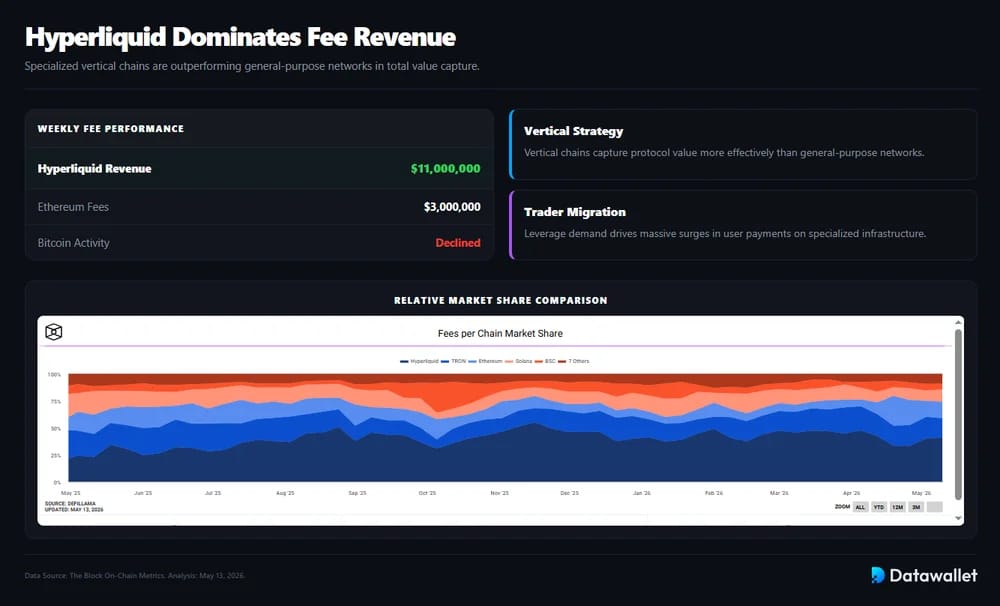
Hyperliquid captured 43% of the entire blockchain fee market by generating $11 million in revenue over the last 7 days. This specialized platform outperformed general purpose networks like Ethereum and Solana by focusing on perpetuals trading activity. Vertical chains are now proving more effective at capturing value.
Traders migrated to this infrastructure to execute leveraged positions which drove the massive surge in captured user payments during the period. Ethereum followed with 3 million in fees while Bitcoin activity declined from previous peaks. These metrics suggest that specialized application chains like Hyperliquid provide more durable paths for monetization.
More Breaking News
- The Bank of England is treating stablecoins as a new form of money and expects to begin welcoming applications for systemic digital asset issuers by the end of 2026.
- Jupiter integrated with Bitwise to curate an isolated lending market for the USDe synthetic stablecoin on Solana to provide institutional investors with high yield opportunities and risk mitigation.
- JPMorgan filed for a tokenized money market fund on Ethereum called JTLXX that will invest in government debt through its permissioned Kinexys platform to improve liquidity and efficiency.
- British regulators are investigating a $6.8 million donation to politician Nigel Farage from a crypto billionaire after he failed to declare the gift during the last general election.
- The Japan Blockchain Foundation plans to issue a yen pegged stablecoin named EJPY on Ethereum and its own enterprise network to facilitate business to business settlements and payments.
- Crypto security firm Ledger paused its $4 billion public listing plans due to difficult market conditions and volatility affecting investor appetite for digital asset companies on national exchanges.
- Vietnam aims to launch a regulated crypto market by the third quarter of 2026 to support its digital economy strategy and oversight of 200 billion in transactions.
- A malicious repository impersonating OpenAI's privacy filter model reached the top of Hugging Face and stole credentials from 244,000 unsuspecting developers before the security platform removed it.
- Wall Street giant Jane Street slashed its Bitcoin fund exposure by over 60% while nearly doubling its Ethereum ETF stake during the first quarter of the current year.
For the latest updates on digital asset markets, follow us on X @Datawalletcom.
For the latest updates on digital asset markets, follow us on X @Datawalletcom.
Get tomorrow’s issue in your inbox