


Login to Track Your Live Crypto Portfolio
Sign Up and Track Your Live Crypto Portfolio for Free
Forgot your password?
MARA Sells 15,133 BTC For $1.1 Billion To Retire Debt

This article has been reviewed and verified for accuracy by our editorial team. All claims, data points and platform details are cross-referenced against primary sources.
Some links on this page are affiliate links. Datawallet may earn a commission when you sign up through them, at no extra cost to you. This never influences our editorial ratings, rankings or recommendations.
Some links on this page are affiliate links. Datawallet may earn a commission when you sign up through them, at no extra cost to you. Ratings and rankings reflect our own testing and assessment criteria.

GM. MARA Holdings sold 15,133 Bitcoin for $1.1 billion this month to slash its debt by 30%, marking a major shift away from its "HODL" strategy toward AI infrastructure.
Meanwhile, US lawmakers introduced the PREDICT Act to ban officials from crypto betting, Trust Wallet launched AI trading agents, and USDT0 expanded to the Tempo network.
Here are the details on mining liquidations and political betting bans to end the week. 👇
MARA Sells 15,133 BTC For $1.1 Billion To Retire Debt
Bitcoin mining titan MARA Holdings liquidated 15,133 tokens for $1.1 billion between March 4 and March 25 to fortify its balance sheet. This gargantuan divestment provided necessary capital to repurchase senior convertible notes maturing in 2030 and 2031.
Chief Executive Officer Fred Thiel orchestrated the maneuver to slash corporate debt by 30% while pivoting toward AI infrastructure. The firm secured an $88 million discount to par value by negotiating private repurchase agreements with note holders.
A staggering $1.7 billion quarterly loss driven by declining crypto prices forced the miner to abandon its long standing HODL strategy earlier this month. This policy shift allows for selling assets beyond newly mined production.
MARA maintains a residual stash of 38,689 coins to support its transition into digital energy and high performance computing fields. Retiring outstanding principal debt provides the financial flexibility required to scale these emerging global technology projects.
Lawmakers Introduce Bill To Ban Officials From Crypto Betting
Bipartisan United States lawmakers introduced the PREDICT Act to prohibit federal officials from wagering on political and policy events. Representatives Adrian Smith and Nikki Budzinski authored the proposal to prevent insiders from profiting through nonpublic information. This legislation targets members of Congress plus their immediate families and children.
The bill establishes civil fines equal to 10% of transaction values for any violators while requiring the total forfeiture of profits. Lawmakers implemented these strict penalties to ensure that public service remains a privilege rather than a pathway to profit through prediction markets. Government proceeds from these fines would flow directly into Treasury.
Trust Wallet Launches AI Agents For Crypto Trades
Trust Wallet launched its new AI powered infrastructure to allow over 200 million customers to execute automated crypto transactions. This toolkit enables intelligent agents to manage recurring buys and cross chain swaps across 25 different networks. Users retain complete control over their private keys throughout the entire process.
The technology offers two distinct operating modes where agents can either suggest trades or execute them based on pre defined rules. Changpeng Zhao owned firms are increasingly experimenting with automation to help investors research and propose portfolio adjustments more efficiently. This release extends the core principle of self custody.
Omnichain Stablecoin USDT0 Expands To Tempo Network
The omnichain stablecoin USDT0 expanded to the payments focused Tempo blockchain on Friday to improve its global transaction capabilities. Stripe and Paradigm co developed this Layer 1 network specifically to handle high throughput stablecoin swaps with low fees. This deployment represents the 23rd network integration for the rapidly growing asset.
These tokens maintain a 1:1 backing with Tether and utilize LayerZero technology to move between various blockchains without traditional bridge risks. Tether recently made a strategic investment into LayerZero Labs to support the development of such interoperable financial infrastructure. The new network features an enshrined active automated market maker.
Data of the Day
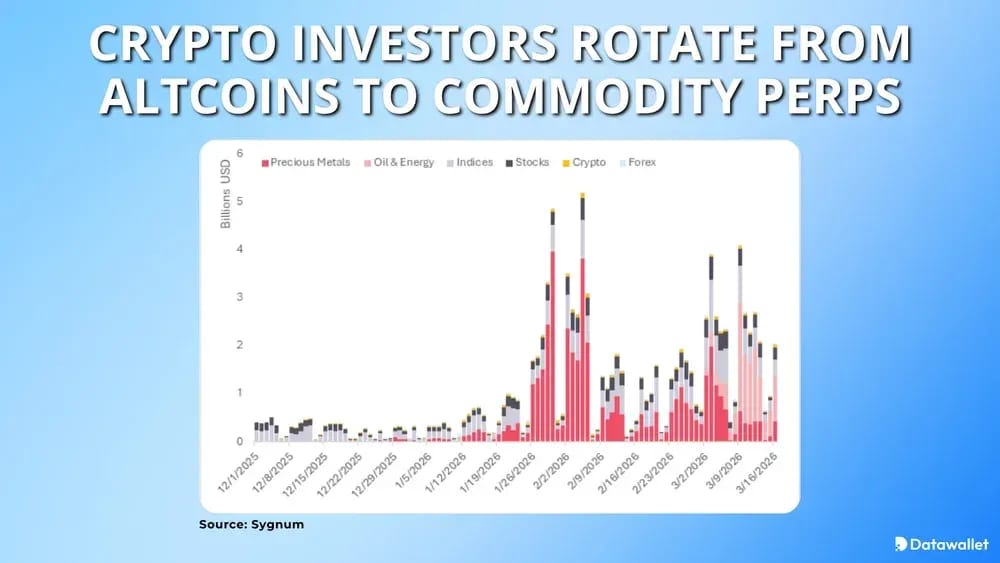
Digital asset bank Sygnum reported on Thursday that trading volumes for commodity perpetual futures have surged as investors abandon underperforming altcoins. Real world assets like gold and oil now account for over 67% of specific builder deployed contracts on Hyperliquid. This rotation reflects a growing desire for assets linked to resources.
Ongoing Middle East conflicts have caused global energy prices to spike drastically while many crypto tokens remain 80% below peaks. Traders are currently using these decentralized platforms to hedge against inflation risks through the same wallets used for crypto. This shift coincides with a 250% increase in tokenized asset caps.
More Breaking News
- BlackRock’s BUIDL fund integrated Chronicle’s Proof of Asset system to provide institutional investors with independently verified, real-time data on fund holdings.
- Bhutan accelerated its Bitcoin liquidations by moving $36.75 million to exchanges, bringing the nation’s total 2026 outflows to roughly $152 million.
- The institutional Canton Network integrated LayerZero’s cross-chain infrastructure to enable secure tokenized asset transfers across 165 different public blockchain networks.
- A federal judge certified a class action lawsuit on Wednesday against Nvidia for allegedly concealing $1 billion in crypto-driven revenue during 2017.
- Coinbase opposed the latest Clarity Act draft due to provisions banning stablecoin yield, which the exchange argues would stifle industry competition.
- Brazil passed a new law allowing authorities to seize and sell digital assets from organized crime groups to fund public security.
- Euro stablecoins now command 85% of the non-dollar market volume as regulatory clarity under MiCA drives adoption among European businesses and treasury.
- Tether launched its gold-backed XAUT token on BNB Chain to expand access for the $2.5 billion asset amid surging precious metals.
For the latest updates on digital asset markets, follow us on X @Datawalletcom.
For the latest updates on digital asset markets, follow us on X @Datawalletcom.
Get tomorrow’s issue in your inbox