




Best Crypto Stocks Compared
We assessed each company on business model durability, balance sheet strength and how much revenue survives a downturn in token prices, rather than ranking on recent share performance alone. Concentration risk was weighted heavily given how many treasury vehicles now exist across the sector.
The table compares the seven companies on the fundamentals that separate them:
1. Coinbase (COIN)
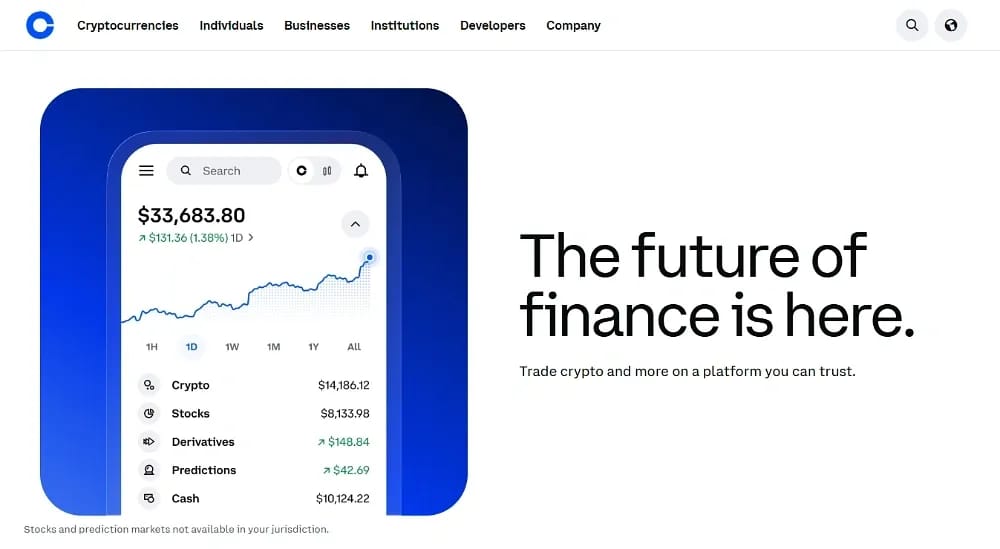
Coinbase remains the cleanest institutional proxy for the sector, and in May 2025 became the first crypto-native company added to the S&P 500. That inclusion forced index funds to hold it, structurally embedding crypto exposure into ordinary retirement portfolios for the first time.
We rate its revenue mix as the sector's most durable. Trading fees fluctuate with volumes, but subscription and services income from custody, staking and USDC economics provides a base that does not vanish when speculation cools, as our Coinbase review covers in detail.
What we like considerably less is the 2026 share performance. The stock fell roughly 10% year-to-date after October 2025's liquidation cascade destroyed speculative volume, and its Base network alongside staking revenue could not fully offset that steep decline in trading fees.
Pros
- Index inclusion: S&P 500 membership means passive funds must hold it, providing structural demand independent of crypto sentiment.
- Diversified revenue: Custody, staking and subscription income cushion the trading-fee volatility that damages pure exchange competitors during downturns.
- Regulatory moat: Extensive US licensing and ETF custody mandates create barriers that offshore exchanges genuinely cannot replicate domestically.
Cons
- Volume dependency: Trading fees still drive a large revenue share, so quiet markets compress earnings faster than management guidance suggests.
- Fee compression: Competition from Robinhood and zero-fee venues pressures the retail take rate that historically funded Coinbase's margins.
- Underperformance: A roughly 10% decline in 2026 trails both Circle and the wider crypto equity group considerably.
2. Strategy (MSTR)
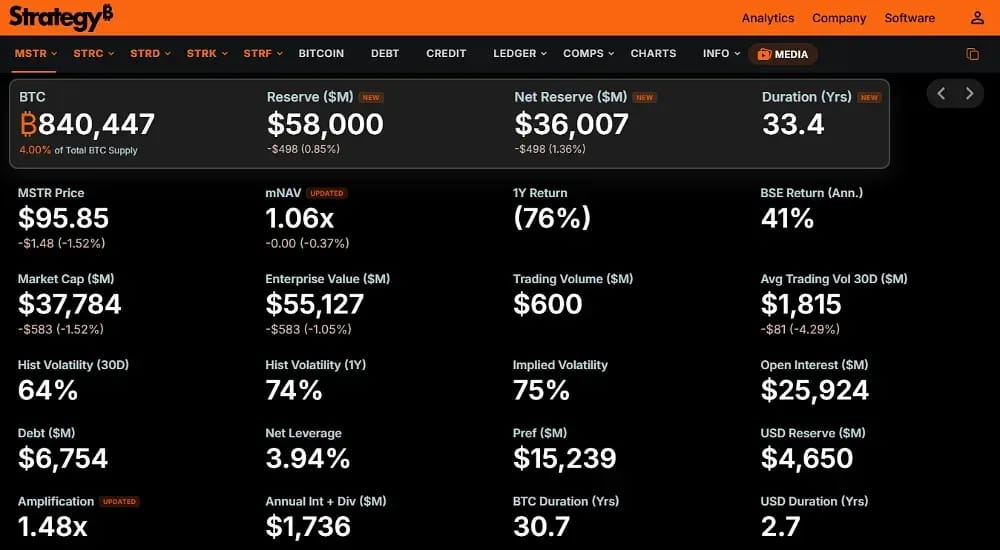
Strategy, formerly MicroStrategy, holds 672,497 Bitcoin and remains the purest leveraged equity proxy for the asset anywhere. The company funds its acquisitions through convertible debt and equity issuance, deliberately amplifying Bitcoin exposure well beyond what simply holding the token directly would provide.
We think the leverage cuts both ways more sharply than retail investors appreciate. The same capital structure that magnified gains during accumulation now magnifies drawdowns, and the shares fell roughly 47% over the past year as Bitcoin retraced from its highs.
The genuine 2026 risk is index exclusion. Potential removal from MSCI indices would force an estimated $9 billion in passive liquidation, and we consider that overhang the single most important variable for anyone holding this stock, alongside its Bitcoin treasury mark-to-market swings.
Pros
- Unmatched BTC exposure: 672,497 Bitcoin makes it the largest corporate holder, offering leveraged upside no competitor matches.
- Capital markets access: Proven ability to raise convertible debt and equity lets it accumulate through cycles when rivals cannot.
- Cash runway: Roughly $1.4 billion in reserves covers around 21 months of debt obligations during extended market weakness.
Cons
- Index exclusion risk: Potential MSCI removal could trigger around $9 billion in forced passive selling regardless of company fundamentals.
- Amplified drawdowns: Leverage that boosted returns in bull markets produced a 47% decline over the past twelve months.
- Negligible operations: Software revenue near $128.7 million quarterly is immaterial, so the equity is essentially a Bitcoin derivative.
3. Circle (CRCL)
Circle was the best-performing crypto equity of 2026, gaining roughly 30% to reach a $25.7 billion market capitalisation while most of its peers declined. That divergence exists because its revenue depends on stablecoin supply growth and Treasury yields rather than on trading volumes.
We consider the business model genuinely differentiated from its peers. Circle earns interest on the reserves backing USDC, so growth comes from adoption rather than speculation. Supply rose over 30% across twelve months, and that expansion outpaced revenue lost to declining rates.
The obvious vulnerability is rate sensitivity paired with competition. Falling yields compress margins directly, and the emerging US stablecoin framework could invite bank-issued dollar tokens into the market, which is the key question we are watching through the rest of 2026.
Pros
- Best 2026 performance: A roughly 30% gain led every crypto equity we track, driven by fundamentals rather than sentiment.
- Non-speculative revenue: Income scales with stablecoin adoption and payments usage rather than trading activity, decoupling it from market cycles.
- Regulatory alignment: Operating as a compliant issuer positions Circle favourably as US stablecoin legislation formalises the market structure.
Cons
- Rate exposure: Reserve interest drives most revenue, so sustained rate cuts compress margins in ways management cannot easily offset.
- Bank competition: New regulatory clarity may invite bank-issued dollar tokens that compete directly for institutional stablecoin share.
- Single product: USDC dominates the business, so any loss of confidence in that token threatens the entire revenue base.

4. Robinhood (HOOD)
Robinhood earns its place on distribution and infrastructure rather than on recent share performance. It delivered record 2025 results with $4.5 billion in revenue and $68 billion in net deposits, then launched its own Layer 2 network in July 2026.
We rate Robinhood Chain as the most interesting development here. Built on Arbitrum and live from 1 July, it crossed $1 billion in volume within days and briefly recorded more trading volume than any decentralised exchange, converting 27 million brokerage users into onchain participants.
What we dislike is the sharp 2026 reality check that followed. Shares fell roughly 27% year-to-date after a first-quarter earnings miss, and crypto segment revenue dropped nearly 40% in Q2, showing how quickly retail trading income evaporates once speculative activity cools.
Pros
- Enormous distribution: 27 million users give it an onboarding funnel into crypto that no competitor here can replicate.
- Chain infrastructure: Robinhood Chain converts brokerage customers into onchain users while capturing settlement economics on its own Layer 2.
- Diversified brokerage: Equities, options and retirement products mean crypto weakness does not collapse the entire revenue base.
Cons
- Sharp 2026 decline: A roughly 27% year-to-date fall followed a Q1 miss driven by weaker than expected crypto revenue.
- Volatile crypto segment: Q2 crypto revenue fell nearly 40%, confirming how rapidly this income line contracts in quiet markets.
- Retail concentration: Revenue skews toward retail trading behaviour, which historically proves the least durable flow during extended downturns.

5. Bitmine (BMNR)
Bitmine has become the largest corporate Ethereum holder anywhere in the world, accumulating 5.77 million ETH worth roughly $10.2 billion. Total holdings across crypto, cash and venture positions now reach $11.3 billion, making it the second-largest crypto treasury behind only Strategy.
The staking economics are what genuinely separate it from passive treasury vehicles. Bitmine has staked 4.92 million ETH through its MAVAN validator network, generating $242 million in annualised revenue at a 2.70% yield, with full deployment projected to reach $284 million.
We view BMNR's Russell 1000 inclusion in June 2026 as the structural catalyst. Index membership brings passive institutional ownership, and the company now holds 4.8% of total ETH supply while pursuing a stated 5% target, though that concentration is precisely what makes it risky.
Pros
- Productive treasury: Staking 85% of its ETH generates $242 million annually, unlike Bitcoin treasuries that hold non-yielding assets.
- Index inclusion: Russell 1000 membership since June 2026 attracts passive institutional flows that were previously unavailable to the company.
- Scale advantage: Holding 4.8% of all ETH supply makes it the definitive listed proxy for Ethereum staking exposure.
Cons
- Extreme concentration: Nearly the entire balance sheet sits in one asset, so an ETH drawdown directly destroys shareholder value.
- Dilution risk: Continued accumulation toward the 5% target requires ongoing equity issuance that dilutes existing shareholders meaningfully.
- Yield compression: Staking returns at 2.70% fall as more ETH is staked network-wide, gradually eroding the revenue thesis.

6. Galaxy Digital (GLXY)
Galaxy Digital is the most diversified operator on this list, combining institutional trading, asset management and investment banking across roughly $17 billion in assets under management. That breadth means no single revenue line determines the company's outcome in any given quarter.
We like the infrastructure pivot most of all. Galaxy is expanding its Helios campus to 800 megawatts serving both AI and crypto compute workloads, targeting $1 billion in annual revenue from contracted capacity rather than from volatile trading fees or principal investment gains.
The trade-off is execution risk on a large capital project. Data centre buildouts run over budget and behind schedule routinely, and the company's roughly $1.9 billion in cash and stablecoins must fund that expansion while absorbing trading revenue that swings violently between quarters.
Pros
- Genuine diversification: Trading, asset management, banking and infrastructure revenue reduce dependence on any single crypto market condition.
- AI compute pivot: The 800 megawatt Helios expansion targets $1 billion in contracted revenue largely uncorrelated with token prices.
- Institutional relationships: Established prime brokerage and banking mandates create recurring client revenue that retail-facing competitors cannot access.
Cons
- Smallest market cap: At roughly $7.8 billion it carries less liquidity and more share price volatility than larger peers.
- Project execution risk: Large data centre buildouts frequently overrun on cost and timeline, straining balance sheets during construction phases.
- Lumpy earnings: Principal investment gains create quarterly results that swing dramatically, making the business genuinely hard to value.

7. Block (XYZ)
Block closes our list on consumer reach rather than on crypto purity. Cash App reaches tens of millions of monthly active users, and its merchant terminals give the company distribution into everyday commerce that no other business on this list can match.
Its Bitcoin commitment is genuine rather than merely promotional. Block develops mining hardware, self-custody products and Lightning Network integration, positioning Bitcoin as functional payment infrastructure instead of a treasury asset, which is a meaningfully different thesis from Strategy's accumulation approach.
We rank it last because the financials disappointed. Gross profit grew 17% to $12 billion, but heavy operating expenditure produced a $3 billion net loss and the shares corrected roughly 23%, so the Rule of 40 target management now emphasises matters considerably.
Pros
- Mass consumer reach: Cash App and Square terminals provide crypto distribution into everyday commerce far beyond crypto-native audiences.
- Payment-first thesis: Lightning integration and mining hardware treat Bitcoin as functional infrastructure rather than a speculative balance sheet asset.
- Gross profit growth: A 17% increase to $12 billion shows the underlying payments business continues expanding despite crypto weakness.
Cons
- Heavy losses: A $3 billion net loss from elevated operating expenditure raises real questions about cost discipline and capital allocation.
- Diluted exposure: Crypto is a modest share of the business, so this is a fintech holding with Bitcoin optionality attached.
- Share weakness: A roughly 23% correction reflects investor scepticism about profitability rather than any specific crypto market condition.

What are Crypto Stocks?
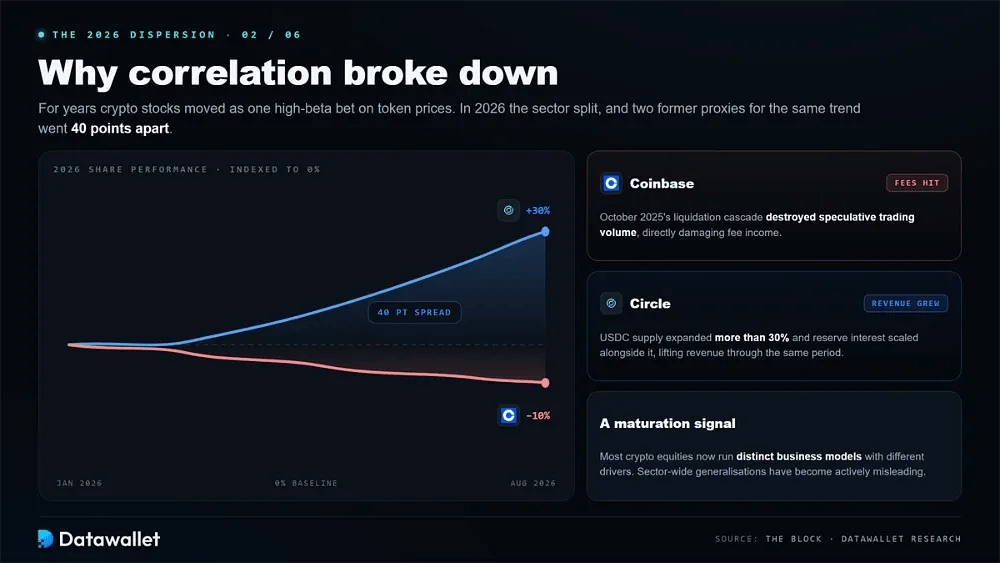
Crypto stocks are shares in publicly listed companies whose underlying revenue depends on blockchain and digital asset activity. They span exchanges, treasury vehicles, stablecoin issuers, miners, payment processors and infrastructure providers, all traded on conventional exchanges under standard securities regulation.
The appeal is access without any of the operational complexity. Buying shares requires only a brokerage account, so investors avoid wallet management, seed phrase security and self-custody risk entirely, while retaining the disclosure requirements and investor protections that regulated equity markets already provide.
These stocks are not equivalent to holding tokens directly. A company adds operational risk, management decisions, dilution, debt and execution failures on top of underlying asset exposure, which can either amplify returns or destroy them independently of what the token itself does.
That distinction matters most for treasury companies. Strategy and Bitmine trade at premiums or discounts to their net asset value depending on sentiment, so investors are buying both the underlying asset and the market's opinion of the vehicle holding it.
The 2026 Dispersion in Crypto Equities
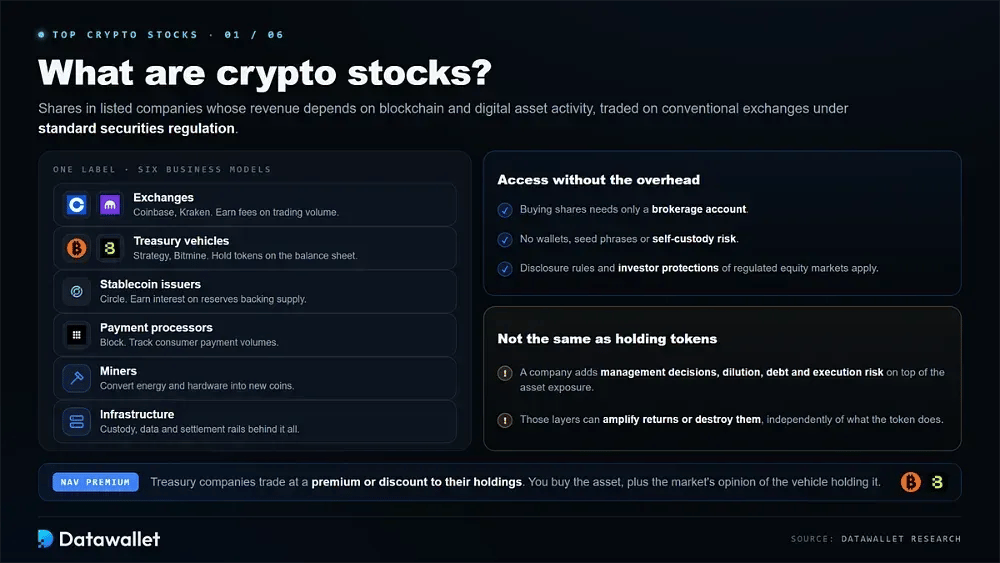
For years, crypto stocks moved together as a single high-beta bet on token prices, tracking overall digital asset treasury sentiment almost mechanically. That relationship broke down during 2026, and the resulting dispersion is the most important development for anyone building sector exposure this year.
Why Correlation Broke Down
The evidence is genuinely stark. Circle gained roughly 30% while Coinbase fell about 10% over the same period, a 40-point spread between two companies that an investor in 2023 would have treated as effectively interchangeable proxies for the same underlying trend.
The underlying cause here is straightforward revenue divergence between them. October 2025's liquidation cascade destroyed speculative trading volume, which directly damaged Coinbase's fee income, while Circle's revenue actually grew because USDC supply expanded more than 30% and reserve interest scaled alongside it.
We read this as a genuine maturation signal rather than a temporary anomaly. As The Block noted, most crypto equities now have distinct business models responding to genuinely different drivers, which means sector-wide generalisations have become actively misleading for investors.
What Actually Drives Each Business
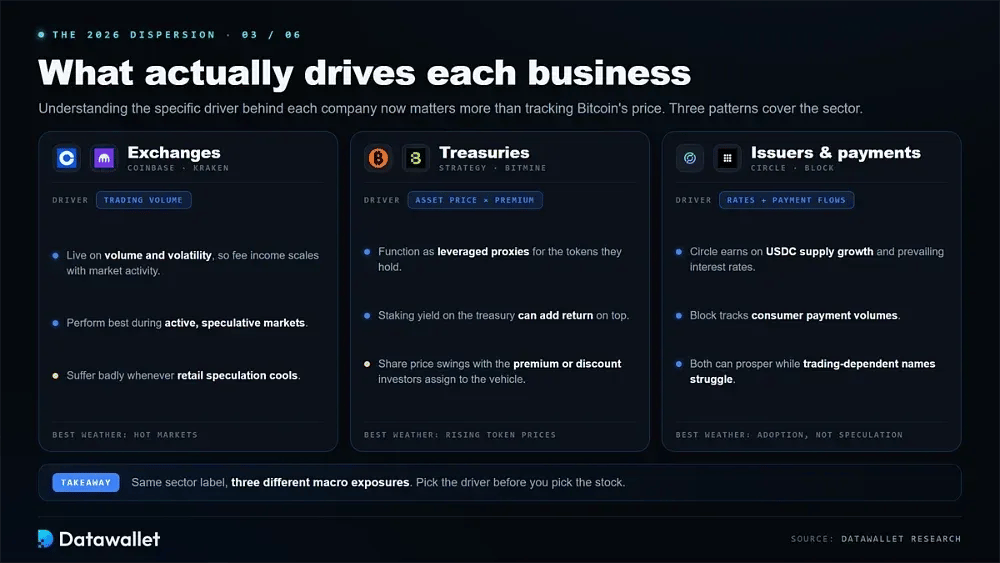
Understanding the specific driver behind each company now matters more than simply tracking Bitcoin's price. Exchanges like Coinbase and Kraken live on trading volume and volatility, so they perform best during active markets and suffer badly whenever retail speculation cools.
Treasury vehicles behave differently in almost every respect. Strategy and Bitmine function as leveraged asset proxies, where the share price tracks underlying holdings adjusted for whatever premium or discount investors assign, plus any yield the treasury itself generates through staking.
Stablecoin issuers and consumer payment businesses follow a third distinct pattern entirely. Circle depends on supply growth and on prevailing interest rates, while Block tracks consumer payment volumes, meaning both can prosper during periods when trading-dependent names are struggling badly.
How to Choose a Crypto Stock
Selecting among these seven companies really means deciding which specific underlying exposure you actually want, since the crypto stock label now broadly covers businesses with almost nothing in common beyond a shared association with digital assets and their market statistics.
Work through these factors before committing capital to any position:
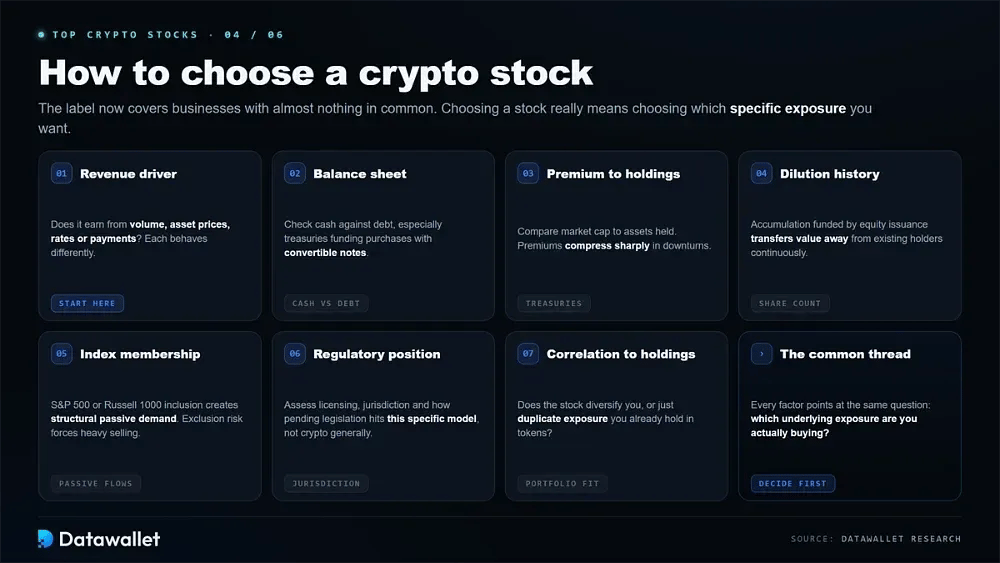
- Revenue driver: Identify whether earnings depend on trading volume, asset prices, interest rates or payment flows, since each behaves differently.
- Balance sheet quality: Check cash reserves against debt obligations, particularly for treasury companies funding purchases through convertible notes and equity issuance.
- Premium to holdings: For treasury vehicles, compare market cap against the value of assets held, since premiums compress sharply during downturns.
- Dilution history: Review share count growth, because companies funding accumulation through equity issuance transfer value away from existing shareholders continuously.
- Index membership: Inclusion in the S&P 500 or Russell 1000 creates structural passive demand, while exclusion risk can force heavy selling.
- Regulatory position: Assess licensing, jurisdiction and how pending legislation affects the specific business model rather than crypto generally.
- Correlation to holdings: Determine whether the stock adds diversification or simply duplicates exposure you already have through tokens directly.
Can I Buy Crypto Stocks Onchain?
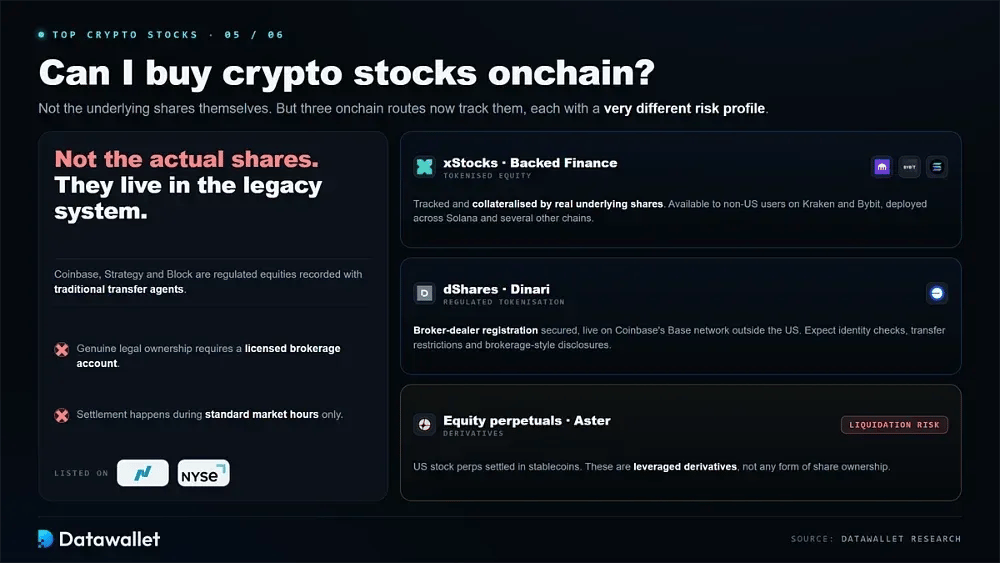
Not the actual underlying shares themselves. Coinbase, Strategy and Block are all regulated equities recorded with traditional transfer agents and traded on Nasdaq or the NYSE, so genuine legal ownership requires a licensed brokerage account and settlement during standard market hours.
Tokenised equity is the closest available alternative to genuine ownership today. Backed Finance's xStocks track and are collateralised by real underlying shares, available to non-US users through tokenised stock platforms including Kraken and Bybit, with tokens deployed across Solana and several other chains.
Regulated tokenisation is advancing along a separate track entirely. Dinari secured broker-dealer registration for tokenised equities branded dShares, already accessible on Coinbase's Base network outside the United States, though you should expect identity verification, transfer restrictions and brokerage-style disclosures throughout.
Equity perpetuals offer a third possible route carrying meaningfully different risk. Venues such as Aster now list US stock perpetuals settled in stablecoins, but these are leveraged derivatives carrying real liquidation risk rather than any form of genuine underlying share ownership.
Risks of Crypto Stocks
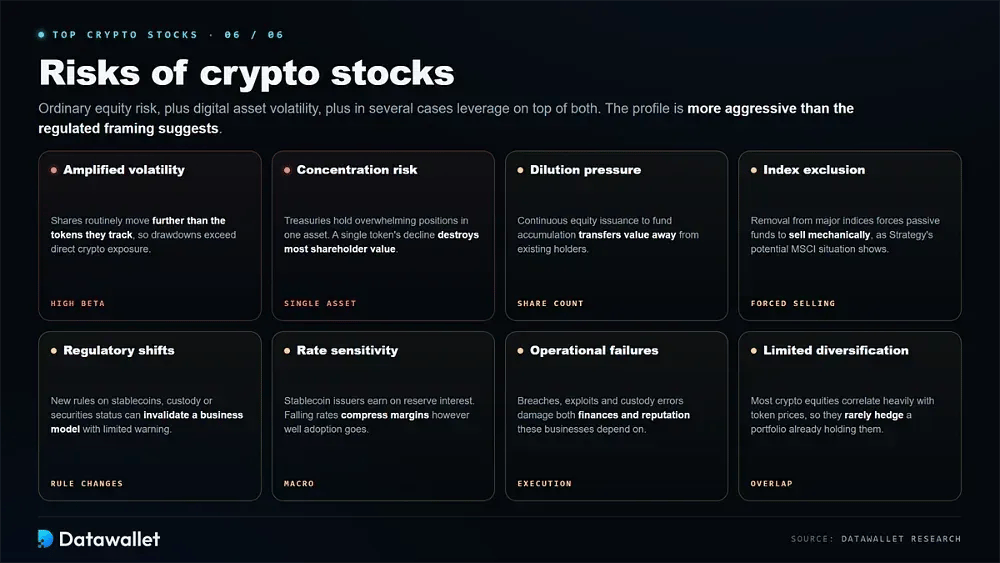
Crypto equities combine ordinary stock market risk with the volatility of the underlying digital assets, and in several cases add leverage on top of both. The result is a risk profile considerably more aggressive than the sector's regulated framing suggests.
Consider each of these before allocating capital to any position:
- Amplified volatility: These shares routinely move further than the tokens they track, so drawdowns exceed what direct crypto exposure would produce.
- Concentration risk: Treasury companies hold overwhelming positions in one asset, meaning a single token's decline directly destroys most shareholder value.
- Dilution pressure: Firms funding accumulation through equity issuance continuously increase share count, transferring value away from existing holders over time.
- Index exclusion: Removal from major indices forces passive funds to sell mechanically, as Strategy's potential MSCI situation demonstrates clearly.
- Regulatory shifts: Changing rules on stablecoins, custody or securities classification can invalidate an entire business model with limited warning.
- Rate sensitivity: Stablecoin issuers earn from reserve interest, so falling rates compress margins regardless of how adoption itself performs.
- Operational failures: Security breaches, smart contract exploits or custody errors damage both finances and the reputation these businesses depend upon.
- Limited diversification: Most crypto equities correlate heavily with token prices, so they rarely hedge a portfolio already holding digital assets.
Final Thoughts
Crypto stocks in 2026 finally stopped behaving as one single correlated trade. Circle's 30% gain measured against Coinbase's 10% decline proved that individual revenue models now matter far more than the sector label, and that dispersion looks likely to widen rather than reverse.
Coinbase remains our overall pick for its S&P 500 status and genuinely diversified income, while Strategy offers the purest leveraged exposure for any investor genuinely comfortable with that degree of single-asset concentration risk. Circle earns attention for delivering growth that did not depend on speculation at all.
Nothing here constitutes investment advice, and we are not financial advisers. Every company listed carries real risk of permanent loss, valuations move faster than fundamentals, and anyone considering these positions should verify current figures and consult a qualified professional first.
Our Methodology
We evaluated each of the seven companies using published financial filings, quarterly earnings reports, live market data and disclosed treasury holdings rather than analyst price targets, deliberately prioritising businesses with verifiable operating revenue over those whose entire value rests on asset appreciation.
Six criteria shaped the final ranking:
- Revenue durability: We assessed how much income survives a downturn in token prices rather than depending entirely on speculative activity.
- Balance sheet strength: We compared cash reserves, debt obligations and runway, particularly for companies funding acquisitions through leverage or issuance.
- Business differentiation: We weighted companies with defensible positions such as licensing, index inclusion or distribution over undifferentiated asset holders.
- Concentration exposure: We penalised heavy single-asset dependency, since treasury vehicles amplify both upside and drawdown well beyond token movements.
- Governance and disclosure: We reviewed reporting quality, insider ownership and how transparently each company communicates holdings and dilution to shareholders.
- Structural catalysts: We considered index membership, regulatory clarity and tokenised equity rails creating demand independent of market sentiment.
Market capitalisations and performance figures move daily in this sector, so our research cycle ran from March through July 2026, with every figure verified against official company filings and live market data before publication rather than sourced from secondary summaries.