


Which Countries Does Bitunix Restrict?
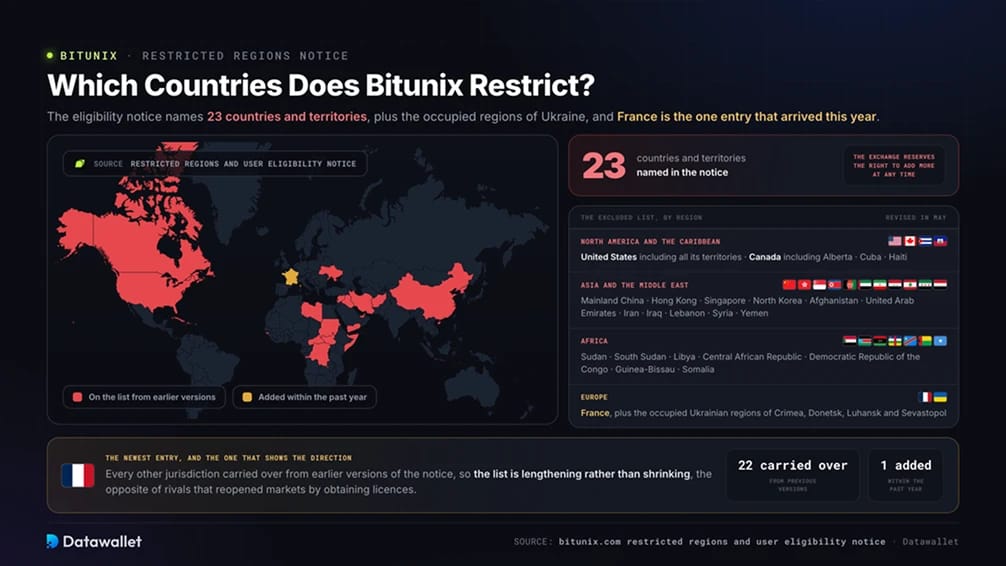
Bitunix publishes its excluded markets in an official restricted regions and user eligibility notice, most recently revised in May. The document names 23 countries and territories, adds the Russian-occupied regions of Ukraine, and reserves the right to exclude further jurisdictions at any time.
France stands out because it arrived on the list within the past year. Every other entry has carried over from earlier versions of the notice, so the list is lengthening rather than shrinking, a pattern that runs opposite to rivals like Bybit, which reopened the UK and India through licences.
Anyone living in a blocked market should look at decentralised exchanges or a platform licensed in their own country.
Why Does Bitunix Block These Jurisdictions?
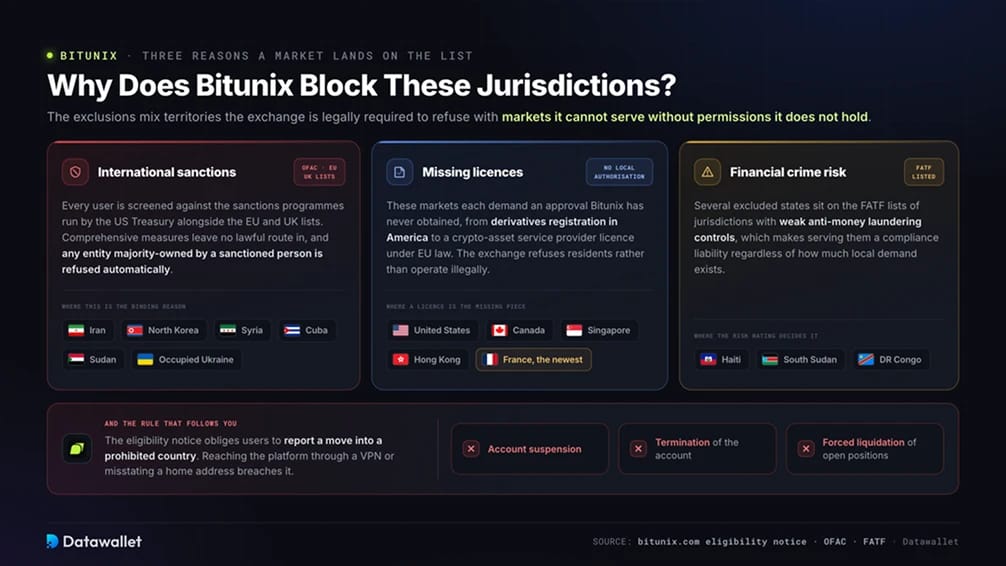
The exclusions mix territories Bitunix is legally required to refuse with markets it cannot serve without permissions it does not hold.
These are the main reasons a country ends up excluded:
- International sanctions: Bitunix screens every user against the US Treasury's OFAC programmes as well as the EU and UK sanctions lists. Iran, North Korea, Syria, Cuba, Sudan, and the occupied Ukrainian territories fall under comprehensive measures, and any entity majority-owned by a sanctioned person is refused automatically.
- Missing licences: The United States, Canada, Singapore, Hong Kong, and now France each demand authorisations Bitunix has not obtained, from derivatives registration in America to a crypto-asset service provider licence under EU law. The exchange refuses residents of these markets rather than operate illegally.
- Elevated financial crime risk: Several excluded states, including Haiti, South Sudan, and the Democratic Republic of the Congo, appear on the FATF lists of jurisdictions with weak anti-money laundering controls, which makes serving them a compliance liability regardless of local demand.
- Residency enforcement: The eligibility notice obliges users to report a move into a prohibited country. Reaching the platform through a VPN or misstating a home address can trigger account suspension, termination, and forced liquidation of open positions.
Bitunix Supported Countries
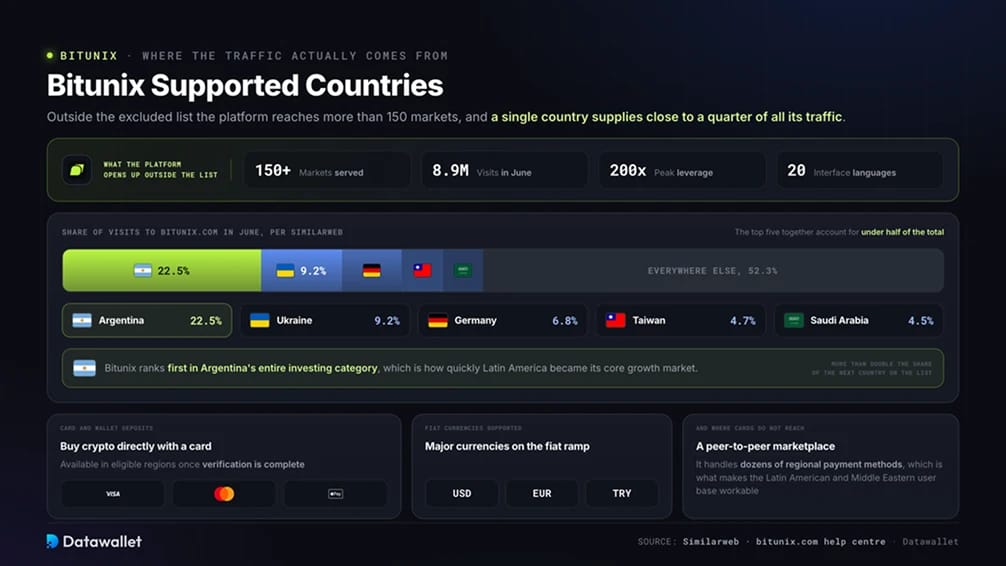
Outside the excluded list, Bitunix advertises availability in more than 150 markets, covering spot trading, perpetual futures with up to 200x leverage, copy trading, and the Earn yield programme.
Traffic figures show where the user base sits. According to Similarweb, bitunix.com recorded 8.9 million visits in June, led by Argentina at 22.5%, Ukraine at 9.2%, Germany at 6.8%, Taiwan at 4.7%, and Saudi Arabia at 4.5%. The site ranks first in Argentina's entire investing category, evidence of how quickly Latin America has become its core growth market.
Users can buy crypto with Visa, Mastercard, or Apple Pay in major currencies including USD, EUR, and TRY, while a peer-to-peer marketplace handles dozens of regional payment methods and the interface runs in 20 languages.
Can I Use Bitunix in Europe Under MiCA?
France is formally blocked, and the rest of the EU now sits in a legal grey zone. MiCA, the EU regulation that created a single licensing rulebook for crypto platforms, closed its transition period on 1 July, and from that date any firm serving EEA residents needs a crypto-asset service provider authorisation from a member state. Bitunix does not appear in ESMA's register of authorised providers.
The French exclusion came first and carries the clearest paper trail. The AMF, France's markets regulator, blacklisted bitunix.com in March 2025 for offering crypto derivatives without authorisation, and Bitunix later wrote France into its own eligibility notice rather than contest the finding.
No other EU country appears on that notice, which leaves European users in an unusual position. Binance suspended EU services when it missed the same deadline, and Bybit moved its European customers onto a licensed Vienna entity, yet Bitunix has published no EEA transition plan while Germany alone still supplies close to 7% of its traffic. An unauthorised platform owes EEA clients none of MiCA's protections, meaning no segregated client asset rules, no EU complaint procedures, and no conduct supervision by a European regulator.
Europeans who want those safeguards can compare the MiCA-licensed crypto exchanges that cleared the authorisation bar, or browse our wider guide to the best crypto exchanges in Europe.
Is Bitunix Available in the USA?
No, the United States heads the excluded list and every US territory is named alongside it. Bitunix holds a FinCEN Money Services Business registration, but that filing covers anti-money laundering reporting only, and offering 200x leverage futures to American retail traders would require derivatives registrations the exchange has never pursued.
OKX pleaded guilty in early 2025 to serving US customers without a licence and paid over $500 million in penalties, a precedent that pushed offshore derivatives platforms to tighten their geographic blocking. Bitunix blocks American IP addresses and rejects US identity documents at verification, and VPN access risks termination with open positions liquidated.
American traders can instead pick from the regulated platforms in our guide to the best crypto exchanges in the USA.
Bitunix Licences and Regulation
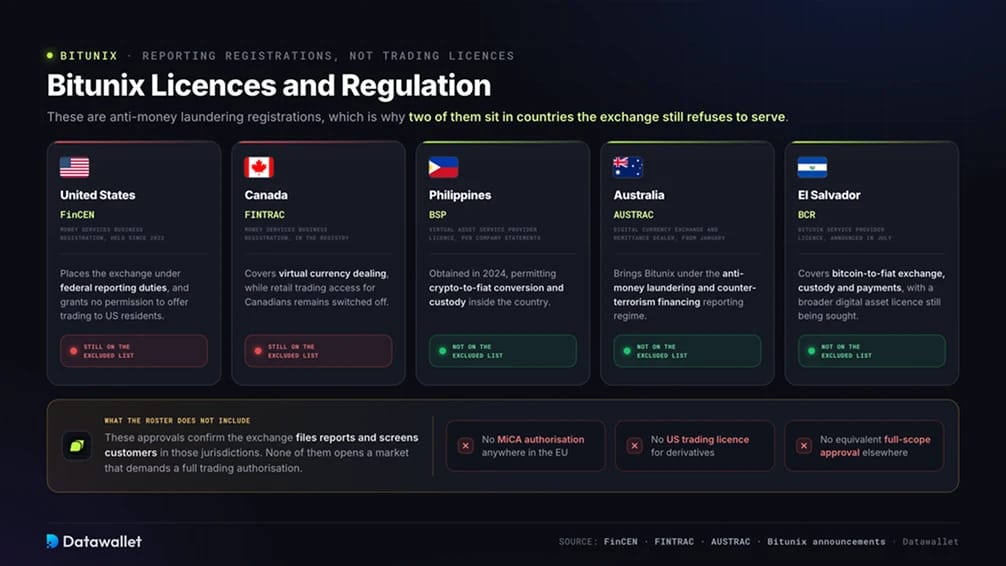
Bitunix has assembled a set of registrations that lean towards anti-money laundering oversight rather than full market authorisations, and the roster has grown this year.
These are the approvals the exchange holds or has announced:
- United States (FinCEN): An MSB registration held since 2022 places Bitunix under federal reporting duties for money services, though it grants no permission to offer trading to US residents.
- Canada (FINTRAC): A money services business registration, searchable in the FINTRAC registry, covers virtual currency dealing while retail trading access for Canadians remains switched off.
- Philippines (BSP): Company announcements describe a virtual asset service provider licence obtained from the Bangko Sentral ng Pilipinas in 2024, permitting crypto-to-fiat conversion and custody services in the country.
- Australia (AUSTRAC): A registration as a digital currency exchange and independent remittance dealer took effect this January, bringing Bitunix under AUSTRAC's AML and counter-terrorism financing reporting regime.
- El Salvador (BCR): In July the exchange announced a Bitcoin Service Provider licence from the Central Reserve Bank, covering bitcoin-to-fiat exchange, custody, and payments, with a broader digital asset licence still being sought.
None of these registrations amounts to a MiCA authorisation, a US trading licence, or an equivalent full-scope approval. They confirm the exchange files reports and screens customers in those jurisdictions, and they explain why its restricted list keeps growing wherever regulators demand more than AML compliance.
Bitunix KYC Requirements
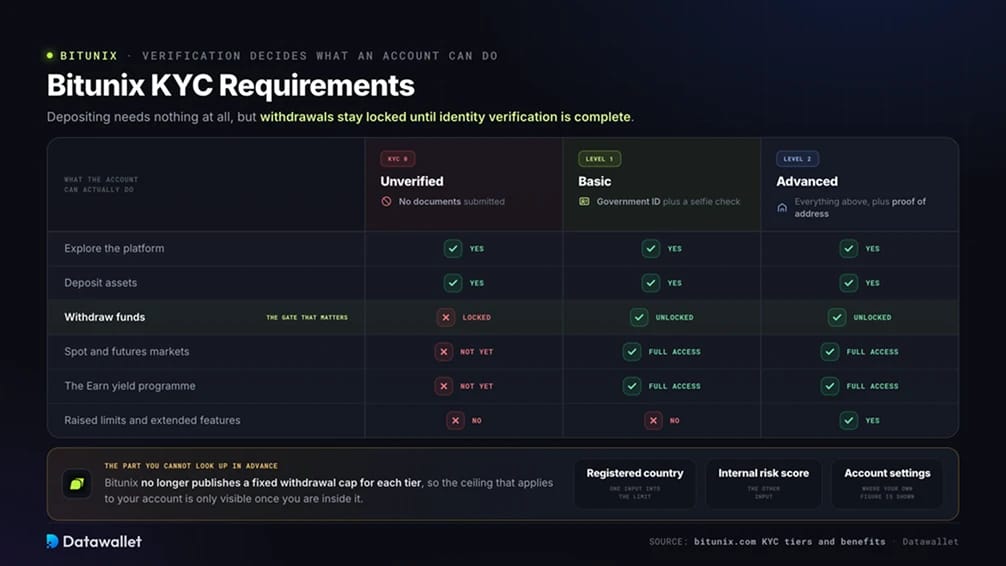
Bitunix treats withdrawals as a regulated service, so identity verification decides what an account can do.
Here is what each verification level covers:
- KYC 0 (Unverified): Account holders can explore the platform and deposit assets, but withdrawals stay locked until verification is complete.
- Level 1 (Basic): Submitting a government-issued ID with a selfie check unlocks withdrawals along with full access to spot trading, futures markets, and the Earn programme.
- Level 2 (Advanced): Adding a recent proof of address document raises account limits and opens extended features aimed at higher-volume traders.
Bitunix no longer publishes fixed withdrawal caps for each tier. Limits now vary by registered country and internal risk assessment, and the figure that applies to a given account is displayed inside its settings.
Is Bitunix Safe?
Bitunix has recorded no hacking incident since trading began in 2022, and the bulk of user funds sits in multi-signature cold storage. A Proof of Reserves page built on Merkle tree verification lets users confirm their balances are backed 1:1 by on-chain holdings.
The Bitunix Care Fund, a $30 million USDC reserve, exists to compensate users after any platform-wide breach, and the independent auditor CER.live rates the exchange BBB with strong marks for penetration testing and its bug bounty programme.
Asset security and legal standing are separate questions, and Bitunix scores far better on the first than the second.
About Bitunix
Bitunix was founded in 2021 and opened for trading the following year, operating through an entity registered in Saint Vincent and the Grenadines. The product is built around derivatives, with 500+ perpetual futures pairs, leverage to 200x, a copy trading marketplace, and multi-chart tooling aimed at active traders.
Growth has been fast enough to place the platform among the busiest offshore futures venues, competing directly with BingX, Bitget, and BloFin for the same trader profile. Our full Bitunix review covers fees, features, and platform testing in depth.
Final Thoughts
Most exchange restriction pages describe a static list of sanctioned states. The Bitunix version is a moving document, and the direction of travel matters more than the count, because France's arrival shows what happens when a major regulator acts and the exchange has no licence to answer with.
Europe is now the open question. The AML-style registrations Bitunix keeps collecting satisfy reporting regimes in Washington, Ottawa, Canberra, and San Salvador, yet none of them opens a market that demands a full trading authorisation, and the EU has become exactly that kind of market.
Anyone checking access from a specific country should treat the eligibility notice on the Bitunix help centre as the definitive record, since the exchange updates it as regulators move.