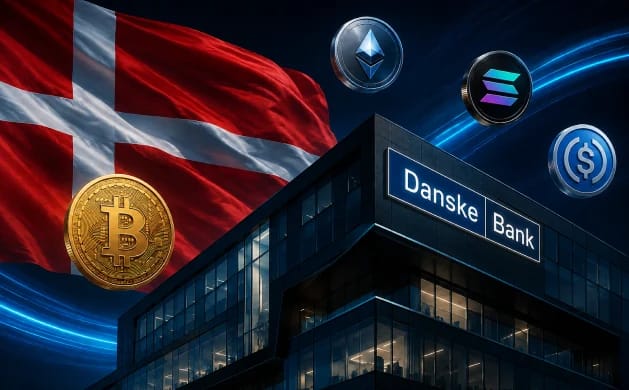



Can I Buy Bitcoin with Danske Bank?
There are two routes. Since February, Danske has listed three crypto ETPs from BlackRock and WisdomTree that track Bitcoin and Ethereum. They are available through Danske eBanking and the mobile bank after completing a suitability questionnaire. To buy coins that can be withdrawn to a personal wallet, customers must fund a MiCA-authorised exchange.
Danske has never blocked exchange payments. Its published position keeps card payments and bank transfers available. Money returned from an exchange is treated like any other investment deposit, although anti-money-laundering checks may apply. The main difference between markets is currency:
- Denmark: Payments to exchanges are permitted, but accounts operate in kroner, so Danske converts every euro deposit.
- Finland: Accounts already use euros, allowing SEPA transfers to arrive without currency conversion.
- Sweden: The policy is the same, with kronor converted instead. Our best crypto exchanges in Sweden guide covers the market in more detail.
Norway is the exception. Danske transferred its 235,000 Norwegian personal customers to Nordea in November 2024. Customers there now follow Nordea's crypto rules.
How to Buy Crypto with Danske Bank
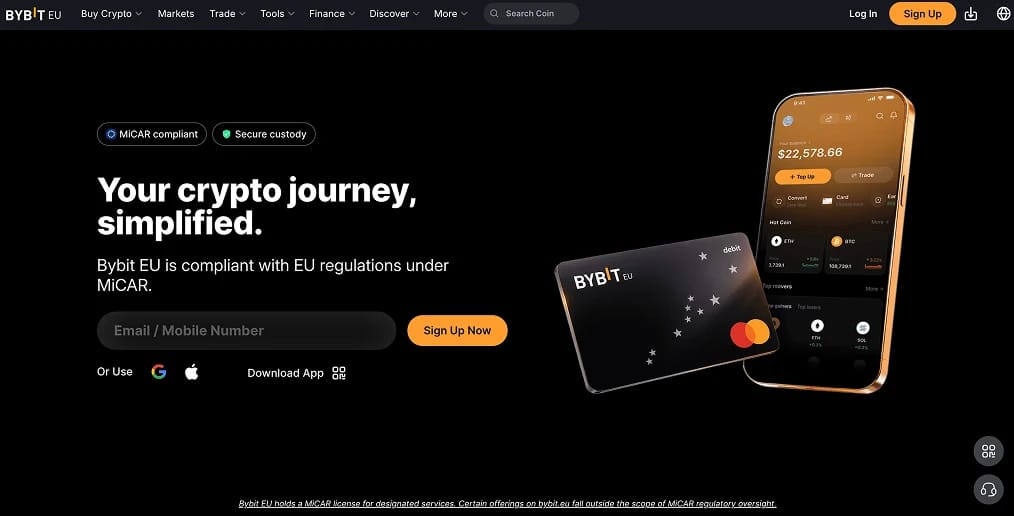
The cheapest route to direct crypto ownership is a euro transfer from Danske Bank to Bybit. Bybit EU is MiCA-authorised, charges nothing for deposits and applies a 0.10% spot trading fee, which undercuts every broker available to Danish customers. Our test transfer from a Danish account cleared without a hold. The currency conversion margin was the only meaningful cost.
Steps to buy crypto with Danske Bank:
- Create and verify a Bybit account: Register with Bybit and complete identity checks (KYC) using a passport or driving licence. Bybit EU GmbH onboards Danish, Finnish and Swedish residents under its Austrian licence.
- Copy the EUR deposit details: Open Deposit in Bybit, select EUR and choose SEPA. Copy the IBAN, beneficiary name Bybit EU GmbH and reference code. Missing the reference is the most common reason for a deposit entering manual review.
- Check your Danske payment limit: Review the paying account's transfer limit in the mobile bank or eBanking. Limits depend on the account agreement. They can usually be raised through the app or an adviser within a day.
- Send the transfer and approve with MitID: Set up an international euro payment to Bybit's IBAN. For Danish accounts, Danske converts kroner at its listed rate. The krone's euro peg keeps this rate near 7.46. Approve the payment with MitID, and it will typically arrive on the same or next business day.
- Buy your asset: After the euros arrive, open the spot market and select BTC/EUR or another trading pair. Place a limit order. Bybit's one-click purchase screen includes a wider spread than the 0.10% order book fee, so we only use it for a small initial test.
Fees, Tax and Transfer Limits for Danske Bank Customers
Danske adds few costs beyond currency conversion. Exchange charges are modest, while Danish tax is by far the largest expense.
Danske Bank costs and limits
- Euro transfers: Under the EU cross-border payments rules, euro transfers to another EU country must cost the same as domestic transfers. They are free when customers send them through the app or eBanking.
- Currency conversion: This is unavoidable when funding an exchange from a Danish or Swedish account. Danske applies its own rate when converting kroner or kronor into euros, making the conversion margin the primary purchase cost.
- Card payments: Danske permits crypto purchases with its debit and credit cards. The bank's published mark-up on European currencies is 1.53%, on top of any card fee charged by the exchange.
- Instant kroner transfers: Straksoverførsler can only reach Danish accounts and cannot fund a euro IBAN. MobilePay is limited to person-to-person and merchant payments, so it cannot be used to pay an exchange.
- Payment limits: Danske does not publish a crypto-specific cap. The ordinary transfer limit in the customer's account agreement therefore applies to exchange payments.
- AML screening: Large or first-time exchange payments may prompt questions from the bank. Keeping exchange statements available can resolve them quickly.
Bybit fees
- SEPA deposit: Free. SEPA Instant payments are credited within minutes.
- Spot trading: Standard-tier maker and taker fees are 0.10%, among the lowest offered by any MiCA-licensed venue. Our Bybit review examines the wider product range.
- Card deposit: Approximately 1.5% on top of Danske's currency mark-up. This may suit a small test purchase but becomes expensive for larger amounts.
- Crypto withdrawal: Only the network fee applies. On low-cost chains, transferring coins to a hardware wallet costs less than one euro.
Danish tax on crypto
- Personal income tax: Skattestyrelsen classifies crypto purchased for speculation as a personal asset. Gains are taxed like earned income at rates of up to 53%, excluding the 8% labour market contribution. Tax is calculated trade by trade using FIFO.
- Asymmetric losses: Gains are entered in box 20 of the tax assessment notice, while losses go in box 58 and provide a deduction worth roughly 26%. Even a year with no net profit can produce a tax bill. Every crypto-to-crypto swap must therefore be recorded.
- DAC8 reporting: Since 1 January, EU exchanges have collected customer transaction data under DAC8 for automatic sharing with tax agencies. Skattestyrelsen will receive the same figures customers declare.
Finnish customers instead pay capital gains tax of 30% to 34%, while Swedish customers face a flat 30% tax on disposals. Crypto-to-crypto swaps are taxable in all three jurisdictions, making exported trade records important across every market where Danske operates.
Best Exchanges for Danske Bank Customers
Because Danske allows payments to any authorised platform, the main points of comparison are licensing, supported funding currencies and trading costs. Every exchange listed below can lawfully serve Danish customers under MiCA. Our best crypto exchanges in Denmark guide ranks the broader market.
Bitpanda is included because it operates a Danish krone account, removing the need for euro conversion. It becomes cost-effective when its 1.49% trading fee is lower than Danske's conversion margin for the transfer amount.
Danske Bank Cryptocurrency Policy
Danske has moved further into crypto during the past year than it did over the previous eight years combined. Its 2021 position paper advised customers against the asset class and excluded crypto trading from the bank's platforms. Even then, Danske committed to keeping card payments and transfers to exchanges open.
That position remained unchanged until the ETP launch. Danske describes these products as opportunistic investments, provides no advice and requires customers to pass a knowledge test before gaining access.
Its institutional activity is more ambitious. Danske is a founding member of the nine-bank consortium developing a MiCA-compliant euro stablecoin. The project is incorporated in the Netherlands, operates under Dutch central bank supervision and plans its first issuance for the second half of the year.
Regulation now performs much of the gatekeeping previously handled by the bank. The MiCA transition ended on 1 July. Only platforms holding crypto-asset service provider authorisation from Finanstilsynet, or a passported licence from another EU regulator, may serve Danish customers. Our best MiCA-licensed crypto exchanges guide tracks the authorised platforms.
About Danske Bank
Danske Bank A/S was established in Copenhagen in 1871 as Den Danske Landmandsbank. It has since become Denmark's largest bank, serving retail customers, businesses and institutions across the Nordic region. Personal banking remains available in Denmark, Finland and Sweden after the Norwegian business transferred to Nordea under the Forward '28 strategy.
The bank is also closely associated with Denmark's payment infrastructure. Danske created MobilePay, an app used daily across the country, before merging it into Vipps MobilePay. Customers now use MitID, Denmark's national digital identity system, for every login and payment approval. The group serves around five million customers and is supervised by Finanstilsynet, the Danish FSA.
Danske's trading platform gives self-directed investors access to more than 15,000 securities, including the newly listed Bitcoin and Ethereum ETPs. Bank deposits are covered by the Danish guarantee scheme. Assets held on a crypto exchange are not.
.webp)
Bottom Line
Danske Bank places fewer restrictions on crypto buyers than almost any other bank in Europe. It blocks neither exchange payments nor crypto card purchases, and no dedicated crypto cap applies. Customers who do not need direct wallet access can now obtain Bitcoin and Ethereum exposure through ETPs on the bank's own platform.
For customers who want control of their coins, we recommend Bybit. Its MiCA licence, free SEPA funding and 0.10% spot fee keep the total cost close to Danske's currency conversion charge. Enter Bybit EU GmbH as the beneficiary, include the payment reference and account for Skattestyrelsen before treating any gain as profit.