



Can I Buy USDT in Mexico?
Mexican law does not prevent individuals from buying, holding, or sending USDT. Article 30 of the Fintech Law defines a virtual asset as an electronically registered representation of value. Bitso has sold USDT to Mexican customers for years. Residents can also use Bybit, Binance, and OKX for peso deposits or P2P trades.
Banxico's Circular 4/2019 restricts institutions, barring banks and authorised fintechs from offering virtual assets to the public. No Mexican bank sells Tether, and no regulator licenses platforms to sell it. Exchanges instead register under the LFPIORPI anti-money-laundering law, which classifies virtual asset dealing as a Vulnerable Activity supervised by the SAT.
Article 30 excludes foreign currency and anything denominated in it from the definition. That leaves dollar-referenced tokens such as USDT in a grey area that Mexican lawyers still debate. The distinction has no effect on buyers. Exchanges quote USDT against pesos, and the SAT taxes gains regardless of the label.
How to Buy Tether (USDT) in Mexico
We recommend funding a verified Bybit account through SPEI from a Mexican bank account in your own name. Banxico operates SPEI, which settles in seconds and runs every hour of the year. A Sunday-night deposit arrives as quickly as one sent on Tuesday morning.
Your bank has more influence on the process than the exchange. Most Mexican banking apps set daily transfer caps and impose a cooling period on the first payment to a new CLABE. Register the exchange's CLABE a day early. Our Banorte and Banamex guides explain how each bank handles transfers.
Steps to buy USDT on Bybit with Mexican pesos:
- Create and verify your account: Register at Bybit and verify your identity with an INE credential or passport plus a selfie. Have your CURP and RFC ready, as several platforms request them on the first deposit. Our INE verification cleared in under an hour.
- Generate SPEI deposit details: Open Buy Crypto, choose Deposit Fiat, then select MXN and SPEI. Copy the 18-digit CLABE and reference exactly. A mistyped CLABE fails the check digit; a missing reference leaves the payment unmatched until support intervenes.
- Send pesos from your bank app: Add the CLABE as a beneficiary and start with a small test. Our MX$500 transfer from BBVA appeared as an MXN balance in the Funding Account in about four minutes. The full deposit arrived just as quickly. Download the CEP from Banxico's site for your acquisition records.
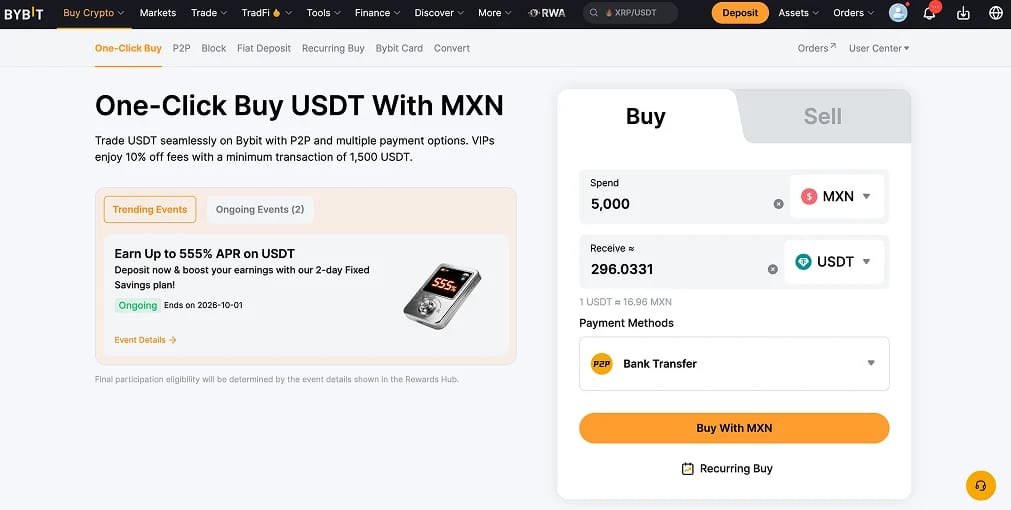
- Convert MXN to USDT: In One-Click Buy, select MXN to USDT and choose Fiat Balance as the payment method. The quote includes a spread rather than a separate commission. Compare it with the day's Banxico FIX rate before confirming, and use P2P instead if a high-reputation merchant offers a tighter price.
- Withdraw or hold: Keep USDT on the exchange, send it to a USDT wallet you control, or transfer it to another platform. TRC-20 costs about 1 USDT and confirms in under a minute, making it suitable for remittances. ERC-20 fits DeFi destinations but carries higher gas costs.
At the FIX of 16.8748 published on 4 September, one USDT cost roughly MX$16.90. Tether's peso price changes daily with the exchange rate.
MXN to USDT Fees
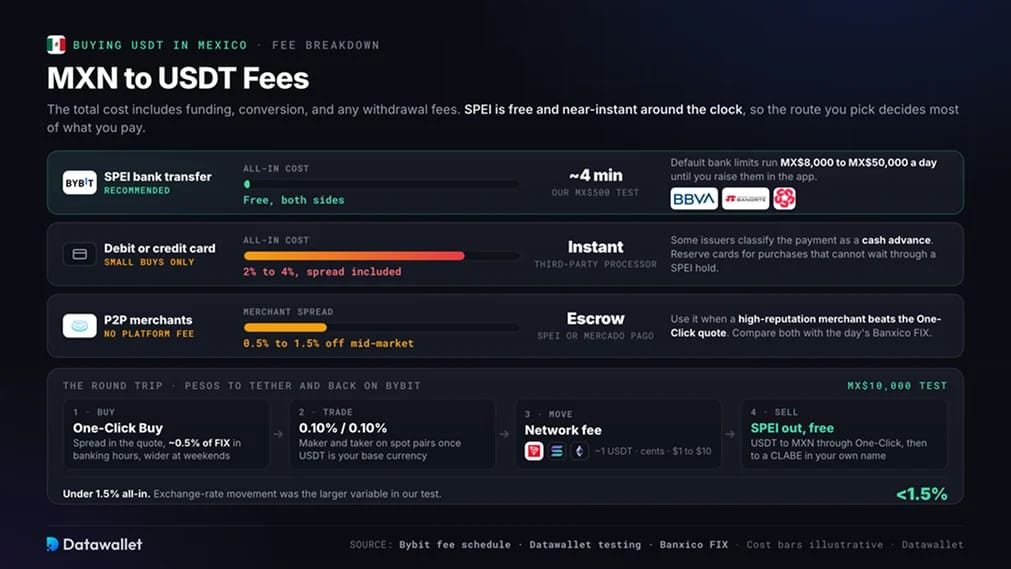
The total cost includes funding, conversion, and any withdrawal fees.
Deposits
- SPEI (recommended): Bybit charges no deposit fee, and every major Mexican bank offers free SPEI transfers through its app. Settlement is near-instant around the clock. Default bank limits often range from MX$8,000 to MX$50,000 a day until you raise them in the app.
- Debit or credit card: Third-party processing typically costs 2% to 4%, including the spread. Some issuers classify the payment as a cash advance. We reserve cards for small purchases that cannot wait through a SPEI hold.
- P2P: There is no platform fee, but merchants charge a spread. In our tests, USDT purchases settled through SPEI or Mercado Pago were usually within 0.5% to 1.5% of mid-market. Our guide to the best P2P crypto exchanges explains escrow and dispute handling.
Trading and withdrawals
- One-Click Buy from Fiat Balance: The margin is included in the quote, with no listed commission. Our test prices stayed within roughly half a percent of FIX during banking hours. Spreads widened slightly at weekends.
- Spot trading once you hold USDT: Bybit charges 0.1% maker and 0.1% taker fees on spot pairs, where USDT becomes the base currency for everything else you buy.
- USDT network fees: TRC-20 costs around 1 USDT, compared with a few cents on Solana. ERC-20 ranges from one to ten dollars, depending on Ethereum gas.
- Selling back to pesos: Convert USDT to MXN through One-Click Buy, then withdraw through SPEI to a CLABE in your own name. Our MX$10,000 round trip cost under 1.5% all-in. Exchange-rate movements were the larger variable.
See our roundup of the best USDT exchanges for a comparison of global platforms' fee structures.
Best USDT Exchanges in Mexico
We rank platforms for converting pesos to Tether by MXN funding options, USDT liquidity, fees, and regulatory standing. The best crypto exchanges in Mexico guide provides our full country comparison.
Bybit leads for peso funding and USDT depth. Buyers starting with cash or wanting a Mexican company behind their account may prefer Bitso. Binance appeals to traders who value its SAT registration, while OKX has the lowest fees once funded. Kraken suits savers willing to accept automatic dollar conversion for the strongest security history.
Regulatory Status of USDT in Mexico
Individuals can hold USDT freely, but Mexico keeps its banks out of crypto. Exchange oversight therefore comes from domestic AML law or foreign regulators.
The LFPIORPI reform published on 16 July 2025 lowered the reporting threshold for virtual asset operations from 645 to 210 UMA. That is about MX$24,635 at the current UMA value, according to the SAT's threshold table. It also brought operations conducted abroad with Mexican citizens into the regime. Offshore exchanges can no longer argue that Mexican AML law stops at the border, and identification applies from the first peso.
A peso stablecoin bill before the Senate leaves USDT untouched. Senator Alejandro Murat's initiative presented on 6 May would create Activos Virtuales Estables. Only Banxico-approved banks and IFPEs holding full 1:1 reserves could issue them, leaving dollar tokens such as USDT as foreign assets bought on exchanges. In its December 2025 financial stability report, Banxico had already compared stablecoins under run conditions with money market funds while recognising their role in remittances.
Bybit is supervised abroad. Austria's FMA granted Bybit EU GmbH a MiCA crypto-asset service provider licence on 28 May 2025, recorded in the ESMA register. The group also holds PSAV No. 48 registration with Argentina's CNV. Neither covers a Mexican account. No Mexican regulator covers any exchange because the licence does not exist, so protection rests on Bybit's controls and its record of restoring every customer balance within 72 hours after the February 2025 hack.
Tax Implications of USDT in Mexico
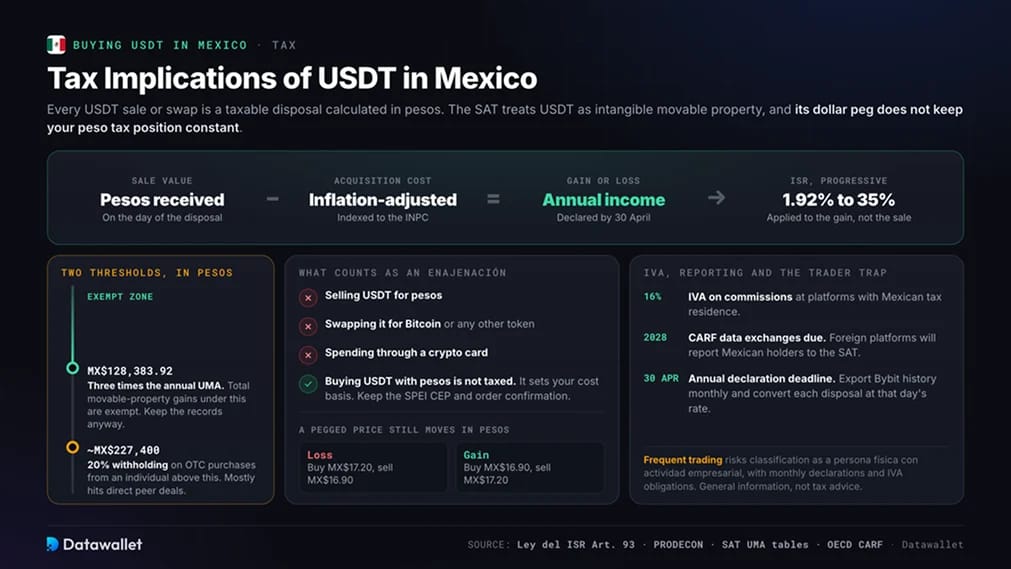
Every USDT sale or swap is a taxable disposal calculated in pesos. The SAT treats USDT as intangible movable property. Its dollar peg does not keep your peso tax position constant.
- Selling or swapping USDT is an enajenación: Selling for pesos, exchanging it for Bitcoin, and spending through a crypto card all count as disposals. Calculate the gain by subtracting the inflation-adjusted acquisition cost, indexed to the INPC, from the sale value. It forms part of your annual income, subject to progressive ISR rates of 1.92% to 35%.
- Buying USDT with pesos is not taxed: A purchase establishes your cost basis. Retain the SPEI CEP and exchange order confirmation as evidence.
- A pegged price still produces peso gains and losses: Buying at MX$17.20 and selling at MX$16.90 creates a loss; reversing those prices creates a gain. With the peso near multi-year highs, many 2025 buyers have unrealised peso losses on their stablecoin balances.
- The small-gains exemption is real: Article 93, fraction XIX(b) of the income tax law exempts individuals whose total annual gains from movable property disposals remain below three times the annual UMA. At the current value, the threshold is MX$128,383.92. You still need records proving your gains fall below it.
- The 20% withholding mostly hits OTC deals: Under PRODECON guidance, a buyer purchasing movable property from an individual above roughly MX$227,400 must withhold 20% as a provisional payment. This is more relevant to direct peer deals than exchange orders.
- IVA and reporting: Platforms with Mexican tax residence charge 16% IVA on commissions. Mexico has committed to the OECD Crypto-Asset Reporting Framework, with account data exchanges due to begin by 2028. Foreign platforms will therefore report Mexican holders to the SAT.
💡 For active users: Export your Bybit trade history monthly and convert each disposal to pesos at that day's rate. Frequent trading risks classification as a persona física con actividad empresarial, bringing monthly declarations and IVA obligations. A contador experienced in crypto is worth the fee before the 30 April annual declaration. Our guide to the best low-tax crypto countries compares Mexico with other jurisdictions. This is general information rather than tax advice.
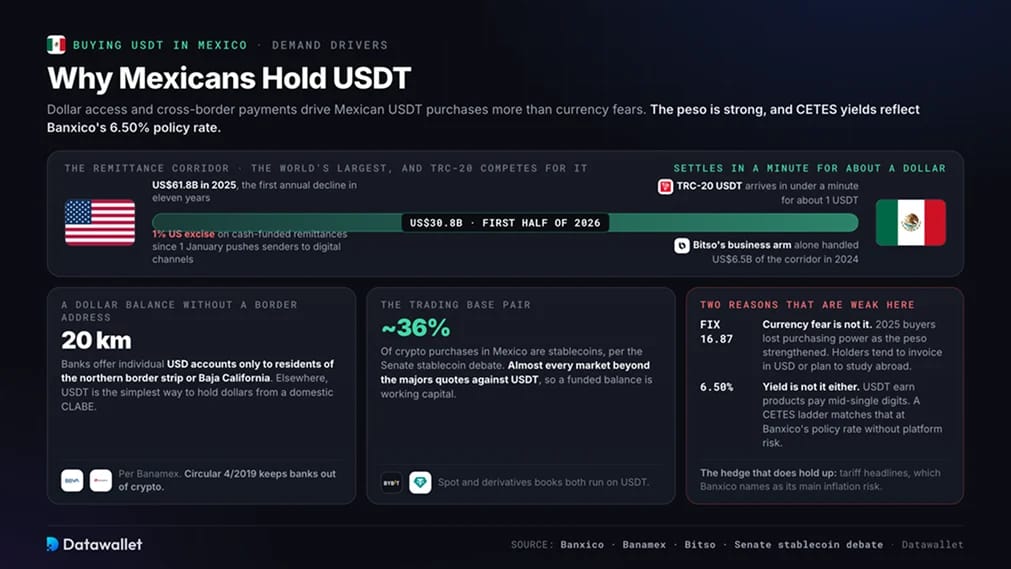
Why Mexicans Hold USDT
Dollar access and cross-border payments drive Mexican USDT purchases more than currency fears. The peso is strong, and CETES yields reflect Banxico's 6.50% policy rate.
- A dollar balance without a border address: Mexican banks offer individual USD accounts only to residents of the 20-kilometre northern border strip or Baja California, as Banamex's product pages explain. For savers in Mexico City or Guadalajara, USDT is the simplest way to hold dollars using a domestic CLABE.
- The remittance corridor: Mexico received US$30.8 billion in remittances in the first half of 2026. The 2025 total was US$61.8 billion, marking the first annual decline in eleven years. Since 1 January, the United States has applied a 1% excise tax to cash-funded remittances, pushing senders toward bank-funded and digital channels. TRC-20 competes with both by settling in a minute for about a dollar. Bitso's business arm alone handled US$6.5 billion of the corridor in 2024.
- The trading base pair: Almost every market beyond the majors quotes against USDT. A funded USDT balance therefore serves as working capital across Bybit's spot and derivatives books. Figures cited during the Senate stablecoin debate put stablecoins at around 36% of crypto purchases in Mexico. Our USDT statistics page covers the token's global scale.
- Exchange-rate views: Holding USDT takes a position on the dollar against the peso. Buyers who exchanged pesos for Tether in 2025 have lost purchasing power as FIX slid toward 16.9. Those who continue holding tend to invoice work in USD or plan to study or travel abroad. Others use it to hedge the tariff headlines that Banxico identifies as its main inflation risk.
- Yield is a weak reason here: USDT earn products offer mid-single-digit returns. A CETES ladder matches those yields without platform risk.
Final Thoughts
Bybit is our pick for buying USDT in Mexico, combining free SPEI deposits with the deepest USDT books accessible from the country. P2P provides a backup, and the Bybit Card in MXN completes the route from CLABE funding to spending. The group holds MiCA and Argentine CNV oversight, though no Mexican regulator covers the account. Our Bybit review examines the platform in detail.
Keep only trading capital on the exchange and self-custody the rest. Bybit covered the 2025 hack in full, but the incident still happened. Use accounts in your own name and retain every CEP. Reconciling disposals in pesos as you go is especially relevant given the July 2025 AML reform's lower thresholds and CARF reporting by 2028.
Verify with your INE and register the CLABE a day early. Send a MX$500 test before funding the account fully, then compare the USDT quote with the day's FIX.