







Can I Buy USDT in Thailand?
Yes. Individuals do not need a licence to buy, hold or sell USDT. The SEC added USDT and USDC to its approved cryptocurrency list on 16 March 2025. Previously, licensed exchanges could only use assets such as Bitcoin, Ether, XRP and Stellar as trading pairs, leaving Tether in a legal grey area despite its popularity. The approval allowed licensed venues to list USDT openly against baht.
The restrictions apply to platforms, not individual buyers. Under the Digital Asset Business Decree B.E. 2561, exchanges, brokers and dealers serving Thai customers must hold a Ministry of Finance licence and operate under SEC supervision. Royal Decrees effective 13 April 2025 extended this requirement to foreign platforms targeting Thai users.
The SEC soon enforced the rules. On 28 June 2025, access to Bybit, OKX, CoinEx, XT.COM and 1000X was blocked after complaints were filed with the Economic Crime Suppression Division. Thai users relying on these platforms' peer-to-peer desks lost access.
Only licensed venues can legally accept baht. Check the SEC licence register before depositing funds. It lists seven licensed exchanges, along with several brokers and dealers. Our tests on Binance TH and Bitkub found both offered prices within a few satang of the interbank dollar rate, showing that Thailand's regulated market provides sufficient liquidity for most buyers.
How to Buy Tether (USDT) in Thailand
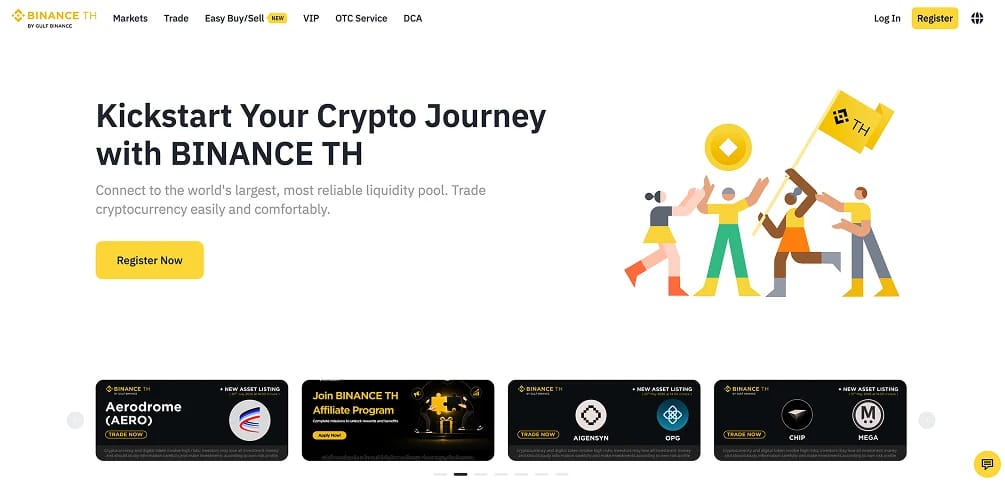
The simplest way to buy USDT in Thailand is to verify a Binance TH account and deposit baht by QR payment from a Thai bank account in your own name. The name on the bank account must match your KYC details; deposits from a spouse's or friend's account are rejected.
The QR process works with major Thai banking apps, including Bangkok Bank, K PLUS, SCB EASY, Krungthai NEXT and KMA. See our Bangkok Bank guide for an example.
Thai citizens verify with a national ID card and liveness check. Foreign residents need a passport, second photo ID, Thai visa with at least three months of validity and proof of their stated purpose of stay, such as a work permit. Binance TH lists its accepted visa types. Tourists entering under a visa exemption are not eligible, and foreign applications typically take three to five days to review.
Steps to buy USDT on Binance TH with Thai baht:
- Create and verify your account: Register at Binance TH, select your nationality and upload your ID. During our test, a Thai ID card was approved in under an hour. Foreign passport applications enter a manual queue, so allow a full working week.
- Generate a QR deposit: Open Deposit THB, choose your bank and enter the account number and deposit amount. The minimum is 100 THB. Deposits are capped at 4,000,000 THB per transaction and per 24-hour period. Binance TH then creates a one-time QR code that expires after an hour.
- Scan and pay from your bank app: Scan the code with your mobile banking app and confirm the payment. Do not change the amount after scanning, as any mismatch will cause the deposit to fail. Transfers of 50,000 THB or more require the face scan mandated by Thai banks under Bank of Thailand rules. Our first deposit became spendable in about ninety seconds.
- Place a limit order on USDT/THB: Open the Spot market and select USDT/THB. Set a limit order at or just inside the best ask so the trade executes only at your chosen price. With USDT trading near 33 baht at the time of writing, the spread remained at a single satang for most of our session. The order therefore completed almost immediately.
- Hold or withdraw: Leave the USDT on the exchange, send it to a wallet you control, or transfer it to another platform. Make sure the network matches the destination because fees vary considerably between chains.
Avoid depositing between 23:30 and 00:10, when the THB gateway undergoes nightly maintenance.
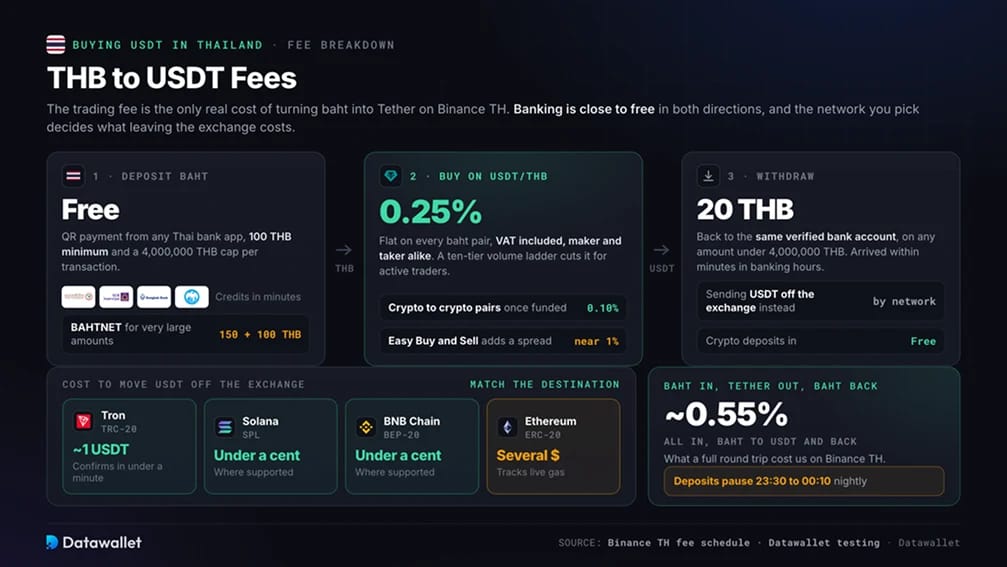
THB to USDT Fees
Trading is the main cost of converting baht into Tether on Binance TH. Banking charges are minimal.
Deposits
- QR payment via mobile banking (recommended): Binance TH charges no fee, nor did any major Thai bank we tested. Deposits can take from one minute to 24 hours, although ours always arrived within a few minutes.
- BAHTNET transfer: Thailand's high-value interbank transfer system is intended for very large deposits. The sending bank typically charges 150 THB and the receiving bank another 100 THB. Binance TH credits the remaining amount. QR is more economical for deposits below the 4 million baht limit.
- Crypto deposit: Free, excluding the network fee charged at the source.
Trading
- USDT/THB on the order book: Binance TH applies a flat 0.25% fee to baht pairs, including VAT. The base rate is the same for maker orders that add liquidity and taker orders that remove it. Active traders can reduce the fee through a ten-tier VIP ladder based on 30-day volume.
- Crypto-to-crypto pairs: These trades cost 0.10% and are executed under the brokerage licence against a Binance order book. Once you own USDT, switching into other assets costs less than half the baht-pair rate.
- Easy Buy/Sell: The quoted price includes a spread in addition to the fee. A limit order placed through the Spot screen costs 0.25%, while Easy Buy is closer to 1%.
Withdrawals
- THB back to your bank: Withdrawals below 4,000,000 THB cost 20 THB. Funds must go to the same verified bank account used for the deposit. In our tests, they arrived within minutes during banking hours.
- USDT to another wallet or platform: Tron (TRC-20) costs about 1 USDT and usually confirms in under a minute. Ethereum (ERC-20) fees track network gas and may reach several dollars. Solana and BNB Chain cost less than a few cents when supported by the destination.
Our round trip from baht into USDT and back cost about 0.55% before market movement. For transactions above a few thousand baht, the 20 baht withdrawal charge has little effect on the total.
Best USDT Exchanges in Thailand
The table compares licensed venues for buying Tether with baht. Rankings weigh THB funding, USDT liquidity, fees and regulatory standing. Every listed platform holds an SEC licence, excluding global exchanges that Thai residents can no longer legally use. See our best crypto exchanges in Thailand guide for a complete country comparison.
Binance TH ranks first for its deep USDT/THB order book and broader asset selection after funding. Bitkub is well suited to buyers who want the platform most Thais already use and fast citizen onboarding. Upbit prioritises a clean mobile experience over asset breadth, while Orbix benefits from the backing of a bank parent. Bitazza is aimed at buyers placing large orders through a dealing desk.
Regulatory Status of USDT in Thailand
Thailand regulates crypto through dedicated legislation instead of extending securities rules to cover the industry. Enforcement has tightened considerably since 2025. These are the main authorities relevant to Thai USDT holders.
Enforcement has affected both licensed and unlicensed platforms. Bybit and OKX previously handled much of Thailand's peer-to-peer USDT volume but have been blocked on Thai networks since 28 June 2025. Residents who access them through a VPN trade without domestic protections and cannot claim the tax exemption.
Licensing does not eliminate platform risk. KuCoin acquired ERX Company Limited, Thailand's first SEC-supervised digital token exchange, and relaunched it as KuCoin Thailand in April 2025 with a native USDT/THB market. On 3 January 2026, the SEC ordered ERX to suspend all digital asset business after its capital fund remained below 60% of the regulatory minimum for five consecutive days. The company attributed the shortfall to a shareholder dispute that prevented a capital raise.
The SEC found that client assets remained intact, and the deadline for a capital injection was extended to 30 March 2026. In April, the platform asked customers to withdraw all assets and took its systems offline without plans to resume. Our KuCoin restricted countries page tracks its status. Keep only trading capital on any exchange, regardless of whether it holds a licence.
Tax Implications of USDT in Thailand
Thailand offers unusually favourable tax treatment for USDT over the next few years, provided transactions take place through the correct venue.
- Gains on licensed exchanges are exempt until 2029: Ministerial Regulation No. 399, gazetted on 5 September 2025, exempts individuals from personal income tax on gains earned from selling cryptocurrencies and digital tokens through an SEC-licensed exchange, broker or dealer. It applies from 1 January 2025 through 31 December 2029. A profitable sale of USDT into baht on Binance TH qualifies.
- Offshore trades stay taxable: Gains realised through an unlicensed platform remain assessable income. This applies whether the venue was used before the June 2025 blocks or accessed through a VPN afterward. Progressive tax rates reach 35%.
- Yield and airdrops are not covered: The exemption applies only to disposal gains. Interest from earn products, staking rewards, airdrops and referral bonuses is treated as income at its baht value when received.
- A pegged price still produces baht gains: USDT is worth about 33 baht at the time of writing. Its price has moved several baht in either direction over the past two years as USD/THB changed. USDT remains a dollar position, so its baht value fluctuates even while the dollar peg holds.
- Losses offset gains on licensed venues: Losses realised through licensed operators have been available to offset gains from the same tax year since 2022. This offers little benefit while gains remain exempt but will become relevant again from 2030.
- Reporting is coming: The Revenue Department is adopting the Crypto-Asset Reporting Framework (CARF), the OECD standard for exchanging crypto account data between tax authorities. Licensed exchanges already send client asset data to the SEC each day. Foreign tax residents spending at least 180 days in Thailand should also consider the 2024 rules covering remitted foreign-sourced income before transferring offshore proceeds into a Thai bank.
💡 For active users: Export your Binance TH trade history every quarter. Keep records showing the baht value of each completed order, deposit and withdrawal. Thai tax follows the calendar year and must be filed by 31 March. Because the exemption was introduced by ministerial regulation rather than statute, a future government can change it without a parliamentary vote. High-volume traders and anyone earning yield should confirm their position with a Thai tax adviser. This is general information, not tax advice.
Why Thais Hold USDT
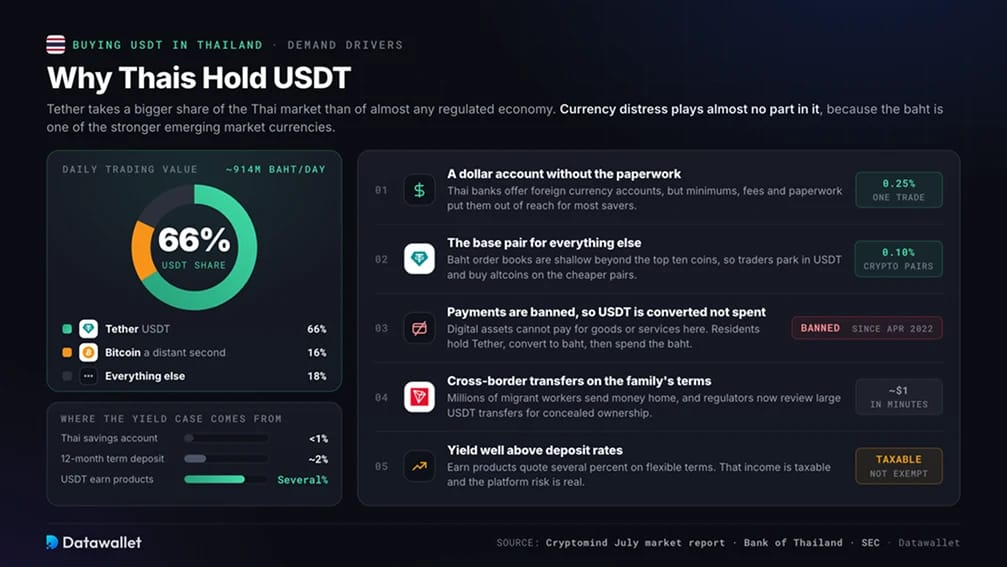
Tether accounts for a larger share of Thailand's crypto market than in most other regulated economies. Cryptomind's July market report found that USDT represented 66% of daily trading value on licensed Thai exchanges, or about 914 million baht per day. Bitcoin ranked second at 16%.
- Dollar exposure without a bank account: Thai foreign currency accounts often require minimum balances and paperwork. USDT provides dollar exposure through a single trade costing 0.25%.
- The main trading pair: Baht order books for smaller assets are shallow, so traders use USDT to access altcoins through 0.10% crypto pairs.
- Held and converted rather than spent: Thailand has prohibited crypto payments for goods and services since 1 April 2022. Residents therefore sell USDT for baht on licensed exchanges before spending it.
- Cross-border transfers: TRC-20 transfers typically settle within minutes for about one dollar, making USDT useful for sending money to relatives or overseas students. The BOT and SEC are reviewing large USDT transactions for hidden ownership and attempts to bypass remittance channels. From the fourth quarter of this year, banks will require source-of-funds documents for cash deposits of at least 5 million baht.
- Potential yield: USDT earn products may offer more than Thai savings accounts, but the income is taxable and users assume platform risk.
The baht's relative strength means USDT's baht value still moves with the dollar. Thai buyers generally use it for trading, overseas spending or diversification rather than protection from currency distress. See our Tether statistics page for broader context.
Final Thoughts
Binance TH offers Thai residents a direct route into USDT. Gulf Binance holds exchange and broker licences under SEC supervision, accepts free QR deposits from Thai bank apps and offers a liquid USDT/THB order book. The standard fee is 0.25%, with lower rates available at higher volumes. Eligible trades qualify for the tax exemption through 2029.
Thai citizens can verify with a national ID. Foreign residents need a passport, valid long-stay visa and supporting document. Fund the account from a bank account in your own name, start with a small QR deposit and use limit orders instead of Easy Buy. Keep dated records of each baht transaction.
Check the SEC register before funding any venue, as ERX showed that a licence can be suspended. Move USDT intended for longer-term storage to a wallet you control. Thailand now offers one of Asia's clearest regulated markets for Tether, with relatively little friction for compliant users.
.webp)