Can I Buy USDT in Japan?
Yes, owning and trading USDT is legal for Japanese residents. The Payment Services Act places no restriction on individuals holding or transferring foreign stablecoins, and the Financial Services Agency has never moved against personal use. The restriction sits on the sell side, where only licensed businesses can distribute a fiat-pegged stablecoin to retail.
Japanese law classifies USDT as an Electronic Payment Instrument rather than a crypto-asset, a category created by the 2023 Payment Services Act amendment. Distributing one requires a separate Electronic Payment Instruments licence that ordinary exchange registration does not cover. SBI VC Trade became the first holder in March 2025 and used it for USDC, and a revised framework in force since June 1 now sets formal conditions for other foreign stablecoins to follow.
Tether has not cleared those conditions, so none of the roughly 30 registered exchanges, Binance Japan included, offers a USDT/JPY pair. Japanese buyers fund yen on a licensed exchange, buy a liquid asset with a real on-chain ecosystem, and swap it for USDT once it leaves the domestic rails. ETH is the practical bridge because USDT's deepest on-chain liquidity sits on Ethereum, so the conversion happens wherever the funds land.
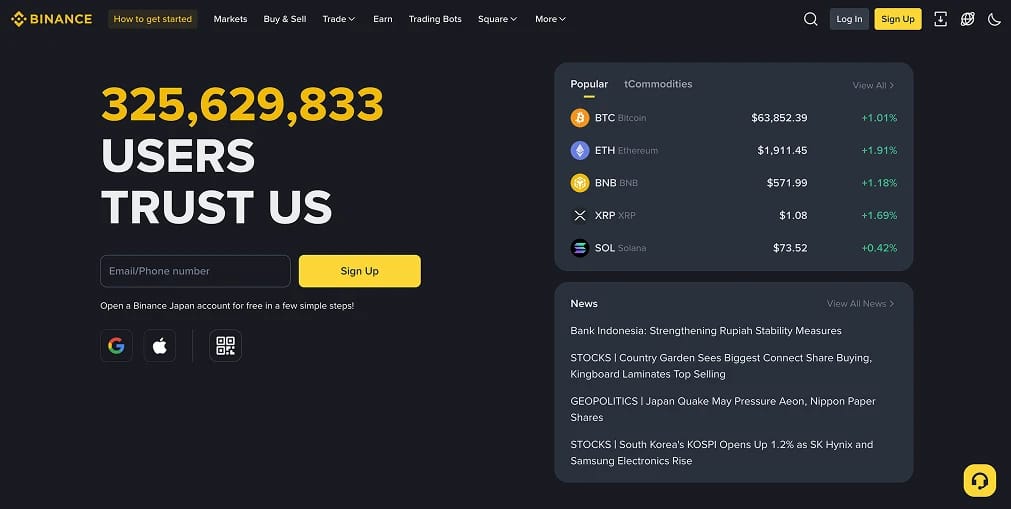
Binance Japan carries more assets than any other platform on the register, its order book fees undercut the domestic incumbents, and since PayPay took a 40% stake in late 2025 you can fund purchases from a PayPay Money balance.
How to Buy Tether (USDT) in Japan
The account you open from Japan is Binance Japan, not the global platform. Binance closed its international service to Japanese residents when the local entity launched in 2023, so everything below happens inside the JFSA-registered environment. The coin list is shorter and derivatives are absent.
Steps to buy USDT from Japan using Binance:
- Create and verify your account: Register at Binance and complete eKYC with a driver's licence, My Number card or residence card. The selfie-based check typically clears the same day, and the interface runs natively in Japanese.
- Deposit JPY by bank transfer: In the wallet section, choose JPY and generate your deposit account at GMO Aozora Net Bank or Sumishin SBI Net Bank. Send a standard transfer from an account in your own name, since mismatched names stall crediting. A transfer we sent from a Sumishin SBI account before noon showed as a tradable balance within the hour, though official guidance allows up to one business day.
- Buy ETH on the order book: Use the exchange tab rather than the instant-buy screen, which prices through a spread of 1% or more against a flat 0.10% on the book. ETH/JPY depth handled our test orders without slippage, and SOL works as a lower-fee alternative with its own deep DEX liquidity.
- Withdraw ETH to your own wallet: Japanese exchanges apply the travel rule to outbound transfers, so withdrawals to another platform must pass a counterparty check, while withdrawals to a wallet you control require a self-declaration. Sending to self-custody first is the smoothest path. Test with a small amount before moving size.
- Convert to USDT: Swap the ETH for USDT on a decentralised exchange or one of the best USDT exchanges that accepts Japanese users. Match the USDT network to where the funds are headed, since TRC-20 costs about 1 USDT to move while Ethereum can run several dollars.
JPY to USDT Fees
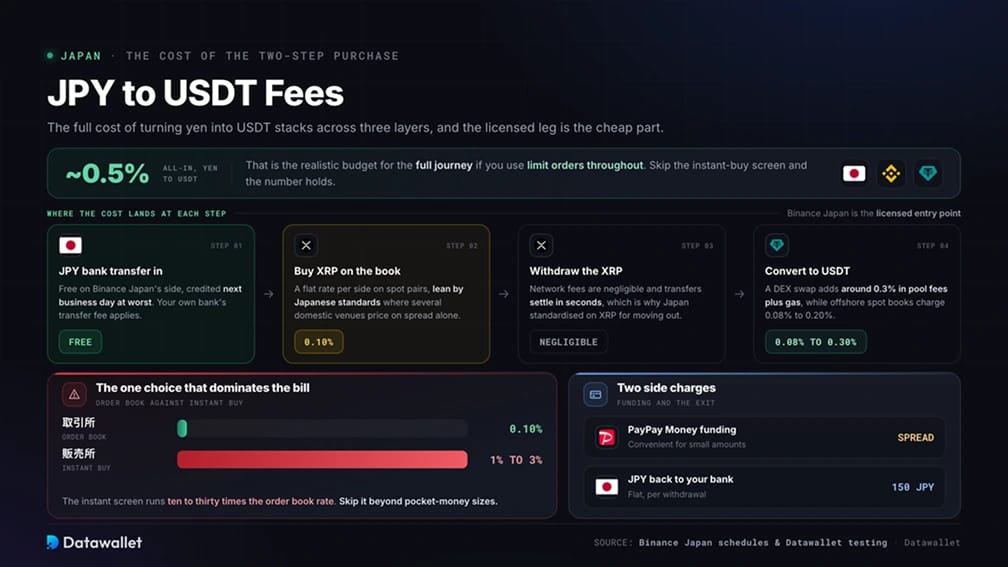
The full cost of turning yen into USDT stacks across three layers, and the licensed leg is the cheap part.
Deposits
- Bank transfer (recommended): Free on Binance Japan's side with next-business-day crediting at worst. Your own bank's transfer fee applies, and most online banks waive several transfers a month.
- PayPay Money: Purchases can be funded directly from a PayPay balance, convenient for small amounts but priced through the instant-buy spread rather than the order book.
Trading
- Order book (取引所): A flat 0.10% per side on spot pairs, lean by Japanese standards where several domestic platforms only offer spread-based pricing.
- Instant buy (販売所): Spreads commonly land between 1% and 3% depending on the asset. Skip it for anything beyond pocket-money sizes.
- The conversion leg: A DEX swap adds pool fees of around 0.3% plus network gas, while offshore spot books charge 0.08% to 0.20%. Budget roughly 0.5% all-in from yen to USDT on meaningful size, more on small amounts once Ethereum gas is counted.
Withdrawals
- ETH out of Binance Japan: The withdrawal fee tracks network conditions and mainnet transfers confirm in under a minute. Converting to USDT on Ethereum keeps the whole journey on one chain with no bridge risk.
- JPY back to your bank: Selling back to yen and withdrawing costs a flat 150 JPY per withdrawal. USDT itself never touches the JPY leg, so returning to fiat means reversing the same two steps.
Best USDT Exchanges in Japan
The ranking weighs licensing, JPY access, fees and how directly each platform gets you to USDT. Our best crypto exchanges in Japan guide covers the domestic market in full.
Regulatory Status of USDT in Japan
Japan regulates stablecoins more precisely than almost any other market, and three bodies define what a USDT holder deals with.
The June 1, 2026 revision to the Payment Services Act created a formal path for foreign stablecoins, provided the issuer satisfies reserve, redemption and disclosure requirements and distribution runs through a licensed provider. USDC moved through SBI VC Trade first, Ripple's RLUSD has a distribution agreement in place, and megabank yen stablecoins are in build. Tether has not entered the approval process publicly, which keeps USDT off registered venues for now.
Six weeks later, on July 15, 2026, the Diet passed the FIEA amendment that moves crypto-assets under securities-style regulation from fiscal 2027. Stablecoins were deliberately carved out and stay under the Payment Services Act, so the reform changes nothing about how USDT is accessed, but it shows a regulator building permanent infrastructure.
Binance Japan operates under Crypto-Asset Exchange Service Provider registration No. 00031 with the Kanto Local Finance Bureau, is a JVCEA member, and segregates customer yen with a trust bank as domestic law requires. Its parent's global licensing record is beside the point here, since the Japanese entity answers to the FSA directly. PayPay, a SoftBank company, has held 40% of it since October 2025.
Tax Implications of USDT in Japan
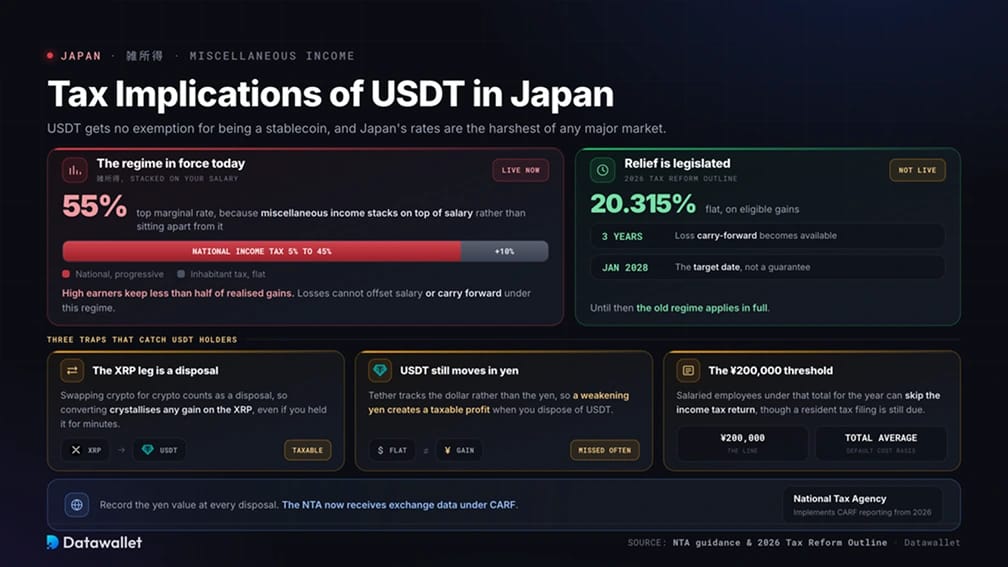
USDT gets no tax exemption for being a stablecoin, and Japan's rates are the harshest of any major market. The NTA treats profits from crypto disposals as miscellaneous income (雑所得).
- Progressive rates up to 55%: Miscellaneous income stacks on top of salary and is taxed at national rates from 5% to 45% plus 10% inhabitant tax. High earners keep less than half of realised gains under the current regime.
- The ETH leg is a taxable event: Swapping crypto for crypto counts as a disposal, so converting ETH to USDT crystallises any gain on the ETH, even if you held it for minutes. A short holding period keeps the figure small, but it still belongs in your records.
- USDT itself generates yen-denominated gains: Tether tracks the dollar rather than the yen, so a weakening yen creates a taxable profit when you dispose of USDT. Plenty of holders miss this because the token "didn't move" in dollar terms.
- The ¥200,000 threshold: Salaried employees whose total miscellaneous income stays under ¥200,000 for the year can skip the income tax return, though a resident tax filing is still due. Cost basis defaults to the total average method unless you notify the tax office otherwise.
- Relief is legislated but not live: The 2026 Tax Reform Outline moves eligible crypto gains to a flat 20.315% with a three-year loss carry-forward, targeted for January 2028. Until then the old regime applies in full, and losses cannot offset salary or carry forward.
💡 For active users: export trade history from every venue you touch, including the DEX or offshore leg, and record the yen value at each disposal. The NTA receives exchange data under CARF, so the reporting gap Japanese traders once relied on is closing.
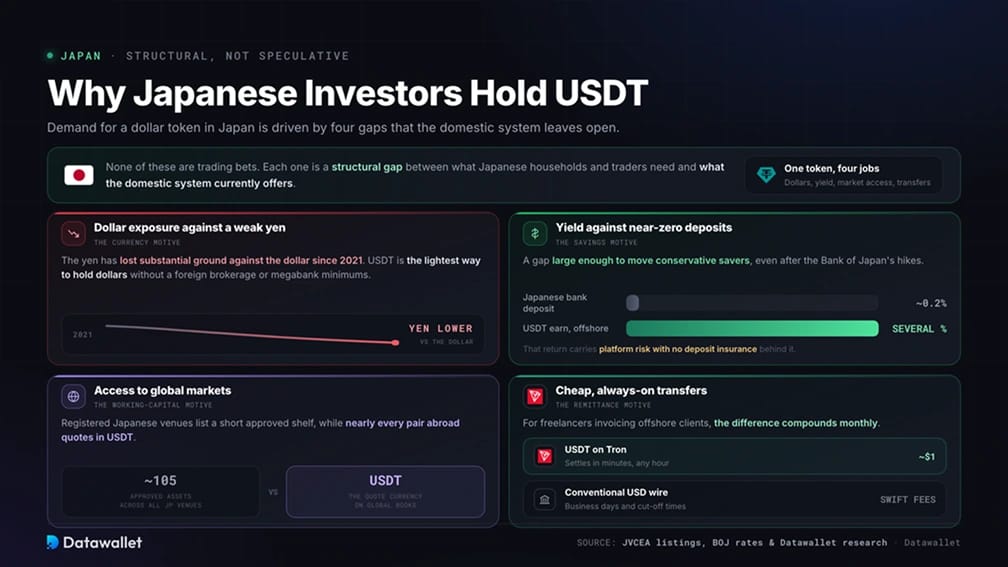
Why Japanese Investors Hold USDT
Demand for a dollar token in Japan is structural rather than speculative.
- Dollar exposure against a weak yen: The yen has lost substantial ground against the dollar since 2021, and households with overseas costs or imported-goods exposure feel it directly. USDT is the lightest way to hold dollars without a foreign brokerage or the USD deposit minimums at a megabank.
- Yield versus near-zero deposits: Ordinary deposit rates at Japanese banks still sit around 0.2% even after the BOJ's hikes. USDT earn products on offshore platforms quote several percent, a gap large enough to move conservative savers, though that return carries platform risk with no deposit insurance behind it.
- Access to global markets: Registered Japanese exchanges list only around 105 approved assets between them, while nearly every pair beyond the majors on international venues quotes in USDT, still the dominant stablecoin by market share. Anyone trading seriously across Asian and global exchanges needs a USDT balance as working capital.
- Cheap, always-on transfers: A USDT transfer settles in minutes at any hour for around a dollar on Tron, against SWIFT fees and cut-off times for a conventional USD remittance. For freelancers invoicing offshore clients or families supporting students abroad, that difference compounds monthly.
Final Thoughts
Buying USDT from Japan takes one more step than almost anywhere else, but each step is cheap and quick once the accounts exist. Binance covers the licensed half better than any registered rival. Yen deposits are free, the asset shelf is the widest on the FSA register, order book fees sit at 0.10%, and ETH liquidity is deep enough to bridge out without slippage.
Run the trade on the order book rather than the instant screen, withdraw to a wallet you control before converting, double-check the withdrawal network, and log the yen value of both legs for the tax return. Treat any USDT yield as income on receipt and remember the token's yen price moves even when its dollar price does not.
The domestic picture is the one to watch. The licensing framework USDT needs has existed since the June revision, USDC and RLUSD are already moving through it, and if Tether follows, yen-to-USDT trading could arrive on registered exchanges within a listing cycle.
Binance Japan, with a payments giant on its register and the deepest asset list in the market, is positioned as well as anyone for that moment.