







Can I Buy Tether (USDT) in Argentina?
Yes. Individuals face no legal barrier to buying, holding, or spending USDT. Ley 27.739, passed in March 2024, created the Proveedor de Servicios de Activos Virtuales (PSAV) category, Argentina's version of the international VASP designation, under the Comisión Nacional de Valores (CNV). Any exchange serving Argentine residents above a modest volume threshold must appear in the CNV's public PSAV Registry, and an unregistered platform can be blocked by court order.
Demand is among the highest anywhere. Chainalysis measured US$93.9 billion in crypto value received by Argentina over a recent twelve-month window, second only to Brazil in Latin America, and stablecoins account for 61.8% of Argentine transaction volume, far above the global average of 44.7%. A generation of savers watched pesos evaporate and now treats a dollar-pegged balance as the default place to keep money.
The cepo cambiario, the currency controls that capped how many dollars an individual could buy, was dismantled for individuals in April 2025, so buying USDT no longer sits in a legal grey area next to the parallel dollar market. When we ran our first peso order, the gap between the exchange quote and the official dollar had narrowed to a fraction of its level in the control years.
How to Buy USDT in Argentina
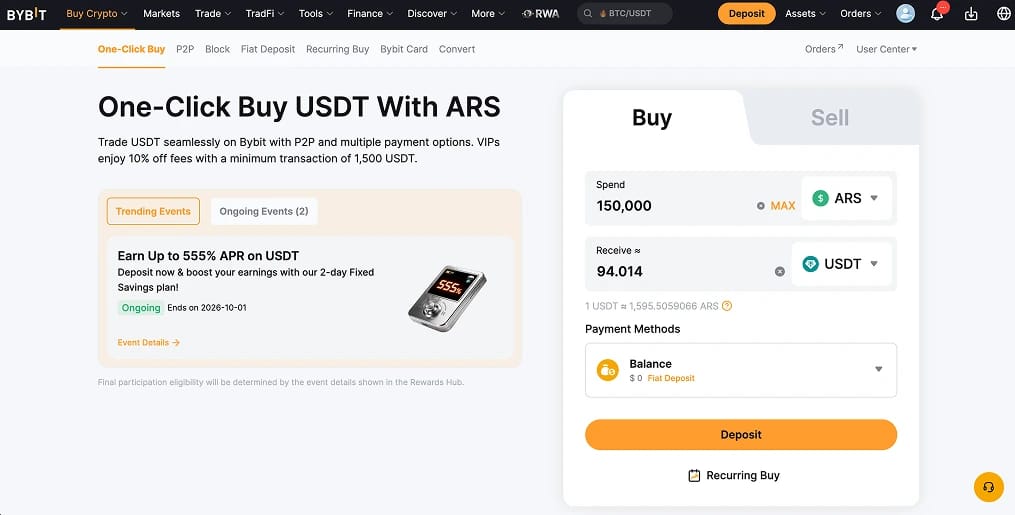
The method we use is a verified Bybit account funded through its ARS P2P market. You pay a vetted seller directly from Mercado Pago or from a bank account with your own CBU or CVU, the identifiers Argentine banks and fintech wallets assign to accounts, and Bybit holds the seller's USDT in escrow until your payment lands. Card purchases exist for speed, but the P2P spread is tighter.
Steps to buy USDT on Bybit in Argentina:
- Create and verify your account: Register at Bybit and complete KYC with your DNI or passport plus a liveness selfie. Verification cleared in under an hour when we tested with a DNI.
- Open the P2P market and set your filters: Go to Buy Crypto, then P2P Trading, select USDT against ARS, and filter by your payment method. Mercado Pago and bank transfer carry the deepest listings. Favour advertisers with a completion rate above 95% and several hundred finished orders.
- Place the order and pay in pesos: Enter your amount, open the order, and send the exact figure to the seller's account within the payment window. The transfer must come from an account in your own name, and the sums have to match to the peso or the seller can dispute the release.
- Confirm payment and receive your USDT: Mark the transfer as paid inside the order screen. Once the seller confirms receipt, escrow releases the USDT into your Funding account. Our test order over Mercado Pago confirmed in under two minutes on a weekday morning.
- Withdraw to self-custody for long-term holdings: Anything beyond active trading capital belongs in a wallet you control. Choose Tron (TRC-20) for cheap transfers that confirm in under a minute, or Ethereum (ERC-20) if the destination is DeFi and you accept the gas cost.
Because USDT tracks the US dollar, its peso price moves with the exchange rate, and the P2P quote sits close to the market dollar rather than any official reference.
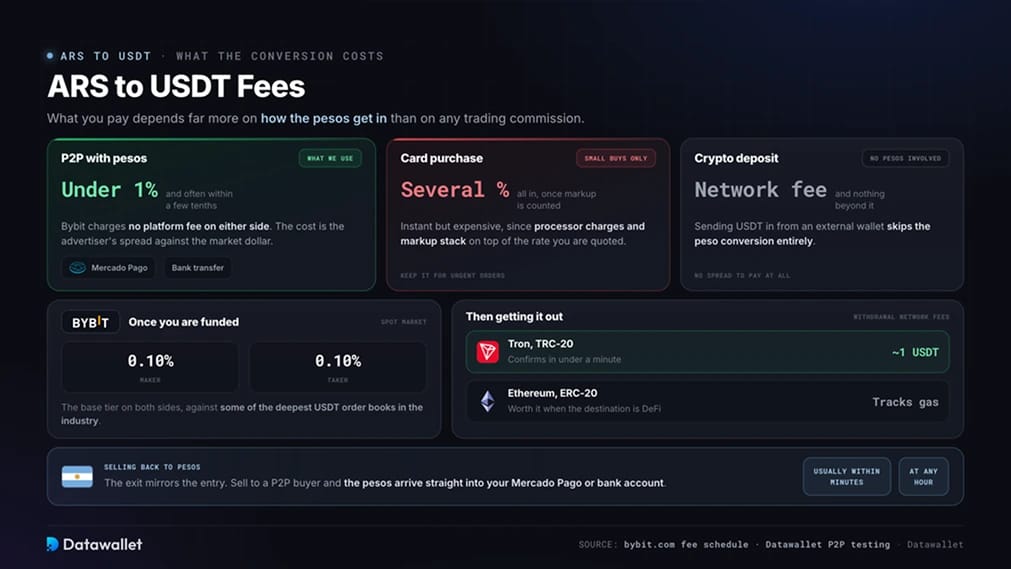
ARS to USDT Fees
What you pay to turn pesos into USDT depends far more on the entry method than on trading commissions.
Funding
- P2P with Mercado Pago or bank transfer (recommended): Bybit charges no platform fee on either side of a P2P trade. The cost lives in the advertiser's spread against the market dollar, which sat under 1% on the listings we compared, and often within a few tenths of a percent.
- Card purchases: Instant but expensive. With processor charges and markup included, an ARS card buy typically costs several percent all-in, so we keep it for small urgent buys only.
- Crypto deposits: Sending USDT or another asset in from an external wallet skips the peso conversion and costs nothing beyond the network fee.
Trading and withdrawals
- Spot trading: Once funded, Bybit's spot market charges 0.10% for both maker and taker at the base tier, and USDT pairs there carry some of the deepest order books in the industry.
- Network fees on withdrawal: A TRC-20 withdrawal costs about 1 USDT and confirms in under a minute. ERC-20 tracks Ethereum gas and runs higher, while cheaper chains suit small transfers where the destination supports them.
- Selling back to pesos: The exit mirrors the entry. Sell USDT to a P2P buyer and the pesos arrive straight into your Mercado Pago or bank account, usually within minutes and at any hour.
For a wider look at how global platforms price stablecoin trading, see our roundup of the best USDT exchanges.
Best USDT Exchanges in Argentina
The ranking below weighs ARS funding access, USDT liquidity, fees, and regulatory standing for Argentine buyers. Our full country comparison lives in the best crypto exchanges in Argentina guide.
Bybit and Binance split the international tier, and the choice rests on whose P2P market quotes tighter at your order size. Lemon and Ripio suit buyers who want a homegrown app with direct CVU deposits and accept a wider spread in exchange.
Regulatory Status of USDT in Argentina
Compliance obligations sit on platforms rather than holders, and they tightened sharply once the CNV took charge. Four bodies shape what an Argentine USDT holder deals with.
Bybit's standing under this framework is stronger than most offshore platforms can claim. It registered with the UIF as a Virtual Asset Service Provider and card operator in August 2024, one of the first global exchanges to do so, and its Argentine-facing pages carry the inscription legend required of registered platforms, listing No. 48 in the CNV's PSAV Registry. The registration underpins its physical Bybit Card for Argentine users and its local team. Beyond Argentina, the group holds a MiCA licence through Austria's FMA for the European market. Our Bybit review covers the platform in depth.
Registration is protective as well as procedural. General Resolution 1058 forces registered platforms to keep client assets segregated from their own, to disclose risks, and to submit to CNV inspection. Checking the registry before funding any exchange takes a minute and filters out the venues most likely to disappear with your pesos.
Tax Implications of USDT in Argentina
Argentine tax law reaches USDT at several points, and the flat dollar peg misleads people into thinking there is nothing to declare.
- Selling at a peso gain is taxed under the cedular regime: Article 98 of the income tax law applies a flat 5% to gains on peso-denominated crypto and 15% where the asset is denominated in foreign currency or held abroad, which is the bracket most USDT activity lands in. Holding through a price rise triggers nothing until you sell.
- Swapping USDT for another crypto is a disposal: Trading USDT into Bitcoin crystallises any peso gain on the USDT at that day's rate, even though no pesos touch your bank account. ARCA applies FIFO, so the oldest units are deemed sold first.
- Wealth tax can apply at year-end: ARCA treats crypto as a financial asset within Bienes Personales, so holdings count toward the taxable minimum, set at roughly ARS 385 million for the most recent filing period. Balances are declared at their peso value on 31 December.
- Exchanges now report your activity monthly: Under General Resolution 5804, platforms operating in Argentina have filed monthly reports on client balances and movements with ARCA since May 2026, replacing the older on-request regime. Undeclared holdings on registered platforms are visible to the agency by default.
- Losses are ring-fenced: A loss on a crypto sale can only offset future gains of the same class and source within five years, never salary or professional income.
💡 For active users: export your full trade history from every platform at least quarterly and record the peso value of each disposal on its date. The 5% versus 15% distinction and the provincial gross receipts taxes that some jurisdictions layer on top make a crypto-literate accountant worthwhile for anyone trading at volume. This is general information rather than tax advice.
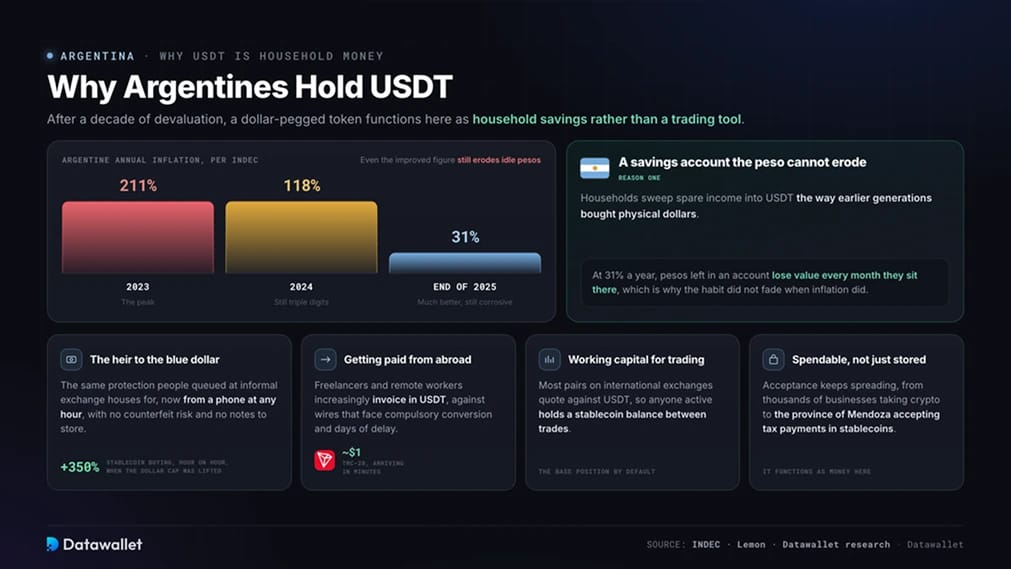
Why Argentines Hold USDT
A few pressures keep demand high even as the economy stabilises.
- A savings account the peso cannot erode: Annual inflation reached 211% in 2023 and 118% the following year before falling to around 31% by the end of 2025, per INDEC data. Even the improved figure devalues idle pesos month after month, so households sweep spare income into USDT the way earlier generations bought physical dollars.
- The heir to the blue dollar: During the control years, Argentines queued at informal exchange houses to buy cash dollars at a premium. USDT delivers the same protection from a phone, at any hour, with no counterfeit risk and no notes to store. The habit outlived the controls. When the cap on dollar purchases was lifted, local platform Lemon recorded stablecoin buying up more than 350% hour on hour.
- Getting paid from abroad: Argentina's large pool of freelancers and remote workers increasingly invoices in USDT. A TRC-20 transfer arrives in minutes for about a dollar, against wire transfers that pass through compulsory conversion and days of delay. Circulation data on the token's scale sits in our USDT statistics page.
- Working capital for trading: Most pairs on international exchanges quote against USDT, so anyone active beyond the majors holds a stablecoin balance as their base position between trades.
- Merchant and everyday payments: Stablecoin acceptance keeps spreading, from thousands of businesses taking crypto payments to the province of Mendoza accepting tax payments in stablecoins. USDT functions as spendable money here.
Final Thoughts
Bybit is the platform we keep returning to for buying USDT in Argentina. It pairs UIF registration as a VASP and card operator with inscription No. 48 in the CNV's PSAV Registry, prices pesos against USDT through a zero-fee P2P market with Mercado Pago and bank transfer settlement, and backs it with the deepest USDT order books in the industry once you move to spot trading.
One caveat. Bybit absorbed the largest exchange hack on record in February 2025, when roughly US$1.5 billion in Ether was stolen from a cold wallet. The company covered the loss in full and kept withdrawals open throughout. Even so, no platform deserves custody of your long-term savings. Keep trading capital on the exchange and move the rest to a USDT wallet you control.
Watch the CNV registry as enforcement ramps up. The regulator has begun auditing registered platforms and can strike off those that fall short, so the list of compliant venues will keep moving. For Argentine buyers, the direction is favourable either way. A market this large is finally getting rules that protect the people using it.
%2520in%2520Argentina.webp)