







Can I Buy USDT in Qatar?
Yes, individuals can, though the legal ground is narrower than anywhere else in the Gulf. Qatar Central Bank Circular No. 6 of 2018 prohibits every bank and financial institution in the country from dealing in cryptocurrencies, with penalties under the QCB law. No Qatari law criminalises owning or trading USDT as an individual, and enforcement has only ever targeted firms.
The QFC Regulatory Authority reinforced the line in December 2019, banning virtual asset services from the Qatar Financial Centre, and confirmed in 2024 that cryptocurrencies, stablecoins, and central bank digital currencies (CBDCs) are Excluded Tokens under the new Digital Assets Regulations. No company can therefore be licensed to sell you USDT from inside Qatar, so residents open accounts with platforms regulated abroad.
When we verified a Rain account with a Qatar ID and funded it in riyal, nothing on the platform side blocked the purchase. The friction comes from the banks.
How to Buy Tether (USDT) in Qatar
The cleanest setup is a verified Rain account funded by QAR transfer from a local bank such as QNB or QIB. A card gets you there faster for small amounts, though each issuer screens crypto merchants in its own way. Because the QCB circular keeps banks out of crypto, expect a first transfer to draw a compliance question or a short delay.
Steps to buy USDT on Rain in Qatar:
- Create and verify your account: Sign up at Rain and complete identity checks (KYC) with your Qatar ID, or a passport plus residence permit if you are an expat. A liveness selfie finishes the check, and approval usually lands the same day.
- Deposit Qatari Riyal: In the funding section, pick QAR and the bank transfer option to reveal Rain's beneficiary details and a personal reference code. That code has to appear in the payment message, because incoming deposits are matched against it rather than pulled automatically. Our QNB transfer cleared the same day, while a first card deposit triggered an SMS confirmation from the bank before it went through.
- Open the QAR market: Once the balance lands, select Tether (USDT) and set the trading pair to QAR. Your riyal never has to pass through a US dollar balance before it becomes USDT.
- Place the order: Type the amount in either currency and check the rate Rain is offering before you confirm. Settlement into your Rain balance is immediate.
- Move long-term holdings to self-custody: Anything you plan to keep or send onward belongs in a USDT wallet you control. Pick TRC-20 on Tron for cheap transfers and remittances, or ERC-20 on Ethereum for DeFi destinations, where the network's transaction fees, known as gas, run higher.
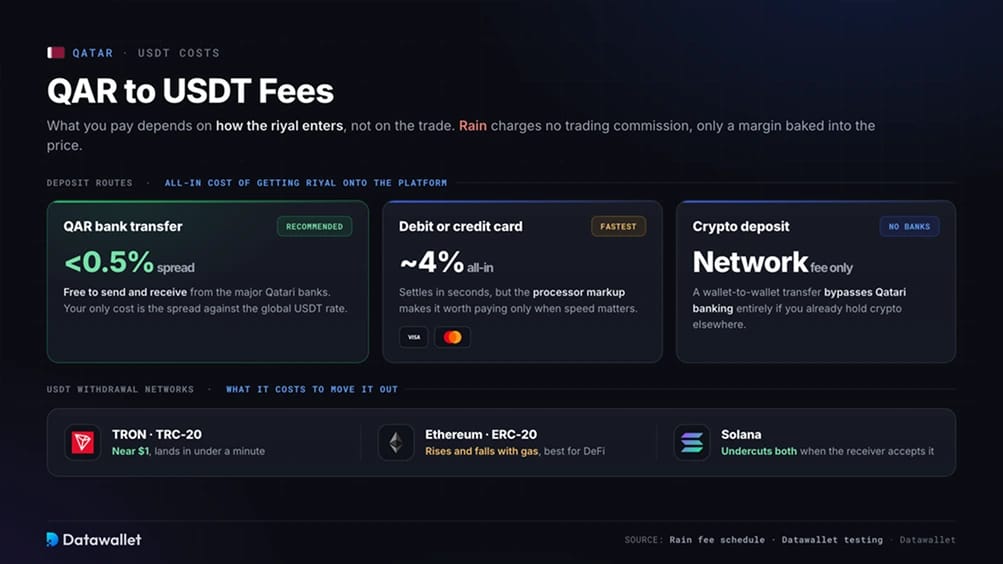
QAR to USDT Fees
What you pay depends far more on how the riyal enters than on the trade itself. There is no separate trading commission on Rain, only a margin baked into the price you see.
Deposits
- QAR bank transfer (recommended): Free to send from the major Qatari banks and free to receive. Your only cost is the spread, and each time we checked Rain's QAR quote against the global USDT rate during banking hours, the gap stayed under half a percent.
- Debit or credit card: Settles in seconds but the processor markup pushes the all-in cost to roughly 4%, worth paying only when speed matters.
- Crypto deposit: If you already hold crypto elsewhere, a wallet-to-wallet transfer bypasses Qatari banking for only the network fee.
Trading and withdrawals
- Spread: Refresh the QAR quote a few times before a large order to check where it sits against the global rate.
- USDT network fees: A TRC-20 withdrawal runs near a dollar and lands in under a minute, while ERC-20 rises and falls with Ethereum gas. Solana undercuts both when the receiving platform accepts it.
- Selling back to riyal: Cashing out runs the same steps in reverse. Sell USDT into QAR on Rain and withdraw the proceeds to your linked Qatari bank account, where the money typically arrives within a business day or two.
To compare against platforms with no Gulf presence, see our ranking of the best USDT exchanges worldwide.
Best USDT Exchanges in Qatar
The ranking weighs QAR access, licensing, fees, and USDT market size. Rain leads on regulation and local funding, while the offshore platforms run larger USDT order books but weaker riyal funding. Our best crypto exchanges in Qatar guide covers the full field.
Use Rain when the priority is getting riyal into USDT under a real licence. Bybit earns its place on the size of its USDT order books once a balance exists, and Binance runs the busiest QAR peer-to-peer desk for the days a card gets declined. In our experience first-time card payments from QNB or Commercial Bank fail most often, so the P2P column carries more weight here than it would in neighbouring markets.
Regulatory Status of USDT in Qatar
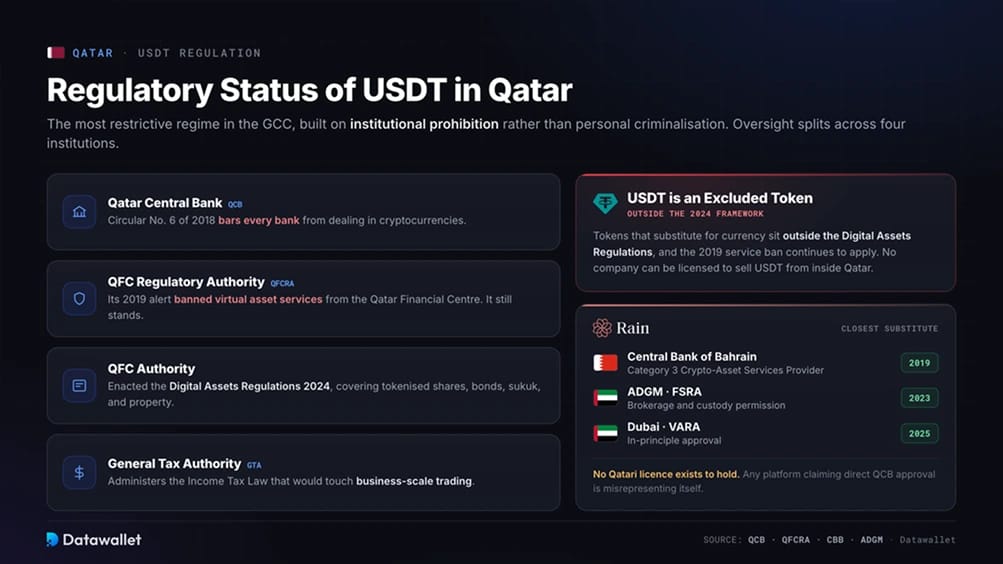
Qatar runs the most restrictive crypto regime in the GCC, built on institutional prohibition rather than personal criminalisation. Oversight splits across four institutions.
The Digital Assets Regulations 2024 look like liberalisation from the headlines but carve stablecoins out explicitly. Tokens that substitute for currency, which covers USDT, sit outside the framework as Excluded Tokens, and the 2019 service ban continues to apply to them. Qatar is building a tokenisation industry while keeping retail crypto at arm's length.
Rain holds no Qatari authorisation, because none exists to hold. Its operating entity is licensed by the Central Bank of Bahrain as a Category 3 Crypto-Asset Services Provider, a licence class that imposes minimum capital, client asset segregation, and ongoing CBB supervision.
A second entity received a Financial Services Permission from the ADGM's Financial Services Regulatory Authority in 2023 covering brokerage and custody in the UAE, and this May the group added an in-principle approval from Dubai's VARA, completing the set of current GCC crypto licences.
None of that puts a Qatari regulator behind your account, and any platform claiming direct QCB approval is misrepresenting itself.
Tax Implications of USDT in Qatar
Qatar remains one of the lightest personal tax environments, and USDT gains fall through the gaps of a system that was never built to catch them.
- Salaries and wages are untaxed. Qatar imposes no personal income tax on employment income, for citizens and expats alike, so there is no annual return on which crypto gains would be declared.
- Individual investment gains are exempt. The General Tax Authority exempts capital gains on securities and real estate disposed of by natural persons, provided the assets are not part of a taxable business. Crypto is not named in the Income Tax Law, and casual USDT gains are untaxed in practice.
- Business-scale activity is the exception. Qatar taxes Qatar-sourced income from commercial activity at a flat 10%. Anyone running USDT trading as a business should assume that regime could reach them and keep records accordingly.
- There is no VAT, wealth tax, or exit tax. Qatar has signed the GCC VAT agreement but has not implemented it, and holding a stablecoin balance carries no annual declaration.
- Home-country tax can still apply. Expats who remain tax resident elsewhere, or who plan to return with gains, should check the rules in that jurisdiction rather than rely on Qatar's silence.
💡 For active users: record the riyal value of each purchase, sale, and transfer even though nothing currently requires it. Qatar's framework is still moving, and a clean history is cheap to build today and impossible to reconstruct later. None of this constitutes tax advice.
Why People in Qatar Hold USDT
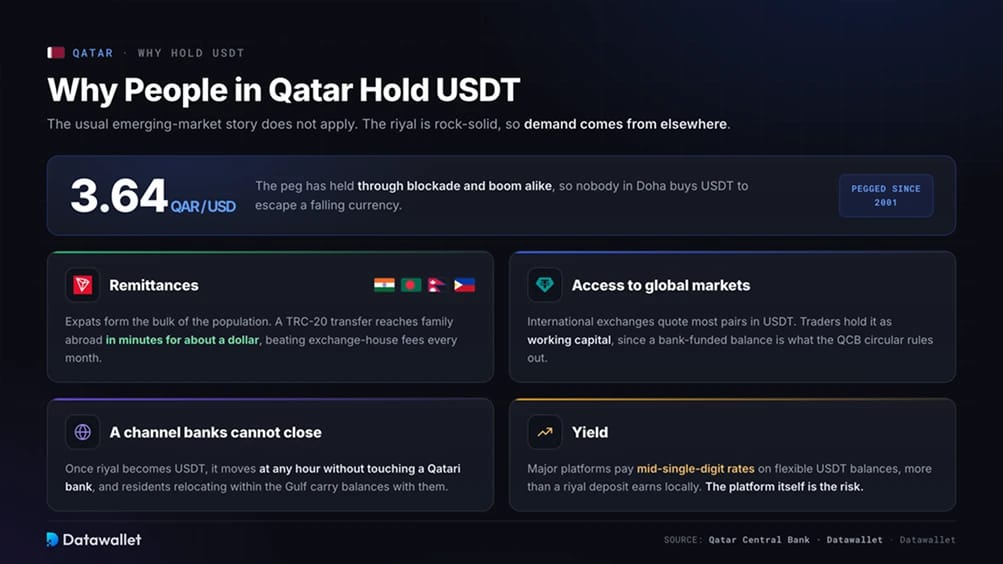
The usual emerging-market story does not apply here. The riyal has been pegged at 3.64 to the US dollar since a Royal Decree formalised the rate in 2001, and the peg has held through blockade and boom alike, so nobody in Doha buys USDT to escape a falling currency. Demand comes from elsewhere.
- Remittances. Qatari nationals make up roughly one in ten residents, with Indian, Bangladeshi, Nepali, and Filipino workers forming the bulk of the population. A TRC-20 USDT transfer reaches family abroad in minutes for about a dollar, and for anyone sending money home every month, the saving against exchange-house fees adds up across a contract.
- Access to global markets. International exchanges quote most of their pairs in USDT, a dominance our Tether statistics page puts numbers on. Traders in Qatar hold it as working capital because the alternative, a bank-funded balance, is what the QCB circular rules out.
- A channel the banking ban cannot close. Once riyal becomes USDT, it moves at any hour without touching a Qatari bank. Residents who relocate within the Gulf carry balances with them, which is why our guides to buying USDT in the UAE and Saudi Arabia share so many readers with this one.
- Yield. Major platforms pay mid-single-digit rates on flexible USDT balances, more than a riyal deposit earns at a local bank. No deposit guarantee covers that return and the platform itself is the risk, a tradeoff our guide to USDT yield opportunities works through.
Final Thoughts
Rain is the pick for buying USDT in Qatar. It is the only platform pairing riyal deposits from local banks with a direct QAR-to-USDT market, and its licensing record, first through Bahrain's central bank and later through the ADGM and VARA, is as strong as any resident of an unlicensed market can access. Our Rain review examines the platform in full.
Qatari law offers you no recourse against any crypto platform, Rain included, so a dispute would play out under Bahraini oversight rather than anything closer to home. Rain also suffered a $16 million theft in April 2024 attributed to North Korea's Lazarus Group, a loss the company absorbed without customer balances taking the hit.
Treat an exchange balance as trading float, hold everything else in self-custody, and plan on the assumption that your bank will occasionally get in the way.
%20(1).webp)