




Canton Network is one of the more distinctive blockchain projects in institutional crypto because it combines privacy, interoperability, and regulated-market infrastructure in a way few public chains are built to support.
That positioning matters more now because Canton is no longer just a technical concept. It has live ecosystem projects, measurable validator growth, and named institutional participants across repo, tokenization, and payment workflows.
For investors and researchers, the challenge is separating real infrastructure progress from token-market hype. Canton gives enough concrete data to make that possible, but it still requires careful reading of adoption, utility, and regulatory context.
Here’s what matters most before forming a view on Canton. 👇
What is Canton Network?
Canton Network is a privacy-focused blockchain network for regulated finance. It launched in 2023, but the more relevant 2026 framing is its recent scale: Canton’s ecosystem materials said in late 2025 that the network had ~600 validators live and 15M+ monthly transactions using Canton Coin in transaction flows.
By March 12, 2024, Canton’s interoperability claims had been tested in a pilot covering 22 distributed applications and more than 350 simulated transactions, showing how tokenized cash, bonds, funds, financing, and margin workflows could interact atomically across separate apps. That pilot is one of the strongest concrete proofs of the network’s design goals.
The network is built for synchronized finance, meaning multiple assets and workflows can settle together instead of passing through disconnected ledgers and reconciliation steps. In the March 2024 pilot, participants included 15 asset managers, 13 banks, four custodians, three exchanges, and one financial market infrastructure provider, underlining Canton’s focus on real institutional coordination.
Canton’s positioning became more concrete on July 1, 2024, when its Global Synchronizer went live after nearly a year of testing and, according to Canton, ten years of technological development behind the broader architecture. That date matters because it marks the shift from concept and pilot activity to live decentralized interoperability infrastructure.
How Does Canton Work?
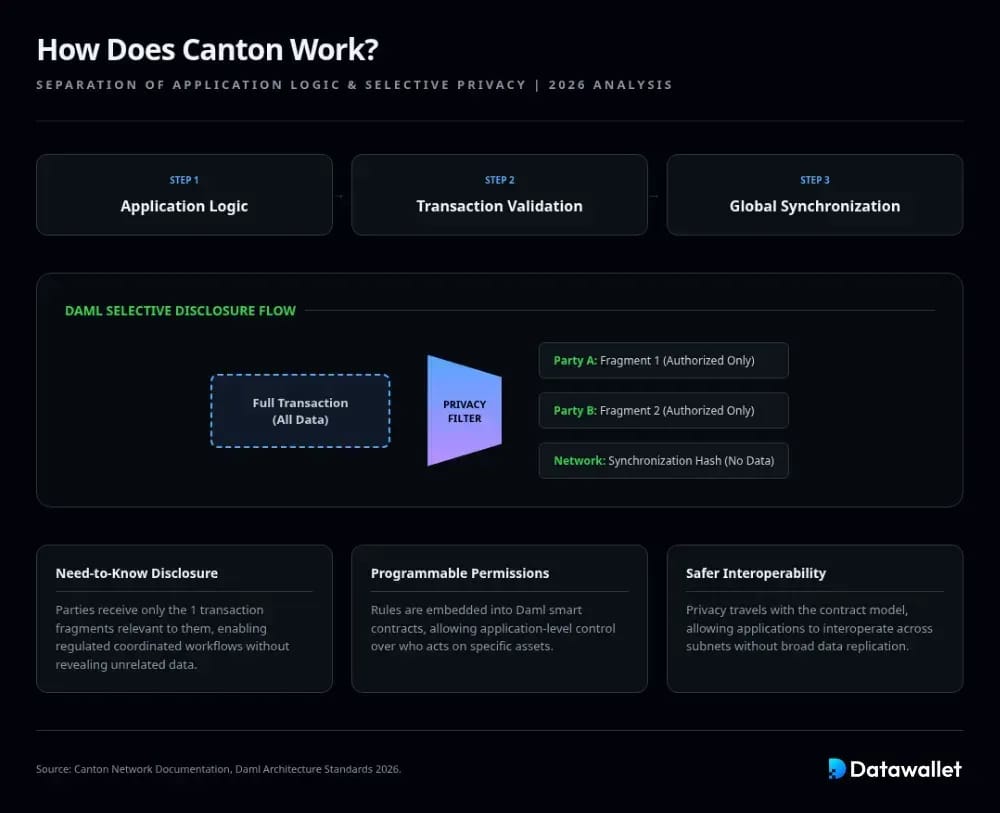
According to its whitepaper, Canton works by separating application logic, transaction validation, and transaction synchronization, so independent apps can share a common network while preserving selective data visibility, operational autonomy, and atomic interoperability across multiple domains.
1. Daml smart contracts and selective privacy
Daml defines business workflows and data permissions, while Canton enforces them so only relevant parties receive the transaction details they need, instead of broadcasting full state changes across the network.
What this privacy model enables across applications:
- Need-to-know disclosure: Parties receive only the transaction fragments relevant to them, which helps regulated applications share value and coordinate workflows without revealing unrelated commercial information.
- Programmable permissions: Privacy rules are written into Daml smart contracts, allowing application-level control over who can view, act on, or validate specific assets and data.
- Safer interoperability: Because privacy travels with the contract model, applications can interoperate across subnets without depending on broad data replication or public-state transparency.
2. Validator nodes hold state and validate business actions
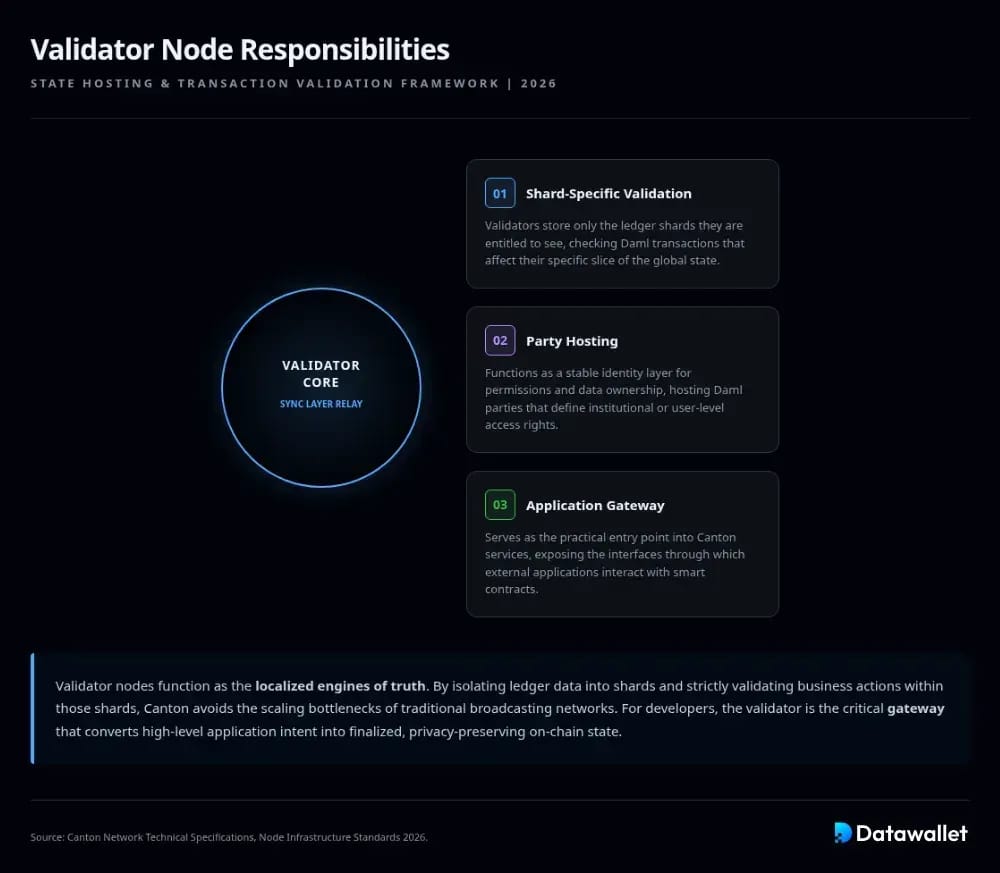
Validator nodes store the ledger shard they are entitled to see, host Daml parties, and validate transactions affecting that data before coordinated commits are finalized across connected applications.
Core validator responsibilities inside the network architecture:
- Shard-specific validation: Validators keep only the ledger data they are permitted to access and check Daml transactions that affect that visible slice of state.
- Party hosting: Daml parties are hosted on validator nodes, giving institutions or app users a stable identity layer for permissions, transaction execution, and data ownership.
- Application gateway: Validators expose the interfaces through which users and applications interact with smart contracts, making them the practical entry point into Canton-based services.
3. Synchronizers coordinate ordering and atomic cross-application commits
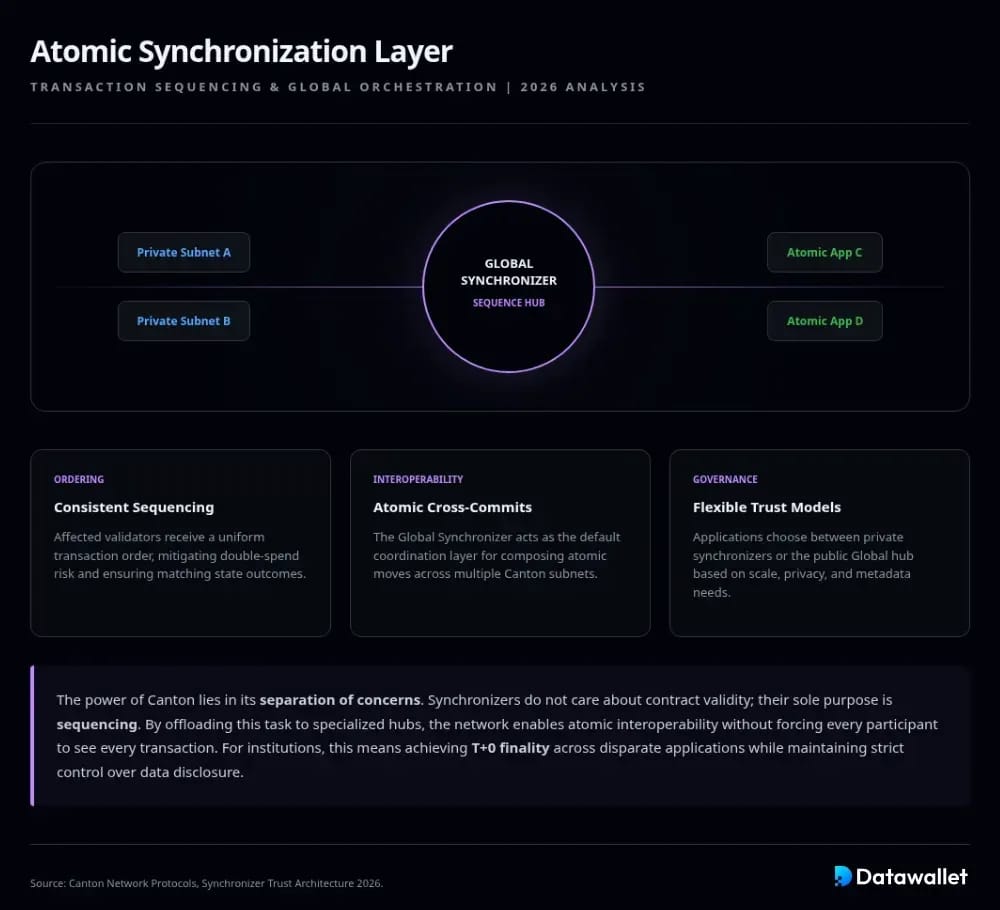
Canton separates smart-contract validity from transaction sequencing. Synchronizers coordinate ordering and commit preparation, while the Global Synchronizer serves as a decentralized option for transactions spanning multiple applications or subnets.
Why synchronizers matter for network-wide composability:
- Consistent ordering: Synchronizers ensure affected validators see a consistent transaction order, reducing double-spend risk and allowing participants to reach matching outcomes.
- Atomic interoperability: The Global Synchronizer is positioned as the default public coordination layer for composing atomic transactions across multiple Canton applications.
- Flexible trust models: Applications may use the decentralized Global Synchronizer or private synchronizers, depending on their needs around scale, governance, and metadata disclosure.
How To Use Canton Network
You can think about using Canton in three broad ways: joining as an application user through a validator, building applications with Daml and Canton infrastructure, or operating validator connectivity that links assets, users, and shared network utility.
1. For institutions and application users
Institutions can access Canton applications and assets through a validator, either self-hosted or provided by a service partner, while choosing custody, wallet, and operational models that fit compliance requirements.
Typical onboarding path for network participants:
- Choose validator access: Decide whether to run your own validator or connect through an infrastructure provider, depending on control, staffing, and deployment preferences.
- Set custody and wallet model: Select self-custodial or custodial arrangements, along with wallet and key-management options suitable for your users and regulatory obligations.
- Connect to applications: Use the validator as your gateway to tokenized assets, payments, financing, or collateral applications already available in the Canton ecosystem.
2. For developers and app providers
Builders use Daml and Canton infrastructure to create multi-party applications whose workflows, permissions, and privacy rules are defined at the smart-contract layer and then exposed through familiar application frontends and backends.
Practical path from prototype to production application:
- Model workflow in Daml: Define assets, counterparties, permissions, and lifecycle logic in Daml so business rules and selective data access are embedded in the application.
- Build app services around ledger logic: Add frontends, backends, and off-ledger integrations to manage users, automate workflows, and connect enterprise systems.
- Deploy against Canton infrastructure: Run or connect validators and synchronizers so the application can interoperate with other Canton services without giving up control.
3. For validators and network operators
Operators participate by running validator infrastructure connected to the Global Synchronizer or other synchronizers, enabling transaction flow, application access, and broader utility across the Canton ecosystem.
Main steps for operating network connectivity and utility:
- Deploy validator infrastructure: Install and configure Canton components, including participant connectivity and synchronizer integration, using supported deployment paths and service-provider assistance when needed.
- Connect to the Global Synchronizer: Link your validator to the decentralized coordination layer so users and applications can participate in cross-application atomic workflows.
- Support ecosystem traffic: Once connected, operators can route application activity, provide network utility, and help users access assets and services across Canton.
The Canton Coin (CC)
Canton Coin is the network’s native utility token, used for fees on the Global Synchronizer and for rewarding infrastructure, application, and user activity.
Tokenomics
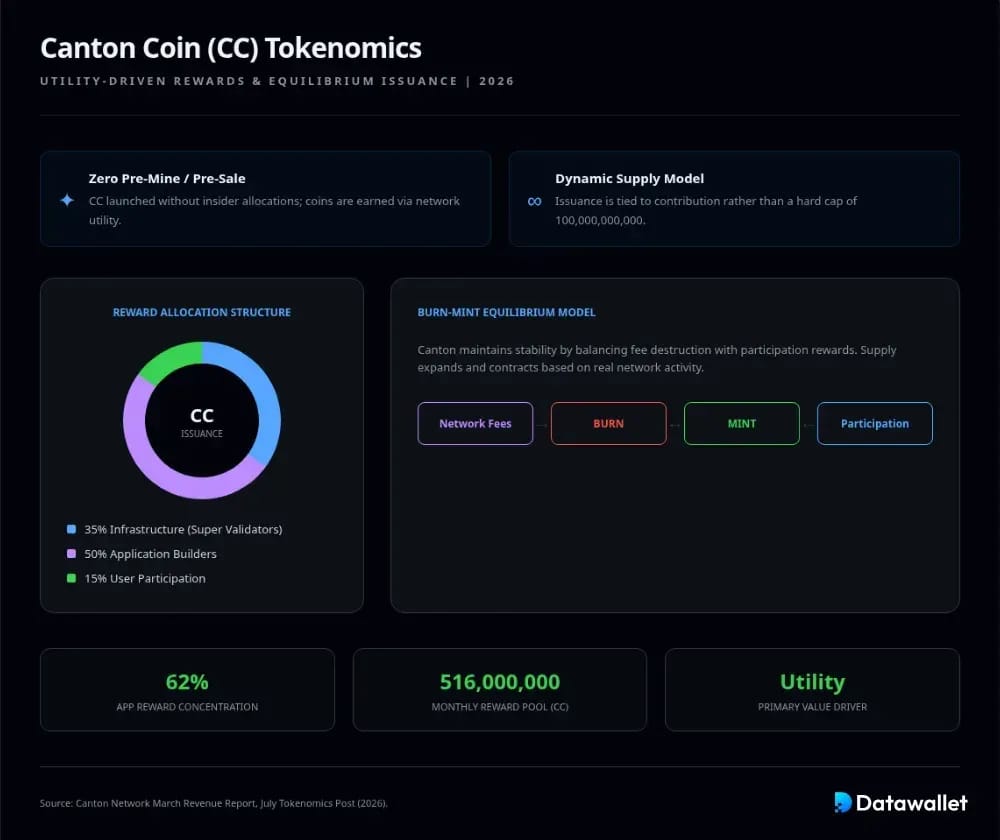
CC’s tokenomics are built around utility rather than a fixed hard cap, with issuance tied to network contribution and fees designed to be burned. Canton’s own materials stress a dynamic supply model instead of simple scarcity marketing.
Key tokenomics mechanics shaping CC today:
- No pre-mine or pre-sale: CoinMarketCap’s project profile says CC launched without a pre-mine, pre-sale, or similar insider allocation, with coins earned for network utility instead.
- Dynamic rather than fixed supply: Canton says the commonly cited 100B figure is not a hard cap, because supply changes with minting and fee burns over time.
- Burn-mint equilibrium model: Network fees are burned, while new CC is minted to reward useful participation, creating a balancing mechanism tied to actual usage.
- Infrastructure reward split: Canton’s July tokenomics post says 35% of rewards go to infrastructure providers, specifically super validators running core decentralized services.
- Application reward split: The same breakdown allocates 50% of rewards to application builders that deploy contracts, tokenize assets, and generate valuable transaction flows.
- User participation reward split: Canton assigns the remaining 15% of rewards to users and validators engaging with apps, creating incentives beyond pure infrastructure operators.
- App-reward concentration today: Canton’s March revenue post says 62% of all CC rewards can currently be minted by featured apps or assets they bring onchain.
- Illustrative monthly reward pool: That same post uses 516M CC as the current monthly mintable app-reward pool, showing how heavily tokenomics favor transaction-generating applications.
Utility
CC is not framed as a governance meme token or generic gas asset. Canton and market trackers both describe it as a network token for paying infrastructure and application fees while rewarding participants who create measurable utility.
Where Canton Coin is supposed to create value:
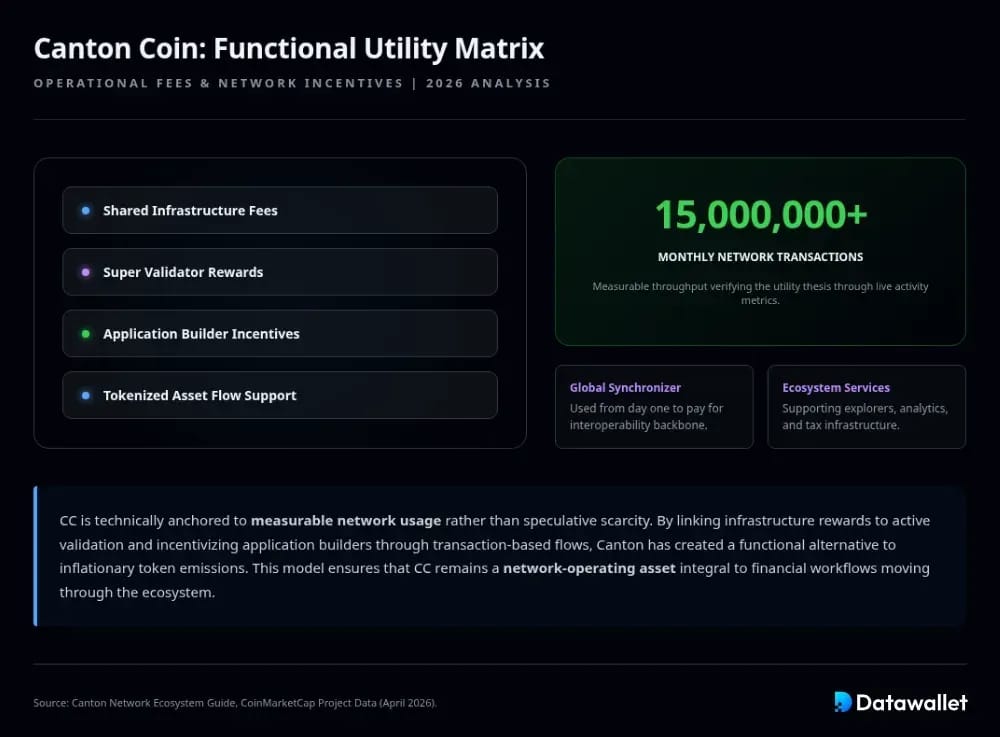
- Fee payment on shared infrastructure: Canton says CC is used from day one to pay for use of the Global Synchronizer, its interoperability backbone.
- Rewarding decentralized operations: Super validators earn CC for running Global Synchronizer infrastructure, making token rewards part of the network’s operating model.
- Rewarding validator access provision: CoinMarketCap’s project description says validators providing network access can also earn CC through participation.
- Rewarding application activity: App builders are explicitly rewarded when their apps drive transactions, which Canton presents as a utility-aligned alternative to speculative token emissions.
- Supporting tokenized asset flows: Canton says fees and rewards are linked to activity from tokenized securities, payments, and other financial workflows moving through apps.
- Enabling broader ecosystem services: The ecosystem page already lists analytics, explorer, tax, payments, and infrastructure services built around CC-related activity and monitoring.
- Tied to network usage, not simple scarcity: Canton’s messaging repeatedly says CC is meant to reward real network usage over speculation, including in its official token pages.
- Connected to measurable throughput: Canton’s latest ecosystem guide says the network sees 15M+ monthly transactions using Canton Coin in their flows, giving the utility thesis a live activity metric.
Token performance
CC’s longer-term market picture is more useful than intraday moves. Live trackers place the token around 22% below its all-time high of roughly $0.194 and about 157% above its all-time low near $0.059, which shows a wide trading range in a relatively short public history.
That range also shows how quickly CC repriced once it reached open-market price discovery. CoinMarketCap’s historical data indicates the token was still trading near $0.07-$0.08 in early December, then later pushed above $0.19 before settling back into the mid-$0.14 area.
From a valuation perspective, the more important long-frame data is supply and market cap, not daily candles. CoinGecko currently shows roughly 38 billion CC tradable and a market capitalization around $5.8 billion, which means price movements now reflect a large existing float rather than a tiny illiquid microcap.
For article readers, the clean takeaway is that CC has already gone through one major repricing cycle: it surged from its December lows, set a peak in early February, and now trades meaningfully below that high while remaining far above its bottom. That is a much better framing than short-term volatility statistics.
Canton Ecosystem
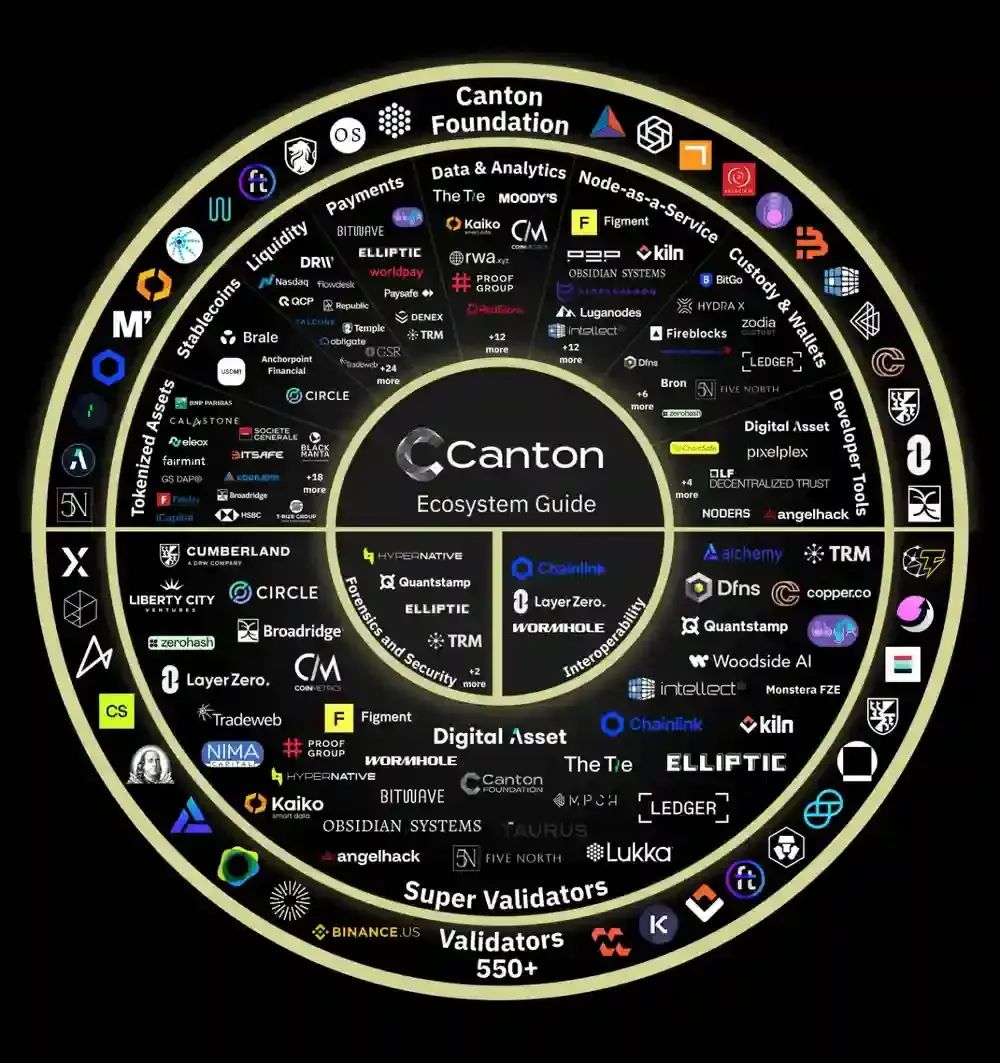
Canton’s ecosystem is easiest to understand through its flagship applications. Broadridge DLR is one of the clearest production-scale examples: Canton’s ecosystem page says the app processes over $8 trillion per month in repo transactions, making it one of the network’s strongest real-world usage anchors.
A second major pillar is GS DAP, Goldman Sachs’ digital asset platform, which Canton describes as natively built on the network for regulated tokenization. That matters because HKMA says it uses both GS DAP and HSBC Orion for tokenization and digital bond offerings, linking Canton to named issuance platforms rather than abstract “RWA activity.”
Payments and cash-like settlement are represented by Circle’s USDCx stack on Canton. Canton’s ecosystem materials say Circle brings USDCx to the network and connects it with acquired treasury tokenization product USYC, while the dedicated USDC page explains that USDCx is minted through xReserve and interoperates without third-party bridges.
The ecosystem also extends beyond issuance and payments into market plumbing and analytics. Versana is referenced through participant pages such as Morgan Stanley and J.P. Morgan for syndicated loan data, DTCC is described as advancing the onchain migration of U.S. Treasuries, and tools like CC Explorer and RWA.xyz give Canton native monitoring and analytics layers.
Canton Network Founders
Canton Network was created by Digital Asset, which describes itself as the creator of Canton and a founding member of the Canton Foundation. The most prominent public face today is Yuval Rooz, repeatedly identified by Canton and Digital Asset as Co-Founder and CEO of Digital Asset.
When naming the actual founders behind the company that built Canton, the clearest published list comes from Digital Asset coverage and market profiles: Yuval Rooz, Eric Saraniecki, Shaul Kfir, and Don Wilson are named on CoinMarketCap’s Canton founder section, while broader company profiles also include Sunil Hirani.
For article purposes, the safest framing is that Canton was launched by a consortium, but the protocol itself was developed by Digital Asset, whose founding team includes Yuval Rooz, Eric Saraniecki, Shaul Kfir, Don Wilson, and Sunil Hirani. Among them, Rooz remains the best-known current executive voice behind Canton’s strategy and public positioning.
Risks and Considerations
Canton is stronger when measured with live figures, but investors and readers still need to balance institutional traction against token, governance, liquidity, and execution risks. The main concerns below come from current network design, market data, and ecosystem structure.
Main risks worth weighing before trusting the bullish case:
- Institutional concentration risk: Canton’s positioning is heavily tied to banks, tokenized assets, repo, and enterprise infrastructure, which means adoption could depend on a relatively narrow institutional buyer base.
- Tokenomics complexity risk: The burn-mint equilibrium, dynamic supply model, and role-based reward splits use more complex smart contracts than standard crypto token models, making valuation harder for general-market participants.
- Supply expansion risk: Live trackers show roughly 38.3B CC circulating today, while Canton also emphasizes ongoing minting tied to utility, so dilution remains a real consideration.
- Liquidity and volatility risk: Despite a $5.8B market cap, 24-hour spot volume remains under $10M on major trackers, which can amplify price swings during sentiment shifts.
- Governance centralization concerns: Canton emphasizes decentralized operations, but its infrastructure still depends on super validators and coordinated governance through the Global Synchronizer Foundation.
- Narrative-versus-usage mismatch: Big ecosystem claims such as $9T+ monthly RWAs or 15M+ CC-linked monthly transactions are impressive, but investors must distinguish network throughput from token-holder value capture.
- Competitive execution risk: Canton is trying to serve regulated finance while also extending toward Ethereum-style developer ecosystems, a difficult strategy that may face competition from other RWA and privacy-focused chains.
- Data transparency limitations: Some of the strongest growth claims come from Canton’s own publications, so independent verification still matters when assessing adoption, rewards, or fee economics.
- Event-driven repricing risk: Recent coverage noted CC holding around the $0.15 range without fresh catalysts, suggesting sentiment can stall quickly when no major adoption or listing news appears.
Regulations and Compliance
Canton’s compliance profile is more developed than that of many crypto networks because it now publishes formal regulatory documentation tied to specific assets and jurisdictions. Its whitepaper library includes a dedicated MiCA white paper for Canton Coin, giving the project a clearer European disclosure basis.
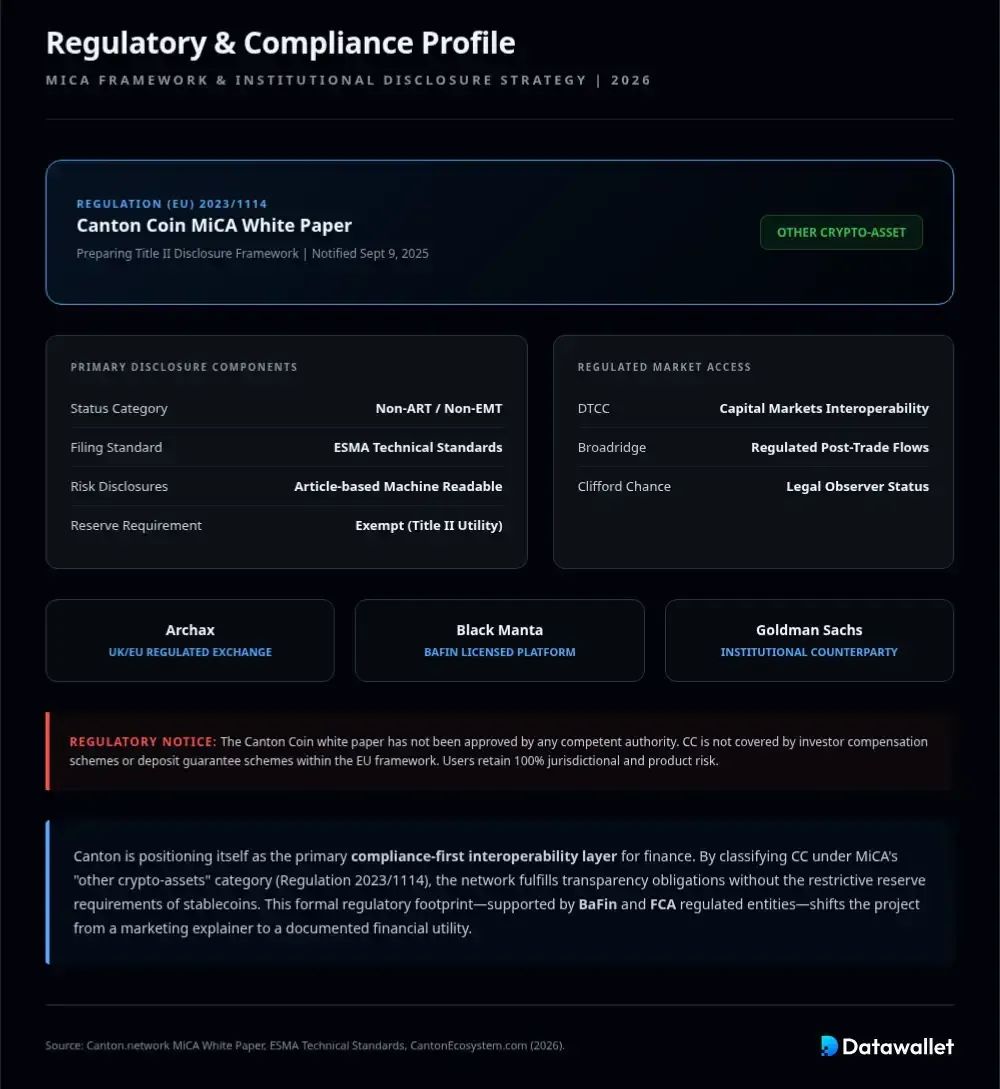
The key filing is the Canton Coin MiCA white paper, notified on September 9, 2025. It states the document was prepared under Title II of Regulation (EU) 2023/1114 and classifies CC as a crypto-asset other than an asset-referenced token or e-money token.
That classification is important because it places CC outside MiCA’s stricter frameworks for ARTs and EMTs. Canton’s filing also says the white paper has not been approved by any competent authority and that CC is not covered by EU compensation or deposit guarantee schemes.
Canton’s broader ecosystem also strengthens its compliance position through regulated counterparties. Official materials list Archax as a UK and EU regulated exchange, broker, and custodian, and Black Manta as BaFin-licensed, while ESMA requires MiCA white papers to follow structured disclosure standards.
Final Thoughts
Canton Network stands out by targeting institutional finance with privacy, interoperability, and compliance tooling rather than retail-first speculation. Recent metrics, named ecosystem projects, and MiCA documentation make it easier to analyze with concrete evidence instead of broad claims.
Its strongest advantages are the quality of participants, the scale of applications like Broadridge DLR, and the effort to align token utility with real network activity. Those strengths give Canton more substance than many infrastructure-led crypto projects.
Still, Canton remains a complex bet. Investors need to separate network adoption from token-holder value capture, watch how rewards and supply evolve, and judge whether institutional blockchain demand can keep expanding across payments, collateral, and tokenized assets.