


What is Farcaster?
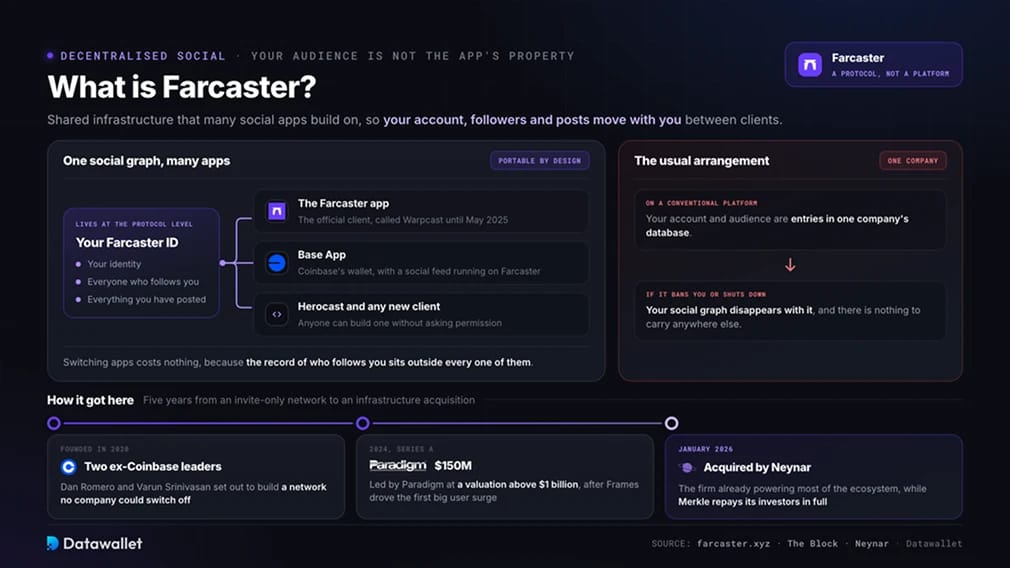
Farcaster is a decentralised social networking protocol, meaning it is shared infrastructure that many social apps can build on rather than a single platform run by one company. Your account, followers, and posts belong to you at the protocol level, so you can switch between apps without losing your audience.
The protocol was founded in 2020 by Dan Romero and Varun Srinivasan, both former Coinbase executives. If a conventional platform bans you or shuts down, your social graph disappears with it, while on Farcaster the record of who you are and who follows you persists independently of any client.
Momentum built quickly through 2024, when the company behind the protocol, Merkle Manufactory, closed a $150 million Series A led by Paradigm at a valuation above $1 billion. Growth later stalled, and in January this year the protocol was acquired by Neynar, the infrastructure firm that already powered most of its developer ecosystem.
Farcaster sits alongside Lens, Nostr, and Bluesky in the broader push to make social media portable. Its distinguishing bet is a hybrid design that keeps identity on an Ethereum Layer 2 while pushing high-volume activity to a purpose-built data network.
How Does Farcaster Work?
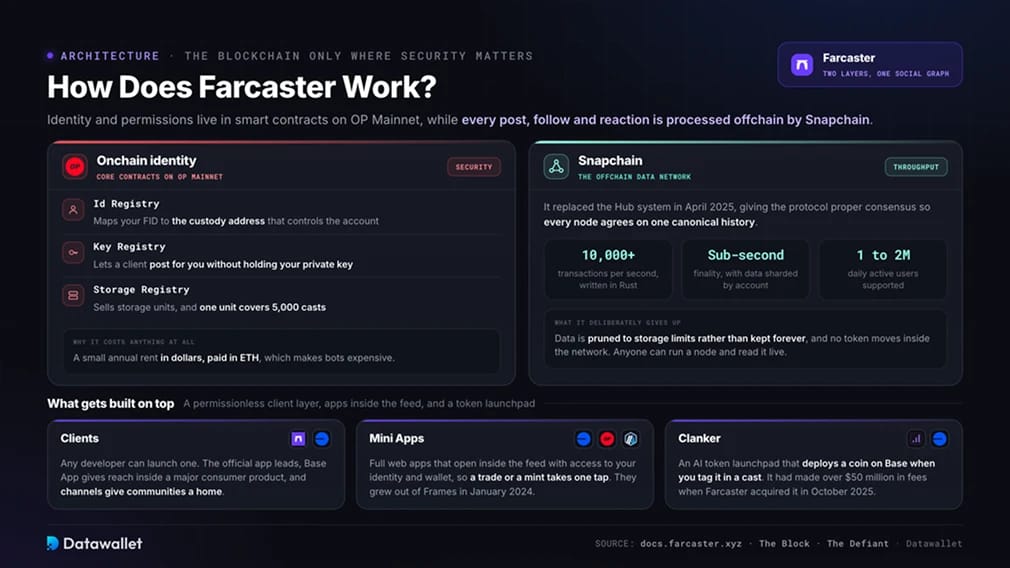
Farcaster splits its architecture into two layers, using the blockchain only where security matters most. Identity and permissions live in smart contracts on OP Mainnet, while every post, follow, and reaction is processed offchain by Snapchain, according to the official architecture documentation.
1. Onchain Identity on Optimism
Every Farcaster account is anchored by a Farcaster ID, or FID, a unique number registered in the protocol's core contracts on OP Mainnet. The Id Registry maps each FID to a custody address, the Ethereum wallet that controls the account and can name a recovery address in case access is lost.
Two further contracts complete the identity layer. The Key Registry records which app keys are allowed to publish on your behalf, so a client can post for you without ever holding your wallet's private key. The Storage Registry sells storage units, and one unit covers 5,000 casts, which is Farcaster's term for posts, plus allowances for reactions and follows.
Storage works like a small annual rent, priced in US dollars and paid in ETH. The fee makes spam and bot registration expensive, and older messages are pruned once an account exceeds its paid allowance.
2. Snapchain
Snapchain is the offchain data network that stores and orders everything users publish. It replaced Farcaster's earlier Hub system in April 2025, moving the protocol from loosely synchronised servers to a blockchain-like network with proper consensus, so every node agrees on one canonical history of the social graph.
Written in Rust, Snapchain is built to process at least 10,000 transactions per second with sub-second finality, and it shards data by account so each FID's messages can be processed independently. Srinivasan has said the capacity supports one to two million daily active users.
Snapchain deliberately trades some blockchain properties for speed. Data is pruned according to storage limits rather than kept forever, and there is no money or token moving inside the network itself. Anyone can run a node to read the full social dataset in real time, keeping the protocol open to competing clients.
3. Clients and the Farcaster App
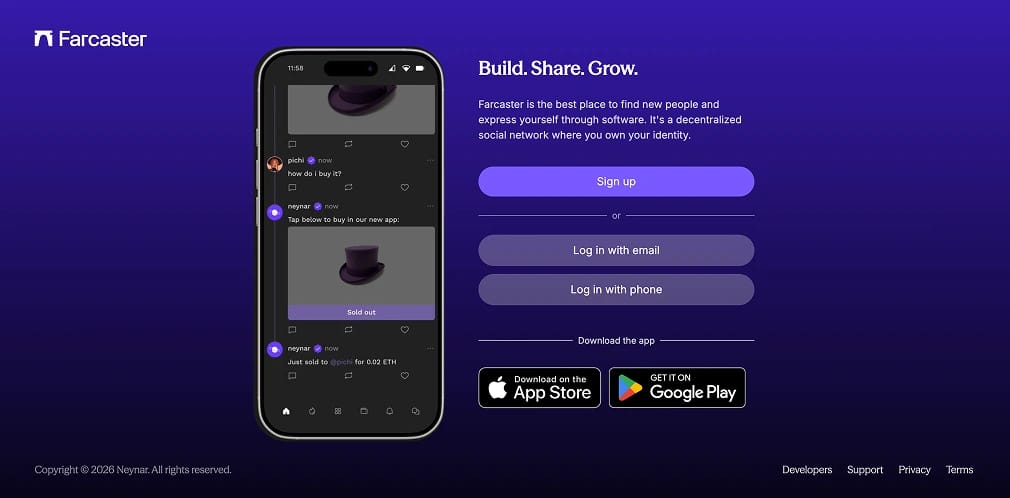
Clients are the apps people use to read and write Farcaster data, and any developer can launch one without permission. The dominant client is the official Farcaster app, called Warpcast until May 2025, when the team renamed it to end confusion between protocol and flagship product.
Coinbase rebuilt its wallet as Base App with a social feed that runs on Farcaster, giving the protocol distribution inside one of crypto's largest consumer products. Smaller clients such as Herocast serve niche audiences, and channels, which are topic-based feeds, give communities a shared home across every client.
4. Mini Apps
Mini Apps are full web applications that run inside the social feed, letting users trade, mint, play games, or vote without leaving the client. They evolved from Frames, the interactive posts Farcaster launched in January 2024 that triggered the protocol's first major user surge.
A Mini App opens as a complete interface with access to the user's Farcaster identity and connected wallet, so a lending deposit or a token purchase takes one tap instead of a separate website, a wallet connection, and an approval screen. Developers gain distribution through social sharing rather than app stores.
Notable Mini Apps span finance and entertainment. Bracky turns sports predictions into tradeable positions, an idea we cover more broadly in our guide to prediction markets, while tipping apps, games, and publishing tools round out a catalogue that spans several EVM networks including Base, Optimism, and Arbitrum.
5. Clanker and Token Launches
Clanker is an AI-powered token launchpad that deploys a tradeable coin on Base when a user tags it in a cast describing the token. Built by Farcaster ecosystem developers in November 2024, it became one of the largest revenue generators on Base, and Farcaster acquired it outright in October 2025.
The acquisition pushed Farcaster deeper into social finance, positioning it against launch platforms like Pump.fun but with a social graph attached to every launch. Clanker had generated more than $50 million in fees by the time of the deal, and the CLANKER token rallied over 300% in the week after the announcement.
How to Get Started on Farcaster
Joining Farcaster takes minutes, though it involves a small payment because your account is a real onchain asset. The steps below follow the official Farcaster app, which handles the blockchain mechanics behind a familiar interface.
Setting up an account follows these steps:
- Download the app: Install the official Farcaster app from the App Store or Google Play, or open the web client at farcaster.xyz on desktop.
- Create your account: Sign up with your email or phone number, and the app registers your FID on OP Mainnet behind the scenes with a custody wallet it generates for you.
- Pay the signup fee: Cover the small one-off charge that funds your onchain registration and first year of storage.
- Choose a username: Pick a free protocol-level name, or connect an ENS name if you already own one and want your existing onchain identity to carry over.
- Save your recovery phrase: Back up the recovery credentials the app provides, since your account is a cryptographic asset that support staff cannot restore for you.
- Follow and join channels: Seed your feed by following active accounts and joining channels for the topics you care about.
- Publish your first cast: Post an introduction, since early engagement builds your graph faster than lurking.
- Explore Mini Apps: Open the Mini App directory to try games, tipping tools, and trading interfaces that run on your Farcaster identity without separate signups.
- Connect a wallet: Link or fund a wallet for onchain features, keeping balances modest while you learn how in-feed transactions behave.
Is There a Farcaster Token?
No, Farcaster has no native token, and the founders repeatedly ruled one out. Dan Romero confirmed publicly that no token existed, none was planned, and no airdrop would reward node operators, arguing that a one-off distribution would spike and fade rather than build a sustainable network. Years of speculation about a "FAR" or "WARPS" ticker never produced anything tradeable.
What the ecosystem has instead is Warps, an in-app credit system priced at roughly one cent per Warp. Warps pay for things like storage top-ups and onboarding invites inside the official client, but they cannot be traded onchain and are closer to app store credit than a cryptocurrency.
The absence of a token became a talking point after the Neynar acquisition, since token expectations had helped sustain interest in the $1 billion valuation. Community tokens filled some of the gap, with DEGEN emerging as a grassroots tipping currency and Clanker launches minting thousands of meme coins, though none are official protocol assets. Neynar has announced no change to that position.
Farcaster Pro and Creator Rewards
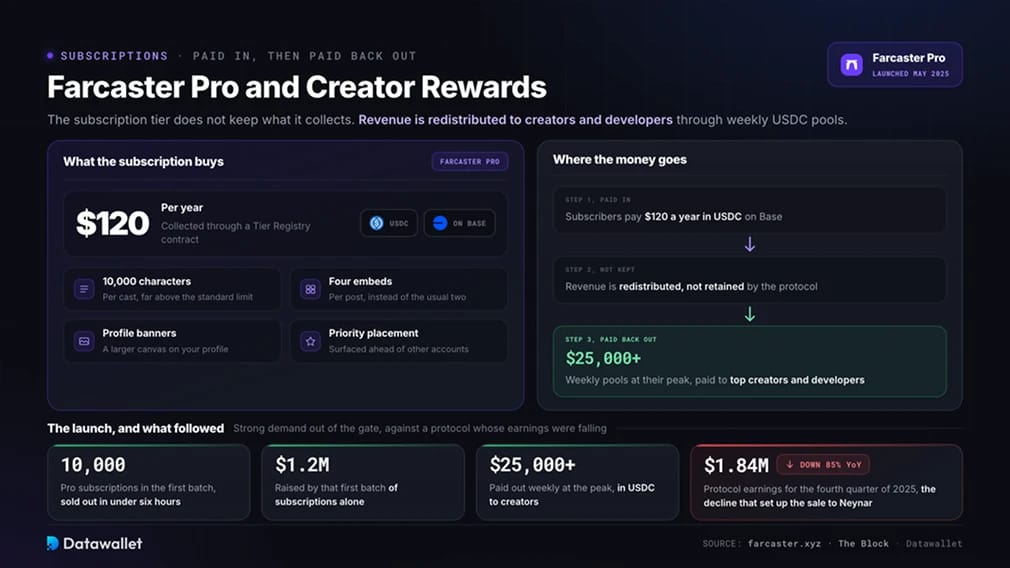
Farcaster Pro is the protocol's subscription tier, launched in May 2025 at $120 per year. Subscribers get casts of up to 10,000 characters, four embeds per post instead of two, profile banners, and priority placement. Payments are collected in USDC through a Tier Registry contract deployed on Base.
Subscription revenue is redistributed rather than kept, funding weekly reward pools paid in USDC to top creators and developers that at their peak exceeded $25,000 per week. The first 10,000 Pro subscriptions sold out in under six hours and raised $1.2 million.
Rewards could not offset the wider slowdown. Protocol earnings for the fourth quarter of 2025 came in at $1.84 million, down 85% year over year, a decline that set the stage for the ownership change that followed.
Who Owns Farcaster? The Neynar Acquisition
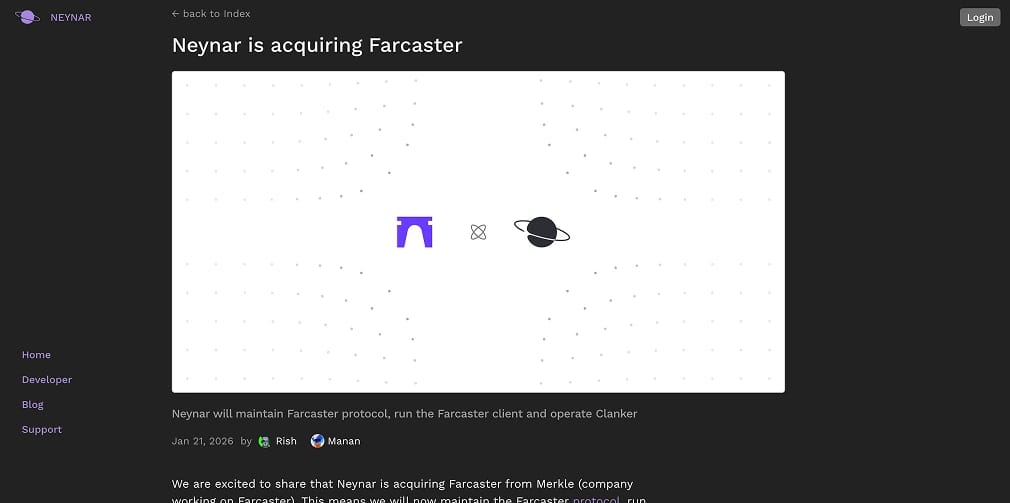
In January 2026, Neynar acquired Farcaster from Merkle Manufactory, taking over the protocol contracts, code repositories, the official app, and Clanker. Neynar had provided the hosted nodes and APIs most Farcaster apps already ran on since 2021, so the deal formalised a dependency that had existed for years.
The founders stepped back from daily operations, and Merkle committed to repaying the full $180 million it raised to its venture investors, a rare outcome in crypto. Romero stated plainly that Farcaster was not shutting down, citing 250,000 monthly active users and over 100,000 funded wallets in the month before the deal.
Neynar has signalled a developer-first direction, treating Farcaster as programmable social infrastructure rather than chasing a consumer breakout. That reach matters, because Base App's social layer and hundreds of Mini Apps now depend on one company maintaining both the protocol and the tooling around it.
Is Farcaster Safe?
Farcaster's core contracts are open source and have been audited by firms including Certik, 0xMacro, and Cyfrin, and the account model is robust by design. Your FID lives onchain with a recovery address, app keys can be revoked without touching your custody wallet, and no client can silently take over your identity.
Decentralisation in practice lags decentralisation in design. The official app has captured the overwhelming majority of activity, Snapchain runs on a small validator set, and one company now maintains the protocol, the dominant client, and the infrastructure most apps depend on. The protocol can survive any single app disappearing, but the ecosystem's day-to-day health is concentrated.
Risks
Weigh these risks before committing time or money:
- Ownership concentration: Neynar controls the protocol, official client, developer infrastructure, and Clanker, so its decisions shape the whole ecosystem.
- User decline: Active users and revenue fell sharply through 2025, and a smaller network reduces the value of building an audience there.
- Token speculation: Ecosystem coins launched through Clanker and community tokens like DEGEN are highly volatile and carry no official backing.
- Data pruning: Snapchain deletes old messages once storage limits are exceeded, so lapsed rent can mean losing historical content.
- Key management: Losing both your custody wallet and recovery credentials means losing the account permanently, with no support desk able to help.
- In-feed transactions: Mini Apps make onchain actions one tap away, which is convenient for users and equally convenient for scam applications.
- Governance gap: With no token and no DAO, users have no formal vote over protocol changes under the new ownership.
Farcaster Founders
Farcaster was founded by Dan Romero and Varun Srinivasan, who met at Coinbase, where Romero rose to vice president and Srinivasan served as a director of engineering. They left to build a social network that no company could switch off, incorporating Merkle Manufactory in 2020 and shipping the earliest version of the protocol to a small invite-only community.
Romero became the public face, arguing that quality of users mattered more than raw growth and resisting the token launches that defined rival projects. Srinivasan led protocol engineering and authored the Snapchain design that went from concept to mainnet in under a year.
Both stepped away after the Neynar sale, closing a five-year run of real technical breakthroughs alongside a commercial outcome that fell short of its billion-dollar valuation. Their decision to repay investors in full set an unusual precedent for the sector.
Final Thoughts
Farcaster proved that portable social identity works. Accounts registered on Optimism, data synced through Snapchain, and a permissionless client layer delivered the technical vision, and pieces of it now power products bigger than the protocol's own app, most visibly Base App's social feed.
The commercial story is more sobering. A $1 billion valuation, a shrinking user base, and a sale to an infrastructure provider show how hard it is to beat entrenched networks, even with better architecture underneath.
For users and builders, Farcaster is best treated as infrastructure with a committed new steward rather than the next mainstream network. The identity layer is durable, the developer tools are strong, and anything speculative built on top deserves the same caution as the rest of crypto.