







Can You Get Free Avalanche Testnet Tokens?
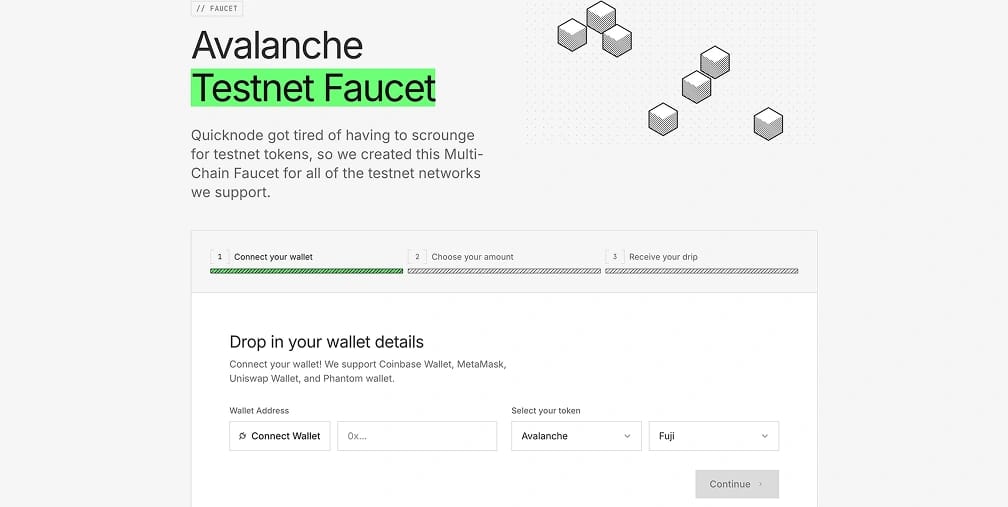
Yes, you can get Avalanche testnet tokens. The QuickNode Multi-Chain Faucet distributes free testnet AVAX on Fuji, Avalanche's public test environment. Each wallet can claim once every 12 hours, and sharing a post about QuickNode on X doubles the drip.
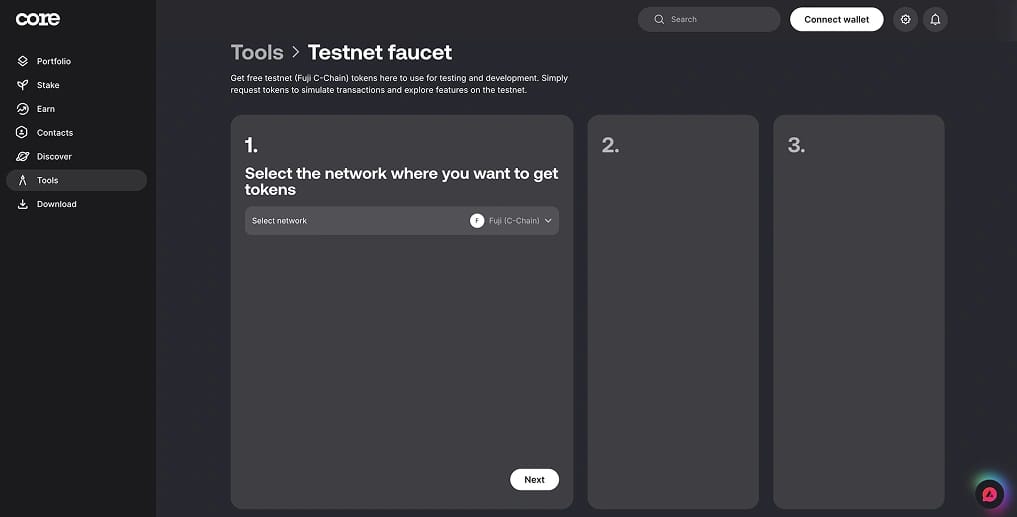
Avalanche runs its own faucet at core.app/tools/testnet-faucet, but it pushes you toward creating a Builder Hub account and installing Core Wallet. For most users who just want testnet AVAX quickly, QuickNode is the easier path. For a broader look at testnet faucets across chains, see our best crypto faucets comparison.
How to Get Avalanche Testnet AVAX
The QuickNode faucet is the simplest way to get Fuji testnet AVAX. It supports 55+ networks under one interface and works with MetaMask, Coinbase Wallet, Phantom, and Uniswap Wallet. I've used it across a few different chains and it consistently delivers within seconds.
- Visit the faucet: Go to faucet.quicknode.com/avalanche/fuji.
- Connect your wallet: Click Connect Wallet and select MetaMask or your preferred option. Make sure your wallet is configured for the Fuji C-Chain (Chain ID 43113).
- Request tokens: Click the drip button to receive testnet AVAX. Tokens arrive almost instantly.
- Optional: double your drip. Share a post mentioning QuickNode on X to unlock a larger allocation.
- Verify your balance: Check your wallet or look up your address on testnet.snowscan.xyz.
QuickNode requires a small mainnet ETH or SOL balance to verify you're a real user. If you're starting from zero, the Chainlink or Thirdweb faucets below have no mainnet requirement.
To add Fuji to MetaMask manually, follow our full guide on how to add Avalanche to MetaMask.
Other Avalanche Testnet Faucets
Several other faucets distribute Fuji testnet AVAX if QuickNode doesn't suit your setup.
- Chainlink Faucet drips both testnet AVAX and LINK tokens in a single claim. If you're integrating Chainlink oracles, VRF, or automation on Avalanche, this bundles everything you need. Connects via MetaMask, WalletConnect, or Coinbase Wallet.
- Thirdweb Faucet offers 0.01 AVAX per day. Smaller drip, but no mainnet balance or signup required.
- AllThatNode Faucet provides one claim per day and supports returning unused tokens back to the faucet.
- Official Avalanche Faucet gives up to 2 AVAX per claim, the largest single drip available. The catch is that Avalanche pushes you toward creating a Builder Hub account and using Core Wallet to claim.
If you're using Core Wallet, toggle Testnet Mode in the extension (hamburger menu > Advanced > Testnet Mode) and it switches to Fuji automatically. If both MetaMask and Core are installed, they can conflict on wallet popups. Disabling MetaMask temporarily avoids this.
What is Avalanche's Fuji Testnet?
Fuji is Avalanche's public testnet, and it's not a typical single-chain test environment. It replicates Avalanche's full multi-chain system: the C-Chain for EVM-compatible smart contracts, the P-Chain for staking and L1 creation, and the X-Chain for asset transfers.
The C-Chain is where most developers spend their time. It supports Solidity, works with Hardhat, Foundry, and Remix, and gas fees are minimal (base fee around 25 gwei, so transfers cost well under 0.001 AVAX). Blocks finalize in about two seconds with deterministic finality, which makes iterative testing noticeably faster than on Sepolia or other 12-second block time testnets.
The Avalanche9000 upgrade (the Etna Upgrade) reshaped Fuji for L1 development. Sovereign L1 blockchains can now be deployed with validator fees of about 1.33 AVAX per month, down from the old 2,000 AVAX staking requirement. Avalanche's Interchain Messaging (ICM) and Interchain Token Transfer (ICTT) protocols are both live on Fuji, so cross-L1 token transfers and message passing can be tested before mainnet.
Core Wallet is the only wallet supporting P-Chain transactions, which is why the Avalanche docs recommend Core over MetaMask for anything beyond C-Chain work.
What Can You Do With Avalanche Testnet Tokens?
Testnet AVAX on Fuji covers gas for several workflows. Here's a quick rundown of what they're most commonly used for:
- Deploy and test smart contracts: Fuji's C-Chain works with Hardhat, Foundry, and Remix out of the box. Point your framework at the Fuji RPC endpoint and deploy as you would on Sepolia. Gas costs are negligible with even a small faucet drip.
- Interact with testnet DeFi: Protocols like Dexalot maintain live testnet deployments on their own Avalanche L1, with dedicated faucets for ALOT and USDC test tokens. Simulate trades, liquidity provision, and order book interactions without financial exposure.
- Build Avalanche L1s: With the Avalanche CLI and P-Chain AVAX, deploy a custom blockchain on Fuji with its own validator set, gas token, and governance. The Retro9000 grant program allocated $40 million in retroactive rewards for developers who build L1s on testnet and deploy to mainnet.
- Test cross-chain workflows: Bridge testnet AVAX between the C-Chain and P-Chain via the Builder Hub, or test ICM messaging between L1s.
Final Thoughts
Avalanche's Fuji testnet is one of the more capable testing environments in crypto right now. The multi-chain architecture, sub-two-second finality, and native L1 tooling give it a depth that most EVM testnets don't offer.
I'd start with the QuickNode faucet for a quick C-Chain drip, and only bother with the official Avalanche Faucet or Builder Hub if your project needs P-Chain AVAX or you're deploying a full L1.
%2520(1).webp)