




Hyperliquid spent 2026 turning itself from an exchange into infrastructure. Builders now deploy their own perp markets on its Layer 1, tokenised equities and commodities dominate its busiest pairs, and Coinbase pays it most of the reserve yield on the USDC sitting in trader accounts.
Lighter took the opposite route. Rather than renting out its engine, it embedded itself inside consumer apps, becoming the perpetuals layer behind Robinhood Wallet while keeping retail trading free and proving every fill with zero-knowledge circuits settled on Ethereum.
Read our full comparison to see which platform deserves your collateral. 👇
Lighter vs Hyperliquid Overview
Lighter is a perpetual futures exchange built as an application-specific zk-rollup on Ethereum, where every match, margin check and liquidation is proven by a validity proof posted to mainnet. It clears roughly $43 billion in 30-day perp volume, holds $525 million in TVL, and charges retail nothing.
Hyperliquid runs its own Layer 1 with a fully onchain central limit order book and sub-second finality. It processes about $245 billion in 30-day perp volume across crypto, equity and commodity markets, has cleared $4.8 trillion cumulatively, and routes almost all fee revenue into HYPE buybacks.
The two now compete on distribution rather than raw technology. Lighter powers perps inside Robinhood Wallet, while Hyperliquid rents its matching engine to builders through HIP-3.
The table below compares both platforms on the metrics that decide where your order fills, what it costs, and what happens to the fees you pay:
Lighter vs Hyperliquid Perpetuals
Both platforms run central limit order books rather than pooled AMMs, so the real differences sit in latency, margin design and how each platform proves your fill was fair, not in the headline leverage number.
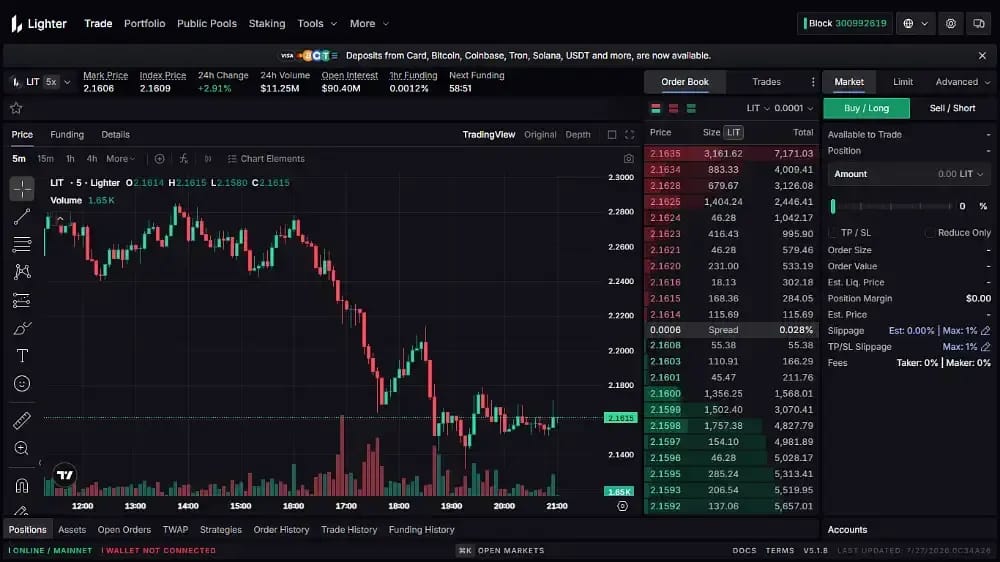
Lighter Perpetuals
Lighter's sequencer posts validity proofs to Ethereum for every action it takes, which lets the exchange run near centralized-exchange speed while still letting traders check the maths themselves rather than trusting an operator afterwards.
The following mechanics define Lighter's perpetual futures engine:
- Verifiable Matching: Custom zk circuits prove price-time priority, margin checks and liquidation maths on Ethereum, so traders confirm the sequencer obeyed the rules rather than trusting it.
- Escape Hatch: Desert mode freezes the rollup after fourteen days of censorship, letting users rebuild balances from Ethereum data and withdraw without any cooperation from the operator.
- Tiered Margin: Majors such as BTC and ETH reach 50x, while mid-caps carry tighter initial margin and experimental contracts stay isolated to contain volatility across the wider book.
- Latency Pricing: Standard accounts take at roughly 300ms, premium accounts at 200ms, and stakers holding 500,000 LIT execute at 140ms with post-only orders never further penalised.
- Order Types: Market, limit, TWAP, stop-loss and take-profit orders run through the app or an institutional API supporting sub-accounts, private keys and high-speed algorithmic connectivity.
- Hourly Funding: Every deployed market currently funds on a one-hour cycle paid directly between longs and shorts, with Lighter taking no cut of those transfers at all.
- Segregated Backstop: LLP splits capital by market type, so a squeeze in a thin pre-launch contract cannot drain the strategy quoting BTC and ETH pairs.
- Multi-Chain Funding: Deposits arrive from Ethereum, Arbitrum, Base, Solana, Avalanche and HyperEVM, with USDC as core collateral and ETH accepted for multi-asset margin positions.
Hyperliquid Perpetuals
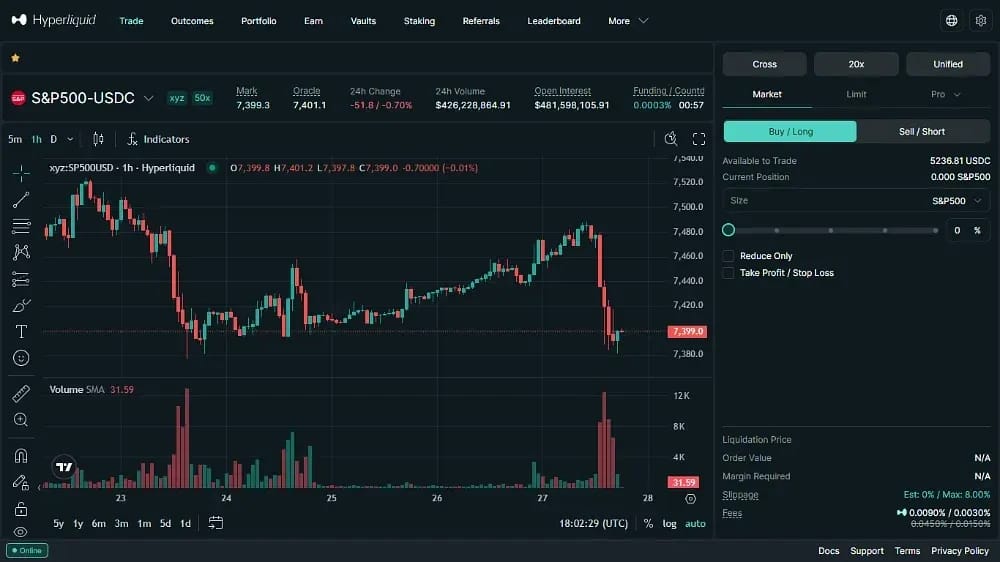
Hyperliquid keeps the entire order book on its own validator set, so verification means watching a public ledger rather than checking a proof, and every risk parameter is enforced by the same HyperBFT consensus.
These are the defining features of the Hyperliquid perp book:
- HyperCore Engine: The matching layer keeps every order, cancel and liquidation onchain with one-block finality, delivering centralized-exchange responsiveness without an off-chain sequencer holding the book.
- Margin Tiers: Native markets cap at 40x, and tiered maintenance margin cuts effective leverage as notional grows, pushing eight-figure positions toward three to ten times.
- HLP Backstop: The community vault market-makes, absorbs liquidations and takes the other side of trader PnL, paying depositors from spreads, funding and fees.
- Mark Pricing: A blended index of external exchange prices and internal book state sets marks, limiting the oracle manipulation that damaged earlier onchain derivatives platforms.
- Auto-Deleveraging: When the insurance fund cannot absorb a bankrupt account, ADL closes profitable counterparties at bankruptcy price, ranked by unrealised profit and leverage.
- Builder Codes: Third-party front ends route flow into the same book and share fees, generating $16.4 million for builders during the second quarter of 2026 alone.
- Hourly Funding: Funding settles every hour from a premium calculation, smoothing the mark-to-market swings that eight-hour cycles create on most centralized futures platforms.
- USDC Collateral: Cross margin is the default, positions settle in USDC, and the May 2026 aligned quote asset deal made that collateral cheaper to trade against.
Lighter vs Hyperliquid Products
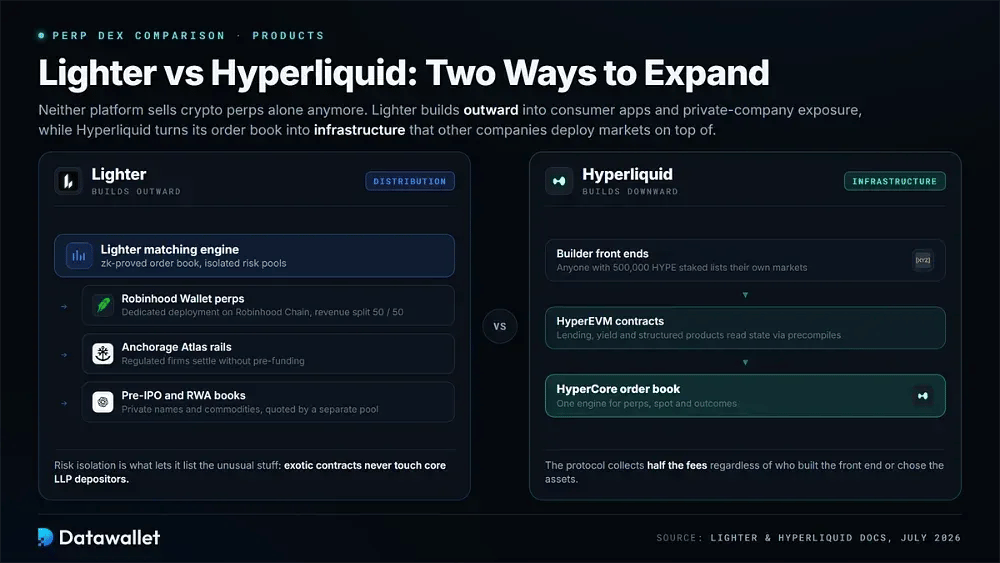
Neither platform sells crypto perps alone anymore. Lighter builds outward into consumer apps and private-company exposure, while Hyperliquid turns its order book into infrastructure that other companies deploy markets on top of.
Lighter Products
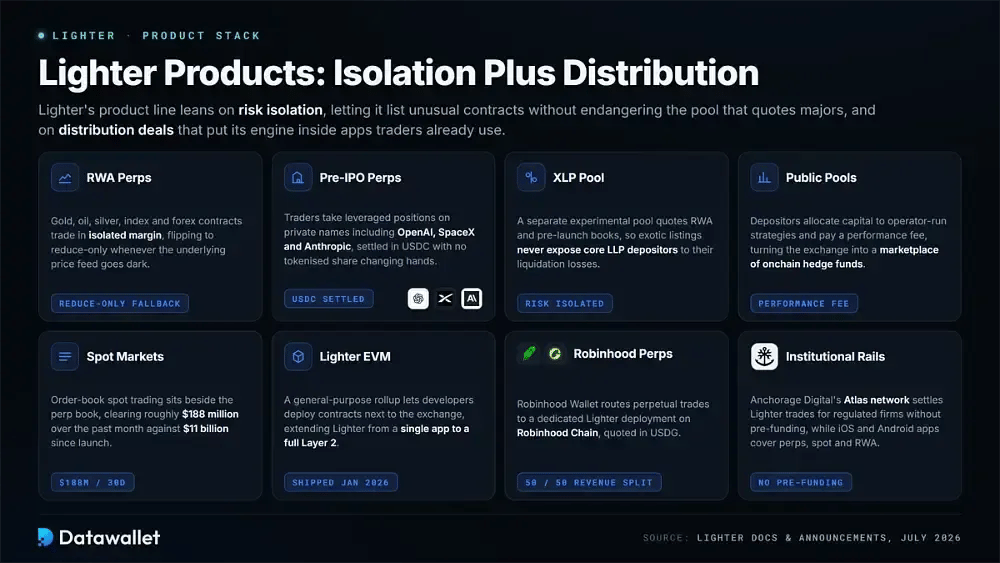
Lighter's product line leans on risk isolation, letting it list unusual contracts without endangering the pool that quotes majors, and on distribution deals that put its engine inside apps traders already use.
Here are the core products available across the Lighter stack:
- RWA Perps: Gold, oil, silver, index and forex contracts trade in isolated margin, flipping to reduce-only mode whenever the underlying market's price feed goes dark.
- Pre-IPO Perps: Traders take leveraged positions on private names including OpenAI, SpaceX and Anthropic, settled in USDC with no tokenised share changing hands.
- XLP Pool: A separate experimental pool quotes RWA and pre-launch books, so exotic listings never expose core LLP depositors to their liquidation losses.
- Public Pools: Depositors allocate capital to operator-run strategies and pay a performance fee, turning the exchange into a marketplace of onchain hedge funds.
- Spot Markets: Order-book spot trading sits beside the perp book, clearing roughly $188 million over the past month against $11 billion since launch.
- Lighter EVM: A general-purpose rollup shipped in January 2026 lets developers deploy contracts next to the exchange, extending Lighter from single app to full Layer 2.
- Robinhood Perps: Robinhood Wallet routes perpetual trades to a dedicated Lighter deployment on Robinhood Chain, quoted in USDG, with revenue split evenly between both companies.
- Institutional Rails: Anchorage Digital's Atlas network settles Lighter trades for regulated firms without pre-funding, while iOS and Android apps cover perps, spot and RWA markets.
Hyperliquid Products
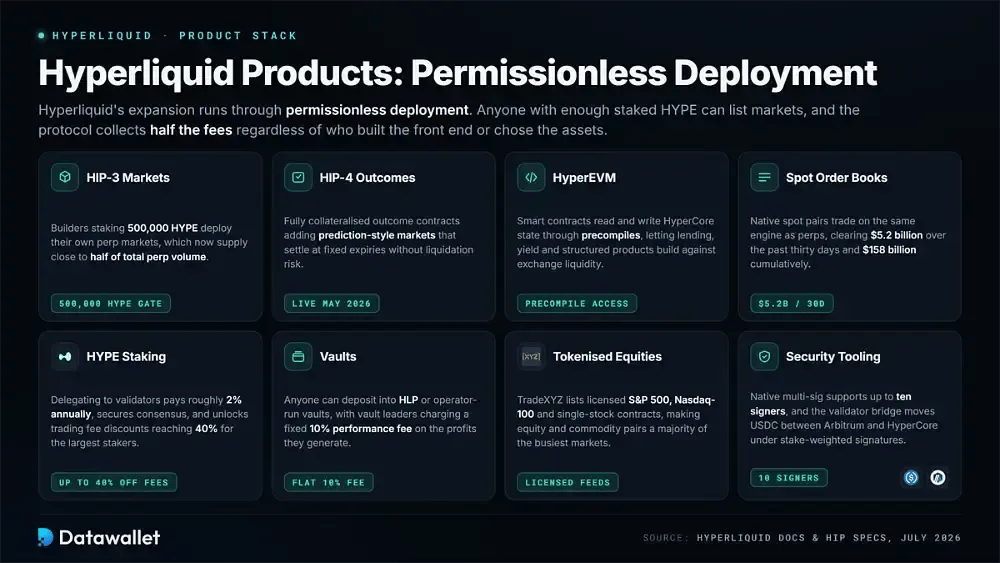
Hyperliquid's expansion runs through permissionless deployment. Anyone with enough staked HYPE can list markets, and the protocol collects half the fees regardless of who built the front end or chose the assets.
The products below define the current Hyperliquid ecosystem:
- HIP-3 Markets: Builders staking 500,000 HYPE deploy their own perp markets, which now supply close to half of total Hyperliquid perp volume.
- HIP-4 Outcomes: Fully collateralised outcome contracts went live in May 2026, adding prediction-style markets that settle at fixed expiries without liquidation risk.
- HyperEVM: Smart contracts read and write HyperCore state through precompiles, letting lending, yield and structured products build directly against exchange liquidity.
- Spot Order Books: Native spot pairs trade on the same engine as perps, clearing $5.2 billion over the past thirty days and $158 billion cumulatively.
- HYPE Staking: Delegating to validators pays roughly 2% annually, secures consensus, and unlocks trading fee discounts reaching 40% for the largest stakers.
- Vaults: Anyone can deposit into HLP or operator-run vaults, with vault leaders charging a fixed 10% performance fee on the profits they generate.
- Tokenised Equities: TradeXYZ lists licensed S&P 500, Nasdaq-100 and single-stock contracts, making equity and commodity pairs a majority of the busiest markets.
- Security Tooling: Native multi-sig supports up to ten signers, and the validator bridge moves USDC between Arbitrum and HyperCore under stake-weighted signatures.
Lighter vs Hyperliquid Fees
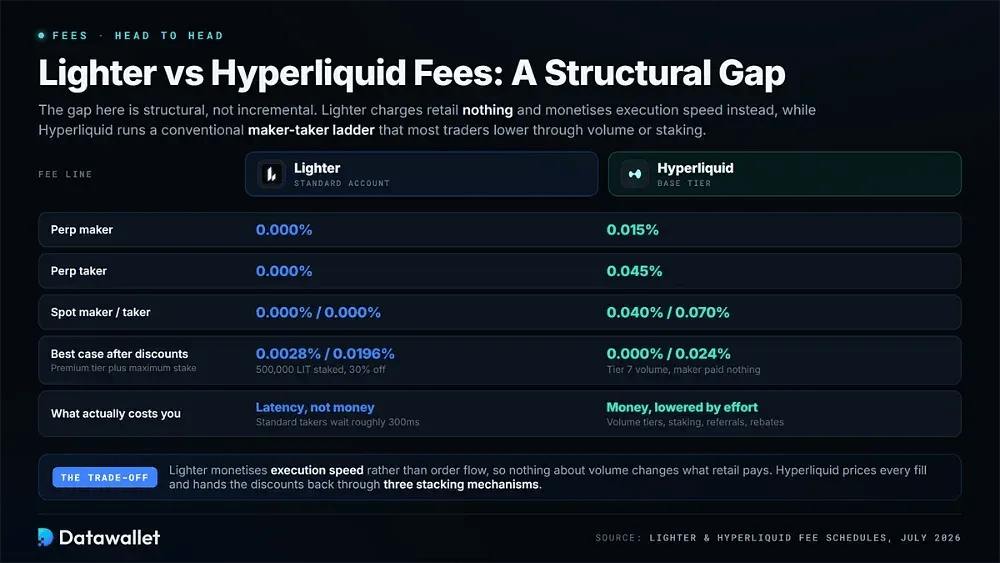
The gap here is structural, not incremental. Lighter charges retail nothing and monetises execution speed instead, while Hyperliquid runs a conventional maker-taker ladder that most traders lower through volume or staking.
Lighter Fees
Lighter's schedule separates accounts by latency rather than size, so a retail trader pays nothing regardless of volume while market makers pay small fees for faster access to the book.
These are the key elements of Lighter's account and fee structure:
- Standard Tier: Every account starts at 0% maker and 0% taker across perps and spot, with no volume threshold, opt-in step or token requirement.
- Latency Cost: The trade-off is speed, since standard takers wait roughly 300ms, which rarely matters manually but penalises arbitrage and latency-sensitive strategies noticeably.
- Premium Tier: Opting in costs 0.0040% maker and 0.0280% taker, cuts taker latency to 200ms, and exempts post-only placements from added delay.
- Staking Discounts: Staking between 1,000 and 500,000 LIT trims premium fees by 2.5% to 30%, bottoming at 0.0028% maker and 0.0196% taker.
- Address Aggregation: Discounts apply at the L1 address level, so a main account and its sub-accounts share a single stake rather than funding separate positions.
- Transfer Fees: Holding at least 100 LIT removes withdrawal and transfer charges, leaving Ethereum gas as the only unavoidable cost of moving collateral around.
- Fee Credits: A LIT-denominated credit system lets professional desks reach premium execution tiers without locking large quantities of the token outright.
Hyperliquid Fees
Hyperliquid stacks three discount mechanisms on one schedule, and understanding how maker and taker fees interact with staking and volume decides whether you pay base rates or get paid to trade.
The points below explain how Hyperliquid prices trading activity:
- Base Rates: Perps open at 0.015% maker and 0.045% taker, while spot starts at 0.040% and 0.070% on the same unified tier ladder.
- Volume Tiers: Seven tiers assessed daily on 14-day weighted volume push takers to 0.024% and makers to zero, with spot notional counting double.
- Staking Discounts: Staking HYPE cuts trading fees between 5% and 40%, and the staked wallet can differ from the trading wallet.
- Maker Rebates: Desks supplying more than 0.5% of platform maker volume earn negative fees, credited continuously to the trading wallet on each fill.
- HIP-3 Pricing: Builder-deployed markets charge double the base schedule, split evenly between deployer and protocol, though growth-mode listings can launch far cheaper.
- Referral Discount: A referral code removes 4% from taker fees on the first $25 million of volume, stacking with other discounts.
- Aligned Quotes: Trading against USDC as the aligned quote asset lowers taker costs by 20% and improves maker rebates across the spot book.
Funding and Withdrawal Costs
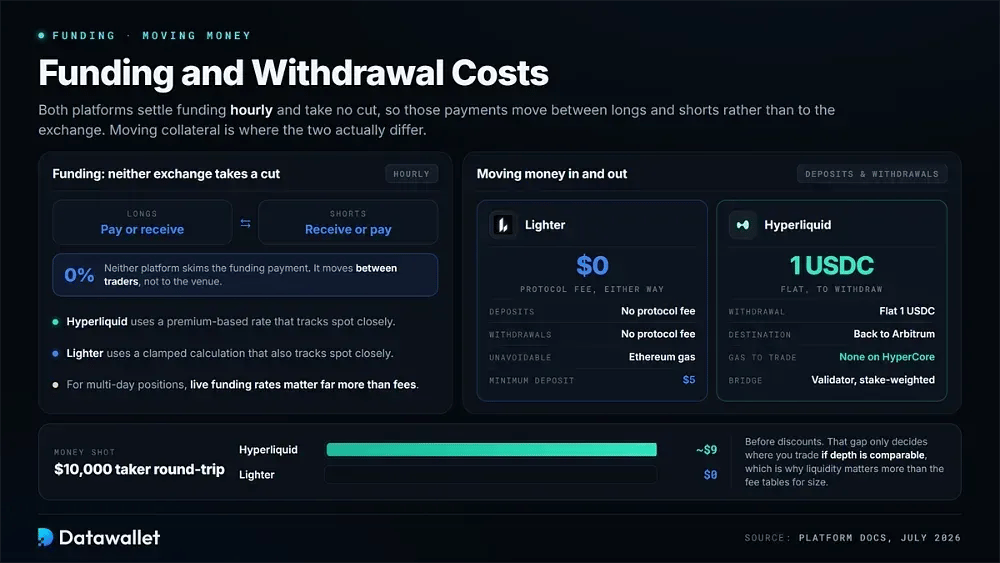
Both platforms settle funding hourly and take no cut, so those payments move between longs and shorts rather than to the exchange. Hyperliquid's premium-based rates and Lighter's clamped calculation both track spot closely, and live funding rates matter far more than fees for multi-day positions.
Moving money differs more. Lighter charges no protocol fee on deposits or withdrawals, leaving only Ethereum gas, with a five-dollar minimum deposit. Hyperliquid charges a flat one-USDC fee to withdraw back to Arbitrum, and trading itself costs no gas on HyperCore.
On a $10,000 taker round-trip, Hyperliquid costs roughly $9 before discounts while Lighter costs nothing. That gap only decides where you trade if depth is comparable, which is why the liquidity comparison below matters more than the fee tables for size.
Lighter vs Hyperliquid Tokens
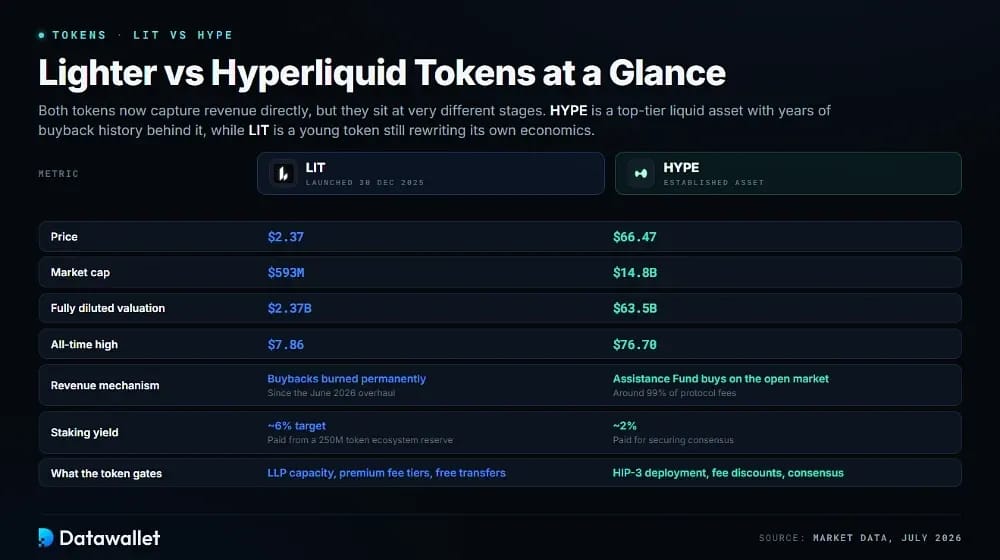
Both tokens now capture revenue directly, but they sit at very different stages. HYPE is a top-tier liquid asset with years of buyback history behind it, while LIT is a young token still rewriting its own economics.
LIT Tokenomics
LIT launched on 30 December 2025 with a fixed one-billion supply and a 25% airdrop to points farmers. Roughly 250 million tokens circulate today at $2.37, giving a $593 million market cap against a $2.37 billion fully diluted valuation and a $7.86 all-time high.
Utility runs through access rather than fee payment. Staking gates the Lighter Liquidity Pool at ten USDC of capacity per token, unlocks premium fee tiers, and removes transfer costs above 100 LIT. Around 125 million tokens are staked, roughly half the circulating float.
The June 2026 overhaul changed the model materially. All revenue-funded buybacks are now burned permanently, starting with 15.5 million LIT worth 6.3% of supply, while staking rewards target 6% annually from a 250 million token ecosystem reserve instead of exchange revenue.
HYPE Tokenomics
HYPE trades near $66.47 with a $14.8 billion market cap and a $63.5 billion fully diluted valuation, sitting some way below its $76.70 record. Around 99% of protocol fees flow to the Assistance Fund, which buys HYPE on the open market continuously.
Those buybacks are large in absolute terms. Hyperliquid recorded $201.8 million in gross protocol revenue during the second quarter of 2026 and returned $148.6 million to holders, against $57.4 million of revenue over the past thirty days as trading conditions cooled.
Beyond buybacks, HYPE secures consensus, pays roughly 2% staking yield, gates HIP-3 market deployment at 500,000 tokens, and drives the fee discount ladder. That makes demand a function of both trading activity and builder expansion.
Lighter vs Hyperliquid Liquidity and Market Share
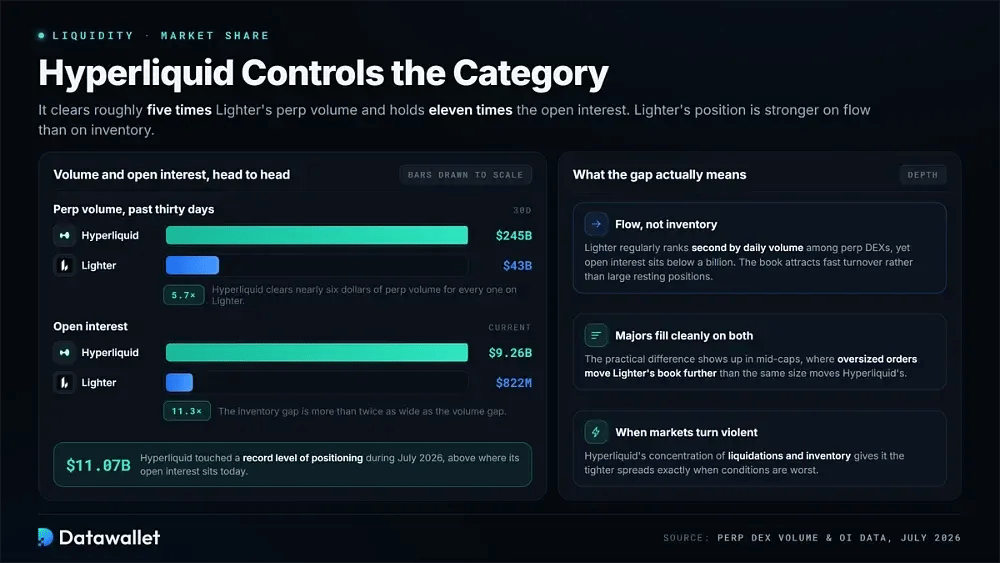
Hyperliquid controls the category. It clears about $245 billion of perp volume every thirty days against Lighter's $43 billion, holds $9.26 billion of open interest to Lighter's $822 million, and touched a record $11.07 billion in positioning during July 2026.
Lighter's position is stronger on flow than on inventory. It regularly ranks second by daily volume among perp DEXs, yet its open interest sits below a billion, which tells you the book attracts fast turnover rather than large resting positions.
Depth is the practical consequence. Majors fill cleanly on both, but oversized orders in mid-caps move Lighter's book further, while Hyperliquid's concentration of liquidations and inventory gives it the tighter spreads whenever markets turn genuinely violent.
Lighter vs Hyperliquid Security
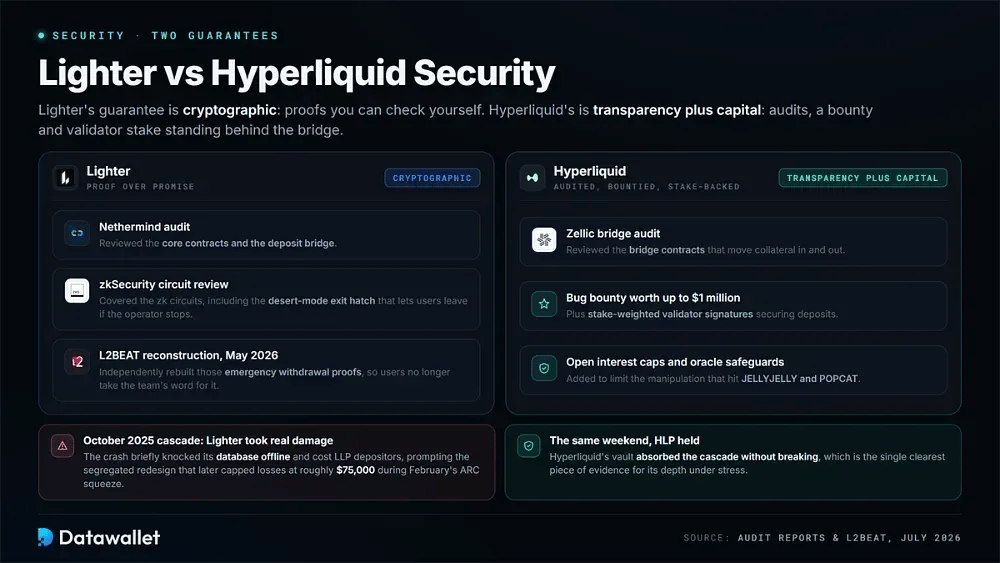
Lighter's guarantee is cryptographic. Nethermind audited the core contracts and deposit bridge, zkSecurity reviewed the zk circuits including the desert-mode exit hatch, and L2BEAT independently reconstructed those emergency withdrawal proofs during May 2026 so users no longer take the team's word for it.
Hyperliquid's guarantee is transparency plus capital. Zellic audited the bridge contracts, the protocol runs a bug bounty worth up to $1 million, and stake-weighted validator signatures secure deposits, while open interest caps and oracle safeguards limit the manipulation that hit JELLYJELLY and POPCAT.
Both have taken real damage. The October 2025 cascade briefly knocked Lighter's database offline and cost LLP depositors, prompting the segregated redesign that later capped losses at roughly $75,000 during February's ARC squeeze. Hyperliquid's HLP absorbed that same weekend without breaking.
Lighter vs Hyperliquid Regulations
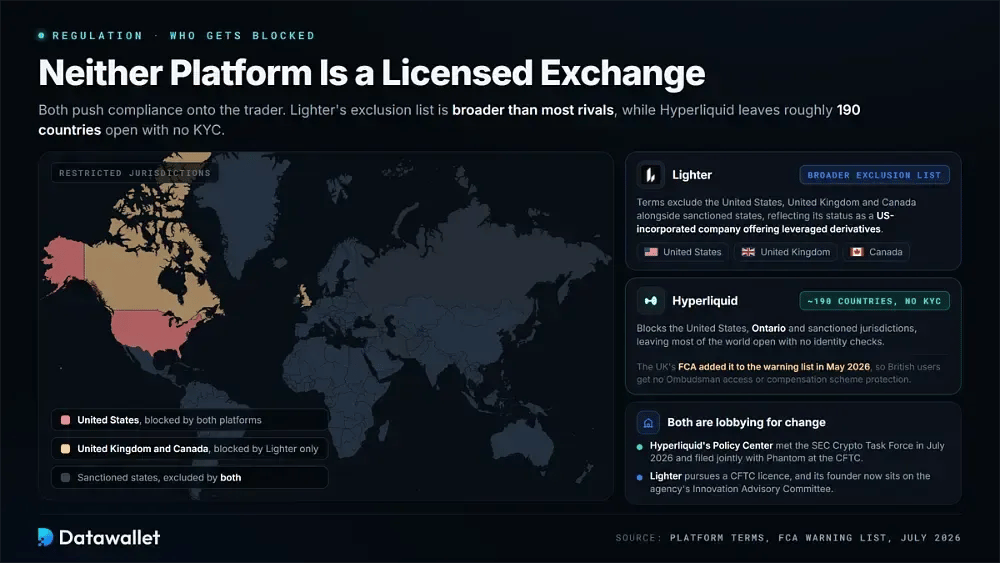
Neither platform is a licensed exchange, and both push compliance onto the trader. Lighter's terms exclude the United States, United Kingdom and Canada alongside sanctioned states, a broader list than most rivals, reflecting its status as a US-incorporated company offering leveraged derivatives.
Hyperliquid blocks the United States, Ontario and sanctioned jurisdictions, leaving roughly 190 supported countries with no KYC. The UK's FCA added it to the warning list in May 2026, meaning British users get no Ombudsman access or compensation scheme protection.
Both are lobbying for change. Hyperliquid's Policy Center met the SEC Crypto Task Force in July 2026 and filed jointly with Phantom at the CFTC, while Lighter pursues a CFTC licence and its founder now sits on the agency's Innovation Advisory Committee.
Is Lighter Better than Hyperliquid?
Lighter wins on cost and on proof. Nobody else offers genuinely free retail trading paired with cryptographic evidence that matching and liquidation followed the rules, and its Robinhood deal gives it a consumer distribution channel Hyperliquid simply does not have.
Hyperliquid still wins overall. Five times the volume, eleven times the open interest, roughly ten times the revenue, licensed equity and commodity markets, and a book that has survived multiple cascades without vault losses make it the safer platform for size.
Final Thoughts
The onchain derivatives market no longer runs through one dominant exchange. Traders now pick between an Ethereum-settled rollup that proves its own fairness and a purpose-built Layer 1 that has become the default listing infrastructure for tokenised stocks, commodities and private-company contracts.
Costs favour Lighter, and meaningfully so for anyone running dozens of round-trips a day. Depth, market breadth and operational history favour Hyperliquid, which is why most professional flow still clears through its book despite paying real taker fees.
Running both remains reasonable: Hyperliquid for size, HIP-3 exposure and deep majors, Lighter for zero-fee execution, pre-IPO contracts and Ethereum-anchored withdrawals. Whichever you fund, size positions for liquidation risk before chasing the maximum leverage either platform advertises.