


Login to Track Your Live Crypto Portfolio
Sign Up and Track Your Live Crypto Portfolio for Free
Forgot your password?
Aave Faces $6.6 billion Crisis Following Kelp Bridge Breach

This article has been reviewed and verified for accuracy by our editorial team. All claims, data points and platform details are cross-referenced against primary sources.
Some links on this page are affiliate links. Datawallet may earn a commission when you sign up through them, at no extra cost to you. This never influences our editorial ratings, rankings or recommendations.
Some links on this page are affiliate links. Datawallet may earn a commission when you sign up through them, at no extra cost to you. Ratings and rankings reflect our own testing and assessment criteria.

GM. Aave faced a $6 billion liquidity crisis today after a breach at Kelp DAO triggered contagion, forcing massive withdrawals as bad debt from fraudulent collateral began weighing on the protocol.
Meanwhile, RaveDAO’s RAVE token crashed 90% amid exchange probes, a $200 million treasury feud erupted at Neo, and Circle debuted a native USDC bridge across 17 chains.
Here are the details on lending contagion, token collapses, and cross-chain stablecoins. 👇
Aave Faces $6.6 billion Crisis Following Kelp Bridge Breach
Aave witnessed a staggering $6.6 billion exodus after a security breach at Kelp DAO triggered structural contagion across decentralized lending markets. Nervous depositors withdrew billions in liquidity as the AAVE token tumbled sixteen percent following the discovery of bad debt lurking within the protocol’s internal reserves.
The crisis erupted on Ethereum after attackers exploited Kelp’s cross-chain bridge to mint nearly $300 million in fraudulent rsETH tokens. These culprits then deposited the hollow collateral into Aave V3 to drain hundreds of millions in wrapped ether through high-leverage borrow positions that now lack backing.
From April 18 into the weekend, Aave’s total value locked fell from $26.4 billion to roughly $20 billion, while the AAVE token dropped 16% to $92. Onchain trackers estimated about $196 million was borrowed from Aave alone. Daily fees surged to $1.99 million as liquidations tore through positions.
Aave founder Stani Kulechov said the exploit was external, and the protocol’s own contracts were not compromised. Even so, depositors are fleeing because the system now appears to be carrying bad debt created elsewhere, with the Umbrella reserve no longer described as a certain backstop.
RAVE Crashes 90% as Exchange Probes Deepen
RaveDAO’s RAVE token collapsed to about $1.15 after peaking at $27.33, erasing more than $5 billion in market value as Binance and Bitget expanded reviews of suspicious trading. The plunge followed a blistering rally that drew $44 million in liquidations. Most of that damage hit traders betting against the token.
Investigators focused on wallets linked to roughly 90% of RAVE’s 1 billion supply and on transfers sent to exchanges before prices exploded. RaveDAO denied involvement but did not answer the central onchain claims. Its statement instead said unlocked tokens may be sold later for operations and marketing.
Neo Treasury Fight Centers on $200 Million
A governance feud at Neo has turned on direct control of assets worth roughly $200 million to $250 million, with co-founder Da Hongfei saying Erik Zhang alone holds most native tokens. Da wants those funds moved into multisig governance. Zhang has pushed back with a rival restructuring plan.
The wider treasury totals about $460 million, including more than 1,100 BTC, stablecoins, cash, and venture holdings split across separate power centers. Da wants a Cayman redomicile and a five-member independent board. Zhang wants investigations into past asset management and to keep a seat in governance.
Circle Debuts USDC Bridge Across 17 Chains
Circle launched USDC Bridge as a new interface for native stablecoin transfers, aiming to simplify cross-chain movement through its burn-and-mint Cross-Chain Transfer Protocol. The company said users will see fees upfront and receive live transfer updates. Gas handling is automated to reduce friction for less experienced users.
The bridge supports transfers across at least 17 EVM-compatible networks, including Ethereum, Arbitrum, Base, Avalanche, Polygon, Optimism, Sonic, Monad, and World Network. Circle says CCTP already processes hundreds of millions of dollars daily. The release also lands as Circle faces a lawsuit tied to the Drift exploit.
Data of the Day
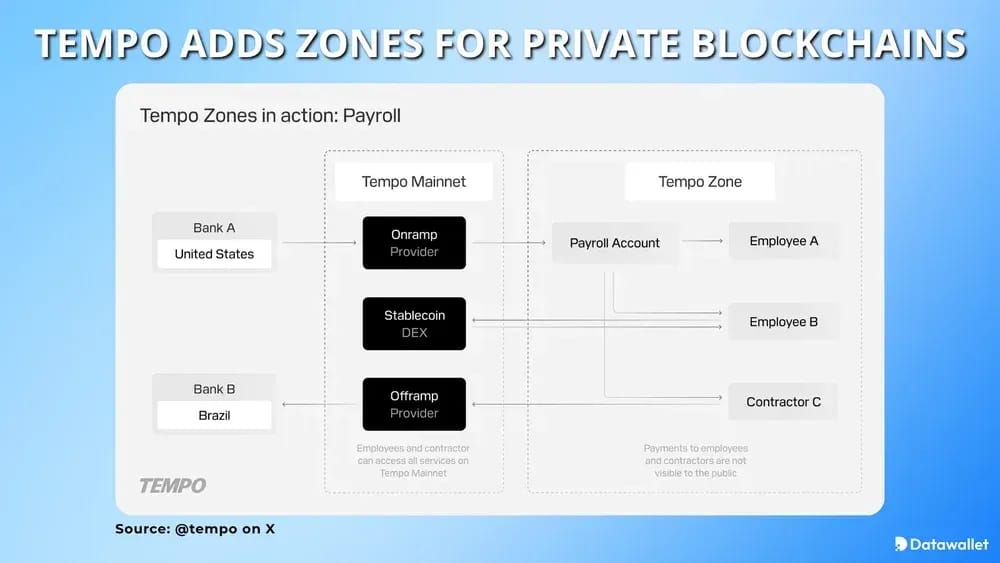
Tempo introduced Zones, a privacy feature that lets businesses run permissioned parallel blockchains connected to its main network while keeping transactions shielded from public view. The company is targeting payroll, treasury, and settlement workflows. Assets still remain interoperable with Tempo, onramps, liquidity pools, and other Zones.
Each Zone is operated by a trusted institution that can enforce access controls, meet compliance duties, and view activity inside its own environment. Tempo said operators do not control user assets held on mainnet contracts. The project, valued at $5 billion, is building the system with design partners.
More Breaking News
- X’s Cashtags feature generated about $1 billion in trading volume within two days, giving the platform an early test of how market data can drive direct brokerage activity.
- Strategy wants STRC dividends paid twice monthly instead of once, a shift aimed at reducing reinvestment lag, improving liquidity, and keeping the preferred stock closer to $100 par.
- A federal judge dismissed claims against Caitlyn Jenner’s memecoin, ruling plaintiffs failed to plausibly show JENNER was a security despite losses after the token’s value collapsed.
- World unveiled a major World ID upgrade with Tinder verification, Zoom deepfake protection, and ticketing tools, broadening its push to sell proof-of-human infrastructure across industries.
- Poland’s parliament again failed to override President Karol Nawrocki’s veto of a MiCA-aligned crypto bill, leaving the country as the European Union’s only holdout.
- Kraken parent Payward agreed to buy Bitnomial for up to $550 million, gaining CFTC-licensed derivatives infrastructure that expands its push into regulated U.S. crypto markets.
- Yuga Labs named chief product officer Michael Figge as chief executive, shifting Greg Solano to chairman as the company tries to build out Otherside and revive momentum.
- Russia introduced a bill that could criminalize unregistered crypto services, with penalties ranging from fines near $4,000 to prison terms of up to seven years.
For the latest updates on digital asset markets, follow us on X @Datawalletcom.
For the latest updates on digital asset markets, follow us on X @Datawalletcom.
Get tomorrow’s issue in your inbox