

Login to Track Your Live Crypto Portfolio
Sign Up and Track Your Live Crypto Portfolio for Free
Forgot your password?
North Korean Hackers Suspected In $285M Drift Protocol Exploit

This article has been reviewed and verified for accuracy by our editorial team. All claims, data points and platform details are cross-referenced against primary sources.
Some links on this page are affiliate links. Datawallet may earn a commission when you sign up through them, at no extra cost to you. This never influences our editorial ratings, rankings or recommendations.
Some links on this page are affiliate links. Datawallet may earn a commission when you sign up through them, at no extra cost to you. Ratings and rankings reflect our own testing and assessment criteria.

GM. Drift Protocol suffered a $285 million exploit on Wednesday after hackers manipulated Solana permissions, draining the insurance fund through fraudulent withdrawals.
Meanwhile, Coinbase received conditional approval for a national trust charter, Telegram launched perpetual futures, and eToro activated crypto trading in New York.
Here are the details on protocol hacks, federal charters, and expanded access. 👇
North Korean Hackers Suspected In $285M Drift Protocol Exploit
Drift Protocol suffered an exploit that drained roughly $285 million from its Solana based vaults. Attackers manipulated protocol level permissions to introduce a fraudulent withdrawal mechanism that gutted the insurance fund within mere minutes.
The perpetrator utilized a legitimate Solana feature called durable nonces to trick security council members into signing malicious transactions. These pre approved approvals remained valid indefinitely, allowing the thief to execute the heist long after gaining signatures.
Onchain data revealed the stolen assets were quickly funneled through the Wormhole bridge and Circle’s transfer protocol to Ethereum addresses. Investigators tracked the movement of various tokens including millions in USDC and wrapped bitcoin to privacy mixers.
Protocol developers froze all deposits and withdrawals to contain the damage while coordinating with security firms to identify the culprits. This massive failure highlights human operational lapses rather than code bugs as the primary threat to decentralized finance.
Coinbase Receives Conditional Approval For National Trust
Coinbase obtained conditional approval for a national trust company charter from the Comptroller of the Currency on Thursday. This federal milestone allows the exchange to establish uniform regulatory standards for its institutional custody and market infrastructure business across America. Officials believe this certification provides partners the legal confidence needed today.
The firm joins a select group of providers including Paxos and Ripple that have sought similar national oversight for their operations. While this charter streamlines federal supervision, Coinbase confirmed it will not accept retail deposits or engage in fractional reserve banking. This shift follows years of development targeting institutional market confidence.
Telegram Wallet Launches Perpetual Futures For Global Users
Wallet in Telegram integrated the Lighter decentralized exchange this week to offer perpetual futures trading directly to its 150 million users. People can now open leveraged positions on 50 assets including bitcoin, gold, and equities without ever leaving the messaging app. This feature brings professional trading tools to consumer interfaces today.
Users can access 50x leverage through their integrated custodial wallets to speculate on price movements. Andrew Rogozov noted that embedding these derivatives lowers barriers for retail participants who already handle and transfer digital currency. The platform initially targets emerging markets where traditional brokerage infrastructure remains scarce today.
eToro Activates New York Crypto Trading After 3-Year Delay
Trading platform eToro officially launched crypto asset services for New York clients this week following a 3 year regulatory waiting period. The company initially listed 20 digital tokens within the state’s strict perimeter after receiving its BitLicense from regulators. McCormick explained that the rollout provides local investors with crypto access today.
The firm secured its license in early 2023 but delayed the activation to focus on compliance standards and its initial public offering. New York residents can eventually expect staking features and additional token listings once the company updates its business plan. This launch addresses the fragmented regulatory framework across American states.
Data of the Day
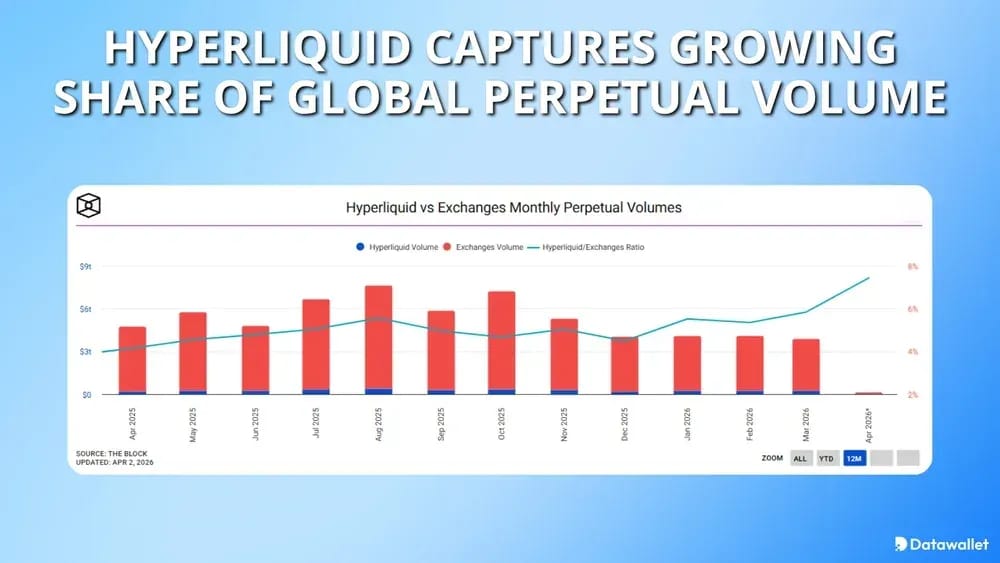
Decentralized exchange Hyperliquid reached a 6% market share of total global perpetual futures volume during the month of March today. Monthly trading activity approached $200 billion as the platform steadily chipped away at the dominance of major centralized institutions like Binance. Professional traders are increasingly migrating to this decentralized venue today.
Hyperliquid outperformed onchain competitors like dYdX by expanding its product suite to include oil and other non crypto derivatives markets. This growth occurred even as overall industry volumes compressed from their previous peaks seen last year. Institutional participants utilize these venues to eliminate weekend gap risks associated with traditional exchanges.
More Breaking News
- Circle unveiled plans for cirBTC, a wrapped bitcoin token designed for institutional grade security and seamless integration across its proprietary blockchain infrastructure.
- Alabama passed the DUNA Act to grant decentralized autonomous organizations legal entity status, providing community members with limited liability and property rights.
- Polymarket integrated Pyth Network to resolve new daily prediction markets for gold and U.S. equities using high frequency institutional grade pricing data.
- Tokyo listed Metaplanet acquired 5,075 bitcoin to become the third largest corporate treasury holder globally, surpassing the holdings of miner MARA Holdings.
- Monad reached $355 million in total value locked within 4 months of launch, though low fee revenue suggests capital remains largely speculative.
- The Bitcoin Policy Institute urged Taiwan to adopt bitcoin reserves as a geopolitical hedge against potential blockades and U.S. dollar currency debasement.
For the latest updates on digital asset markets, follow us on X @Datawalletcom.
For the latest updates on digital asset markets, follow us on X @Datawalletcom.
Get tomorrow’s issue in your inbox