


Login to Track Your Live Crypto Portfolio
Sign Up and Track Your Live Crypto Portfolio for Free
Forgot your password?
Pump.fun Overhauls Creator Fees Amid Massive Token Surge

This article has been reviewed and verified for accuracy by our editorial team. All claims, data points and platform details are cross-referenced against primary sources.
Some links on this page are affiliate links. Datawallet may earn a commission when you sign up through them, at no extra cost to you. This never influences our editorial ratings, rankings or recommendations.
Some links on this page are affiliate links. Datawallet may earn a commission when you sign up through them, at no extra cost to you. Ratings and rankings reflect our own testing and assessment criteria.

GM. Kicking off the week, Pump.fun overhauled fees to favor high-risk traders over casual deployers as 30,000 new tokens flooded Solana in a single day.
Meanwhile, Vitalik Buterin warned of stablecoin fragility, CryptoQuant’s CEO slammed X for bot-driven censorship, and Nancy Pelosi backed a ban on federal betting profits.
Here are the details on platform pivots, protocol risks, and political ethics. 👇
Pump.fun Overhauls Creator Fees Amid Massive Token Surge
Solana powerhouse Pump.fun overhauled its contentious creator fee protocols to prioritize high-risk traders over casual memecoin deployers. This strategic realignment follows co-founder Alon Cohen’s recent admission that previous incentives skewed toward low-quality asset creation.
The protocol deployed these key structural updates on 9 January 2026 across its high-traffic decentralized launching platform. Daily activity peaked during this transition as nearly 30,000 fresh tokens flooded the Solana ecosystem in a single day.
Leadership enacted these shifts because existing fee models failed to improve behavior among average developers while stifling vital liquidity. Pump's management now aims to rebalance the platform’s internal economy by empowering market participants to dictate overall value.
Developers implemented a multi-wallet fee-sharing system that permits teams to distribute earnings across 10 distinct digital addresses. This mechanism allows creators to transfer ownership and revoke authority, encouraging more transparent and collaborative project management structures.
Vitalik Buterin Highlights Structural Flaws In Stablecoins
Vitalik Buterin addressed the Ethereum community this Sunday regarding the persistent vulnerabilities within decentralized stablecoin architectures. He stated that these digital assets remain fundamentally fragile because they rely heavily on the stability of the US dollar. The co-founder suggested that future designs must track broader price indexes rather than being tied indefinitely to national fiat currencies.
The critique focused on how weak oracles can compromise a protocol by allowing capital-rich attackers to manipulate price data. Buterin noted that staking yield creates a hidden tension where users effectively accept lower returns for the sake of stability. His analysis identified that current systems are not yet prepared to withstand extreme political or economic shocks over long time horizons.
CryptoQuant CEO Slams X Over Bot Activity Suppression
Ki Young Ju reported a massive 1224% surge in automated crypto spam on the X platform this weekend. The CryptoQuant founder noted that over 7.7 million bot posts were generated in a single day, triggering aggressive algorithmic penalties for all users. He claims these automated filters are now downranking legitimate crypto discussion because the system cannot distinguish between humans and machines.
The platform's product lead responded by suggesting that visibility problems are self-inflicted by accounts that post excessively low-value content. However, the crypto community remains skeptical as many authentic contributors see their reach drastically reduced due to these new spam filters. This ongoing conflict involves a large niche of users who rely on the platform for real-time market insights and project updates.
Nancy Pelosi Backs Bill Banning Federal Betting Profits
Former Speaker Nancy Pelosi joined 30 Democrats on Friday to support new legislation banning officials from betting on prediction markets. The bill follows a $400,000 payout on Polymarket regarding the recent capture of former leader Nicolás Maduro. Representative Ritchie Torres introduced the act to prevent government insiders from profiting from nonpublic information about high-stakes international military operations.
The proposed law specifically prohibits federal employees and congressional staff from purchasing event contracts related to government policies or actions. Proponents argue that allowing officials to wager on their own decisions creates a perverse incentive that corrupts the integrity of public service. This legislation seeks to establish clear ethical guardrails for the rapidly growing sector of decentralized prediction markets across the United States.
Data of the Day
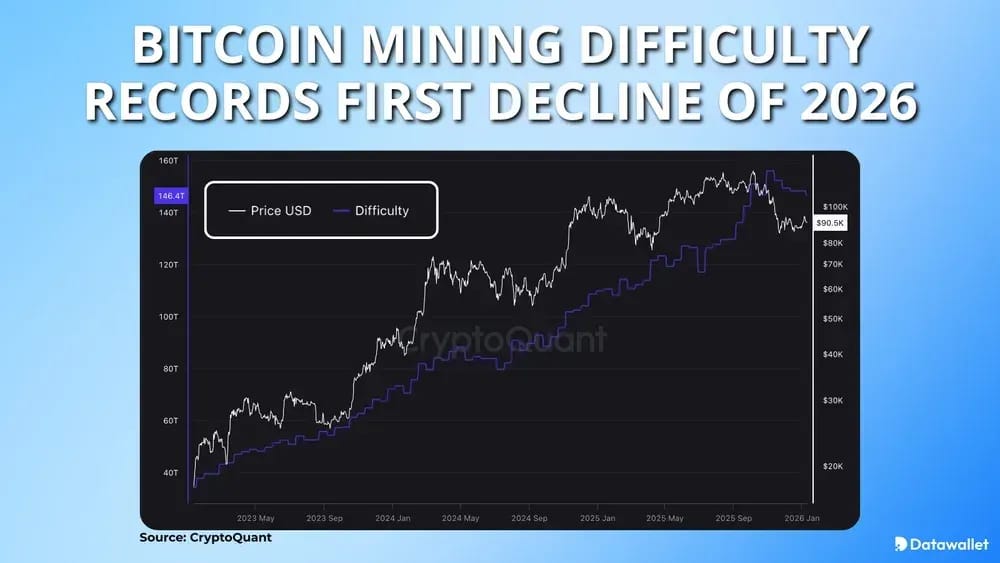
The Bitcoin network recorded its first mining difficulty adjustment of 2026 with a slight decrease to 146.4 trillion. This Thursday update followed a period where block times averaged 9.88 minutes, indicating a slight mismatch with the protocol's 10-minute target. Miners currently face intense competition as they navigate a challenging margin environment following the halving and various macroeconomic headwinds.
Recent data shows that miner hash prices dropped below breakeven levels in late 2025, forcing many to reconsider their operational costs. This small difficulty reduction provides minor relief for companies struggling with rising energy prices and new international equipment tariffs. Analysts estimate the next adjustment will occur on January 22 to better align the network's computing challenge with its global supply.
More Breaking News
- Ripple secured authorization from the UK’s Financial Conduct Authority, clearing the path for the firm to expand its digital payment services nationwide.
- President Donald Trump confirmed he will not pardon former FTX CEO Sam Bankman-Fried, despite recent clemency for other high-profile cryptocurrency figures.
- An investigation revealed Iran's Revolutionary Guard moved $1 billion through UK-registered crypto exchanges using Tether to evade heavy international financial sanctions.
- Starknet developers released a report detailing a network outage caused by a state discrepancy, which required an 18-minute rollback of activity.
- Tennessee's sports wagering regulator issued cease-and-desist letters to Polymarket and Kalshi, threatening criminal prosecution over unauthorized sports event prediction contracts.
- US spot XRP ETFs reached record weekly trading volumes while Bitcoin and Ether funds faced combined net outflows of 750 million dollars.
- BNY launched a tokenized deposit service for institutional clients, allowing blockchain-based settlements for major partners like Citadel Securities and Circle.
For the latest updates on digital asset markets, follow us on X @Datawalletcom.
For the latest updates on digital asset markets, follow us on X @Datawalletcom.
Get tomorrow’s issue in your inbox