

Login to Track Your Live Crypto Portfolio
Sign Up and Track Your Live Crypto Portfolio for Free
Forgot your password?
Six Anonymous Polymarket Users Net $1M From US-Iran Strike

This article has been reviewed and verified for accuracy by our editorial team. All claims, data points and platform details are cross-referenced against primary sources.
Some links on this page are affiliate links. Datawallet may earn a commission when you sign up through them, at no extra cost to you. This never influences our editorial ratings, rankings or recommendations.
Some links on this page are affiliate links. Datawallet may earn a commission when you sign up through them, at no extra cost to you. Ratings and rankings reflect our own testing and assessment criteria.
GM. Six Polymarket users netted $1 million by predicting the US-Iran strike, sparking a bill from Ritchie Torres to bar officials from betting on nonpublic data.
Meanwhile, Kalshi is reimbursing fees for the Khamenei market, Mark Karpeles proposed a Bitcoin fork, and Ethereum's Hegota will debut smart accounts.
Here are the details on geopolitical bets, protocol forks, and account abstraction. 👇
Six Anonymous Polymarket Users Net $1M From US-Iran Strike
Six anonymous Polymarket wallets made $1 million in profits by accurately predicting a United States military strike against Iran. These well-timed wagers triggered immediate scrutiny from onchain investigators regarding potential insider trading within decentralized prediction markets.
The suspicious betting activity materialized on 28 February 2026 across the blockchain-based platform as geopolitical tensions escalated greatly. These accounts were created in February and focused almost exclusively on contracts timing the specific military intervention.
Lawmakers initiated the Public Integrity in Financial Prediction Markets Act because informed participants might possess nonpublic government data. Representative Ritchie Torres introduced this legislation to bar officials from trading on policy outcomes using privileged information.
Traders achieved these massive returns by purchasing shares for $0.10 on Polymarket just hours before explosions were reported in Tehran. Consequently, $529 million flowed into strike-related contracts, fueling global concerns over the integrity of anonymous event-based speculation.
Kalshi Reimburses Fees After Controversial Khamenei Market
Kalshi CEO Tarek Mansour defended a prediction market tied to the death of Ali Khamenei this Sunday morning. The platform is currently reimbursing all trading fees and settling pre-death positions at the last-traded price of the contract. This specific decision follows the killing of Iran’s Supreme Leader during targeted military strikes conducted early Saturday.
The market generated over $50 million in total volume before being halted by the exchange due to settlement ambiguity. Regulators previously urged the industry to ban contracts that correlate to the death of specific individuals for ethical reasons. Kalshi maintains that its design prevents users from profiting directly from assassination while providing essential geopolitical and national security data.
Ex Mt. Gox CEO Proposes Bitcoin Fork To Recover Funds
Former Mt. Gox CEO Mark Karpeles published a proposal to recover $5.2 billion in stolen Bitcoin. The plan suggests a coordinated hard fork to unlock nearly 80,000 BTC sitting in a dormant address from a 2011 hack. This technical change would allow the funds to be returned to verified creditors through the ongoing court-supervised rehabilitation process.
Karpeles described the theft as an unambiguous case that justifies a narrow and one-time hardcoded protocol exception. Critics warn that altering ownership rules for a specific address would set a dangerous precedent by undermining the immutability of Bitcoin. The proposal acknowledges that a chain split could occur if large portions of the network refuse to adopt the change.
Ethereum To Deploy Smart Accounts In Hegota Fork
Vitalik Buterin confirmed on Saturday that native account abstraction will officially arrive with the upcoming Hegota network upgrade. This specific improvement enables smart accounts and flexible gas payments within the next twelve months for all global users. The update utilizes a new frame transaction sequence to allow multi-signature wallets and quantum-resistant signatures to function as first-class citizens.
The developer explained that removing intermediaries from the payment process remains a core principle of the cypherpunk Ethereum ethos. Users can soon pay gas fees in non-ETH tokens via decentralized exchanges that provide liquidity for transactions. This framework also simplifies the user experience for privacy protocols by replacing public broadcasters with a more general-purpose public mempool.
Data of the Day
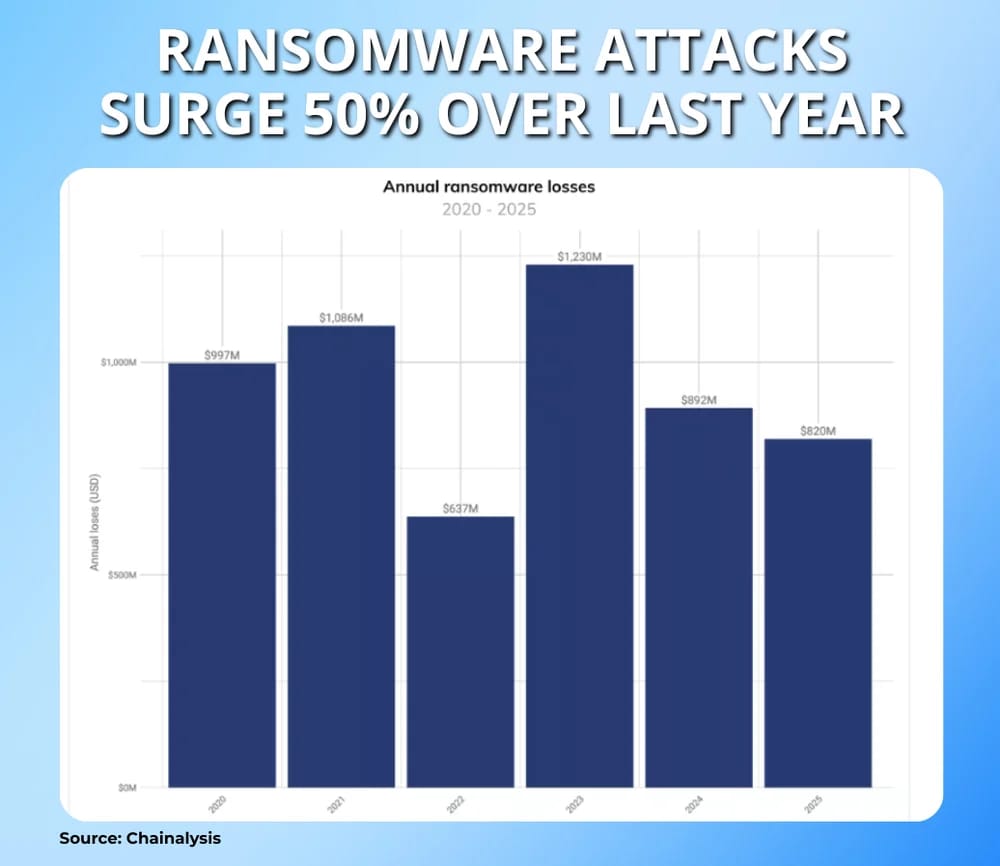
The number of crypto ransomware attacks rose 50% in 2025 as hackers shifted their focus toward small and medium-sized enterprises. Chainalysis reported on Wednesday that nearly 8,000 total leak events occurred while total onchain payments fell to $820 million. This divergence suggests that while intrusions are more frequent, large organizations are increasingly refusing to pay any demanded digital ransoms.
Increased regulatory scrutiny and enforcement actions against laundering infrastructure have successfully depressed the average price for victim access. Attackers are currently utilizing industrialized AI tools and cheap software strains to flood the market with high-volume but lower-yield exploits. Despite the reduction in total ransom proceeds, phishing scams continue to cause huge losses for the global cryptocurrency industry.
More Breaking News
- Martin Habovštiak challenged the BIP-110 proposal by embedding a 66-kilobyte image on Bitcoin without using the opcodes or scripting features targeted for restriction.
- Eleven US senators urged Treasury and Justice officials to investigate Binance’s compliance controls following reports of $1.7 billion in Iran-linked digital transfers.
- Barclays is reportedly evaluating blockchain-based settlement tools and tokenized deposits as the global stablecoin market approaches $300 billion in total circulating supply.
- Magic Eden is terminating support for Bitcoin and Ethereum assets to focus on its iGaming platform and Solana-based digital collectible marketplace ecosystem.
- ZKsync announced a May 4 deprecation date for its Lite network, permanently freezing the state to consolidate resources on the Era rollup.
- Strategy raised the annualized dividend on its STRC preferred stock to 11.5% to maintain par value amid a challenging monthly market downturn.
For the latest updates on digital asset markets, follow us on X @Datawalletcom.
For the latest updates on digital asset markets, follow us on X @Datawalletcom.
Get tomorrow’s issue in your inbox