

Login to Track Your Live Crypto Portfolio
Sign Up and Track Your Live Crypto Portfolio for Free
Forgot your password?
Trump Media Withdraws Truth Social Bitcoin ETF Filings

This article has been reviewed and verified for accuracy by our editorial team. All claims, data points and platform details are cross-referenced against primary sources.
Some links on this page are affiliate links. Datawallet may earn a commission when you sign up through them, at no extra cost to you. This never influences our editorial ratings, rankings or recommendations.
Some links on this page are affiliate links. Datawallet may earn a commission when you sign up through them, at no extra cost to you. Ratings and rankings reflect our own testing and assessment criteria.

GM. Trump Media and Technology Group withdrew its Bitcoin and Bitcoin-Ethereum ETF filings today, effectively ending the company’s bid to enter the crowded US crypto fund market.
Meanwhile, Securitize reported record Q1 revenue of $19.5 million, South Carolina enacted crypto-friendly legislation that bans CBDCs and protects miners, and Tether acquired SoftBank’s stake in the Bitcoin treasury firm Twenty One Capital.
Here are the details on the ETF retreat, tokenization growth, and state-level regulatory safeguards. 👇
Trump Media Withdraws Truth Social Bitcoin ETF Filings
Trump Media and Technology Group withdrew its Bitcoin and Bitcoin-Ethereum ETF filings, abruptly stepping back from plans to push Truth Social-branded crypto funds into the US market. The company told regulators it would not pursue the offerings at this time, ending the current SEC review track.
Yorkville America, the sponsor and investment adviser, said the withdrawal reflects a shift toward a 1940 Act structure, which it argued allows more flexible strategies than a 1933 Act product. That explanation landed awkwardly, because nothing fundamental changed in the rules between the original filing and the retreat.
A harsher reading is simple competition: the US spot Bitcoin ETF arena has already pulled in $57.4 billion, while fee pressure keeps intensifying. Morgan Stanley’s MSBT, launched in April, quickly gathered $266.72 million and undercut rivals with a 0.14% expense ratio, squeezing late entrants before they even start.
The reversal lands inside a much wider Trump-family crypto expansion that already spans NFTs, the TRUMP meme coin, and World Liberty Financial. That footprint has become a political target in Washington, where Democrats have tried to curb crypto ventures tied to the president as market structure legislation advances.
Securitize Revenue Hits $19.5 Million in First Quarter
Securitize posted record first-quarter revenue of $19.5 million, up 39%, while tokenized assets under management reached $3.4 billion and transaction volume hit $1.9 billion. The firm said it now services about 650 active funds. Those figures underline tokenization’s shift from pilot programs toward repeat institutional usage.
The quarter also brought strategic ties with the New York Stock Exchange and Uniswap, widening Securitize’s distribution channels for tokenized securities. Regulators are warming as well. With FINRA approvals and an expected 2026 public listing, the company is positioning itself as infrastructure rather than a single-product issuer.
South Carolina Bans CBDCs, Shields Bitcoin Mining
South Carolina signed Senate Bill 163, blocking any state use of central bank digital currencies while protecting residents’ rights to hold, spend, and self-custody digital assets. The law also safeguards hardware wallets. It establishes one of the clearest state-level lines between private crypto activity and government-backed digital money.
The measure also protects Bitcoin miners and node operators from licensing burdens if they meet ordinary industrial and noise standards. Lawmakers approved it overwhelmingly. The statute arrives as another proposal in the state still seeks authority for public fund allocations of up to 10% into Bitcoin.
Tether Buys SoftBank Out of Twenty One Capital
Tether acquired SoftBank’s entire stake in Twenty One Capital, taking over 89.1 million shares and tightening control over the Bitcoin treasury firm it co-founded with Jack Mallers. The price was undisclosed. SoftBank had paid almost $1 billion, but its position was recently valued near $711 million.
The exit forced resignations from SoftBank-linked board members, temporarily leaving Twenty One out of step with New York Stock Exchange audit committee requirements. Shares still rose. The company holds 43,514 Bitcoin worth roughly $3.4 billion, even after a long stretch without disclosing any fresh purchases.
Data of the Day
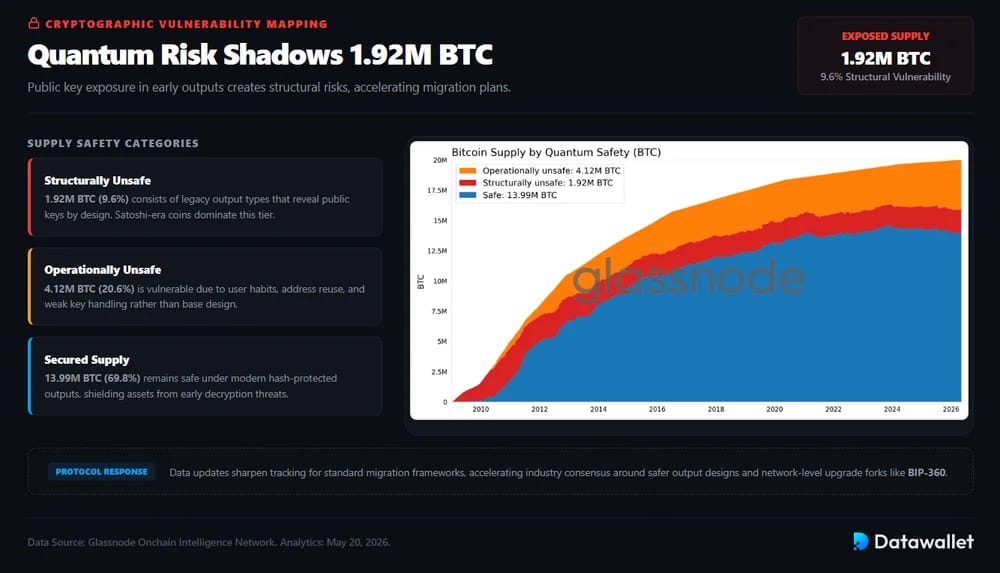
Glassnode said 1.92 million Bitcoin, or 9.6% of supply, is structurally exposed to a future quantum breakthrough because certain output types reveal public keys by design. Satoshi-era coins dominate that group. The data sharpened focus on technical proposals such as BIP-360 and safer output standards.
Another 4.12 million Bitcoin, or 20.6%, is operationally unsafe because of key reuse and weak address management rather than design-level exposure. By contrast, about 69.8% remains safe. The findings push exchanges, custodians, and large institutions toward stricter migration plans before quantum threats become practical rather than theoretical.
More Breaking News
- Crypto tax reform lawmakers revived the Parity Act, directing the IRS to study sub-$200 transactions and de minimis exemptions while refining stablecoin, staking, broker, and wash-sale rules.
- Trump ordered regulators to review crypto firms’ access to master accounts, forcing the Federal Reserve to justify within 120 days whether nonbanks can reach core payment rails.
- The European Commission opened a consultation on whether MiCA still fits a fast-changing market, inviting industry and public feedback before the review window closes on August 31.
- Qivalis expanded to 37 banks across Europe, adding 25 institutions from 15 countries as it pushes toward a MiCA-regulated euro stablecoin launch in second-half 2026.
- Senators grilled prediction market firms over sports manipulation, youth advertising, gambling harms, and tribal revenue threats as the CFTC fights states over federal jurisdiction.
- Irish authorities and Europol accessed another dormant wallet holding 500 BTC, extending the recovery of a long-lost 6,000 BTC cache tied to convicted trafficker Clifton Collins.
- GitHub said a poisoned VS Code extension let attackers reach internal repositories, while TeamPCP claimed it stole 4,000 private repos and tried selling the data online.
For the latest updates on digital asset markets, follow us on X @Datawalletcom.
For the latest updates on digital asset markets, follow us on X @Datawalletcom.
Get tomorrow’s issue in your inbox