







Compare Top Ethiopian Crypto Exchanges
1. Bitget
Bitget holds first place because it pairs an ETB card deposit option with monthly reserve disclosures and a Protection Fund. Founded in 2018, the exchange reports more than 125 million users. Spot orders cost 0.1% across more than 800 coins, or 0.08% when fees are paid in its BGB token. On perpetual futures, makers are charged 0.02% and takers 0.06%, with leverage up to 125x.
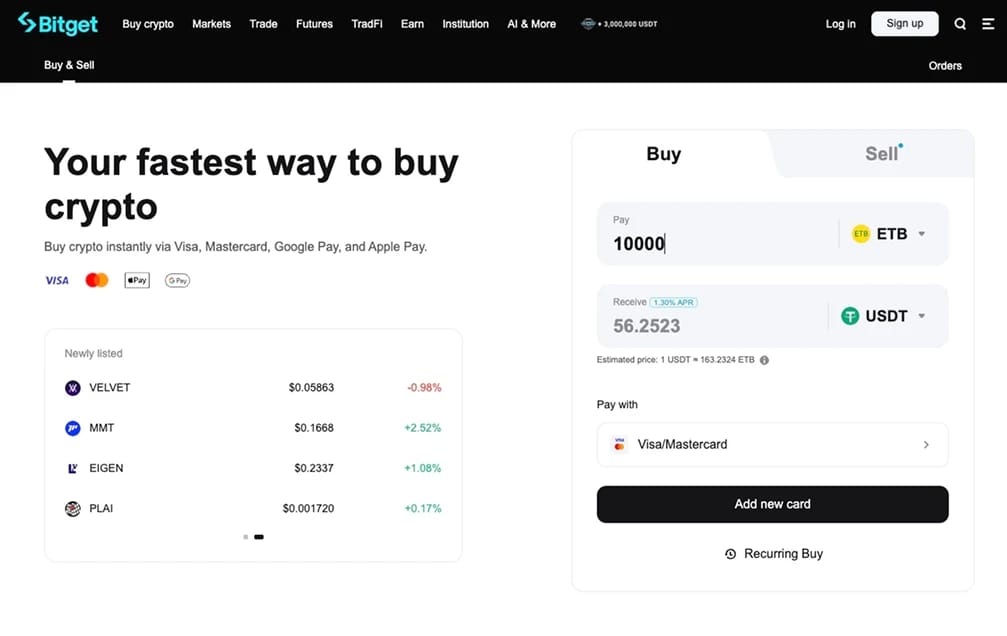
Cards are now Bitget's only birr funding method. It removed five P2P pairs, including USDT/ETB and BTC/ETB, when birr support ended on 8 May 2026. Our account displayed a card deposit option priced in ETB in September 2026, though the NBE has not authorized it. Purchases can carry a processing charge, and Ethiopian banks may decline international card payments.
Since December 2022, Bitget has published a proof of reserves (PoR) report every month, comparing the assets it holds with the balances owed to customers. Its August 2026 report, the 45th, showed a 122% ratio, down from 169% in February. The separate Protection Fund holds 5,500 BTC and averaged $382 million in August. As our Bitget review explains, these snapshots do not guarantee repayment.
Pros
- Bitget has published 45 consecutive monthly reserve reports, with 122% coverage in August 2026.
- Its Protection Fund holds 5,500 BTC and has a stated minimum value of $300 million.
- In September 2026, our account showed ETB card deposits alongside spot, futures, and copy trading.
Cons
- Birr P2P trading ended on 8 May 2026. The card option has no NBE authorization.
- Without NBE authorization, Bitget customers have no protection under Ethiopian law.
- High leverage is common among copied traders and can quickly cause losses for followers.
2. MEXC
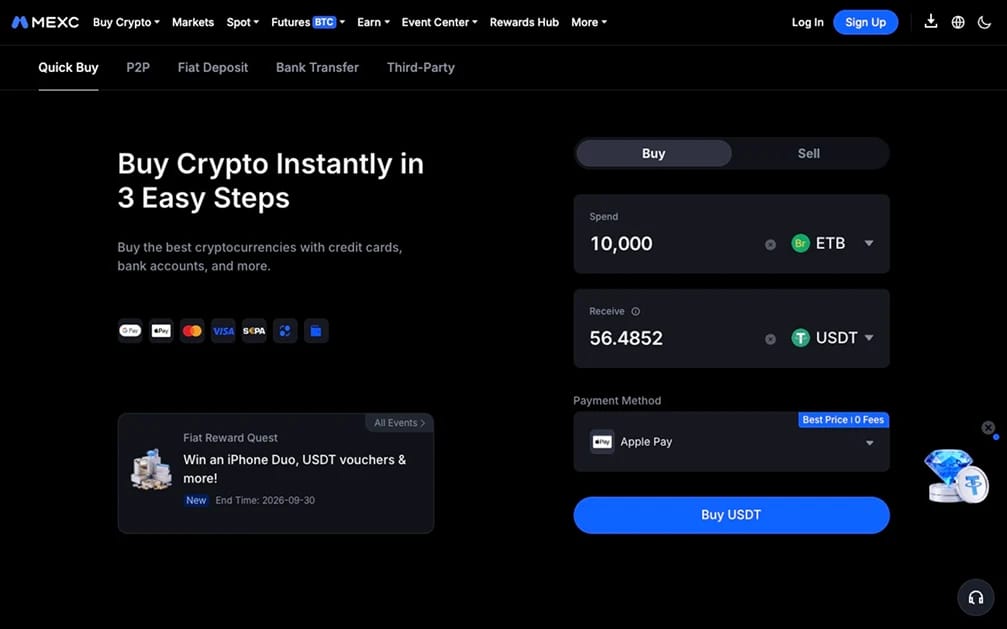
MEXC is included for its broad coin selection and published trading fees. The rates used in this comparison are 0% maker and 0.05% taker on spot, and 0% maker and 0.02% taker on futures. MEXC says fees can vary by region and promotions, while MX discounts depend on account eligibility. Our September account check showed an ETB-priced card payment screen.
With more than 3,000 cryptocurrencies available for spot and futures trading, MEXC has the largest catalog in this ranking. It often lists new tokens first. Many fail, however, and their order books contain few orders, so buyers should check trading volume before placing an order for a small coin. To learn more about the exchange's features, visit our detailed MEXC review.
Security firm Hacken audits MEXC's monthly reserve snapshots. The June 2026 report recorded an average ratio of 156.5% across major assets, with Bitcoin at 269%. MEXC also maintains a $100 million Guardian Fund. It is registered in Seychelles but has no license from a major financial regulator. We could not confirm a birr P2P market, and its card option has no NBE authorization.
Pros
- Makers pay 0% on spot and futures; spot takers pay 0.05%.
- Our September 2026 account check showed an ETB card deposit option.
- Hacken audits monthly reserve reports. Average coverage reached 156.5% in June 2026.
Cons
- Local banks can decline ETB card payments, and the option has no NBE authorization.
- Offshore terms govern disputes, and MEXC holds no license from a major regulator.
- Many quickly listed tokens are weak and require careful checks before purchase.
3. Bitunix
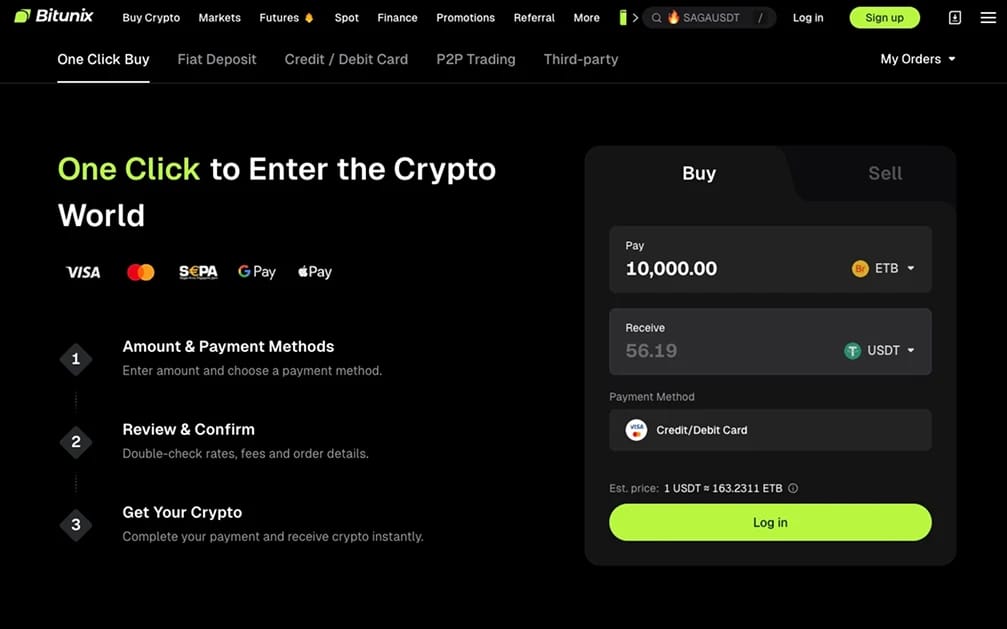
Bitunix is the third and final platform where we found ETB card deposits. Founded in 2021, the exchange is registered in Saint Vincent and the Grenadines. Built mainly for derivatives, it charges perpetual futures makers 0.02% and takers 0.06%. The corresponding spot rates are 0.08% and 0.1%. Selected contracts allow leverage of up to 200x.
High leverage magnifies losses and can lead to liquidation after a small adverse price move. The leverage limit alone does not explain when a position will be liquidated. Cautious readers should treat Bitunix as a second account for a specific strategy. Additional features include Earn options like Dual Investment and staking, plus the Bitunix crypto card and Token Splash, an airdrop tracker.
Its 3 March 2026 reserve update reported $128.5 million in assets. Reserve ratios were 109% for Bitcoin, 100% for Ether, and 109% for USDT. Cards are the only birr method, as we could not confirm a birr P2P market. See our Bitunix review for verification levels.
Pros
- At 0.02% for makers and 0.06% for takers, futures fees match the largest derivatives platforms.
- Users can check whether their balances were counted through Merkle tree reserve proofs.
- An ETB card deposit option appeared in our account in September 2026.
Cons
- The reserve figures cited here are dated 3 March 2026 and do not establish current coverage.
- A position using up to 200x leverage can be erased within minutes.
- Bitunix has operated only since 2021 and has no major financial license.
4. Binance
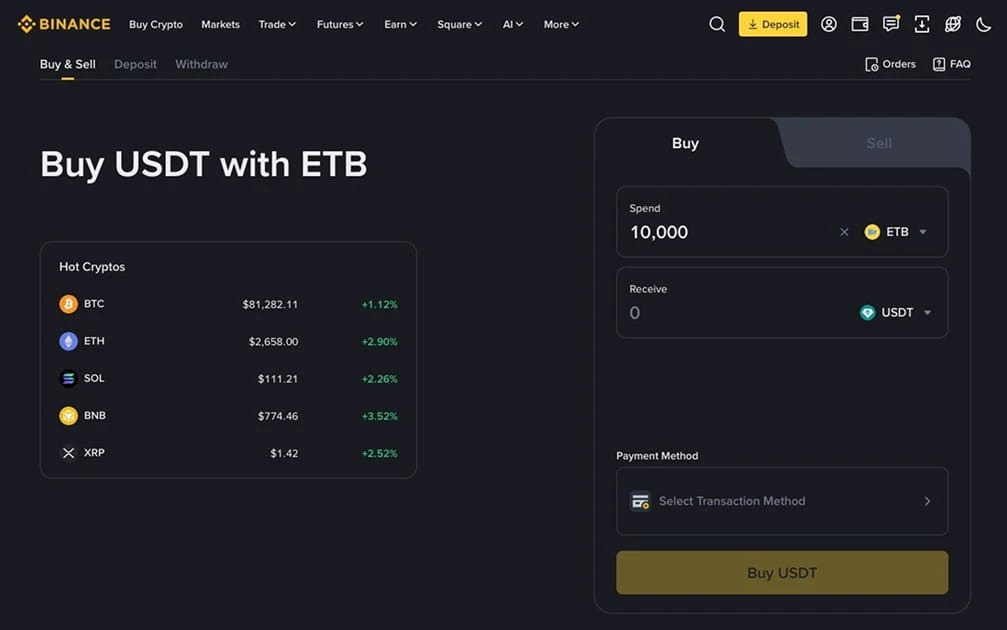
Binance places fourth because it has no direct birr funding method, even though its order books hold more buy and sell orders than any rival listed here. Large trades in Bitcoin and Ether therefore move the price less. More than 500 coins trade at 0.1%, and paying fees in BNB reduces that rate by 25%. Futures makers pay 0.02%, and takers pay 0.06%.
On 15 May, Binance disabled birr trading and said it was working with regulators. Users subsequently lost access to its website on the Ethio telecom network. An email to customers on 23 June said access had returned after what Binance called successful regulatory engagements. The terms were never published by either side.
Binance paid $4.3 billion in a 2023 settlement with US authorities. Since then, its SAFU emergency fund and monthly reserve reporting have continued. Discussions with Ethiopian officials do not confer NBE authorization. The company's regulatory record is covered in our Binance review.
Pros
- The deepest order books in this ranking lower the cost of large orders.
- Paying in BNB cuts spot fees from 0.1% to 0.075%.
- Ethio telecom access returned on 23 June 2026 following discussions with regulators.
Cons
- Birr trading has remained disabled since 15 May 2026, with no published return date.
- Binance's record includes a $4.3 billion settlement with US authorities in 2023.
- New users can be confused by an interface that places leveraged products close to basic buying.
5. Bybit
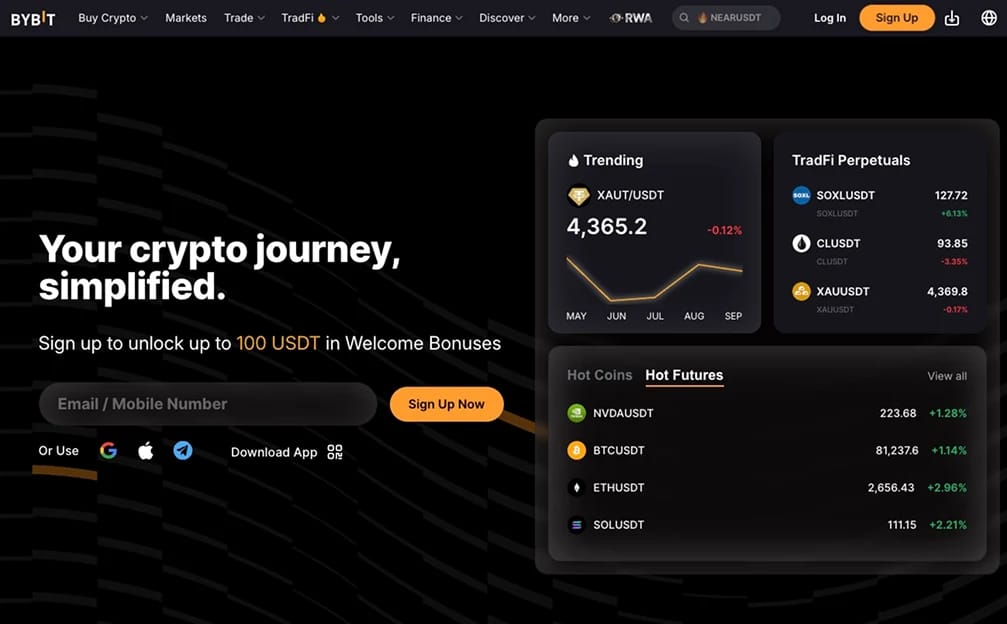
Bybit lists more than 2,600 coins at a flat 0.1% spot fee. It ranks fifth because we could not confirm a birr funding method. The first large exchange to react to the February notice, Bybit announced the end of birr P2P trading on 6 March 2026. Ethiopia-registered accounts are therefore funded through crypto transfers or other fiat currencies.
Perpetual futures cost makers 0.02% and takers 0.055%. A single login also provides access to options, copy trading, bots, and a demo account. It was also one of the first dedicated crypto exchanges to begin offering access to TradFi products like stocks and ETFs. Our Bybit review covers the full platform’s features, products, and services in depth.
Hackers stole Ether worth about $1.5 billion from a Bybit cold wallet in February 2025, the largest amount any exchange has lost in a single attack. Withdrawals continued, and Bybit replaced the missing coins. Hacken verifies the exchange's reserve reports. The 36th report, dated 27 May 2026, showed $16.5 billion in major assets, with ratios of 106% for USDT and 108% for Bitcoin.
Pros
- Spot trading costs 0.1% across more than 2,600 coins, while futures makers pay 0.02%.
- Through May 2026, Hacken had verified 36 reserve reports, all above 100% for major assets.
- Beginners can learn without leverage using Lite mode and a demo account.
Cons
- Birr P2P trading ended in March 2026, and we could not confirm an ETB card option.
- Its security record includes the February 2025 theft of about $1.5 billion.
- Bybit has no NBE authorization, and disputes are governed by offshore terms.
6. KuCoin
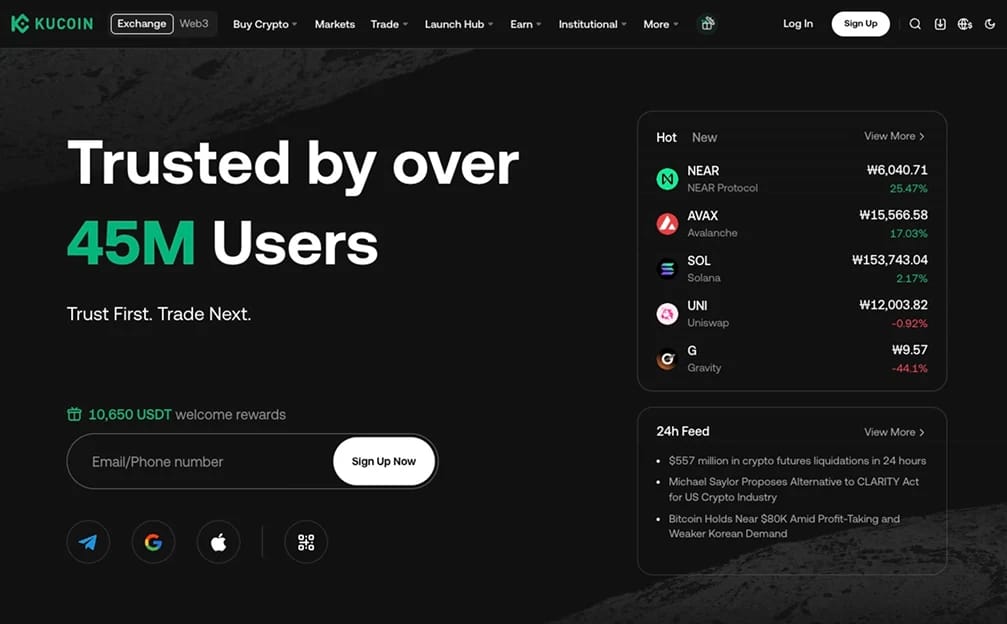
KuCoin is ranked sixth for its broad catalog but no birr funding method we could confirm. More than 1,000 coins trade at a 0.1% spot fee. GemSPACE adds small new tokens before larger exchanges list them, and trading bots are free. KuCoin Earn covers savings, staking and lending, though promotional yields on minor tokens do not represent normal returns on Bitcoin or stablecoins.
You can fund accounts by transferring crypto from another wallet or depositing fiat. KuCoin publishes reserve proofs and holds three external security certifications: ISO 27001, PCI DSS and SOC 2 Type II. These assess internal systems and differ from a financial license.
The exchange has a history of serious regulatory issues. In January 2025, operator Peken Global admitted in a US court that it had transmitted money without a license. The company agreed to about $297 million in penalties and left the US market for two years. Our KuCoin review describes its rebuilt compliance program.
Pros
- More than 1,000 coins are listed, with new tokens added early through GemSPACE.
- Bots carry no charge beyond the normal 0.1% trading fee.
- Published reserve proofs and three independent security certifications support KuCoin's safety claims.
Cons
- Users need crypto from another source because no birr funding method could be confirmed.
- The January 2025 US guilty plea remains part of KuCoin's record.
- Many small tokens trade in shallow order books and can lose most of their value.
How to Choose a Crypto Exchange in Ethiopia
Birr P2P markets have closed on every ranked exchange. Only three platforms still display ETB card deposits, making funding access a deciding factor alongside legal exposure, reserve evidence, and cost. We suggest five checks:
- Read the NBE notices before anything else: February's notice bans birr-paired P2P trading. The July notice also prohibits exchanging, transferring, and safekeeping crypto assets without NBE approval. None of the platforms in this guide is authorized, regardless of licenses held elsewhere.
- Confirm the birr option in your own account: Our Bitget, MEXC, and Bitunix accounts showed ETB card deposits in September 2026, but these options can disappear at short notice. Before paying, compare the quote with the NBE indicative exchange rate and check for a processing charge.
- Compare reserve evidence: Check how recently the exchange reported its reserves and whether it named an outside auditor. Review the size of any protection fund too. A ratio above 100% is a snapshot for one date, not proof that every customer would be repaid.
- Calculate fees on the order book: Spot limit orders cost between 0% and 0.1% on these platforms. The price margin added by one-click purchase screens is often several times higher.
- Avoid informal brokers: Some trading has shifted to commission-based brokers and Telegram groups since the exchanges left, according to local media. Dealers provide no escrow or place for fraud victims to complain. Commercial Bank of Ethiopia, Awash Bank and Dashen Bank are among the banks that can freeze accounts showing such payment patterns.
Crypto and Bitcoin Regulation in Ethiopia
The National Bank of Ethiopia (NBE) must approve crypto activity in Ethiopia, and it has not granted approval so far. Bitcoin mining is the only area in which the state has signed contracts with the industry. The rules developed through the following stages:
- June 2022: The NBE confirmed that only the birr has legal tender status and warned that people using crypto for transactions could face legal measures.
- August 2022: After Parliament extended its mandate to cryptographic products, the Information Network Security Administration (INSA), Ethiopia's national cybersecurity agency, gave crypto operators ten working days to register. That registration process never became an exchange licensing system.
- 2022 to 2025: The government allowed Bitcoin mining companies to purchase electricity from state-owned Ethiopian Electric Power (EEP) in foreign currency. The EEP chief executive said in August 2025 that the utility would sign no new mining contracts. Its flat tariff of 3.14 US cents per kilowatt-hour ended on 1 December 2025.
- 2025: National Bank of Ethiopia Proclamation No. 1359/2025 confirmed the birr as legal tender and restricted foreign exchange dealing to banks and authorized dealers. Separately, an anti-money-laundering law amendment extended its definitions to digital property.
- 27 February 2026: An NBE notice prohibited birr-paired P2P trading on exchanges without the bank's authorization. The NBE said it was preparing a full framework for digital assets but gave no date.
- March to June 2026: Bybit announced the end of birr P2P trading on 6 March. Bitget, Binance and OKX followed in May. Exchange websites became unreachable on the Ethio telecom network before Binance announced that access had returned on 23 June.
- 23 July 2026: A second notice named five prohibited activities: exchanging crypto assets for fiat currency, exchanging one crypto asset for another, transfers, safekeeping or administration, and financial services for token sales. According to a legal analysis by Dablo Law Firm, the notice sets no separate rule for passive holding.
- 15 September 2026: Low rainfall reduced hydropower output, prompting EEP to cut electricity supplied to Bitcoin miners to about 23% of contracted volumes.
Under its licensing directive, the Ethiopian Capital Market Authority also treats digital assets that function as investments as securities. ETB card deposits still appear on some platforms, but none has NBE authorization. Until the bank publishes its framework, offshore exchanges set their own terms for Ethiopian accounts. No local authority protects those balances.
.webp)
How Does the Ministry of Revenue Tax Crypto?
Ethiopia has no crypto-specific tax rule or published guidance from the Ministry of Revenue. The ministry applies Federal Income Tax Proclamation No. 979/2016, amended by Parliament in July 2025 through Proclamation No. 1395/2025. The following points describe that general law:
- Business tax depends on classification: Trading organized for profit may be treated as a business activity. For individuals assessed on taxable business income, rates run from 0% to 35%, with the highest bracket applying above ETB 168,000 a year. Category B taxpayers assessed on gross sales follow a separate regime. How these categories apply to crypto requires case-specific advice.
- Occasional gains have no clear category: Crypto is absent from the list of assets subject to the 15% disposal gains tax, which names immovable property, shares and bonds. Income outside all other categories can be taxed at 15% as other income.
- Large payments generally require banking channels: The amendment requires payments above ETB 50,000 to use authorized banking channels, subject to specified exemptions.
- Mining companies pay ordinary business tax: The 30% company rate applies to their profits.
Tax reporting obligations and compliance with NBE restrictions require separate assessment. Keep dated transaction records, acquisition costs, and birr valuations. Ask an Ethiopian tax adviser how to classify and report the income. This section provides general information, not tax advice.
.webp)
Cryptocurrency Adoption in Ethiopia
Before the 2026 restrictions, Ethiopia was one of Africa's fastest-growing crypto markets. Chainalysis ranked it third in Sub-Saharan Africa by value received from July 2024 to June 2025, behind Nigeria and South Africa. The region received more than $205 billion during that period. Four factors explain the demand:
- Currency weakness drives dollar savings: Under an IMF-supported reform program, the NBE floated the birr in July 2024. It had traded near 57 per US dollar before the float and has since lost more than half its value. Stablecoins, tokens that track the dollar price, became a common savings method.
- Inflation has returned to double digits: Headline inflation reached 13.4% in May 2026 following fuel supply problems linked to conflict in the Middle East. In July 2026, the NBE raised its policy rate from 15% to 16%.
- Remittances and freelance income are large: For the 2024/25 fiscal year, the Ethiopian Diaspora Service reported $7.17 billion in remittances. Earlier Chainalysis research measured 180% yearly growth in small stablecoin transfers to Ethiopia.
- Mining made Ethiopia visible worldwide: Mining companies supplied about 35% of EEP revenue last year and consumed almost one third of national electricity output, Bloomberg reports.
Ethiopia has more than 130 million people, with mobile money services such as Telebirr and CBE Birr widely used. Comparisons with other markets appear in our crypto adoption statistics.
.webp)
How to Buy Bitcoin in Ethiopia
No method of buying Bitcoin with birr has NBE approval. Our September 2026 checks found only ETB card deposits on Bitget, MEXC and Bitunix, while birr P2P trading is prohibited. For residents, every step below falls within the activities named in the July 2026 notice:
- Check your legal position first: Read both NBE notices in full. No ranked platform is authorized in Ethiopia, so residents bear the legal risk personally.
- Open an account in your own name: Register using your country of residence, then verify your identity with a passport or national ID.
- Fund the account by card or crypto transfer: Open the card deposit screen on Bitget, MEXC or Bitunix and select ETB. Compare the quoted price with the market rate before paying with a card in your own name. Some banks decline these payments. Our guide to buying crypto with a credit card explains the usual charges.
- Set a price limit for the Bitcoin purchase: In the BTC/USDT spot market, enter the highest price you will accept. The order stays open while the market trades above that level and executes at your limit or lower.
- Withdraw coins you plan to keep: Ethiopian law provides no protection for exchange balances. Send a small test amount, followed by the remainder, to a wallet whose keys you hold. Compare the choices in our best crypto wallets ranking.
Do not buy USDT from street brokers or Telegram dealers who accept birr. These trades directly breach the February notice and offer no escrow. They are also a common source of fraud.
Final Thoughts
ETB card deposits and consistent reserve reporting put Bitget first. MEXC and Bitunix follow with ETB card funding of their own. Binance, Bybit, and KuCoin have deeper markets or larger catalogs, but we could not confirm a birr funding method on any of them.
None of the six exchanges holds NBE authorization. Follow the bank’s announcements and seek advice on any existing holdings before making a new transaction. Confirmed authorization and documented funding access would justify reassessing the ranking.
Follow NBE announcements and keep complete records. Avoid informal dealers. Datawallet has separate rankings for Kenya, Nigeria, and Tanzania.
Our Methodology
We completed account checks and a desk review in September 2026. Logging into our Bitget, MEXC, and Bitunix accounts confirmed that each displayed a card deposit option in ETB. We did not test birr P2P trading because the NBE prohibits it. The ranking uses six criteria:
- Our Rating: Datawallet's rating out of 5 considers security history and reserve reporting, together with the regulatory record and each company's response to earlier incidents.
- Birr funding: We recorded ETB deposit options displayed in our accounts. We also read exchange announcements on birr support and followed reports of website access.
- Reserve evidence: The comparison covered each latest reserve report's date, ratio and auditor, plus the size of any protection fund.
- Trading costs: Fees came from published spot and futures schedules for standard accounts without discounts.
- Product range: We counted listed coins and reviewed futures and wallets, along with Earn products, copy trading and bots.
- Regulatory record: Our checks covered licenses in other countries and enforcement cases from 2023 onward.
NBE notices, Ethiopian proclamations, and analysis by law and audit firms support the legal and tax statements. Our editorial methodology explains how we research and check facts.
.webp)