




Can I Buy Bitcoin with ADCB?
ADCB provides two ways to buy Bitcoin, one more than almost any other bank in the Emirates. The conventional route involves sending AED from the ADCB Mobile Banking App to a UAE-licensed exchange such as Rain. Alternatively, ADCB Securities, the bank's brokerage subsidiary, has offered a Virtual Assets Trading Platform for buying and holding major cryptocurrencies since January 2026.
There is an important caveat with the in-house service. ADCB Securities operates only as an introducer. Trading, settlement, and custody are handled by Morpheus Technology, the Dubai company behind Fuze. Dubai's virtual asset regulator, VARA, fined Morpheus in August 2025 over anti-money laundering failures and unlicensed activity. The company remains under enhanced supervision while completing its remediation plan.
For that reason, we continue to direct ADCB customers to Rain. Client assets are held with an exchange directly supervised by the FSRA in Abu Dhabi's ADGM, a short drive from ADCB's head office. Payments from ADCB to licensed platforms undergo the bank's standard screening. On a first transfer to a new beneficiary, the app may ask its usual questions about the payment's purpose.
How to Buy Crypto with ADCB
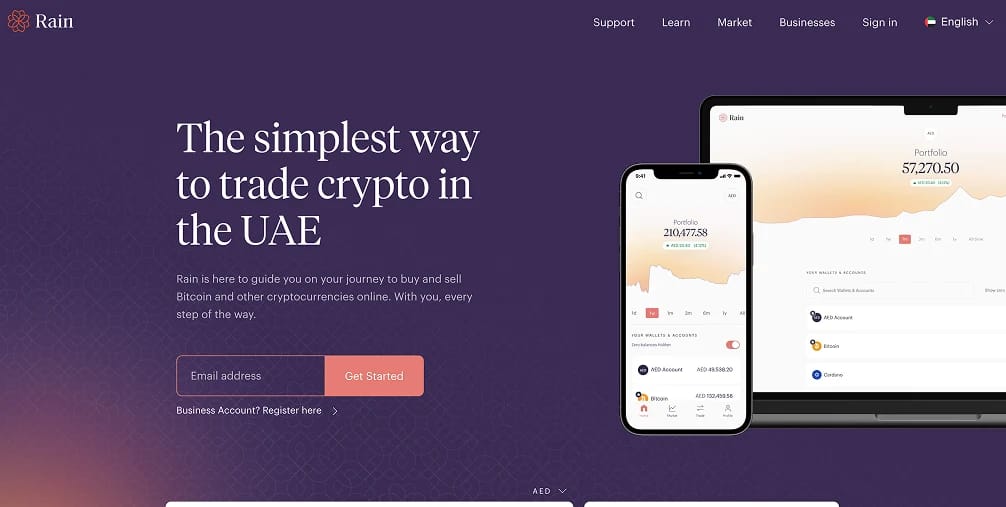
The lowest-cost route to withdrawable crypto is to transfer AED from the ADCB app to Rain, then place a limit order through Rain Pro. AED deposits are free, while resting orders on the Pro interface carry no maker fee.
Steps to buy crypto with ADCB:
- Create a Rain account: Register with Rain and complete identity checks (KYC) using your Emirates ID. Verification must be completed under FSRA requirements before making a deposit. Approval typically takes only a few minutes.
- Copy the AED deposit details: Open Deposit in the Rain app, choose AED bank transfer, and record the IBAN and payment reference. During our review, omitting the reference was the only issue that sent a deposit into manual review.
- Check your limits or enrol on Aani: ADCB handles local AED transfers below AED 50,000 near-instantly. Higher amounts settle within one business day. You can also enrol in Aani through the ADCB app to move up to AED 50,000 in around ten seconds.
- Send the dirhams: Add Rain as a beneficiary in the ADCB Mobile Banking App and approve the transfer with FacePass. Copy the Rain payment reference exactly and answer any purpose question directly.
- Trade on Rain Pro: After the AED arrives, select BTC/AED or another preferred pair and submit a limit order. Maker orders on Rain Pro cost nothing.
Customers who prefer to remain within the bank can join the ADCB Securities platform using their Customer Identification number and FacePass. Consider its custody structure carefully before leaving a large balance on the service.
Fees and Transfer Limits for ADCB Customers
Costs on the bank's side are minimal. The exchange fees are therefore the main numbers to compare.
ADCB costs and limits
- Local AED transfers: Payments are sent through the ADCB Mobile Banking App. Any applicable charge from the schedule of fees appears before confirmation. Transfers below AED 50,000 generally reach the receiving bank within seconds.
- Larger transfers: Payments above AED 50,000 take up to one business day. Send a substantial purchase early if timing is important.
- Aani instant payments: Aani is free after enrolment through the app. Payments settle in about ten seconds, with a limit of AED 50,000 per transfer, which covers most retail purchases.
- Daily ceilings: Transfer limits depend on your account package and can be adjusted through the app's card and transfer controls. Check the ceiling first if an initial payment fails rather than assuming ADCB has blocked the crypto transaction.
- Cards: Support for ADCB debit and credit cards varies between exchange gateways. Processor surcharges also make cards better suited to a small initial test.
- Compliance screening: As a bank licensed by the Central Bank of the UAE, ADCB screens payments under its anti-money laundering obligations. An exchange statement should resolve a source-of-funds request triggered by a large or first-time transfer.
Rain costs
- AED deposits and local withdrawals: Both are free, so returning funds to an ADCB account adds no round-trip cost.
- Rain Pro trading: Fees are 0% maker and 0.05% taker. At the entry tier, this is cheaper than any global venue serving the UAE.
- Standard buy screen: Rain adds 0.5% to the source rate. That may be acceptable for an initial test but becomes costly for larger orders.
- Card deposits: Processor fees reach up to 3.99%, an expense avoided entirely with a free bank transfer.
- Crypto withdrawals: Users pay only the network fee. Sending USDT on Tron (TRC-20) to a personal wallet rarely costs more than a dollar.
Funding an AED 10,000 purchase costs nothing, as does the deposit itself. A taker order on Rain Pro adds AED 5. Few markets anywhere offer a full purchase journey at such a low price.
Best Exchanges for ADCB Customers
Each platform listed below holds a UAE licence and accepts dirhams directly. The main differences are licensing scope, available deposit methods, and trading fees.
Rain ranks first for AED pricing and Shari'a certification. Bybit holds the first full federal licence from the Securities and Commodities Authority, while OKX operates an AED order book under its VARA licence. Binance combines VARA authorisation with the deepest global market. Our guide to the best crypto exchanges in the UAE compares the wider market.
ADCB Cryptocurrency Policy
ADCB has moved further into retail crypto than any other major UAE bank. Its ADCB Securities Virtual Assets Trading Platform allows customers to buy, sell, and hold major cryptocurrencies after a single FacePass check. Funds move instantly between the bank account and trading wallet at no charge. However, the structure keeps ADCB at arm's length because its securities subsidiary only introduces customers to Fuze. It does not handle trading, settlement, or custody.
The bank takes a neutral position on outbound payments. ADCB has published neither a prohibition on transfers to licensed exchanges nor a crypto-specific allowance. Transactions are instead governed by ordinary account limits and AML screening. The bank's other blockchain activity has focused on operations, including the UAE Trade Connect trade finance platform and Meedaf, an ADGM-based financial infrastructure venture announced in March 2025.
Regulation surrounding ADCB continues to tighten. Federal Decree-Law No. 6 of 2025 took effect that September, placing payment services that use virtual assets under Central Bank licensing. Dubai exchanges fall under VARA, while the FSRA oversees Abu Dhabi's ADGM. Rain has held a Financial Services Permission since July 2023. The SCA licenses providers operating on the federal mainland.
Stablecoin buyers should also understand one Central Bank restriction. Under the Payment Token Services Regulation, only dirham-backed tokens can be used to pay for goods and services. Holding and trading USDT in the UAE remains legal, but spending it at checkout does not.
Our guides to FAB, Emirates NBD, and Mashreq compare how the other major UAE banks handle the same transfers.
About ADCB
Abu Dhabi Commercial Bank was established in 1985 following the merger of Emirates Commercial Bank, Federal Commercial Bank, and Khaleej Commercial Bank. Another consolidation took place in May 2019, when Union National Bank joined ADCB and Al Hilal Bank became the group's Islamic banking arm. The deal made ADCB the third-largest bank in the UAE. Group assets reached AED 719 billion as of June 2025, while Mubadala Investment Company owns around 60% of its shares.
Customers can access their accounts through the ADCB Mobile Banking App, which uses FacePass facial recognition, as well as through branches and uBank self-service centres across the Emirates. Its retail offering includes current and savings accounts, Privilege Club premium banking, and the TouchPoints rewards programme. ADCB Securities provides brokerage access to the ADX, DFM, and US markets alongside its virtual assets service. ADCB is listed on the Abu Dhabi Securities Exchange and licensed by the Central Bank of the UAE.
Bottom Line
ADCB customers have more ways to buy crypto than most UAE bank users. They can transfer AED to a licensed exchange, use Aani for instant payments of up to AED 50,000, or access crypto through ADCB Securities.
Rain remains our preferred option. It offers free AED deposits, 0% maker fees on Rain Pro, FSRA supervision in the ADGM, and Shari'a certification. Enter the payment reference exactly and answer any questions in the ADCB app directly to keep your first deposit on track to arrive the same day.
Our Rain review covers the platform in more detail.