



Can I Buy Bitcoin with Standard Chartered?
Yes, though rarely inside the bank itself. Standard Chartered runs institutional spot Bitcoin and Ether trading through its UK branch, launched in July 2025 as the first global systemically important bank to do so. Retail accounts cannot access that desk, so the practical route is funding a licensed exchange from your SC account.
The single retail exception sits in Hong Kong. Mox Bank, the virtual bank majority-owned by Standard Chartered, began offering Bitcoin and Ether trading in January 2026 under an upgraded SFC Type 1 license, with HashKey handling execution and custody. Coins cannot be withdrawn to your own wallet, so it works as a closed brokerage rather than true ownership.
For everyone else, transfers out are the path, and SC processes them to crypto platforms in Hong Kong without drama. The bank custodies client assets for UAE exchange Rain and banks crypto firms like FalconX, so a payment to a licensed exchange is routine business rather than a red flag.
How to Buy Crypto with Standard Chartered
The cheapest route to Bitcoin you actually control is a bank transfer to an exchange licensed in your market, then a limit order rather than an instant buy.
Steps to buy crypto with Standard Chartered:
- Confirm the venue is licensed where you bank: Check your regulator's own register before sending anything. Hong Kong's SFC list of licensed platforms, Singapore's MAS financial institutions directory, and India's FIU-IND register each name every approved operator, and payments to unlisted platforms are what SC compliance questions.
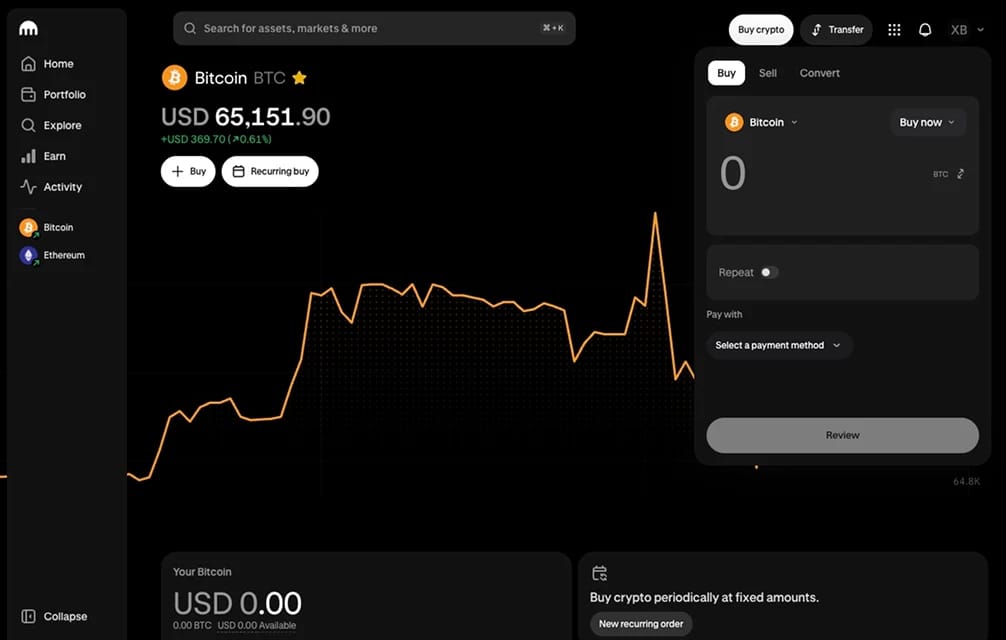
- Open and verify a Kraken account: Register at Kraken and pass identity verification with your passport or national ID. Your account opens with the Kraken entity matching your residency, which sets the funding currencies available to you.
- Generate your deposit details: In Kraken, open your fiat balance and copy the account number, beneficiary name, and reference code. UAE residents can fund in dirhams through Kraken's ADGM entity, while Hong Kong clients typically send USD by wire, free within monthly limits on SC Priority accounts.
- Send the transfer from Standard Chartered: Add Kraken as a new payee in the SC Mobile app, enter the reference exactly, and send. Local rails settle in minutes to hours, SWIFT in one to three banking days. Keep the first transfer small until the full loop has cleared once.
- Trade and withdraw: Once funds land, buy BTC on Kraken Pro with a limit order, priced around 0.25% against roughly 1% plus spread on Instant Buy. Long-term holders then move coins to self-custody, a step Mox cannot offer.
Fees and Transfer Limits for Standard Chartered Customers
SC rarely charges anything crypto-specific. What you pay depends on the rail you pick and the screen you trade on.
Standard Chartered costs and limits
- Local transfers: Free on the main retail rails, including FPS in Hong Kong, FAST and PayNow in Singapore, and Aani in the UAE. These settle in seconds to minutes and are the default for funding a locally licensed exchange.
- International wires: SC Priority and Priority Private clients in Hong Kong get free USD telegraphic transfers within monthly caps, the standard route onto global platforms like Kraken. Standard accounts pay per wire, so check your tier before choosing SWIFT over a local rail.
- Transfer limits: Daily online limits vary by market and account tier and can usually be raised in the app. Raise the limit first, because a bounced oversized transfer takes longer to unwind than a limit change.
- Card payments: SC debit cards work on exchanges that accept them, with a surcharge of roughly 2% to 4%. Credit card funding risks being coded as a cash advance, stacking fees and immediate interest on top, so we treat cards as a small-test option only.
Kraken fees
- Deposits: Free by most bank transfer methods, with SWIFT costs depending on intermediary banks rather than Kraken.
- Spot trading: 0.25% maker and 0.40% taker on Kraken Pro at the entry tier, falling with 30-day volume.
- Instant Buy: Around 1% plus a spread built into the quote, so we route every meaningful order through Pro.
- Crypto withdrawals: Network fee only, which runs to cents on low-cost chains.
Tax by market
- Hong Kong, Singapore and the UAE: None of the three taxes individuals on investment gains, one reason they anchor SC's wealth business. Frequent trading that resembles a business can still be assessed as income in Hong Kong and Singapore.
- India: Gains on virtual digital assets carry a flat 30% tax with no loss offsets, plus 1% TDS on transfers above modest thresholds under Section 194S. The exchange's tax report is the document you will need at filing time.
Best Exchanges for Standard Chartered Customers
The right platform is the one your local regulator licenses. These four cover SC's biggest retail footprints.
Rain deserves a specific mention. Client assets on Rain sit in Standard Chartered custody, so a UAE customer buying there keeps the bank on both sides of the trade. Our guides to the best crypto exchanges in Hong Kong, Singapore, the UAE and India rank the full field in each market.
Standard Chartered's Cryptocurrency Policy
No large bank has committed harder to digital assets, and in 2026 the pieces joined up. The July 2025 spot desk now sits alongside custody launched in the UAE in 2024, Luxembourg in January 2025, and Hong Kong in January 2026, a stack supporting more than 75 cryptoassets according to the bank's own digital assets division.
The Hong Kong build-out is the clearest signal. In April, Anchorpoint, the joint venture between Standard Chartered Bank (Hong Kong), HKT and Animoca Brands, became one of the first two firms granted a stablecoin issuer license by the HKMA, clearing it to issue HKDAP, a phased Hong Kong dollar stablecoin. In May, the bank delivered Hong Kong's first G-SIB institutional crypto custody for Nasdaq-listed Solowin.
The deal flow points the same way. SC agreed to move to full ownership of Zodia Custody, the institutional custodian its ventures arm incubated, took a stake in market maker GSR at a $1 billion valuation, and partnered with liquidity provider B2C2 to plug crypto trading firms into its settlement network. CEO Bill Winters expects essentially all transactions to settle on blockchains eventually.
About Standard Chartered
Standard Chartered is a London-headquartered bank with a presence in 54 markets across Asia, Africa and the Middle East, listed in London and Hong Kong and counted among the roughly 30 global systemically important banks. Unusually for a UK-based lender, it has no domestic British retail network, earning its income where its customers live.
Retail and wealth banking center on Hong Kong, Singapore, the UAE, India, Korea, Taiwan and a band of African markets, with Priority and Priority Private tiers serving affluent clients. Alongside the main bank, SC Ventures builds standalone businesses, including Mox in Hong Kong, Trust Bank in Singapore, and the digital asset firms now being folded closer to the group.
.webp)
Final Thoughts
Standard Chartered is the strange case of a bank racing into crypto at the institutional level while leaving retail customers where they were, funding an external exchange. That route works well. Free local rails in major markets, free Priority USD wires for bigger tickets, and a compliance posture that treats licensed platforms as normal counterparties.
Match the venue to your market before anything else. Hong Kong customers should stay on SFC-licensed platforms or use Mox for a simple closed-loop holding, Singapore clients need an MAS licensee like Coinbase, UAE residents get dirham rails at Kraken or Rain, and Indian clients must stick to the FIU register and budget for the 30% tax.
Kraken remains the strongest single answer for most SC customers, pricing trades near a quarter of a percent and letting you withdraw to your own wallet, which no SC-linked product allows. Send a small test first, keep statements for the money coming back, and treat the bank's own billion-dollar crypto build-out as due diligence on where this is heading.