



Can I Buy Bitcoin with Western Union?
Yes, but indirectly. Western Union does not sell Bitcoin or run an exchange. It gives you a payment rail with cash pickup, bank deposit, and mobile wallet payout across more than 200 countries, and that rail can settle a peer-to-peer trade.
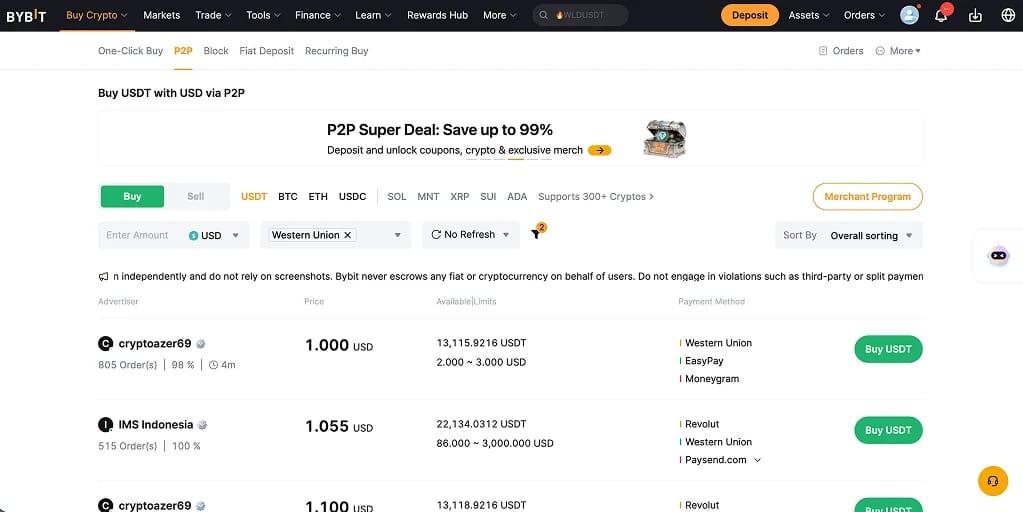
The mechanic is simple. You find a seller who accepts Western Union, the platform locks their crypto in escrow, you send the transfer, and escrow releases once they confirm receipt. On Bybit P2P, I could not mark a payment as sent until the seller's USDT was already held.
There is now a more official angle. Western Union launched USDPT in May 2026, a US dollar stablecoin issued by Anchorage Digital Bank on Solana, and Bybit became the first major exchange to list it on 4 June. You buy Western Union's digital dollar with local currency rather than wiring cash, but in the launch markets it is the cleanest link between Western Union and crypto yet.
One caution. Money transfers move fast and are hard to claw back, which made them a scammer favourite and led Western Union to admit aiding and abetting wire fraud in 2017 and pay $586 million to the DOJ and FTC. Buy only inside an escrow-protected trade with a high-reputation merchant. Outside escrow, treat any request to pay for crypto by Western Union as a scam signal.
How to Buy Crypto with Western Union
The practical path is a P2P trade on Bybit, where escrow sits between you and the seller. The payment itself can be cash at a Western Union agent or an online send from the app, depending on what the seller accepts.
Steps to buy crypto with Western Union:
- Create an account: Sign up on Bybit and complete identity verification. Your verified name must match the name you send the Western Union transfer under, since P2P sellers reject mismatched payments.
- Open the P2P desk and filter: Go to Buy Crypto, then P2P Trading, and filter for Western Union. Available offers depend on which merchants are active in your corridor, so choices vary by country. Sort by completion rate and order count, and read the seller's terms first.
- Open the order so escrow locks first: Choose your amount and start the trade. Confirm the seller's crypto is held in escrow before you move any money. This step separates a protected trade from an unrecoverable Western Union transfer.
- Send the Western Union payment: Pay the exact recipient details the seller gives you, in cash at an agent or through the app. Keep the receipt and tracking number (MTCN), and never write words like "crypto" or "Bitcoin" in a reference field, as that can get a transfer held.
- Mark as paid and receive your crypto: Upload the receipt in the chat and click Payment Completed. Once the seller confirms, escrow releases the coins to your account. I then move long-term holdings to a self-custody wallet.
Western Union Fees, Limits and Funding for Crypto
Cost has two layers: what Western Union charges to move the money, and the premium baked into the P2P price. New senders underestimate the second.
Western Union side
- Transfer fee: Ranges from $0 to roughly $25 or more depending on corridor, amount, and whether you pay at an agent or in the app, per Western Union's pricing. First transfers are often fee-waived.
- Exchange rate margin: When the payout currency differs from what you send, Western Union typically adds 1% to 3% over the mid-market rate, more on some corridors. This is the hidden cost, not shown as a line item.
- Limits: Verified online accounts are commonly capped near $5,000 per transfer and $50,000 over a rolling 30 days, while a new sender's first online transfer can sit near $1,000 until checks clear. Agent limits differ.
- Speed: Card-funded cash pickup can be ready in minutes; bank-funded transfers take one to two business days to clear before the seller sees them.
- Sanctions: Western Union cannot send to destinations under US sanctions, so OFAC-restricted countries are off the table regardless of the exchange.
P2P side (Bybit)
- Platform fee: Takers pay nothing on Bybit P2P. Makers may pay a small fee that varies by asset and region.
- Merchant premium: The real expense is the spread a seller adds over spot for accepting a slow, manual method. On thin corridors it can be steep, so compare offers.
- Withdrawal: Moving crypto off Bybit costs only the network fee. USDT exchanges and wallets on a low-fee chain keep this minimal.
Stack the Western Union margin on top of the P2P premium and the method rarely beats a local bank transfer or card on cost. Use it when Western Union is the rail you already rely on, not to find the cheapest entry into crypto.
Buying Crypto with Western Union by Region
Western Union's footprint is global, but the smart approach shifts by market. Here are how some of their key user geographies differ:
- United States:L Western Union is a registered money services business and a state-licensed money transmitter across the country. For buying crypto, though, an ACH transfer or debit card into a US-regulated exchange is cheaper and safer than P2P. See our guides to buying USDT in the USA and the best US exchanges first.
- Latin America: This is where the Western Union to crypto link is most developed, since the USDPT integration on Bybit launched here first to serve heavy remittance corridors. Mexico, Argentina, and Colombia all pair large inbound volume with active P2P markets. Mexican users can start with our Mexico exchange guide and buying USDT in Mexico.
- Philippines: One of the world's largest remittance recipients, with Western Union cash pickup in pharmacies, malls, and pawnshops nationwide. P2P is widely used to turn received funds into stablecoins. See our Philippines exchange guide and buying USDT in the Philippines.
- India: India receives more remittances than any country, and Western Union pays out to bank accounts and wallets across it. Tread carefully: crypto gains are taxed at a flat 30% with a 1% TDS on transfers, and in P2P the buyer often carries the TDS duty. Read our India exchange guide and buying USDT in India before starting.
- Gulf and MENA: The UAE and Saudi Arabia are major sending markets, mostly toward South Asia and the Philippines. Crypto rules in the Gulf have tightened and formalised, so use a licensed venue. Start with the UAE exchange guide and buying USDT in the UAE.
- Africa: In markets like Nigeria, Western Union and P2P together are a primary way to reach dollars and stablecoins. Liquidity is deep but scam pressure is high, so merchant reputation and escrow discipline matter even more. See the Nigeria exchange guide.
- Europe and the UK: Western Union is authorised by the FCA in the UK and runs through regulated entities in the EU. For Europeans, a free SEPA transfer to Bybit EU usually undercuts any Western Union method, so the transfer service is rarely the right tool here.
Best Exchanges for Western Union Users
The platforms below run escrow-protected P2P with broad payment-method support, which is what you want when a seller accepts Western Union. Availability of any specific method depends on active merchants in your corridor.
Western Union Cryptocurrency Policy
Western Union stayed out of crypto for most of its history, with no custody or trading for retail customers. That changed in 2026.
In May, Western Union Digital launched USDPT, a US dollar stablecoin issued by Anchorage Digital Bank, built on Solana and redeemable 1:1 against fully backed reserves. The company says it is designed to fit the GENIUS Act, the US framework for payment stablecoins. The Bybit listing on 4 June 2026 gave it a first major exchange on-ramp, starting in Latin America. A separate WUUSD trademark filing from late 2025 hints at broader plans, though none are confirmed products.
On the consumer side, Western Union is a regulated money transmitter: registered with FinCEN in the US, licensed state by state, FCA-authorised in the UK, and supervised by equivalent regulators elsewhere.
That oversight has history. The 2017 settlement with the DOJ and FTC followed hundreds of thousands of fraud complaints, and the FTC order now requires Western Union to show fraud warnings, block transfers to known fraudsters, and refund some fraud-induced payments. A properly escrowed P2P trade is still safe, but this is why the transfer leg deserves caution, and why USDPT points to where the company's crypto strategy is heading.
About Western Union
The Western Union Company (NYSE: WU) began in 1851 as a telegraph operator and is now one of the world's largest cross-border money-movement networks. It serves more than 200 countries and territories in nearly 130 currencies, reaching billions of bank accounts, millions of digital wallets and cards, and hundreds of thousands of retail agent locations.
Customers send money three ways: online or in the app, in person at an agent, or through partners, funded by debit card, credit card, or bank account. Payout reaches recipients as cash pickup, bank deposit, or mobile wallet credit. The company has leaned harder into digital services, and USDPT plus the Bybit integration are its clearest move yet from pure remittance into digital-asset settlement.
Bottom Line
Buying crypto with Western Union means using its transfer rails inside an escrow-protected P2P trade, and Bybit is the venue I trust for that, with Bybit EU for European users. The rule that keeps it safe is simple: never send a Western Union payment until the seller's crypto sits in escrow.
On cost, Western Union rarely wins, since its exchange-rate margin stacks on top of the seller's P2P premium. Where a local bank transfer or card into a licensed exchange exists, that path is usually cheaper and lower-risk. And if you are in a Latin American market where Western Union's USDPT now trades on Bybit, that regulated stablecoin is the most direct bridge between the network you already use and the crypto you want to hold.