







Can I Buy USDT in Canada?
Holding, transferring, and trading USDT is legal for Canadian residents. The constraint sits on registered crypto trading platforms (CTPs) distributing it, while individual ownership stays unrestricted. Under CSA Staff Notice 21-333, stablecoins are Value-Referenced Crypto Assets (VRCAs), and a CTP can only list one if the issuer files an undertaking covering reserves, audits, and redemption rights. Circle did so for USDC. Tether has not.
That cascaded across the market. Kraken delisted USDT, DAI, WBTC, WETH, and WAXL on November 30, 2023, and every other registered Canadian exchange followed: Coinbase, Crypto.com, Bitbuy, Newton, Wealthsimple, Netcoins, and Shakepay. The platforms that refused to register (Binance, OKX, KuCoin) exited Canada entirely, and Bybit blocks Canadian residents at the account level.
The compliant workflow is two steps. Buy USDC on a registered platform, self-custody it, then swap to USDT on a decentralized exchange like Uniswap, Curve, or Jupiter. First time I ran this it was about fifteen minutes end to end, most of it waiting on Kraken's 24-hour first-deposit hold.
How to Buy Tether (USDT) in Canada
The most efficient setup is Kraken for the CAD on-ramp and USDC purchase, then a self-custody wallet plus a stablecoin DEX for the swap. All-in cost typically lands under 0.5% when you pick the right network and use the Pro book rather than the Simple Buy flow.
Steps to buy USDT in Canada via Kraken and a DEX:
- Open a Kraken account. Sign up at Kraken, submit your government ID (Canadian driver's licence, passport, or provincial ID), complete the liveness check, and answer the investor questionnaire that the OSC requires of all Restricted Dealer clients. Verification usually clears within an hour.
- Fund with CAD via Interac e-Transfer. From the funding page select CAD, then e-Transfer. Kraken provides a unique recipient email and security question per deposit. Send from your bank's e-Transfer screen. First-time deposits hold for 24 hours; repeat deposits clear within minutes.
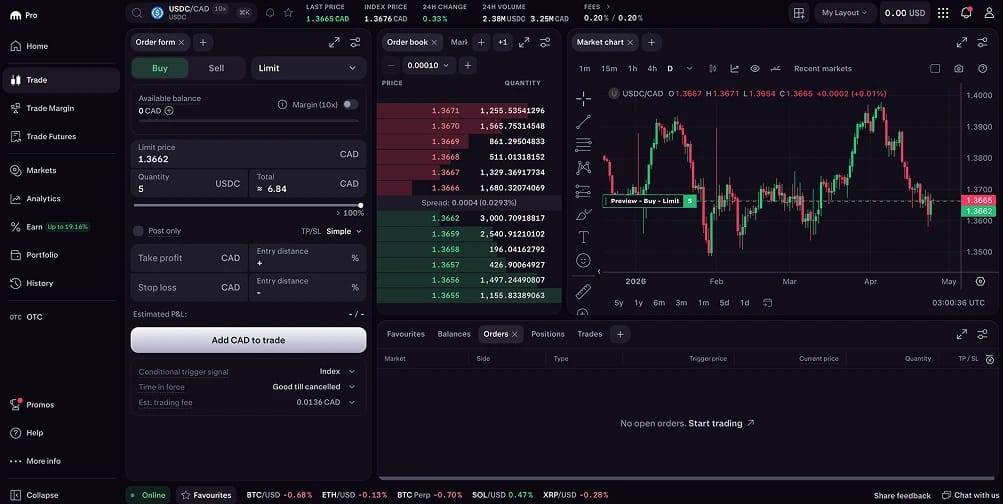
- Buy USDC against CAD on Kraken Pro. Open the CAD-USDC market, place a limit order near the midpoint of the spread, and confirm. Spreads typically run 5 to 15 basis points. Skip the Simple Buy interface since its markup is around 1.5% versus the Pro book.
- Withdraw USDC to self-custody. Send to MetaMask, Phantom, Rabby, or your hardware wallet. Solana SPL is cheapest at under $0.01 per transfer. Base and Arbitrum both stay under $0.10. Ethereum mainnet is only worth the gas for five-figure transfers.
- Swap USDC for USDT on a DEX. Use Uniswap, Curve, or Jupiter. Curve's StableSwap pools quote USDC-to-USDT inside 0.04% on L2s. Jupiter routes through Orca and Raydium on Solana at similar tightness. The swap settles in seconds.
If your goal is just a dollar-pegged asset rather than USDT specifically, USDC alone handles most use cases. The DEX leg is for users who need USDT for offshore trading pairs, DeFi markets that quote exclusively in it, or cross-border flows where the receiving desk prefers Tether.
CAD to USDT Fees
All-in cost for the Kraken-to-DEX workflow is usually 0.3% to 0.6%, materially below any direct USDT on-ramp available to Canadians (Bitcoin ATMs with USDT routinely run 6% to 12%).
Deposits
- Interac e-Transfer (recommended): Free on Kraken since the April 2025 Restricted Dealer registration. CAD $5 minimum.
- Wire transfer: Free incoming on Kraken's end. Your bank typically charges $15 to $30 outbound, worth it above $10,000.
- Debit card: 3.75% processor markup. Only sensible under $500.
Trading and Conversion
- CAD-USDC spot on Kraken Pro: 0.25% maker, 0.40% taker. Volume tiers cut taker fees to 0.10% at $50,000 monthly turnover.
- USDC withdrawal: Network fee only. Solana under $0.01, Base around $0.05, Arbitrum around $0.10, Ethereum mainnet $1 to $10 depending on gas.
- DEX swap (USDC to USDT): 0.04% to 0.15% slippage plus gas. Curve and Uniswap v3 stable pools quote tightest.
Withdrawals to CAD
- Interac e-Transfer: CAD $10 flat fee on Kraken, same-day settlement during business hours.
- Domestic wire: CAD $10 flat fee, 1 to 2 business days.
A representative $5,000 buy costs roughly $15 to $25 total: free deposit, $20 USDC purchase at maker, $0.10 network fee, $5 on the swap. Not bad for a workflow that three years ago simply meant you held USDT on Kraken directly.
Best USDC On-Ramps for Buying USDT in Canada
Since no Canadian-registered exchange lists USDT directly, the platform decision is really about the USDC leg: which venue gives you the cleanest CAD-to-USDC conversion and the cheapest withdrawal to self-custody, where the DEX swap to USDT then happens. The table below ranks the strongest options on regulatory standing, CAD funding quality, fee transparency, and withdrawal flexibility.
Wealthsimple is included because they quietly expanded multi-network USDC withdrawals in 2024, opening the DEX workflow for existing Wealthsimple users. The spread is wider than Kraken Pro, so heavy users still benefit from routing through Kraken.
Regulatory Status of USDT in Canada
Canada runs one of the stricter crypto regimes in the developed world, with overlapping federal and provincial layers. Anyone moving meaningful USDT volume should know who oversees what.
For USDT specifically, the binding constraint is Staff Notice 21-333. It requires the issuer of any VRCA traded on a Canadian CTP to commit to full fiat backing, segregated custody, audited reserves, and enforceable redemption. Circle cleared that bar with USDC. Tether has not pursued it.
The federal Stablecoin Act, passed through Bill C-15 and given Royal Assent on March 26, 2026, changes the medium-term picture. It shifts stablecoin oversight from provincial securities regulators to the Bank of Canada and treats compliant stablecoins as payment instruments under a prudential regime rather than investment securities. Full implementation runs through 2027. Until operational rules land, the interim VRCA regime continues and USDT stays outside it.
Quebec adds one wrinkle. The AMF historically interpreted several crypto activities more conservatively than the OSC, and some exchanges that serve the rest of Canada exclude Quebec residents. Kraken is registered with the AMF, so the workflow above works identically for Quebec users.
Tax Implications of USDT in Canada
The CRA treats cryptocurrency as a commodity, which shapes almost every tax outcome a Canadian USDT user encounters.
- Buying USDT is not taxable. Holding USDC, swapping it for USDT, or transferring USDT between your own wallets creates no tax event. Track cost basis at acquisition.
- Disposing of USDT is taxable. Selling for CAD, swapping for another crypto, or paying for a service all count as dispositions. The taxable amount is the CAD-equivalent gain at transaction time against your adjusted cost base (ACB).
- Capital gains versus business income. If you hold as an investment, 50% of any gain is taxable at your marginal rate. If trading frequency, intent, and time spent suggest a business, 100% is taxable as business income. The CRA weighs frequency, duration, knowledge, time, financing, and promotion.
- Crypto-to-crypto swaps count. Swapping USDC for USDT via DEX is both a disposition of USDC and an acquisition of USDT. Each leg needs CAD-equivalent valuation at execution. Keep the on-chain transaction hash as your record.
- Reporting forms. Capital gains land on Schedule 3 of T1 General. Business income uses Form T2125. Foreign holdings above $100,000 CAD require Form T1135, which captures crypto held on offshore exchanges.
- Crypto-Asset Reporting Framework (CARF). Canada signed on in 2023 with implementation rolling through 2027. Registered Canadian CTPs will automatically report user transaction data to the CRA. Offshore venues in CARF-participating jurisdictions share data under information-exchange agreements.
Why Canadians Still Need USDT
The workaround exists because of one disclosure-standard disagreement between Tether and the CSA, with no underlying problem on the asset side. Three use cases keep Canadian demand alive despite the friction.
- Offshore venue access: Most crypto markets outside the regulated Canadian perimeter quote against USDT, with USDC liquidity running thinner. Hyperliquid, perpetual DEXs, most Solana and Base altcoins, and nearly every launchpad allocation default to USDT pricing. Users who want exposure beyond the roughly 60 to 80 assets listed on Canadian platforms eventually need it.
- Cross-border use cases: USDT is the dominant remittance stablecoin globally. Canadians sending money to family in Latin America, Southeast Asia, or West Africa find USDT easier on the receiving end, where local OTC desks and P2P liquidity skew heavily toward Tether.
- DeFi yield spreads: USDT lending markets on Aave, Compound, and similar venues often quote 1% to 3% above USDC equivalents during borrow-demand spikes. The spread has compressed since 2024 but still persists.
For casual users, USDC covers the same ground with less friction and stays fully inside the regulated framework. The DEX workflow is worth the setup only when one of the three use cases above applies.
.webp)
Final Thoughts
Kraken is the highest-quality regulated on-ramp in Canada and the cleanest CAD-to-USDC bridge for users who then need to swap to USDT in self-custody. The combination of OSC Restricted Dealer status, FINTRAC MSB registration, free Interac e-Transfer deposits, and deep CAD-USDC liquidity is unmatched elsewhere.
If the regulated framework matters more than USDT specifically, USDC handles almost every job Canadian users actually need, without the DEX leg. The Bank of Canada's federal framework should reshape this picture through 2027, and Tether may file under it. Until then, the bridge is what works.
Across any setup, keep CAD-denominated records per trade, archive every Etherscan or Solscan hash for the DEX leg, and keep large balances off centralized venues once the swap is done. Self-custody is the right end state for USDT held longer than an active trading window.
%2520in%2520Canada.webp)