







Can I Buy Tether (USDT) in Pakistan?
Individuals in Pakistan can legally own and trade USDT. The Virtual Assets Act, 2026 classifies crypto as property under Pakistani law, while placing the compliance burden on platforms. Any Virtual Asset Service Provider must obtain authorisation from the Pakistan Virtual Asset Regulatory Authority (PVARA) before serving local users. This category includes exchanges, custodians, and token issuers.
The authorisation process has two stages. A No Objection Certificate allows a platform to incorporate locally and register for anti-money-laundering supervision. It must then submit a second application for a full licence.
Binance and HTX received the first NOCs in December 2025. PVARA stressed that an NOC does not amount to permission to operate, meaning every major exchange used by Pakistanis still operates offshore.
Pakistan ranks third on the Chainalysis Global Crypto Adoption Index, behind only India and the US. PVARA estimates that the country has nearly 40 million crypto users generating close to US$300 billion in annual volume. Stablecoins account for most of this activity, largely because people use them to protect savings from a weakening rupee rather than as trading instruments.
How to Buy USDT in Pakistan
Our tested method uses a KYC-verified Bybit account and its rupee P2P market. Seven years of banking restrictions prevented exchanges from developing direct PKR deposits. Buyers therefore purchase USDT from individual merchants while Bybit holds the coins in escrow.
Available payment methods include Easypaisa, JazzCash, and bank transfers. For a broader platform comparison, see our guide to the best crypto exchanges in Pakistan.
Steps to buy USDT on Bybit in Pakistan:
- Create and verify your account: Register with Bybit, then complete KYC using a CNIC, NICOP, or passport and a liveness check. Your account name must exactly match the document. Spelling differences are the most common cause of verification delays.
- Open the P2P desk and set your filters: Go to Buy Crypto, select P2P Trading, and choose USDT priced in PKR. Filter listings by your preferred payment method. Look for a merchant with a completion rate above 98% and an extensive order history.
- Pay the seller in rupees: Send the exact amount before the payment timer expires. The Easypaisa, JazzCash, or bank account must be registered in your name. Even a difference of a few rupees may give the seller grounds to dispute the release.
- Confirm and collect your USDT: Mark the order as paid, then wait for the merchant to confirm receipt and release the escrowed USDT. Our test orders placed during Karachi business hours settled within a few minutes.
- Move savings off the exchange: Keep only trading funds on the platform. Tron (TRC-20) is generally the cheapest network for transferring USDT. Ethereum (ERC-20) is better suited to DeFi destinations when its gas costs are acceptable.
Keep all receipts and correspondence inside the order chat from your first trade onward. Escrow teams can only assess the evidence available on the platform, and Pakistani banks have frozen accounts connected to disputed P2P payments.
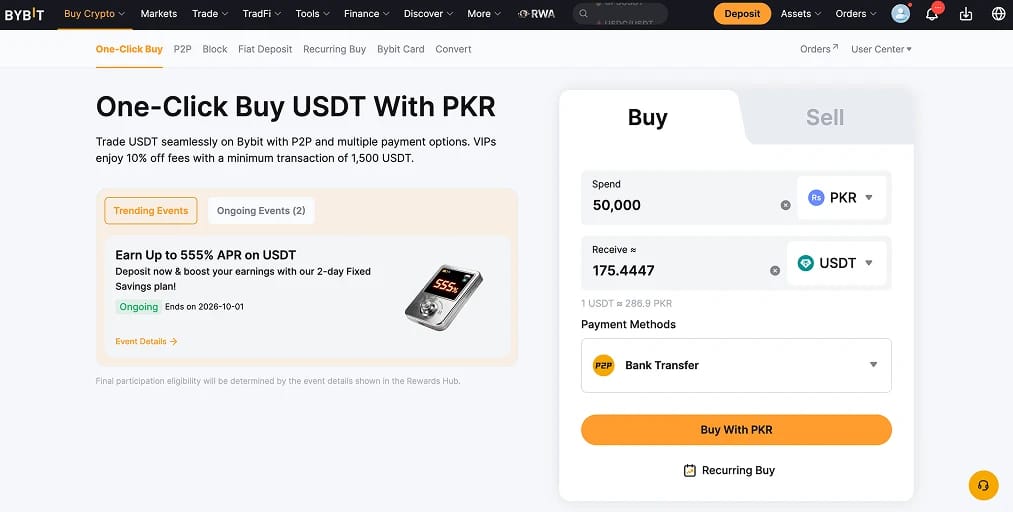
PKR to USDT Fees
Published trading fees reveal little about the true cost of buying USDT in Pakistan. The main expense is the P2P premium over the open-market dollar rate, which determines the rupee price of Tether rather than the interbank rate.
Funding
- P2P with Easypaisa, JazzCash, or bank transfer (recommended): Bybit charges neither party a fee on P2P orders. The merchant’s margin over the open-market dollar is the actual cost. It was close to 1% across the listings we reviewed and generally narrowed when more merchants were active during daytime hours.
- Card purchases: Processor markups typically range from 2% to 5%. Cards are fast, but their cost makes them more appropriate for small, urgent purchases.
- Crypto deposits: Transferring USDT from another platform avoids rupee conversion entirely. Only the relevant network fee applies. This is a common way for Pakistanis to fund exchanges that lack a PKR market.
Trading and withdrawals
- Spot trading: Bybit charges base-tier users a flat 0.10% for both maker and taker spot orders. Its USDT markets are also among the most liquid available.
- Network fees on withdrawal: A TRC-20 USDT withdrawal costs around one dollar and usually confirms in under a minute. ERC-20 fees vary with Ethereum network congestion.
- Selling back to rupees: The P2P buyer pays directly into your Easypaisa, JazzCash, or bank account. Settlement typically takes only a few minutes, regardless of banking hours.
Our best USDT exchanges roundup compares stablecoin costs across leading global platforms.
Best USDT Exchanges in Pakistan
These platforms were ranked by rupee funding depth, USDT liquidity, fees, and regulatory standing. We tested CNIC verification on each exchange and placed live P2P orders wherever a rupee market was available.
Binance has Pakistan’s largest P2P merchant pool and already holds a PVARA NOC. Bybit delivered the lowest total cost in our testing, so compare live quotes for your intended order size before choosing between them.
OKX, Bitget, and KuCoin work better as secondary accounts. Users can complete the rupee conversion elsewhere and transfer USDT to these platforms afterward.
Regulatory Status of USDT in Pakistan
Individuals can legally own and trade USDT in Pakistan. The country’s new framework regulates the exchanges, custodians, and other service providers handling virtual assets rather than tokens held in a personal wallet.
- The 2018 banking prohibition: An April 2018 circular from the State Bank of Pakistan prohibited banks and payment companies from processing virtual currency transactions. Crypto ownership remained lawful, but the restriction pushed rupee trading toward P2P markets and mobile money.
- The Virtual Assets Act, 2026: Parliament converted the 2025 ordinance into permanent law and gave PVARA authority to license, supervise, and sanction providers operating in or from Pakistan. Foreign applicants must already be recognised in a major jurisdiction, while a Sharia advisory committee reviews products against Islamic finance principles.
- Banking access restored: The SBP’s Circular Letter No. 10 of 2026 permits banks to maintain segregated rupee accounts for PVARA-licensed providers. Banks still cannot trade crypto, and direct PKR access will remain limited until the first full licences are issued.
Bybit has strong overseas credentials, including a full UAE SCA licence and MiCA authorisation in Austria. Neither approval authorises it to operate in Pakistan. Bybit has not received a PVARA NOC, and no exchange has yet secured a full local licence, so its PKR market continues to operate through offshore P2P trading.
Users should monitor PVARA’s register as applications progress. Our Bybit review examines the platform’s licensing, security, and trading features in more detail.
Tax Implications of USDT in Pakistan
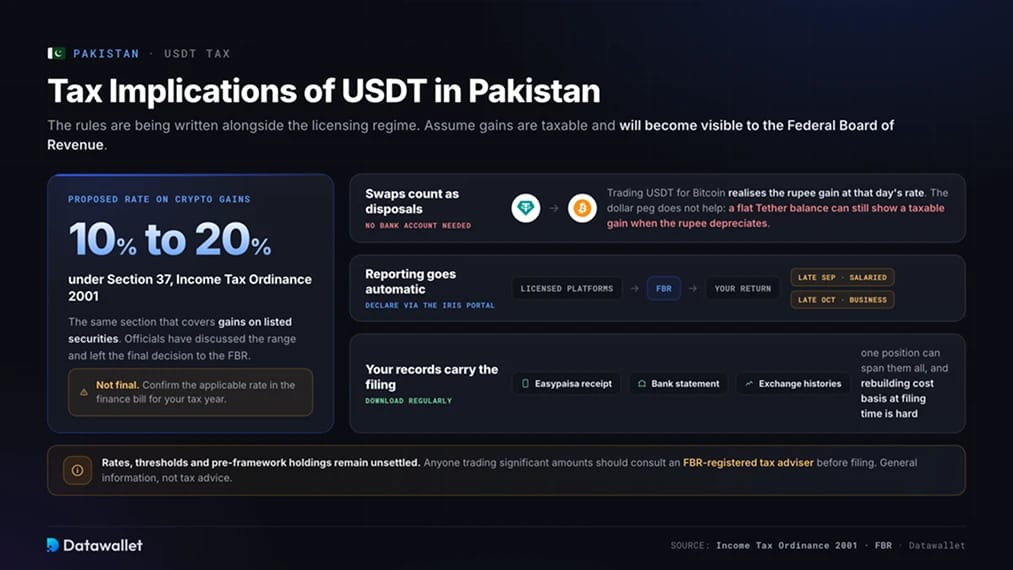
Pakistan is developing its crypto tax rules alongside the licensing regime. The position is more defined than it was a year ago, but it is not final. Users should assume that gains are taxable and will eventually become visible to the Federal Board of Revenue.
- Gains are being written into the tax net: The government intends to tax crypto profits under Section 37 of the Income Tax Ordinance, 2001, which also covers gains on listed securities. Officials have discussed a rate between 10% and 20%, leaving the final decision to the FBR. Confirm the applicable rate in the finance bill for your tax year.
- Swaps count as disposals: Exchanging USDT for Bitcoin realises any rupee-denominated gain on the Tether at that day’s rate, even if no funds enter a bank account. USDT’s dollar peg does not prevent this. A flat token balance can still produce a taxable gain when the rupee depreciates.
- Automatic reporting is arriving: Licensed platforms are expected to provide transaction records to the FBR. Individuals will declare their activity through the IRIS portal. Filing deadlines fall in late September for salaried taxpayers and late October for business filers.
- Your records carry the filing: One position may involve an Easypaisa receipt, a bank statement, and two exchange histories. Download records from every platform regularly. Reconstructing the cost basis across several apps at filing time can be difficult.
💡 For active users: Tax rates, thresholds, and the treatment of assets acquired before the new framework remain unsettled. Anyone trading significant amounts should consult an FBR-registered tax adviser before filing. This is general information, not tax advice.
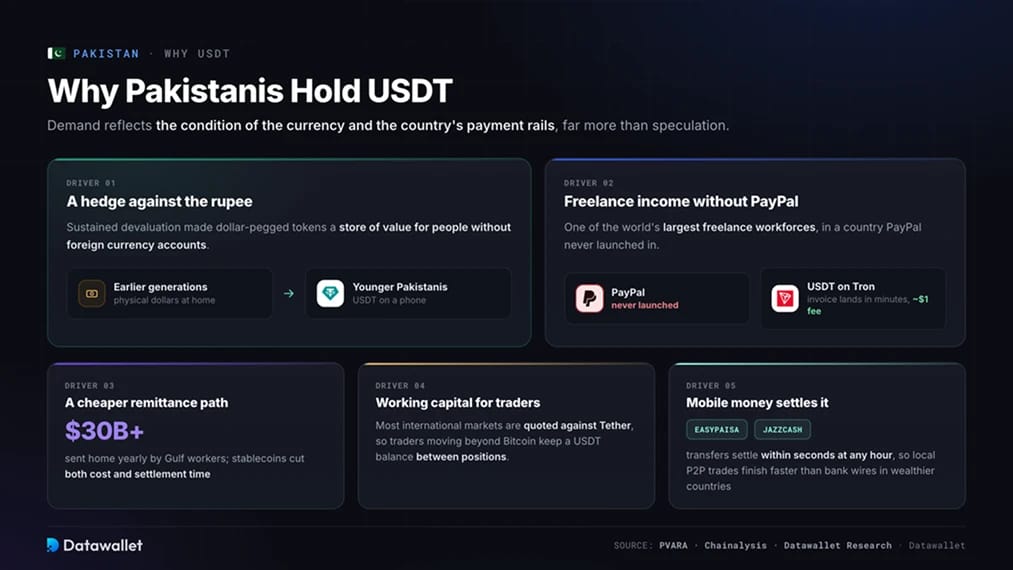
Why Pakistanis Hold USDT
USDT demand in Pakistan reflects the condition of the currency and the country’s payment infrastructure more than speculation.
- A hedge against the rupee: Sustained devaluation has made dollar-pegged tokens a common store of value for people without foreign currency accounts. Earlier generations often kept physical dollars at home. Many younger Pakistanis now hold USDT on a phone.
- Freelance income without PayPal: Pakistan has one of the world’s largest freelance workforces, while PayPal has never launched in the country. USDT has consequently become a standard method for receiving foreign client payments. A Tron transfer delivers the invoiced amount within minutes for roughly one dollar. Our USDT statistics page tracks the token’s global scale.
- A cheaper remittance path: Workers in Gulf countries send more than US$30 billion home each year. Stablecoin transfers can reduce both the cost and settlement time compared with traditional remittance channels. Our guides explain how to buy USDT in the UAE and Saudi Arabia, while the Western Union guide covers the conventional alternative.
- Working capital for traders: Most international exchange markets are quoted against Tether. Traders moving beyond Bitcoin often keep a USDT balance between positions.
- Mobile money does the settlement: Easypaisa and JazzCash serve a large portion of Pakistan’s adult population. Transfers settle within seconds at any time of day, allowing many local P2P trades to complete faster than bank wires in wealthier countries.
Final Thoughts
Bybit is our recommended platform for buying USDT in Pakistan. It combines a liquid PKR P2P market supporting Easypaisa, JazzCash, and bank transfers with 0.10% spot fees, an Urdu interface, and broad international licensing.
The February 2025 theft of nearly US$1.5 billion in Ether was the largest exchange breach on record. Customers lost nothing, withdrawals remained open, and Bybit restored the balance. However, Binance is further ahead locally because Bybit lacks a PVARA NOC. Keep only trading funds on an exchange and move savings to a self-custody USDT wallet.
Pakistan’s banking prohibition has ended, and PVARA is processing applications for full licences. As clearer rules emerge for the country’s 40 million crypto users, verified accounts, vetted merchants, and complete records remain essential.
.webp)