







Can I Buy USDT in Switzerland?
Yes. Swiss law places no limit on individuals buying, holding, or spending USDT, and FINMA treats it as a payment token rather than a security. The Distributed Ledger Technology Act, fully in force since August 2021, gave crypto assets a settled legal footing earlier than almost any other jurisdiction.
The Swiss twist affects issuers rather than buyers. Under FINMA Guidance 06/2024, anyone issuing a stablecoin from Switzerland needs a banking licence or a bank default guarantee, and must identify every holder of the token. That whitelisting demand is why no major dollar stablecoin issues from Swiss soil, and why USDT circulates here as a foreign token bought on exchanges rather than a product sold by local banks.
Around 20 Swiss banks now offer crypto trading, yet their retail menus centre on Bitcoin, Ether, and a shortlist of majors. Swissquote is the main exception with a wider list that includes USDT, though its trading commission sits near 1% on small orders. When we compared that against a 0.20% limit order on a dedicated USDT/CHF order book, the exchange won on cost by a factor of four or more.
How to Buy Tether (USDT) in Switzerland
The setup we recommend pairs a Kraken account with a direct CHF transfer over SIC. Kraken's franc account sits with Bank Frick in Liechtenstein, so the IBAN starts with LI rather than CH. Liechtenstein participates in SIC, so your e-banking should treat it as a domestic franc payment. If your bank's payment screen offers a choice, pick the domestic or SIC option rather than an international transfer, or you may be charged foreign payment fees.
Steps to buy USDT on Kraken with Swiss francs:
- Create and verify your account: Register at Kraken and complete KYC with your Swiss passport or identity card plus proof of address. Intermediate verification, which unlocks fiat funding, cleared in a few hours when we tested with a Swiss ID card.
- Generate the CHF deposit details: In the Funding section, select CHF and choose Bank Frick (SIC). Copy the beneficiary name, the LI IBAN, and your personal reference code beginning with AA. The reference must appear in the payment message or the deposit will sit unmatched until support intervenes.
- Send francs from your e-banking: Enter the details as a standard CHF payment. Deposits over SIC carry no Kraken fee and a 100 CHF minimum, and ours arrived as a tradable balance the same morning. Transfers only settle during Swiss banking hours, so a Friday evening payment lands on Monday.
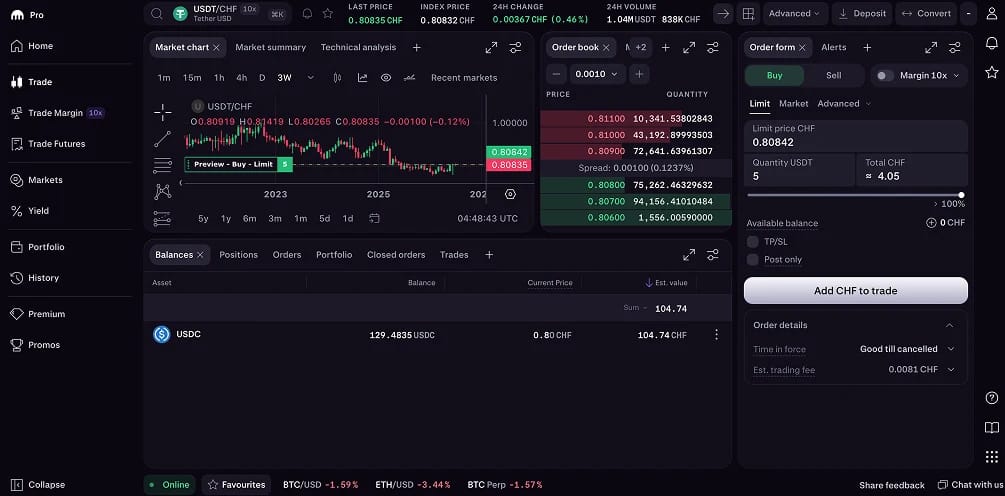
- Place a limit order on USDT/CHF: Open Kraken Pro, load the USDT/CHF pair, and set a limit order at or just inside the best ask. When we tested, the spread sat near 0.1% and the levels within a centime of mid held five-figure USDT quantities, so retail orders fill without moving the price.
- Withdraw or hold: USDT can stay on the exchange, move to self-custody, or transfer onward to another platform. Pick the network to match the destination, since fees differ sharply between chains.
CHF to USDT Fees
The all-in cost of turning francs into USDT on Kraken breaks into three layers.
Deposits
- Direct CHF over SIC (recommended): Free on Kraken's side with a 100 CHF minimum, and most Swiss banks charge nothing for a domestic e-banking payment. Settlement is same-day during banking hours.
- SWIFT CHF from a non-Swiss bank: 0.75 CHF received-payment fee on Kraken's side, plus whatever your sending bank and any correspondent charge in transit.
- Card and instant buys: Convenient but priced through a spread plus processing costs that typically total 3% or more. We treat these as an emergency option only.
Trading
- USDT/CHF on the order book: Kraken's stablecoin and FX schedule applies, opening at a flat 0.20% for both maker and taker below US$50,000 in 30-day volume and tapering as volume rises. Kraken+ subscribers trade fee-free up to a monthly cap.
- Instant-buy screens: The simple buy widget prices through a wider spread than the order book. Placing a limit order on Kraken Pro is the difference between paying 0.20% and paying north of 1%.
Withdrawals
- USDT to another wallet or platform: Tron (TRC-20) costs about 1 USDT and confirms in under a minute, Solana lands below US$0.10, and Ethereum runs anywhere from one to ten dollars depending on gas.
- CHF back to your bank: Selling USDT/CHF and withdrawing over the same SIC channel returns francs to a Swiss account the same business day. A full round trip, francs to USDT and back, cost us under 0.5% excluding any market movement.
Best USDT Exchanges in Switzerland
The ranking below weighs CHF funding access, USDT liquidity, fees, and regulatory standing for Swiss buyers. Our full country comparison lives in the best crypto exchanges in Switzerland guide.
Regulatory Status of USDT in Switzerland
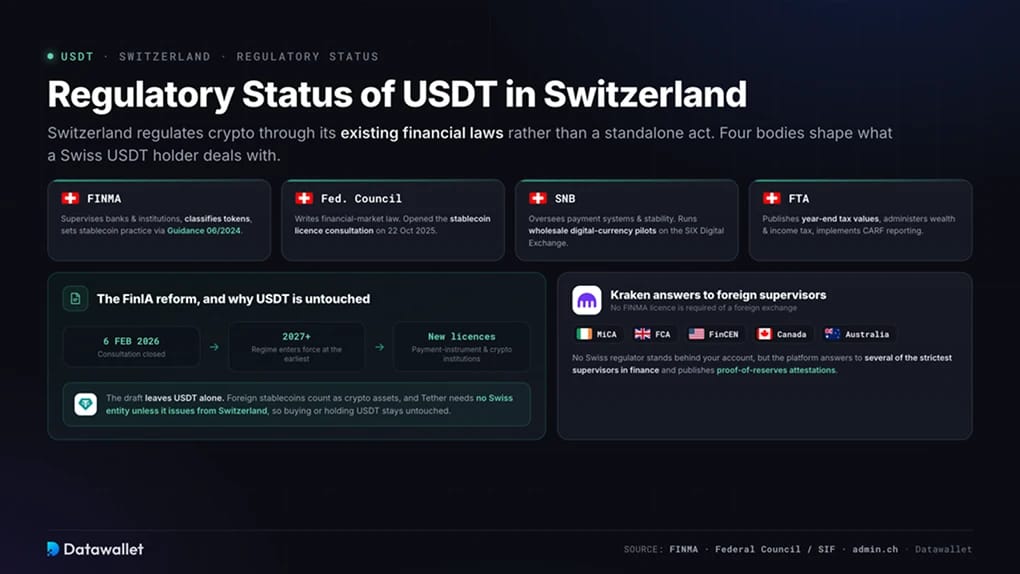
Switzerland regulates crypto through its existing financial laws rather than a standalone crypto act, and the framework is in the middle of its biggest revision since the DLT Act. Four bodies shape what a Swiss USDT holder deals with:
The change to watch is the Financial Institutions Act amendment. Payment instrument institutions would replace the fintech licence and issue stablecoins without the current CHF 100 million deposit cap, while crypto institutions would bring custody, trading, and staking under direct FINMA oversight. The consultation closed on 6 February 2026, and the regime is expected to enter force in 2027 at the earliest.
The draft leaves USDT alone. Foreign stablecoins distributed in Switzerland count as crypto assets, and offshore issuers such as Tether need no Swiss entity unless they issue from Switzerland, so buying USDT on Kraken or holding it in your own wallet stays untouched.
Kraken holds no FINMA authorisation, which Swiss law does not demand of a foreign exchange serving residents from abroad. It holds MiCA authorisation from the Central Bank of Ireland, an Irish e-money licence, a Cyprus MiFID licence for derivatives, FCA registration in the UK, a Wyoming bank charter and FinCEN registration in the US, and registrations in Canada and Australia.
No Swiss regulator stands behind your account, but the platform answers to several of the strictest supervisors in finance and publishes proof-of-reserves attestations.
Tax Implications of USDT in Switzerland
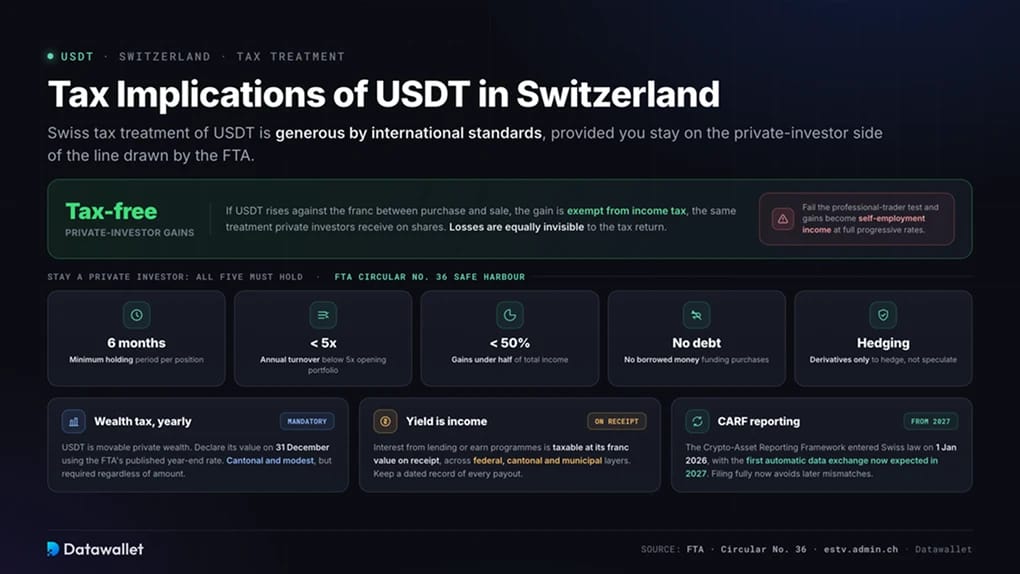
Swiss tax treatment of USDT is generous by international standards, provided you stay on the private-investor side of the line drawn by the Federal Tax Administration.
- Gains are tax-free for private investors. If USDT rises against the franc between purchase and sale, the gain is exempt from income tax, the same treatment private investors receive on shares. Losses are equally invisible to the tax return.
- The professional-trader test can flip everything. FTA Circular No. 36 sets five safe-harbour criteria, including a six-month minimum holding period, annual turnover below five times your opening portfolio, gains under half of total income, no borrowed money, and derivatives used only for hedging. Fail the overall assessment and your gains become self-employment income, taxed at full progressive rates.
- Wealth tax applies every year. USDT counts as movable private wealth and must be declared at its value on 31 December using the FTA's published year-end rate. Rates are cantonal and modest, but the declaration itself is mandatory regardless of amount.
- Yield on USDT is income. Interest from lending or exchange earn programmes is taxable at its franc value on receipt, across federal, cantonal, and municipal layers. Keep a dated record of every payout.
- CARF reporting has a legal basis but a delayed start. The Crypto-Asset Reporting Framework entered Swiss law on 1 January 2026, and the first automatic exchange of data is now expected in 2027 after a Federal Council postponement. Filing completely now avoids awkward mismatches later.
💡 For active users: export your Kraken trade history at least quarterly and store the CHF value of each transaction. Cantonal offices make the private-versus-professional call case by case, so anyone trading at volume should put the question to a Swiss tax adviser before the classification is made for them. For context on how this regime compares abroad, see our guide to the best low-tax crypto countries.
Why Swiss Investors Hold USDT
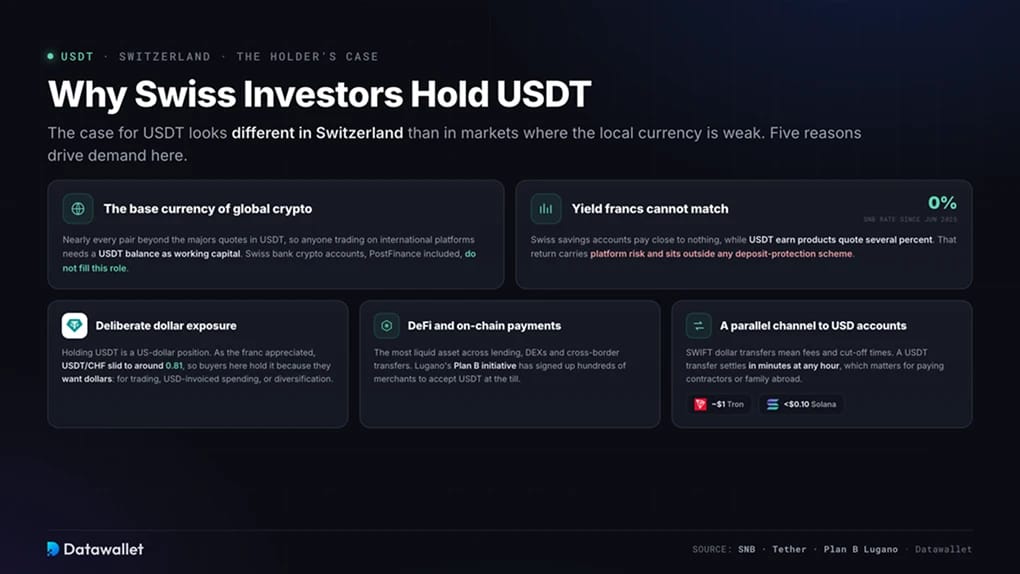
The case for USDT looks different in Switzerland than in markets where the local currency is weak.
- It is the base currency of global crypto trading: Nearly every pair beyond the majors quotes in USDT, so anyone trading on international platforms needs a USDT balance as their working capital. Swiss bank crypto accounts, PostFinance included, do not fill this role.
- Yield that franc savings cannot match: The SNB has held its policy rate at 0% since June 2025, and Swiss savings accounts pay close to nothing. USDT earn products on major exchanges quote several percent, though that return carries platform risk and sits outside any deposit protection scheme.
- Deliberate dollar exposure: Holding USDT is a US dollar position, and against one of the strongest currencies in the world that cuts both ways. The USDT/CHF rate has slid to around 0.81 as the franc appreciated, so a Swiss holder buying purely for stability would have lost purchasing power. Buyers here hold USDT because they want dollars, whether for trading, USD-invoiced spending, or diversification away from an expensive home currency.
- DeFi and on-chain payments: USDT is the most liquid asset across lending markets, decentralised exchanges, and cross-border transfers. Closer to home, Lugano's Plan B initiative has signed up hundreds of merchants to accept USDT and Bitcoin at the till, the most tangible everyday-payment experiment in the country.
- A parallel channel to USD accounts: Swiss banks open dollar accounts readily, but moving those dollars internationally means SWIFT fees and cut-off times. A USDT transfer settles in minutes at any hour for around a dollar on Tron, which matters for anyone paying contractors or family abroad. Neobank users can compare the app-based alternative in our guide to buying USDT with Revolut.
Final Thoughts
For Swiss buyers who want USDT at the lowest cost with the least friction, Kraken settles the question. It pairs free CHF deposits over SIC and a native USDT/CHF order book with a flat 0.20% stablecoin fee and oversight from a stack of tier-one foreign regulators. No other global platform lets francs enter, trade, and exit without a conversion step in the middle.
Verify with a Swiss ID, send a small SIC test payment to confirm your bank handles the LI IBAN as domestic, place limit orders on USDT/CHF rather than using instant buy, and keep dated records of every trade and payout for the cantonal return. Declare the year-end balance for wealth tax and treat any earn income as taxable on receipt.
Watch the FinIA revision as it moves through Parliament. If Switzerland's new payment instrument licence tempts a major issuer onshore, the local stablecoin landscape could look very different within a few years. Until then, USDT remains a foreign token that Swiss residents buy cheaply, hold legally, and declare annually.
%20(1).webp)