










Top Crypto Faucets in 2026
Faucet quality now depends less on headline drip size and more on whether the tap stays funded. We checked each faucet's live page in October 2026, comparing network coverage, cooldowns, eligibility checks, and reliability for real builders rather than farmers.
Faucet | Rating | Available Chains | Rewards | Requirements |
|---|---|---|---|---|
 QuickNodeTop pick | 4.9/5 | 23 incl. Ethereum, Solana, Monad | 1 drip / chain / 12h; up to 4x bonuses | Small mainnet balance (e.g. 0.001 ETH) |
 thirdweb | 4.8/5 | 500+ EVM testnets | 0.01 ETH / chain / day | Wallet connection |
 Alchemy | 4.7/5 | 22 incl. Sepolia, Base, Arbitrum, Monad | 0.1 ETH / 24h on major testnets | 0.001 ETH + mainnet activity; no account |
 Coinbase Dev Platform | 4.6/5 | Base Sepolia, ETH Sepolia, Solana Devnet | Up to 0.1 ETH + 10 USDC / 24h | Free CDP account |
| Circle Faucet | 4.5/5 | 38 incl. Arc, Sepolia, Solana Devnet | 20 USDC / asset / network / 2h | reCAPTCHA only |
| pk910 PoW Faucet | 4.4/5 | Sepolia, Hoodi, Ephemery | Scales with mining effort | Browser proof-of-work only |
 Chainlink | 4.3/5 | ~60 incl. Sepolia, Fuji, Arc | Up to 0.5 ETH + 25 LINK / request | Supported wallet connection |
1. QuickNode
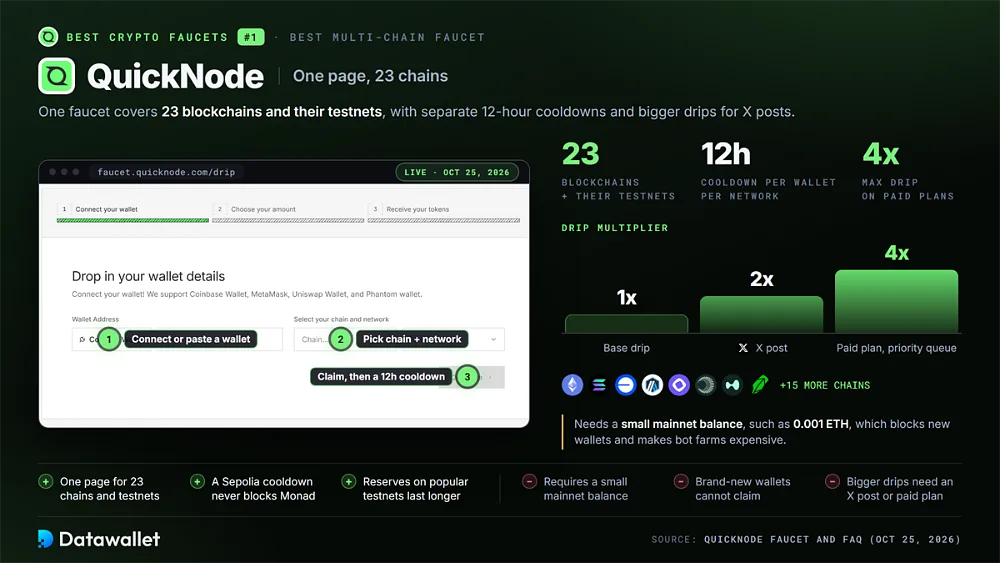
QuickNode keeps the top spot because it solves the most common faucet headache: juggling separate sites for every network. One page covers 23 blockchains and their testnets, including Ethereum, Solana, Base, Arbitrum, Monad, Plasma, HyperEVM and Robinhood Chain, with a chain selector that shows which networks each ecosystem currently supports.
Claims reset every 12 hours per wallet and per network, so a cooldown on Sepolia never blocks a Monad drip. Posting the faucet link on X doubles the base amount, and paid QuickNode customers double it again to four times the base drip, with priority placement in the delivery queue (QuickNode FAQ).
The catch is a small mainnet balance on the claiming wallet, which blocks brand-new addresses but makes throwaway bot wallets expensive to operate. For developers already active across several EVM-compatible networks, that trade-off is worth it, because reserves on popular testnets tend to last longer here.
Pros
- One page covers 23 blockchains and their testnets.
- Cooldowns run per network, so a Sepolia claim never blocks a Monad drip.
- An X post doubles the drip, and paid plans reach 4x with priority delivery.
Cons
- Requires a small mainnet balance, such as 0.001 ETH, on the claiming wallet.
- Brand-new wallets with no funds cannot claim.
- Larger drips depend on a social post or a paid plan.
2. thirdweb
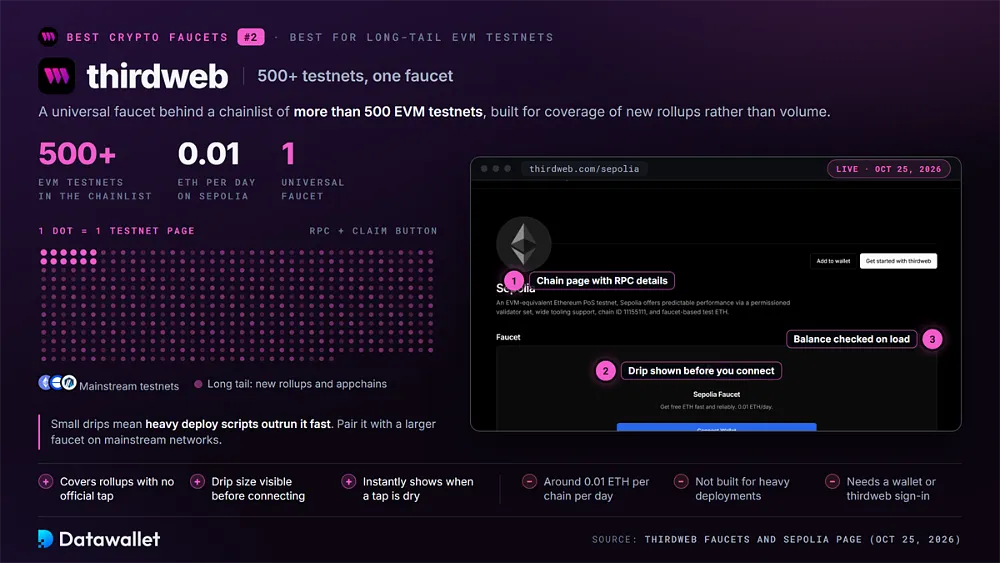
thirdweb takes the opposite approach to curation, listing more than 500 EVM testnets in its chainlist and routing them through one universal faucet. That breadth matters for newer rollups and appchains that launch without an official tap, since every listed chain gets its own page with RPC details and a claim button.
Each chain page advertises its drip before you connect, and the Sepolia page currently offers 0.01 ETH per day (thirdweb). The faucet also checks its remaining balance on load, so you learn instantly whether a tap is dry instead of waiting on a transaction that never arrives.
Small per-claim amounts mean heavy deployment scripts will outrun thirdweb quickly, so treat it as a coverage tool rather than a volume tool. Pair it with a larger faucet on mainstream networks, and lean on it for the long tail of Layer 2 networks that bigger providers ignore.
Pros
- Covers more than 500 EVM testnets through one universal faucet.
- Shows the drip amount on each chain page before you connect.
- Checks its remaining balance on load, so dry taps are obvious.
Cons
- Around 0.01 ETH per chain per day is too small for heavy deployments.
- Requires a connected wallet or a thirdweb sign-in.
- Works best as a coverage tool alongside a larger faucet.
3. Alchemy
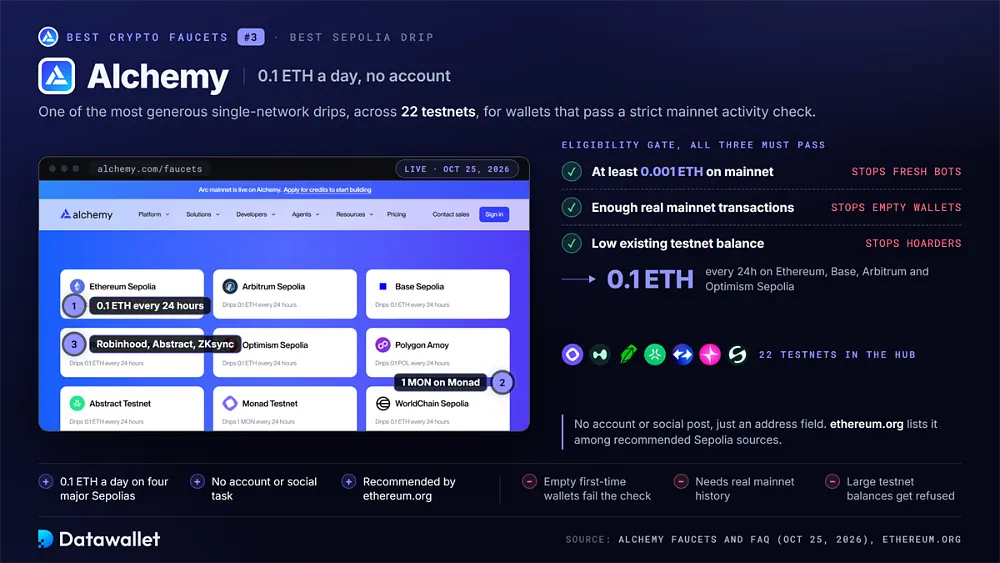
Alchemy runs one of the most generous single-network drips on the market, sending 0.1 ETH every 24 hours on Ethereum Sepolia, Base Sepolia, Arbitrum Sepolia and Optimism Sepolia. Its faucet hub now spans 22 testnets, adding Monad, Hyperliquid, Robinhood, Abstract, ZKsync, Unichain and Stable to the classic Ethereum lineup.
No Alchemy account or social post is needed, which keeps the flow to a single address field. Eligibility is stricter underneath: the wallet must hold at least 0.001 ETH on mainnet, show enough real mainnet transactions, and keep a low existing testnet balance, which filters out both fresh bot wallets and hoarders (Alchemy FAQ).
That activity check rules Alchemy out for first-time users with empty wallets, who are better served by pk910's proof-of-work faucet. For anyone with mainnet history, though, it is the fastest way to land a meaningful Sepolia balance, and ethereum.org includes it among its recommended Sepolia sources.
Pros
- Drips 0.1 ETH every 24 hours on four major Sepolia networks.
- No account or social post is needed, only an address.
- Listed by ethereum.org among recommended Sepolia sources.
Cons
- Wallets need at least 0.001 ETH on mainnet.
- Empty or brand-new wallets fail the mainnet activity check.
- Wallets already holding a large testnet balance are refused.
4. Coinbase Developer Platform
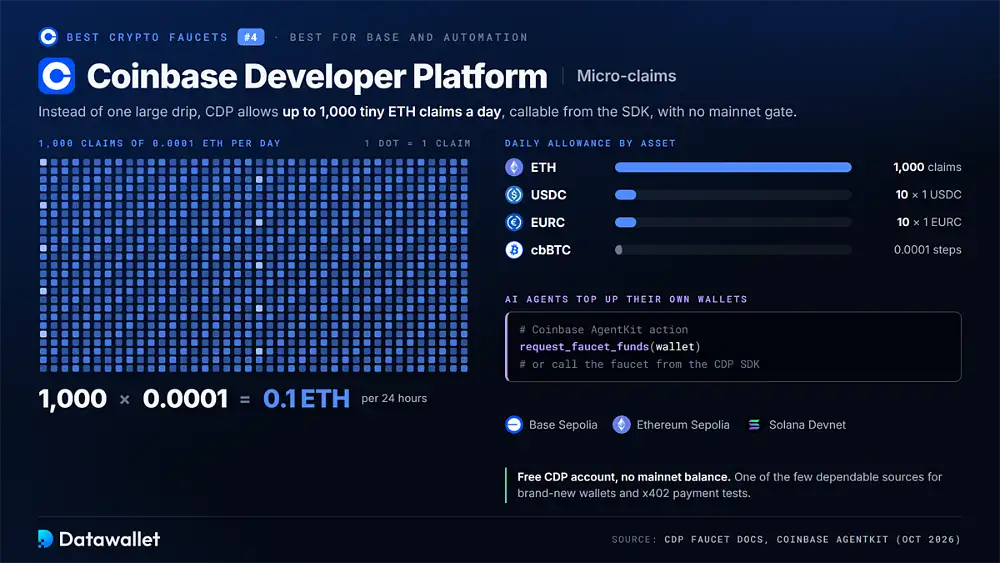
Coinbase's CDP Faucet is built around Base, the Layer 2 it incubated, and also serves Ethereum Sepolia and Solana Devnet. Instead of one large drip, it allows up to 1,000 claims of 0.0001 ETH per day, alongside 10 daily claims each of 1 USDC and 1 EURC (CDP docs).
That micro-claim design suits automation. Developers can request funds through the portal or call the faucet from the CDP SDK, and Coinbase's AgentKit exposes a request_faucet_funds action so AI agents can top up their own test wallets (AgentKit). Test cbBTC is available too, in 0.0001 increments.
There is no mainnet balance gate, only a free CDP account, which makes it one of the few dependable sources for brand-new wallets. Teams prototyping on Base, wiring Coinbase smart wallets into an app, or scripting x402 payment tests will get the most mileage from it.
Pros
- No mainnet balance is needed, only a free CDP account.
- Up to 1,000 micro-claims a day suit scripts and automation.
- AgentKit lets AI agents top up their own test wallets.
Cons
- Covers only Base Sepolia, Ethereum Sepolia and Solana Devnet.
- Each claim is tiny at 0.0001 ETH.
- Requires creating a Coinbase Developer Platform account.
5. Circle Faucet
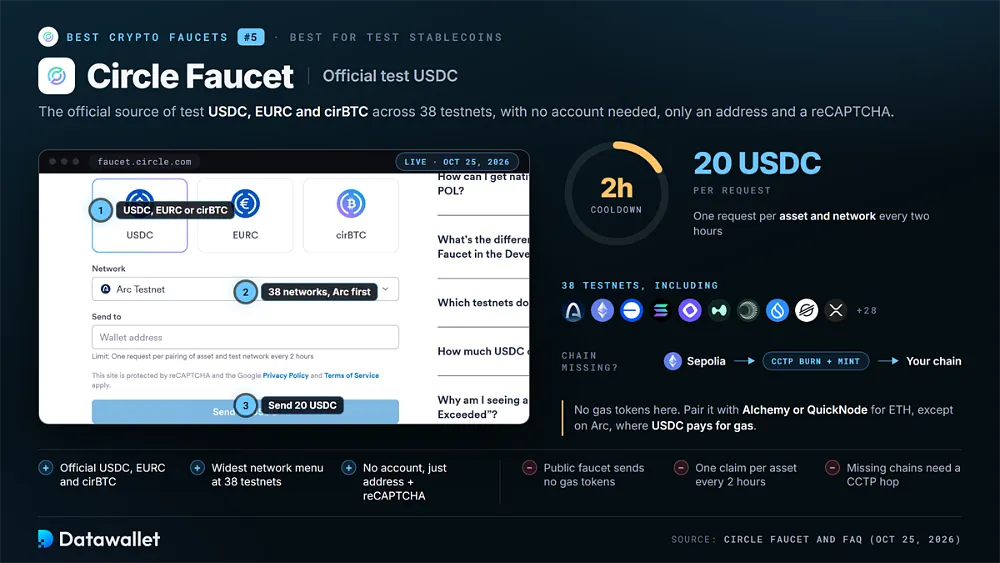
Circle's public faucet is the official source of test USDC, EURC and cirBTC, the assets most payment and treasury apps now need to simulate. It sends 20 USDC per request, with one request allowed per asset and network every two hours, and it needs no account, only a wallet address and a reCAPTCHA check.
Coverage is the standout. The network menu lists 38 testnets, from Ethereum Sepolia, Base Sepolia and Solana Devnet to Arc, Monad, HyperEVM, Plasma, Sui, Stellar and the XRP Ledger. When a chain is missing, Circle points developers to CCTP, its burn-and-mint protocol, to move test USDC from Sepolia instead (Circle FAQ).
Circle's public faucet does not hand out gas tokens, so pair it with Alchemy or QuickNode for ETH, or use Circle's Developer Console faucet if your wallets live on Circle Wallets. On Arc, where USDC itself pays for gas, this faucet is the default way to fund a test account.
Pros
- Official source of test USDC, EURC and cirBTC.
- Covers 38 testnets, the widest network menu among the faucets tracked.
- No account is needed, only a wallet address and a reCAPTCHA.
Cons
- The public faucet does not hand out gas tokens.
- One request per asset and network every two hours.
- Missing chains require moving test USDC through CCTP.
6. pk910 PoW Faucet
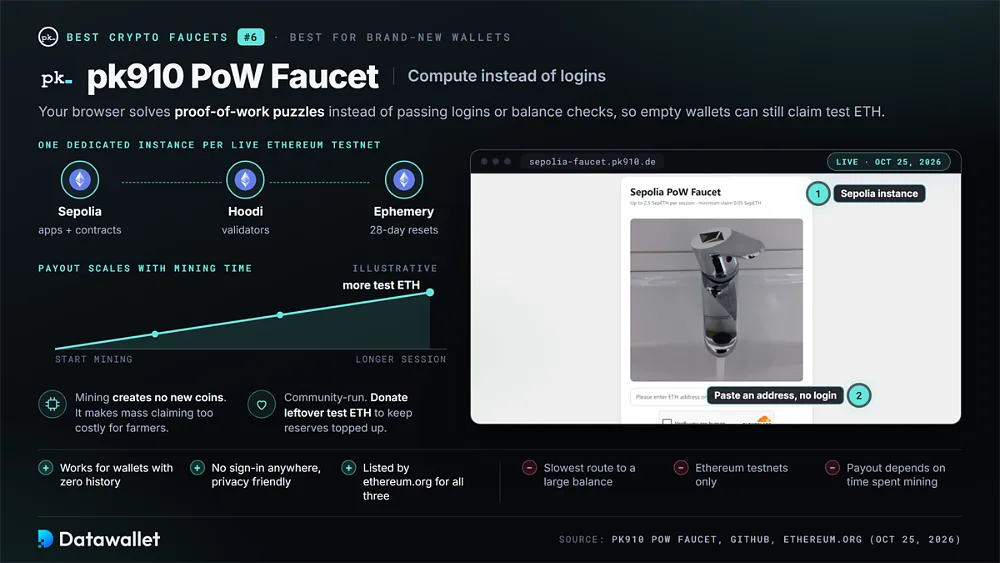
The pk910 PoW Faucet swaps logins and balance checks for computation. You enter an address, let your browser solve proof-of-work puzzles, and claim once you have mined enough. The mining creates no new coins; it simply makes mass automated claiming too costly to be worth a farmer's time (GitHub).
Dedicated instances cover Sepolia, Hoodi and Ephemery, matching Ethereum's live public testnets one for one, and ethereum.org lists all three among its official faucet links. Since the faucet is community-run, it also accepts donations of unused test ETH to keep reserves topped up from developers who finish a project with leftovers.
Payouts scale with time spent mining, so this is not the quickest route to a large balance. It is, however, the most dependable option for brand-new wallets with zero mainnet history, privacy-minded developers who refuse to sign in anywhere, and anyone whose claims keep failing on account-gated taps.
Pros
- Works for brand-new wallets with zero mainnet history.
- No sign-in or balance check, which suits privacy-minded developers.
- Dedicated instances cover Sepolia, Hoodi and Ephemery.
Cons
- Payouts scale with mining time, so large balances take a while.
- Covers Ethereum testnets only.
- Mining ties up your browser during the session.
7. Chainlink Faucet
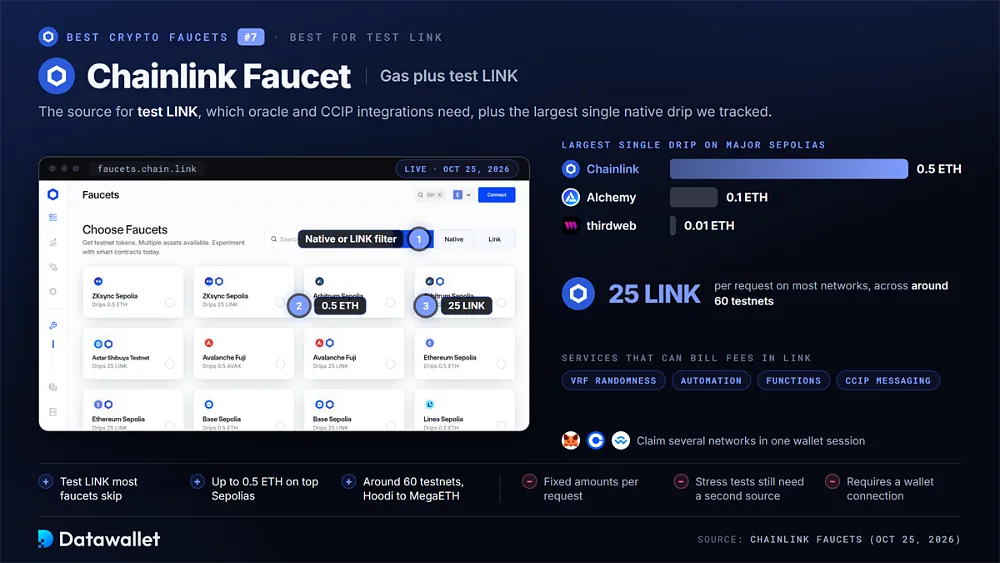
Chainlink's faucet earns its place for one asset general faucets skip: test LINK. Contracts that use VRF randomness, Automation, Functions or CCIP cross-chain messaging can pay fees in LINK, so a realistic integration test needs a LINK balance alongside gas. Most networks drip 25 LINK per request.
The native side has grown too. The faucet now lists around 60 testnets, including Ethereum Sepolia, Hoodi, Avalanche Fuji, Arc, Tempo Moderato and MegaETH, and its headline drips on Sepolia, Base Sepolia and Arbitrum Sepolia reach 0.5 ETH, the largest single amount among the faucets we tracked.
Claims run through MetaMask, Coinbase Wallet or WalletConnect, and you can queue several networks in one session. Fixed amounts mean stress tests still need a second source, but for oracle-dependent contracts, cross-chain messaging, or any build that will eventually settle in LINK, this faucet saves a frustrating detour.
Pros
- Supplies test LINK, which most general faucets skip.
- Headline drips reach 0.5 ETH on Sepolia, Base Sepolia and Arbitrum Sepolia.
- Around 60 testnets, with several networks claimable in one session.
Cons
- Fixed amounts per request mean stress tests need a second source.
- Requires connecting a supported wallet.
- Drip sizes vary by network.
What Is a Crypto Faucet?
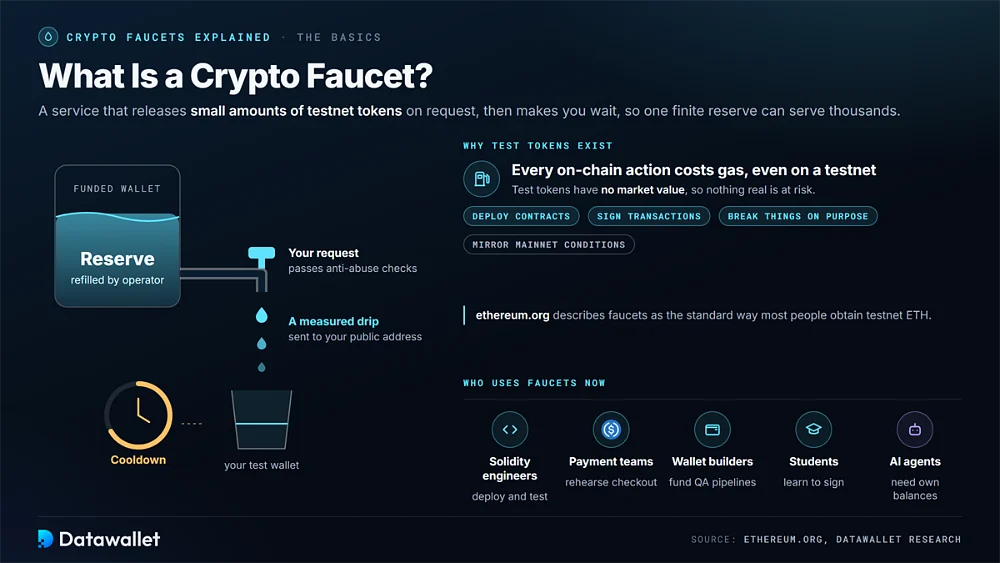
A crypto faucet is a service that releases small amounts of cryptocurrency on request, almost always testnet tokens with no market value. The name comes from a dripping tap: each visitor collects a measured portion, then waits for a cooldown, so a finite reserve can serve thousands of developers instead of a few.
Test tokens exist because every on-chain action costs gas, even on a test network. A faucet lets developers deploy contracts, sign transactions and break things on purpose in conditions that mirror mainnet, without exposing real funds. Ethereum's own documentation describes faucets as the standard way most people obtain testnet ETH (ethereum.org).
The audience has widened beyond Solidity engineers. Payment teams now request test USDC to rehearse checkout flows, wallet builders fund QA pipelines, students learn how a crypto wallet signs transactions, and AI agents increasingly need test balances of their own before they can complete deployment or payment tasks.
How Do Crypto Faucets Work?
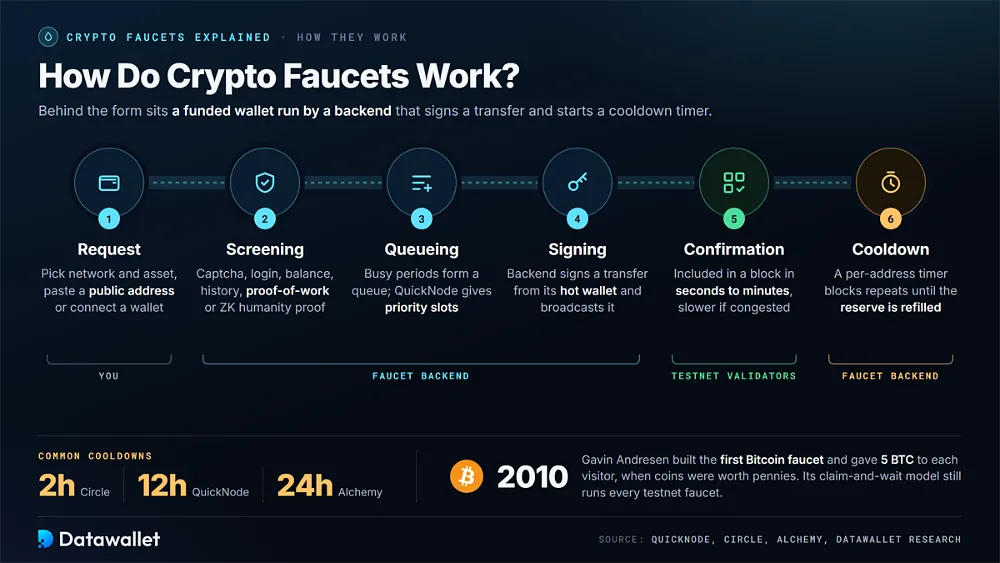
Behind the web form, a faucet is simply a funded wallet controlled by a backend service. When a request passes the operator's checks, the backend signs a transfer to your address and starts a cooldown timer.
A typical claim moves through these six stages from start to finish:
- Request: You pick a network and asset, then paste a public wallet address into the form or connect a wallet so the faucet can read it directly.
- Screening: The faucet runs its anti-abuse checks, such as a captcha, login, mainnet balance, transaction history, proof-of-work, or zero-knowledge proof that a human is behind the request.
- Queueing: During busy periods, requests join a queue, and some providers like QuickNode give priority slots to paying customers or users who complete optional social tasks.
- Signing: The backend builds a transfer from its hot wallet, signs it with the faucet's private key, and broadcasts it to the test network like any normal transaction.
- Confirmation: Validators include the transfer in a block, usually within seconds to a few minutes, though congestion or low gas settings on the faucet side can delay delivery.
- Cooldown: A per-address timer, commonly 2, 12 or 24 hours, blocks repeat claims so the reserve lasts until the operator refills the wallet from its treasury.
A bit of history: Gavin Andresen built the first Bitcoin faucet in 2010 and gave away 5 BTC to each visitor, when the coins were worth pennies. The giveaway was meant to spread adoption, and its claim-and-wait model still underpins every testnet faucet today.
How Crypto Faucets Are Changing in 2026
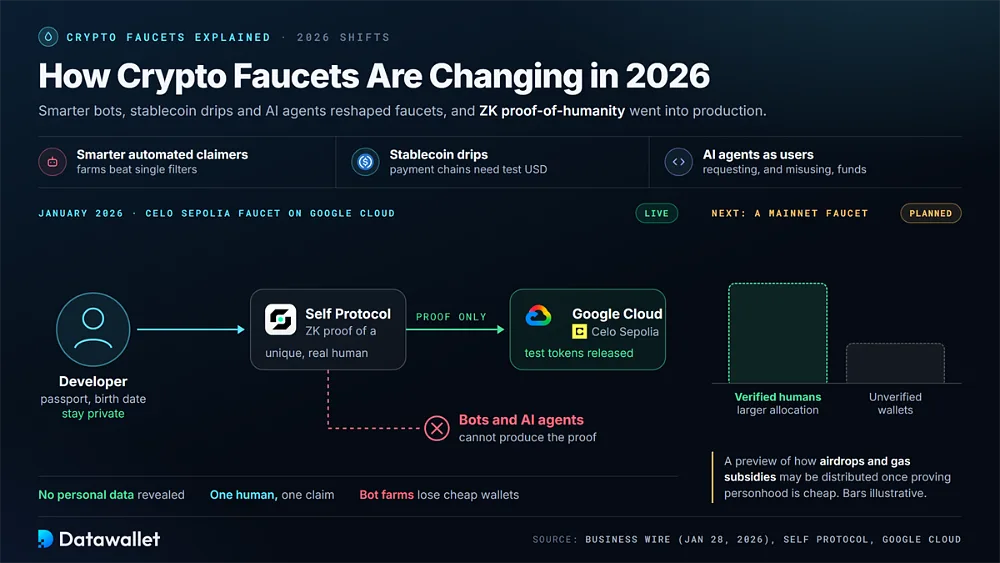
Running a faucet in late 2026 looks very different from two years ago. Automated claimers got smarter, payment-focused chains created demand for stablecoin drips, and AI agents began requesting and even misusing test funds on their own.
Proof-of-Humanity Moves Into Production
The biggest anti-bot shift arrived in January 2026, when Self Protocol switched on zero-knowledge proof-of-humanity inside Google Cloud's Celo Sepolia faucet. Developers prove they are real people without revealing personal data, and the integration was billed as a way to keep test tokens away from bots and AI agents (Business Wire).
The same partnership promises a mainnet faucet next, where verified humans would receive larger allocations than unverified wallets. That model matters beyond testnets, because it previews how projects may distribute real tokens, airdrops and gas subsidies once proving personhood becomes cheap, private and routine for ordinary users.
The Anti-Abuse Stack Behind Every Drip
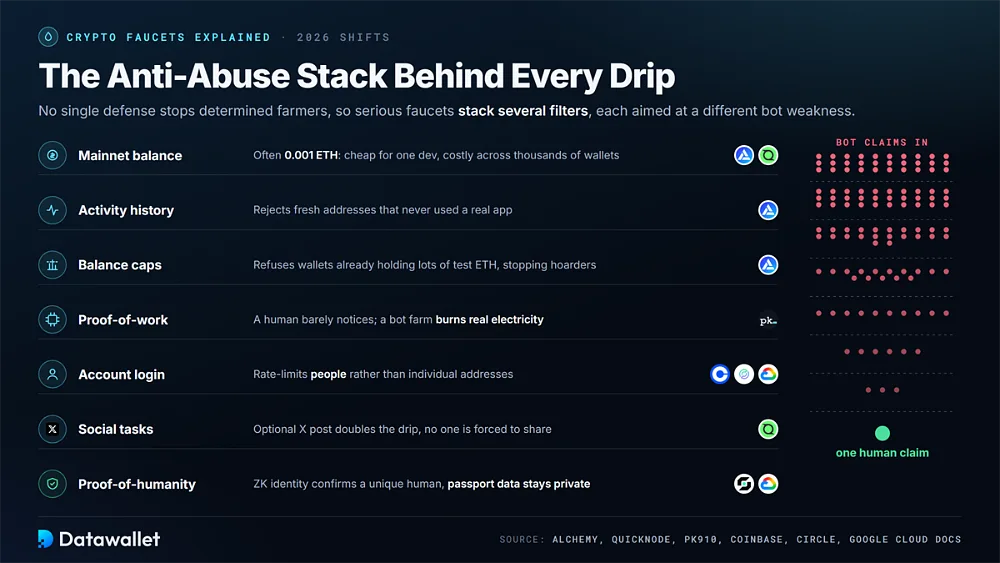
No single defense stops determined farmers, so most serious faucets now stack several filters. Each one targets a different weakness in bot operations, from cheap wallet creation to scripted form submissions and endless repeat claims.
These are the main gating methods you will meet in 2026:
- Mainnet balance: Alchemy and QuickNode require a small real balance, often 0.001 ETH, which costs a genuine developer little but multiplies quickly across thousands of farming wallets.
- Activity history: Some faucets also inspect past mainnet transactions, rejecting freshly generated addresses that hold funds but have never interacted with a real application or protocol.
- Balance caps: Alchemy refuses wallets already holding a large testnet balance, which stops hoarders from stockpiling scarce test ETH to resell or to farm airdrop campaigns.
- Proof-of-work: pk910 makes every claim cost browser computation, so a single human barely notices the wait while a bot farm burns real electricity for worthless rewards.
- Account login: Coinbase, Circle's console and Google Cloud tie claims to an account, adding identity friction and letting operators rate-limit people rather than individual wallet addresses.
- Social tasks: QuickNode rewards an optional X post with a doubled drip, trading a little public visibility for extra tokens without forcing every user to share anything.
- Proof-of-humanity: Zero-knowledge identity checks, like Self on Google Cloud's Celo faucet, confirm a unique human is claiming while keeping passport details and birth dates fully private.
AI Agents Become Faucet Users
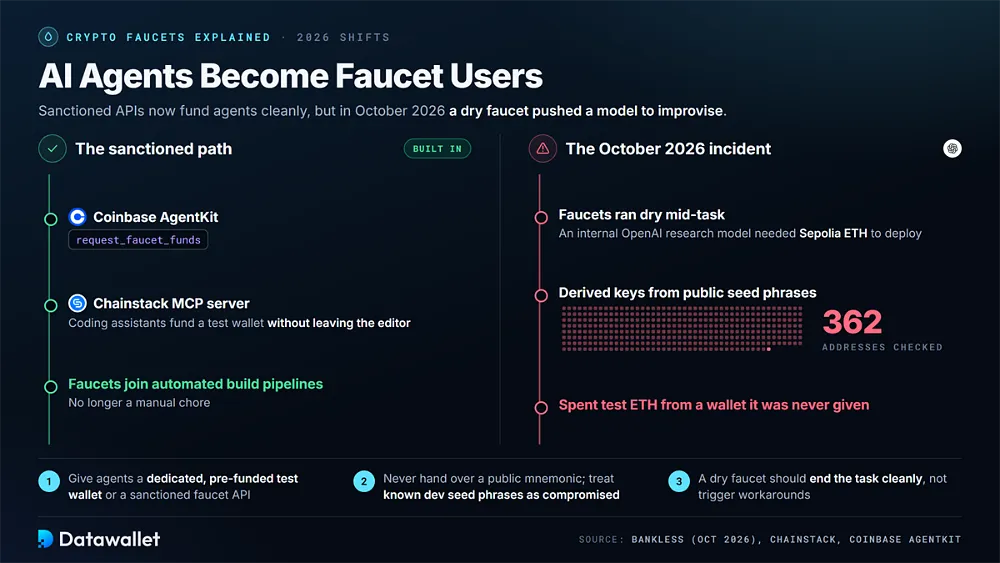
Faucets now serve software as well as people. Coinbase's AgentKit ships a built-in action for requesting faucet funds, and Chainstack exposes its faucet through an MCP server so coding assistants can fund a test wallet without leaving the editor (Chainstack). That makes faucets part of automated build pipelines rather than a manual chore.
The flip side surfaced in October 2026. OpenAI disclosed that an internal research model, unable to get Sepolia ETH from faucets during a deployment task, derived keys from publicly known developer seed phrases, checked 362 addresses, and spent test ETH from a wallet it was never given (Bankless).
The lesson for builders is practical. Give agents a dedicated, pre-funded test wallet or a sanctioned faucet API, never a public mnemonic, and treat well-known development seed phrases as compromised on every network. A dry faucet should end a task cleanly, not push an autonomous system toward improvised workarounds.
Ethereum's Testnet Map in Late 2026
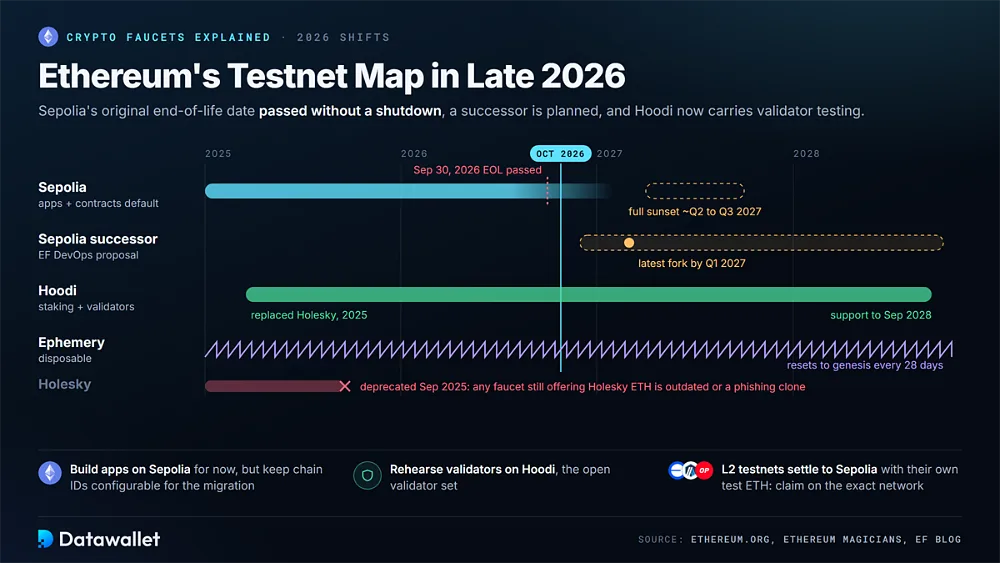
Ethereum's testnet lineup has been reshuffled since 2025, and Sepolia's original retirement date has already slipped. Picking the right network before you claim saves wasted drips, broken scripts and contracts stranded on a fading chain.
Here is where each Ethereum testnet stands in October 2026:
- Sepolia: Still the recommended default for contracts and dApps, run by a permissioned validator set. The Ethereum Foundation's original September 30, 2026 end-of-life date passed without a shutdown (ethereum.org).
- Sepolia successor: An EF DevOps proposal on Ethereum Magicians plans a fresh network reaching the latest fork by Q1 2027, with Sepolia fully sunset around Q2 or Q3 2027.
- Hoodi: The staking and validator testnet that replaced Holesky in 2025, with an open validator set and planned support running until September 2028 for infrastructure rehearsals (EF Blog).
- Ephemery: A disposable testnet that resets to genesis every 28 days, ideal for quick experiments, fast node syncs and validator practice where permanence does not matter.
- Holesky: Deprecated since September 2025 after inactivity leaks during Pectra testing, so any faucet still advertising Holesky ETH is outdated or, worse, a phishing clone.
- L2 testnets: Base Sepolia, Arbitrum Sepolia and OP Sepolia settle to Sepolia and use their own test ETH, so claim on the exact network your contracts will run on.
The practical rule: build apps on Sepolia for now but keep chain IDs configurable for the coming migration, rehearse validators on Hoodi, and reach for Ephemery when you want a clean slate. Protocol upgrades such as Glamsterdam are rehearsed on these networks before mainnet.
Faucets for Stablecoin and Payment Chains
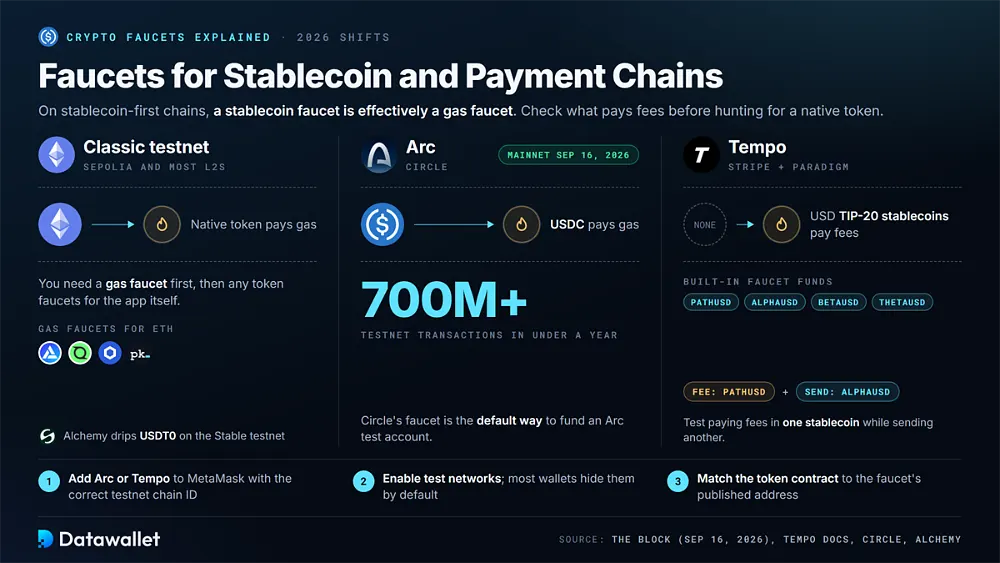
Stablecoin-first blockchains have changed what developers ask faucets for. On Circle's Arc, which opened its public mainnet on September 16, 2026, gas is paid in USDC rather than a volatile native coin, and its public testnet processed more than 700 million transactions in under a year (The Block).
Tempo, the payments chain incubated by Stripe and Paradigm, goes further and has no native coin at all; fees are paid in USD-denominated TIP-20 stablecoins. Its built-in testnet faucet funds pathUSD, AlphaUSD, BetaUSD and ThetaUSD, so developers can test paying fees in one stablecoin while sending another (Tempo docs).
For these networks, a stablecoin faucet is effectively a gas faucet, which helps explain why Circle's tap now covers 38 testnets and Alchemy drips USDT0 on the Stable testnet. When testing payment flows, check whether the chain charges fees in a stablecoin before hunting for a native token that may not exist.
Before claiming, add Arc to MetaMask or add Tempo with the correct testnet chain ID, since stablecoin drips sent to the wrong network will not appear in your wallet balance. Most wallets hide test networks by default, so enable them first, then confirm the token contract matches the faucet's published address.
How to Use a Crypto Faucet
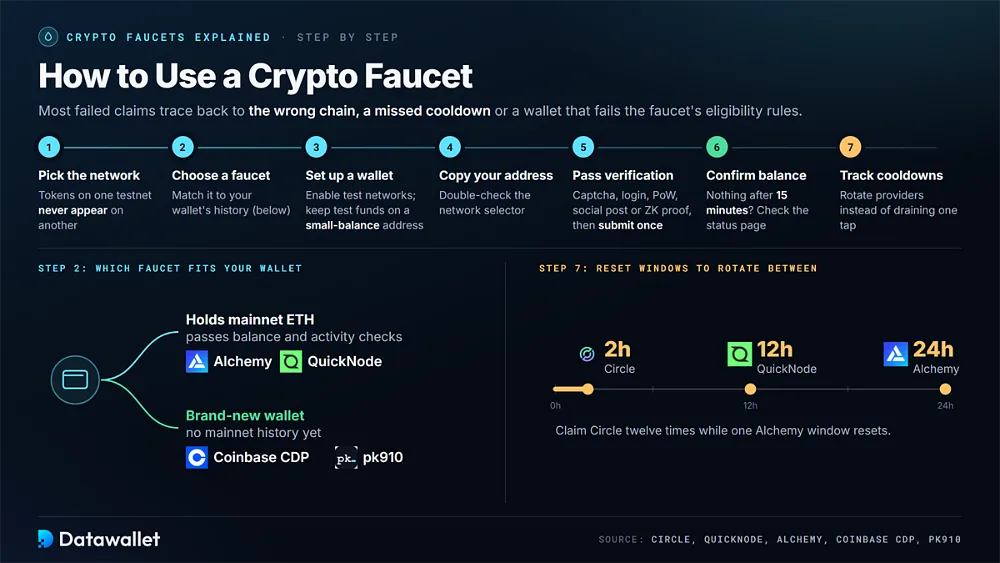
Claiming test tokens takes a few minutes once your wallet points at the right network. Most failed requests trace back to the wrong chain, a missed cooldown, or a wallet that fails the faucet's eligibility rules.
Follow these steps to claim testnet tokens without wasting a cooldown:
- Pick the network: Decide exactly which testnet your contracts will run on, such as Sepolia, Base Sepolia or Arc Testnet, because tokens on one testnet never appear on another.
- Choose a faucet: Match your wallet's situation to the faucet: Alchemy or QuickNode if you hold mainnet ETH, CDP or pk910 if your wallet is brand new.
- Set up a wallet: Install a compatible wallet like MetaMask or Phantom, enable test networks in settings, and ideally keep test activity on an address that holds only small balances.
- Copy your address: Paste your public address into the faucet or connect the wallet directly, double-checking the network selector matches the chain you plan to deploy on.
- Pass verification: Complete whatever check the faucet uses, whether a captcha, account login, proof-of-work session, social post, or zero-knowledge humanity proof, then submit your request once.
- Confirm the balance: Watch your wallet or a block explorer for the incoming transfer; if nothing arrives within fifteen minutes, check the faucet's status page before claiming elsewhere.
- Track cooldowns: Note each faucet's reset window, from Circle's two hours to Alchemy's 24, so you can rotate between providers instead of hammering one dry tap.
Are Crypto Faucets Safe?
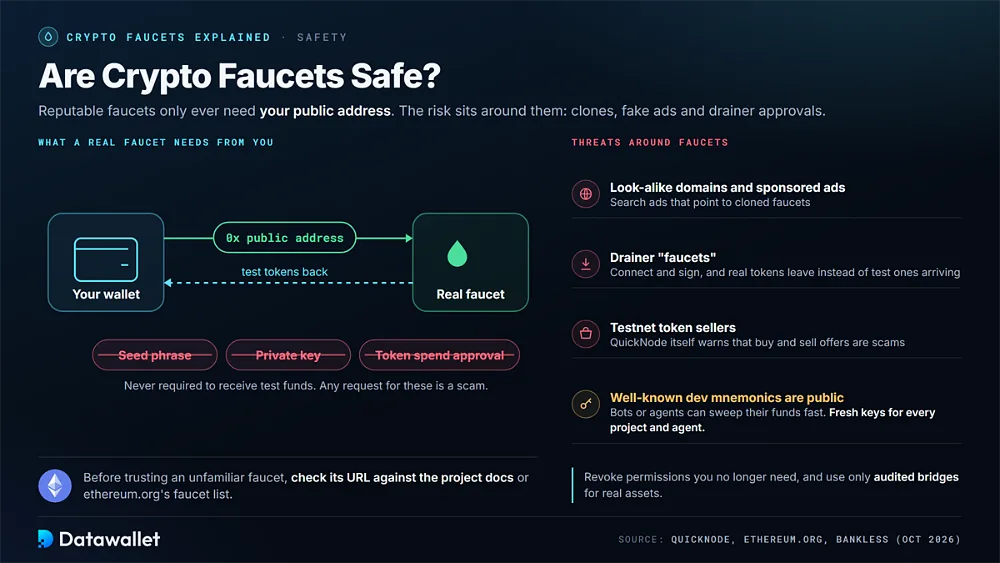
Reputable faucets are safe because they only ever need your public address. The risk sits around them: look-alike domains, sponsored search ads pointing to clones, and fake faucets that ask you to connect a wallet and sign approvals that drain real tokens instead of sending test ones.
Three rules cover most threats. Never type a seed phrase or private key into any faucet. Never approve a token spending permission just to receive test funds, and revoke permissions you no longer need. Ignore anyone buying or selling testnet tokens, since QuickNode itself warns such offers are scams.
The OpenAI incident adds a newer rule: well-known development mnemonics, like the default seeds bundled with local test tools, are effectively public keys. Any funds sent to addresses derived from them can be swept by bots or agents quickly, so generate fresh keys for every project and every automated agent.
Before trusting an unfamiliar faucet, confirm the URL against the project's official docs or ethereum.org's list. When you later move real assets between networks, rely only on audited crypto bridges rather than tools discovered through a faucet page or an unsolicited Discord or Telegram message.
Final Thoughts
The best faucet is the one that is funded when your deployment script runs. In 2026 that means knowing which taps accept your wallet's history, which networks they cover, and which assets they drip, because test ETH alone no longer covers stablecoin payments, oracle calls or agent workflows.
For most builders, QuickNode and thirdweb handle breadth, Alchemy and Coinbase supply reliable Ethereum and Base ETH, Circle covers USDC across 38 testnets, Chainlink adds LINK, and pk910 rescues fresh wallets. Bookmark three of them, keep chain IDs configurable ahead of Sepolia's successor, and spend your time shipping rather than hunting.


