




Hyperliquid is no longer simply an exchange. Builder-deployed HIP-3 markets now account for close to half its volume, while tokenised stocks and commodities have overtaken bitcoin as its largest market.
Aster has responded with its own Layer 1 and a 97% reduction in token emissions. Its tokenomics overhaul also commits 99% of daily fees to ASTER buybacks, accompanied by matching burns.
Here is how the two compare head to head in every category that matters. 👇
Hyperliquid vs Aster Overview
Hyperliquid is a fully onchain perpetual and spot exchange built on its own Layer 1 with sub-second finality. As of August 2026, it clears about $178 billion in 30-day perpetual volume across crypto, equity and commodity markets. Open interest is roughly $9.1 billion, and cumulative volume has reached $4.8 trillion.
Aster emerged from the Astherus and APX Finance merger as a multi-chain perp exchange backed by YZi Labs. It reports more than 16 million users and roughly $40 billion in 30-day perpetual volume. Its privacy-focused Layer 1, Aster Chain, launched in March.
The table below compares both platforms on the numbers that determine where orders fill and what they cost:
Hyperliquid vs Aster Perpetuals
Both platforms use central limit order books. The more consequential differences lie in settlement architecture, margin rules and risk controls rather than headline leverage limits.
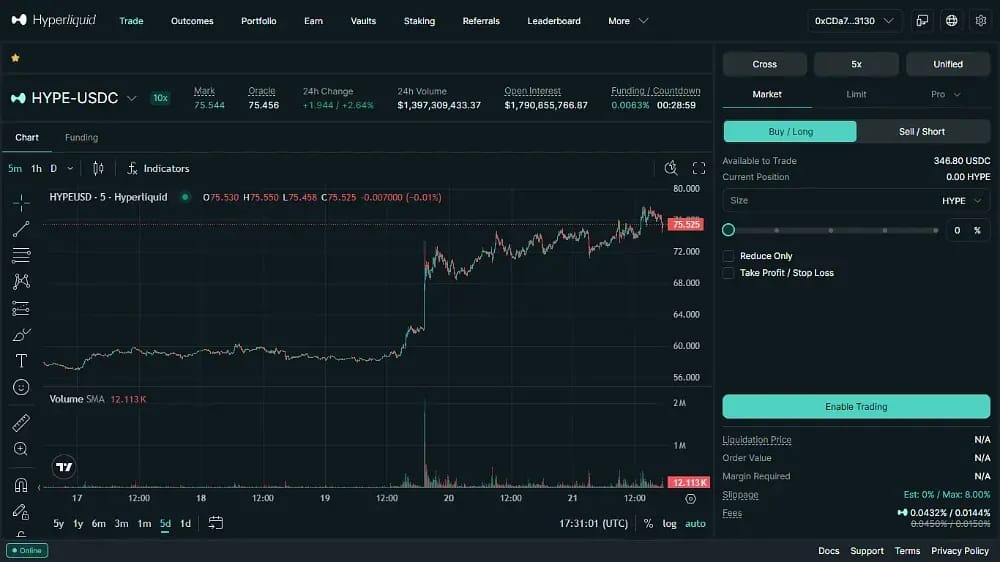
Hyperliquid Perpetuals
Hyperliquid keeps its entire order book within validator consensus. Every fill, cancellation and liquidation is therefore publicly verifiable instead of being reconstructed later from an operator's records.
The mechanics below define Hyperliquid's perpetual engine:
- HyperCore Engine: Every order, cancellation and liquidation settles on Hyperliquid's Layer 1 with one-block finality. The result is centralised-exchange responsiveness while the complete book remains publicly verifiable.
- Margin Tiers: Native markets allow leverage of up to 40x. Maintenance requirements rise with position size, leaving the largest accounts effectively trading closer to three to ten times leverage.
- HLP Backstop: Hyperliquid's community-owned HLP vault supplies liquidity and absorbs liquidations. It also warehouses the opposite side of trader PnL, distributing spreads, funding income and fees to depositors.
- Mark Pricing: Mark prices combine external exchange feeds with the platform's own order-book state. This reduces exposure to the oracle manipulation attacks that broke earlier onchain derivatives venues.
- Auto-Deleveraging: If liquidations exhaust the insurance fund, the ADL system trims the most profitable and most leveraged opposing positions at bankruptcy price, preventing the book from carrying bad debt.
- Hourly Funding: Funding settles hourly using a premium measured against the oracle price. That keeps perpetual prices tied to spot more closely than the eight-hour cycles used by centralised exchanges.
- Builder Codes: Independent front ends including MetaMask Perps and Phantom route volume into the same book and share fees, extending distribution without splitting liquidity.
- Performance: HyperCore matches around 200,000 orders per second with sub-second finality. That performance is why professional desks treat it as the default onchain venue for size.
Aster Perpetuals
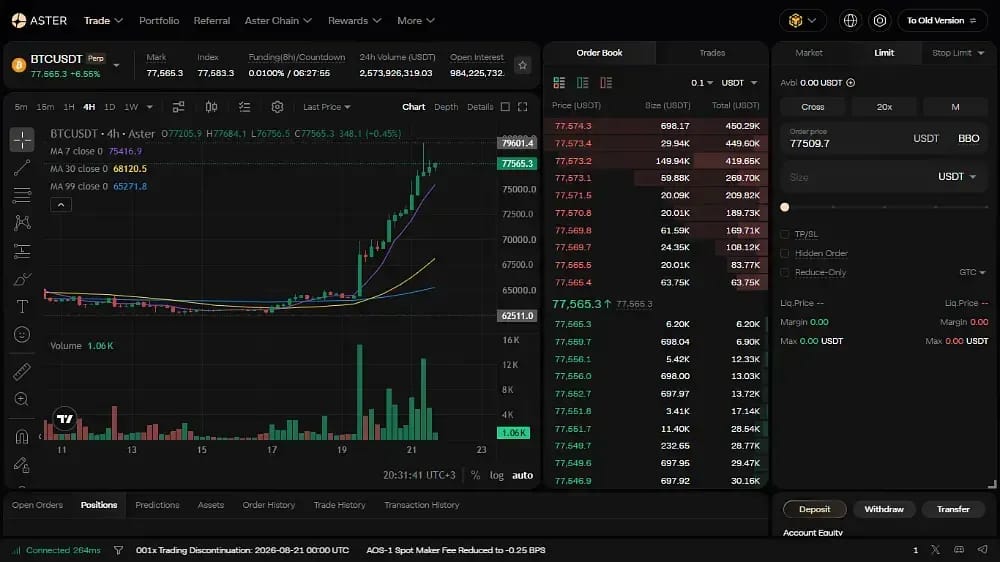
Aster divides perpetual trading between two products with different risk systems. Privacy features and unusually broad collateral support sit on top of those separate trading modes.
Aster's perpetual futures offering is built around the following features:
- Dual Modes: Pro Mode uses a full central limit order book for advanced traders. Simple Mode instead provides one-click, pool-based execution for fast, high-leverage retail speculation.
- Max Leverage: Simple Mode advertises leverage of up to 1001x, the highest figure in the sector. Pro Mode applies much tighter caps across its order-book markets.
- Multi-Chain: Accounts can be funded from BNB Chain, Ethereum, Solana and Arbitrum without manual bridging, allowing traders to deposit from the network where their collateral already sits.
- Aster Chain: Perpetual settlement is moving to Aster's own Layer 1. Launched in March, the chain uses zero-knowledge components designed for private, low-latency order matching at scale.
- Shield Mode: Zero-knowledge proofs hide order size and direction from the public book. The design aims to protect large traders from front-running, copy trading and liquidation hunting by onchain observers.
- Stock Perps: Tokenised United States equities and index contracts trade around the clock with leverage of up to 50x. Settlement occurs in stablecoins without any share changing hands.
- Collateral: Pro Mode accepts yield-bearing margin including asBNB and USDF. Capital can therefore continue earning staking or stablecoin yield while supporting open perpetual positions.
- Open Listings: Under the AOS-2 standard, projects can launch their own perpetual markets by staking 1 million ASTER for four years before an onchain validator vote.
Hyperliquid vs Aster Products
Crypto perpetuals are no longer the limit of either platform. Hyperliquid makes its matching engine available to outside builders, whereas Aster surrounds its exchange with consumer features, yield products and a new chain.
Hyperliquid Products
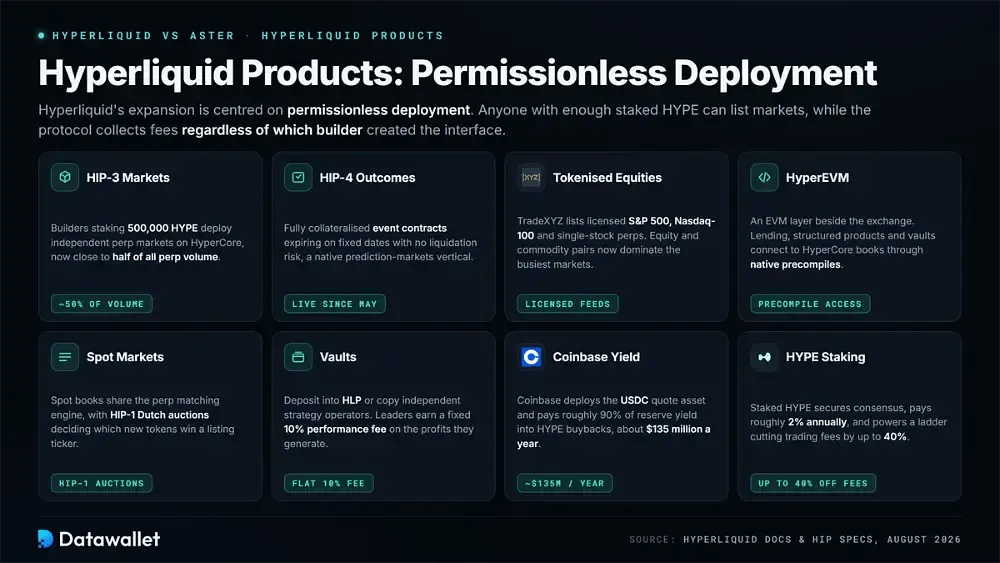
Hyperliquid's expansion is centred on permissionless deployment. Anyone with sufficient staked HYPE can list markets, while the protocol collects fees regardless of which builder created the interface.
These products define the current Hyperliquid ecosystem:
- HIP-3 Markets: A builder that stakes 500,000 HYPE can deploy an independent perpetual market on HyperCore. These HIP-3 deployments now account for almost half of Hyperliquid's perpetual trading volume.
- HIP-4 Outcomes: Added in May, the HIP-4 upgrade introduced fully collateralised event contracts. They expire on fixed dates, carry no liquidation risk and give Hyperliquid a native prediction-markets vertical.
- Tokenised Equities: TradeXYZ lists licensed S&P 500, Nasdaq-100 and single-stock perpetual contracts through HIP-3. Equity and commodity pairs now dominate the platform's busiest markets.
- HyperEVM: An EVM layer operates alongside the exchange. Lending markets, structured products and vault protocols can connect directly to HyperCore order books through native precompiles.
- Spot Markets: Spot order books use the same matching engine as perpetuals, with HIP-1 Dutch auctions determining which new tokens receive a listing ticker.
- Vaults: Users can deposit into HLP or copy independent strategy operators through user vaults. Strategy leaders receive a fixed 10% performance fee on profits they generate.
- Coinbase Yield: Coinbase now deploys the USDC quote asset on Hyperliquid and pays roughly 90% of reserve yield into HYPE buybacks, an estimated $135 million per year.
- HYPE Staking: Staked HYPE secures consensus and pays holders roughly 2% annually. It also powers a discount ladder that can cut trading fees by as much as 40%.
Aster Products
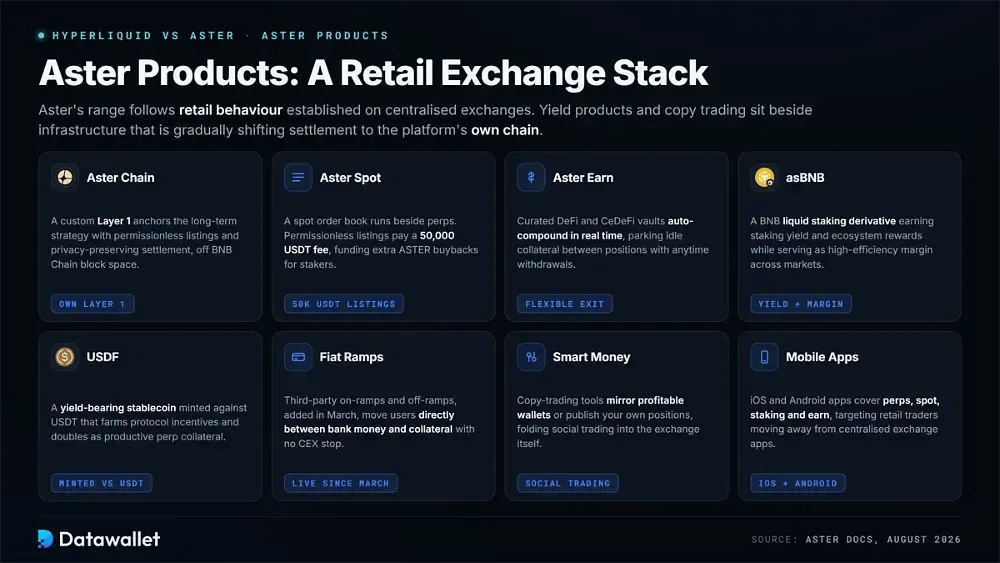
Aster's product range follows retail behaviour established on centralised exchanges. Yield products and copy trading sit beside infrastructure that is gradually shifting settlement to the platform's own chain.
The Aster stack currently includes:
- Aster Chain: Aster's custom Layer 1 anchors its long-term strategy, supporting permissionless asset listings and privacy-preserving settlement rather than depending permanently on BNB Chain block space.
- Aster Spot: A spot order book operates alongside perpetuals. Permissionless listings pay a 50,000 USDT fee, which funds additional ASTER buybacks for stakers.
- Aster Earn: Curated DeFi and CeDeFi vaults auto-compound yield in real time. Traders can park unused collateral between positions while retaining flexible, anytime withdrawals.
- asBNB: Aster's BNB liquid staking derivative earns staking yield and ecosystem rewards while remaining available as high-efficiency margin across perpetual and spot markets.
- USDF: This yield-bearing stablecoin, minted against USDT, keeps holders exposed to the dollar while farming protocol incentives. It can also serve as productive collateral in Aster's perpetual markets.
- Fiat Ramps: Third-party fiat on-ramps and off-ramps introduced in March allow users to move directly between bank money and trading collateral without first using a centralised exchange.
- Smart Money: Copy-trading tools allow users to mirror profitable wallets or publish their own positions publicly, integrating social trading into the exchange interface.
- Mobile Apps: Aster's iOS and Android applications support perps, spot, staking and earn products, targeting retail traders moving away from centralised exchange apps.
Hyperliquid vs Aster Order Types and API Access
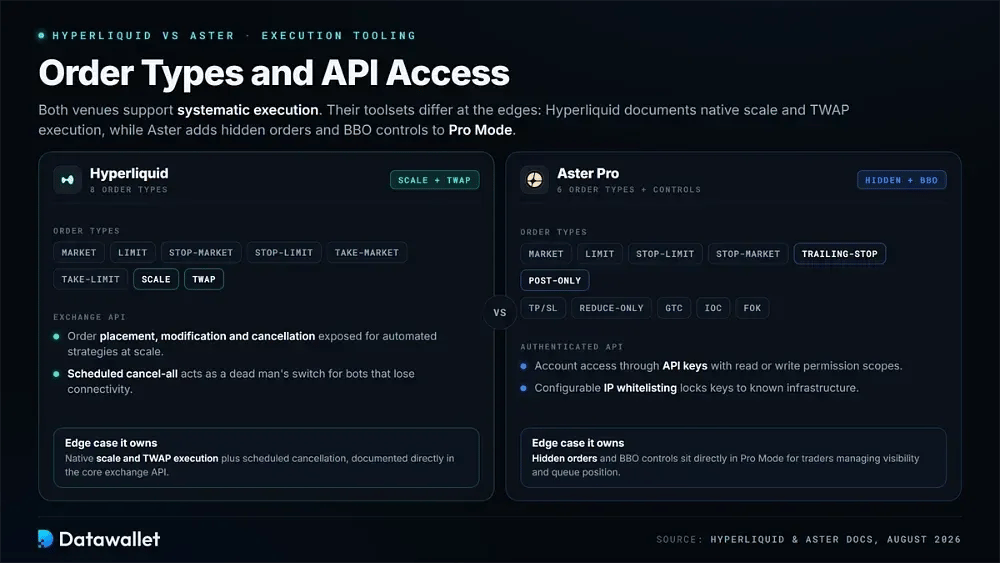
Execution tooling becomes important once trading moves beyond manual order entry. Hyperliquid supports market, limit, stop-market, stop-limit, take-market, take-limit, scale and TWAP orders, while its exchange API also exposes order placement, modification, cancellation and scheduled cancel-all functions for automated strategies at scale.
Aster Pro offers market, limit, stop-limit, stop-market, trailing-stop and post-only orders, alongside TP/SL, reduce-only controls, GTC, IOC and FOK time-in-force settings. Its authenticated API supports account access through API keys, with configurable IP whitelisting and read or write permissions.
Both venues therefore support systematic execution, although their toolsets differ at the edges. Hyperliquid documents native scale and TWAP execution plus a scheduled cancellation function, while Aster adds hidden orders and BBO controls directly to Pro Mode for traders managing visibility and queue position.
Hyperliquid vs Aster Fees
Aster starts with lower base rates. Both platforms then apply volume tiers, token-based discounts and rebates, so the amount a trader ultimately pays depends heavily on activity and trading style.
Hyperliquid Fees
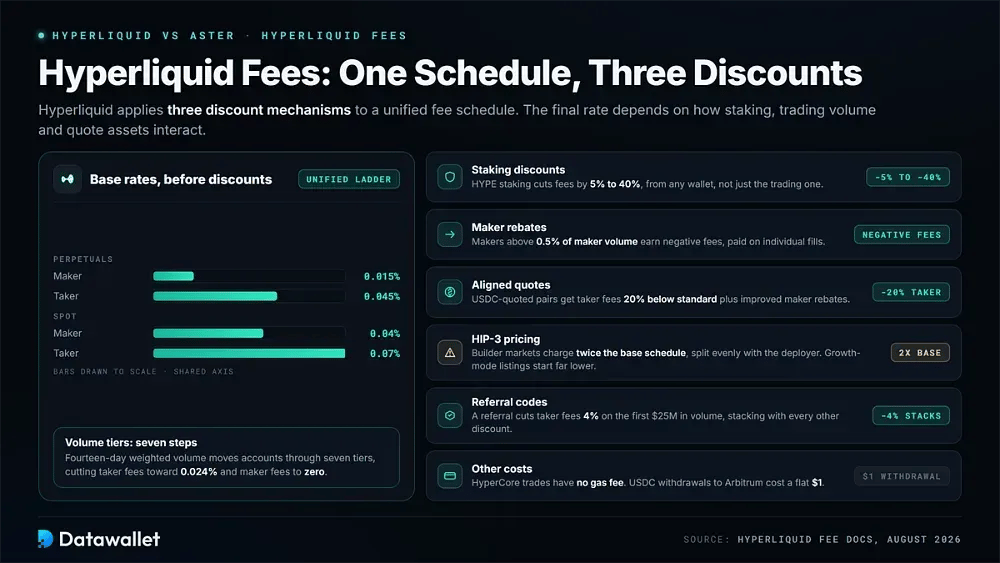
Hyperliquid applies three discount mechanisms to a unified fee schedule. The final rate depends on how staking, trading volume and quote assets interact.
Hyperliquid prices trading activity as follows:
- Base Rates: Perpetual fees begin at 0.015% maker and 0.045% taker. Spot fees start at 0.04% maker and 0.07% taker, with both markets using the same unified fee-tier ladder.
- Volume Tiers: Accounts move through seven tiers based on fourteen-day weighted volume. The most active traders can reduce taker fees toward 0.024% and maker fees to zero.
- Staking Discounts: HYPE staking reduces trading fees by 5% to 40%, depending on the amount staked. The tokens do not need to be held in the same wallet that places the trades.
- Maker Rebates: Market makers responsible for more than 0.5% of maker volume receive negative trading fees. Rebates are paid continuously on individual fills rather than through a monthly settlement.
- Aligned Quotes: Pairs quoted in USDC, the aligned quote asset, have taker fees 20% below standard rates and improved maker rebates on Hyperliquid's native spot books.
- HIP-3 Pricing: HIP-3 markets charge twice the base schedule, with revenue split equally between the deployer and protocol. Growth-mode listings, however, begin with substantially lower pricing.
- Referral Codes: Using a referral code reduces taker fees by 4% on the first $25 million in volume, and the reduction stacks with every other discount.
- Other Costs: HyperCore trades have no gas fee. Sending USDC back to Arbitrum costs a flat one dollar regardless of withdrawal size.
Aster Fees
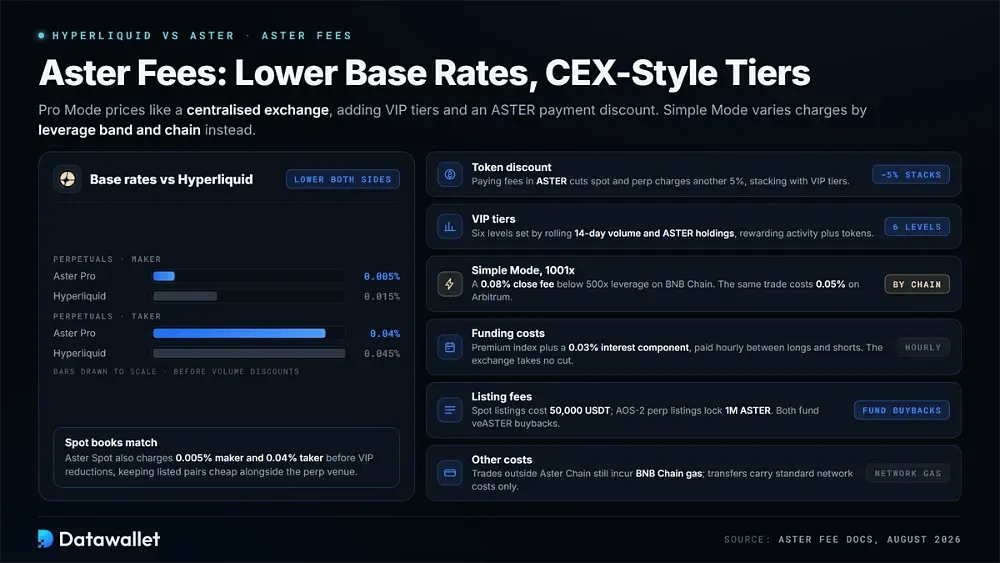
Pro Mode uses pricing similar to a centralised exchange, adding VIP tiers and a discount for paying fees with ASTER. Simple Mode takes a different approach, with charges varying by leverage band and chain.
Aster's fee structure includes:
- Base Rates: Pro Mode perpetuals currently charge 0.005% maker and 0.04% taker, below Hyperliquid's base perpetual rates on both sides before volume discounts.
- Spot Fees: Aster Spot charges 0.005% maker and 0.04% taker before VIP reductions, keeping costs low for token pairs listed alongside the perpetual venue.
- Token Discount: Paying fees in ASTER reduces both spot and perpetual charges by another 5%. This discount stacks with reductions earned through VIP tiers.
- VIP Tiers: Six VIP levels are determined by rolling 14-day trading volume and ASTER holdings, giving lower rates to traders who maintain both activity and tokens onchain.
- Simple Mode: The 1001x product charges a 0.08% close fee below 500x leverage on BNB Chain. Equivalent trades on Arbitrum carry a lower 0.05% rate.
- Funding Costs: Funding uses a premium index plus a 0.03% interest component. Payments move between longs and shorts every hour, with the exchange taking no cut.
- Listing Fees: Permissionless spot listings cost 50,000 USDT, while AOS-2 perpetual listings require 1 million ASTER to be locked. Both mechanisms fund additional buybacks for veASTER stakers.
- Other Costs: Trades outside Aster Chain still incur BNB Chain gas where applicable. Deposits and withdrawals carry standard network costs rather than platform-level charges.
Hyperliquid vs Aster Tokens
HYPE and ASTER both turn exchange fees into open-market buybacks, but the tokens occupy very different stages of maturity. HYPE has a multi-year buyback history and spot ETFs. ASTER, meanwhile, is reducing supply through the sector's most aggressive burn schedule.
HYPE Tokenomics
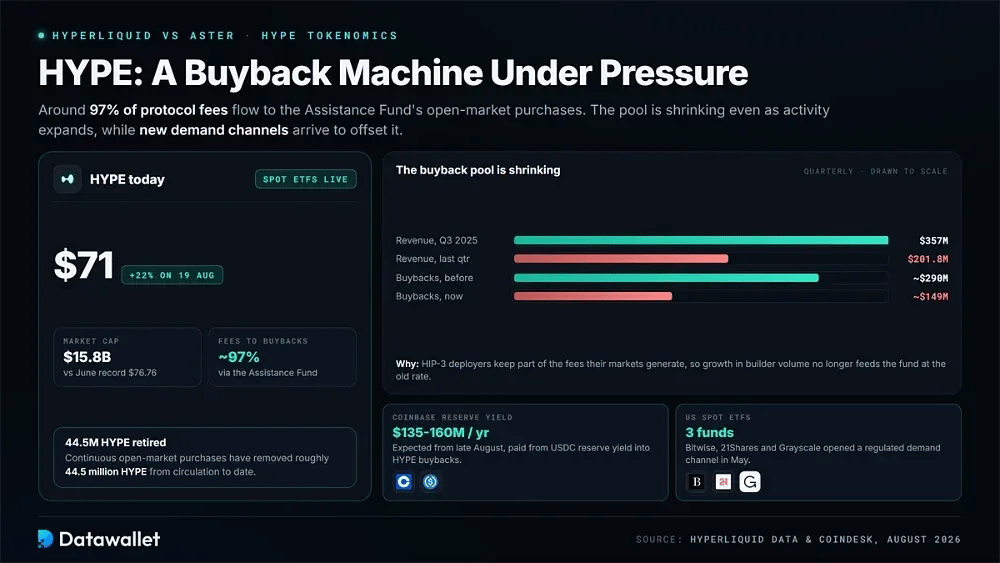
HYPE trades near $71 after rising 22% in a single day on 19 August. That values the token at roughly $15.8 billion, compared with its June record of $76.76. Around 97% of protocol fees flow to the Assistance Fund, which has retired approximately 44.5 million HYPE through continuous open-market purchases.
The buyback pool is shrinking even as activity expands. Gross revenue fell from $357 million in the third quarter of 2025 to $201.8 million last quarter. HIP-3 deployers retain part of the fees generated by their markets, reducing quarterly repurchases from about $290 million to $149 million.
New sources of buyback demand are arriving. Coinbase's reserve-yield agreement is expected to contribute an estimated $135 million to $160 million annually from late August. Three United States spot HYPE ETFs from Bitwise, 21Shares and Grayscale also opened a regulated demand channel in May.
ASTER Tokenomics
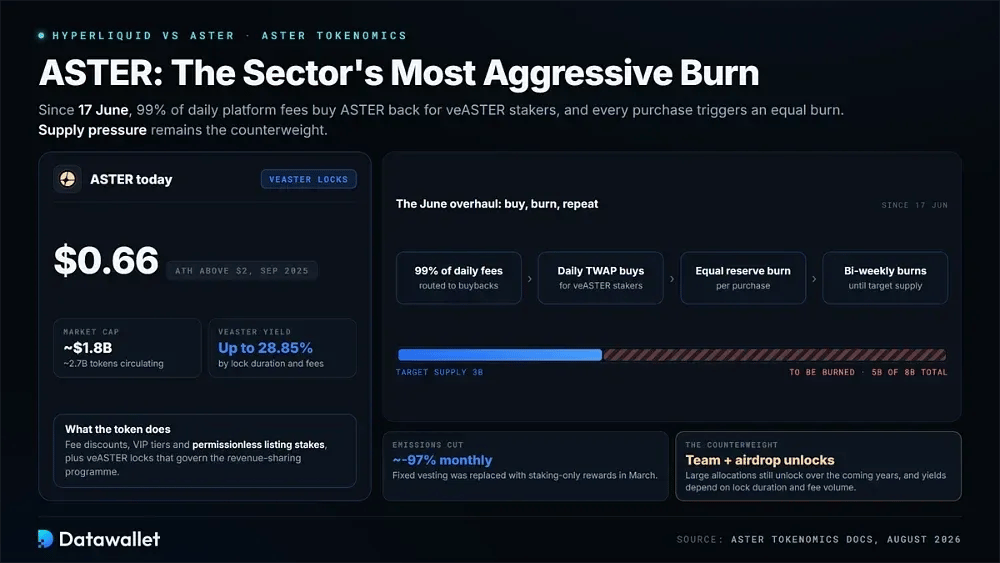
ASTER trades near $0.66, with a market cap of roughly $1.8 billion and about 2.7 billion tokens in circulation. That remains well below its September 2025 record above $2. The token is used for fee discounts, VIP tiers and permissionless listing stakes, as well as veASTER locks governing the platform's revenue-sharing programme.
A June overhaul substantially changed the model. Since 17 June, 99% of daily platform fees buy ASTER back through a daily TWAP for veASTER stakers. Each purchase triggers an equal burn from reserves, while bi-weekly burns continue until total supply drops from 8 billion to 3 billion.
Supply pressure remains the counterweight. Monthly emissions fell roughly 97% in March when fixed vesting was replaced with staking-only rewards. Large team and airdrop allocations still unlock over the coming years, however, and veASTER yields reaching 28.85% depend on lock duration and fee volume.
Hyperliquid vs Aster Liquidity and Market Share
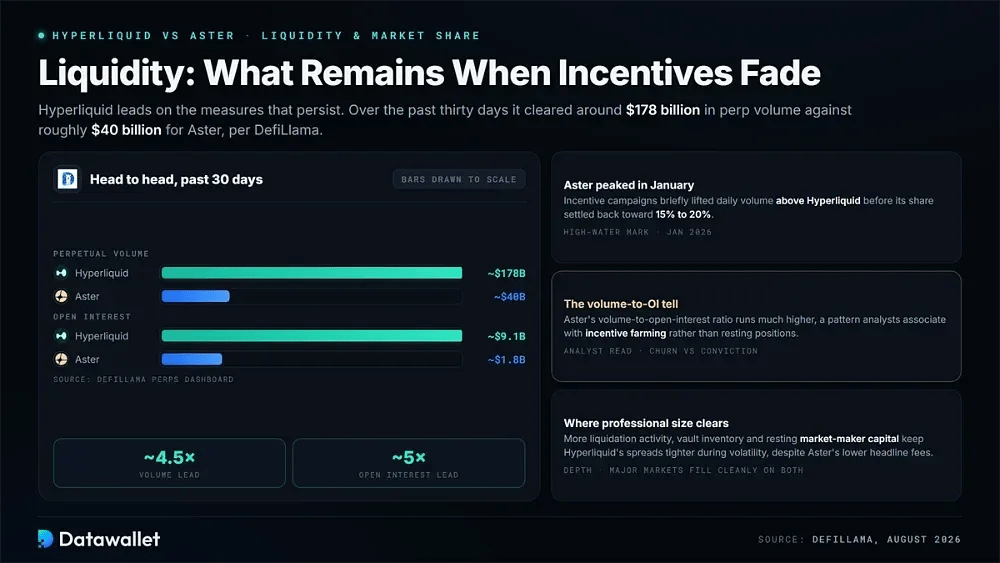
Hyperliquid leads on the measures that remain once incentives fade. Over the past thirty days it cleared around $178 billion in perpetual volume, compared with roughly $40 billion for Aster. Open interest is close to $9.1 billion, about five times Aster's $1.8 billion, according to DefiLlama.
Aster reached its high-water mark in January. Incentive campaigns briefly lifted daily volume above Hyperliquid before its share settled back toward 15% to 20%. Its volume-to-open-interest ratio remains much higher than Hyperliquid's, a pattern analysts associate with incentive farming rather than resting positions.
Capital concentration also shapes depth. Major markets fill cleanly on both exchanges, but Hyperliquid has more liquidation activity, vault inventory and resting market-maker capital. That keeps spreads tighter during volatility, which is why professional size continues to clear there despite Aster's lower headline fees.
Hyperliquid vs Aster Security
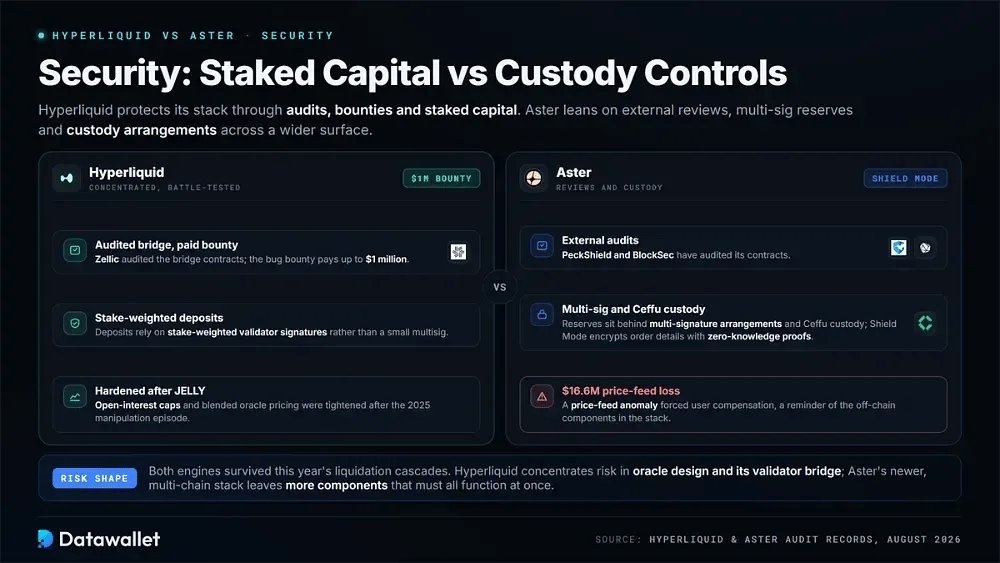
Hyperliquid protects its stack through audits, bounties and staked capital. Zellic audited its bridge contracts, while its bug bounty pays up to $1 million. Deposits rely on stake-weighted validator signatures, and open-interest caps plus blended oracle pricing were tightened after the JELLY manipulation episode in 2025.
Aster relies more heavily on external reviews and custody controls. PeckShield and BlockSec have audited its contracts. Reserves are protected through multi-signature arrangements and Ceffu custody, while Shield Mode encrypts order details using zero-knowledge proofs. The platform absorbed a $16.6 million loss following a price-feed anomaly that required user compensation.
Both engines have survived this year's liquidation cascades, though their guarantees are different. Hyperliquid concentrates risk around oracle design and its validator bridge. Aster has a newer stack, a wider multi-chain surface and some off-chain infrastructure, leaving more individual components that need to function simultaneously.
Hyperliquid vs Aster Regulations
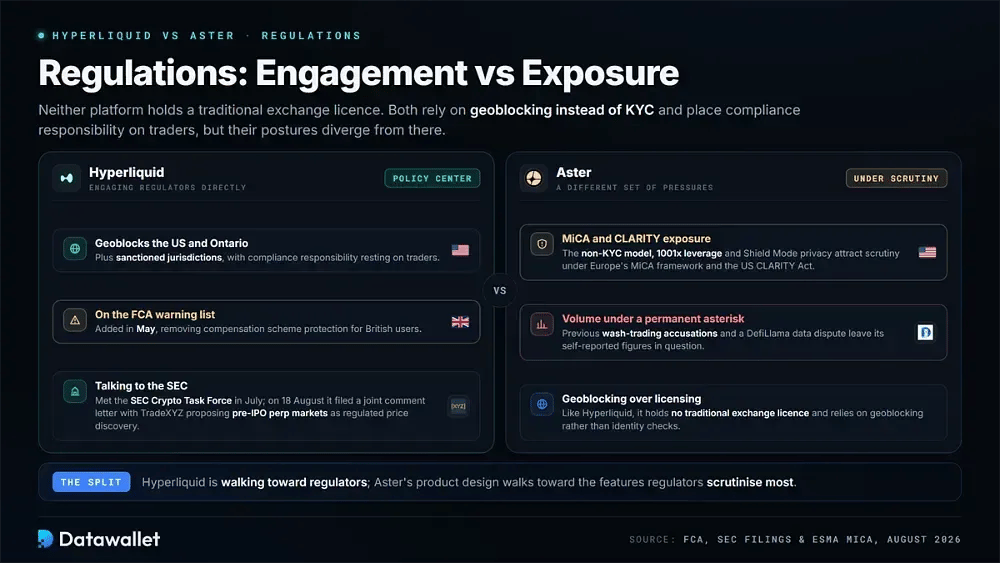
Neither platform holds a traditional exchange licence. Instead of KYC, both rely on geoblocking and place compliance responsibility on traders. Hyperliquid blocks the United States, Ontario and sanctioned jurisdictions. The UK's FCA added it to its warning list in May, removing compensation scheme protection for British users.
Hyperliquid has chosen to engage regulators directly. Its Policy Center met the SEC Crypto Task Force in July. On 18 August, the protocol and TradeXYZ submitted a joint SEC comment letter proposing pre-IPO perpetual markets as a regulated price-discovery mechanism before public listings.
Aster faces a different set of pressures. Its non-KYC model, 1001x leverage and Shield Mode privacy features attract scrutiny under Europe's MiCA framework and the US CLARITY Act. Previous wash-trading accusations and a DefiLlama data dispute also leave its self-reported volume figures under a permanent asterisk.
Is Aster Better than Hyperliquid?
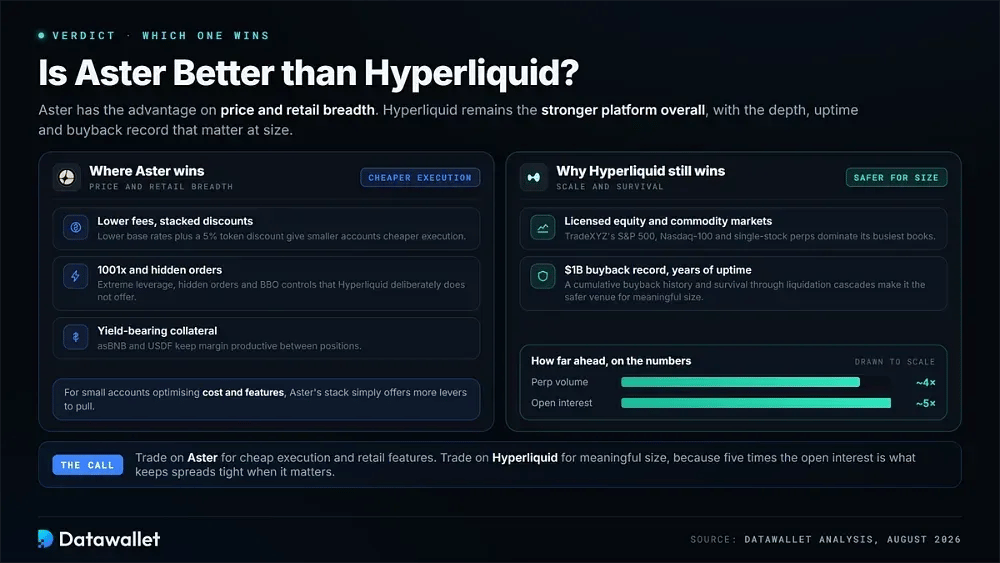
Aster has the advantage on price and retail-oriented product breadth. Its lower base fees, 5% token discount and 1001x leverage sit alongside hidden orders and yield-bearing collateral, giving smaller accounts cheaper execution and access to features Hyperliquid deliberately does not offer.
Hyperliquid remains the stronger platform overall. It has around five times the open interest and roughly four times the volume, along with licensed equity and commodity markets. A $1 billion cumulative buyback record and years of uptime through liquidation cascades also make it the safer venue for anyone trading meaningful size.
Final Thoughts
The two exchanges are moving closer on tokenomics while taking different strategic paths. Hyperliquid is opening its engine to builders and engaging regulators. Aster is reducing token supply while adding retail features, privacy tools and yield products around its new chain.
Fees favour Aster, particularly for high-frequency traders using Pro Mode's lower maker schedule. Hyperliquid holds the advantage in depth, market breadth, liquidation absorption and operational history. Those factors explain why most professional capital still settles on its books despite higher base fees.
Using both platforms is a defensible approach. Hyperliquid is better suited to size, tokenised equities and HIP-3 exposure. Aster fits traders prioritising inexpensive execution, high-leverage stock perps and private orders. Our guide to the best decentralised perpetuals exchanges covers the broader market.