



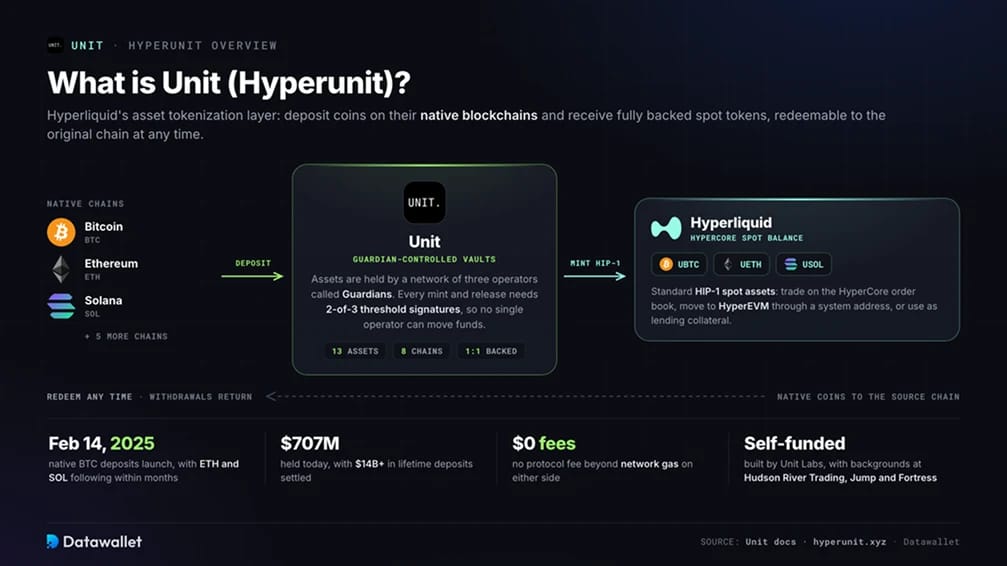
What is Unit (Hyperunit)?
Unit is Hyperliquid's asset tokenization layer. Users deposit coins on their native blockchains and receive fully backed tokens in their Hyperliquid spot balances. These tokens can be redeemed to the original chains at any time.
Deposited assets are held in vaults controlled by a network of operators called Guardians. Unit then issues matching tokens on HyperCore under Hyperliquid's HIP-1 native token standard. Bitcoin becomes UBTC, Ether becomes UETH and Solana becomes USOL, with each token backed one-to-one by reserves on its source chain.
Unit Labs built the protocol as a self-funded research collective. Its core contributors have backgrounds at Hudson River Trading, Jump and Fortress, as well as experience in cybersecurity. Native BTC deposits launched on February 14, 2025. ETH and SOL followed over the next few months, with Unit, Hyperliquid Labs and Infinite Field forming the initial Guardian set.
Although Unit operates independently of Hyperliquid Labs, the two work closely together. Its tokens function as standard HIP-1 spot assets, allowing UBTC to trade on the HyperCore order book and move to HyperEVM through a system address.
How Does Hyperunit Work?
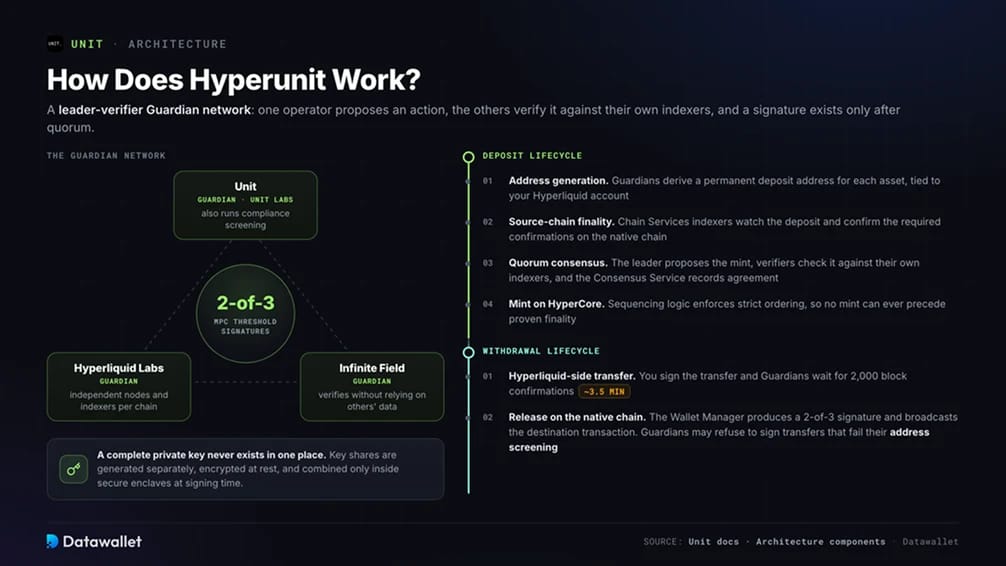
Unit uses a leader-verifier network that prevents any single operator from minting tokens or releasing funds. One Guardian proposes an action, while the others verify it using their own blockchain indexers. A signature is created only after a quorum agrees.
The component design includes:
- Guardian Network: Three independent operators run the Unit Agent software using separate nodes and indexers for every supported chain. Each Guardian can verify transactions without relying on another operator's data.
- Threshold Signing: A 2-of-3 Multi-Party Computation threshold signature scheme prevents a complete private key from existing in one location. Key shares are generated separately and encrypted at rest. They are combined only inside secure enclaves when a transaction is signed.
- Chain Services: Indexers monitor incoming deposits and confirm finality on the source chain. They also construct the payloads needed for withdrawals.
- Sequencing Logic: Each Agent runs a deterministic state machine that enforces strict ordering. Mints cannot occur before finality is proven, while releases require confirmation of the Hyperliquid-side transfer.
- Consensus Service: Guardians must reach a quorum on every critical operation before the Wallet Manager can produce a signature.
- Compliance Screening: Guardians may conduct their own address screening and refuse to sign transactions that fail their checks. The app front end also uses IP geofencing and VPN detection.
Deposits move through address generation and source-chain finality before the Guardians reach consensus and mint the token on HyperCore. Withdrawals begin with a transfer on Hyperliquid. After roughly 3.5 minutes and 2,000 block confirmations, the Guardians sign a release on the destination chain.
Which Assets Does Hyperunit Support?
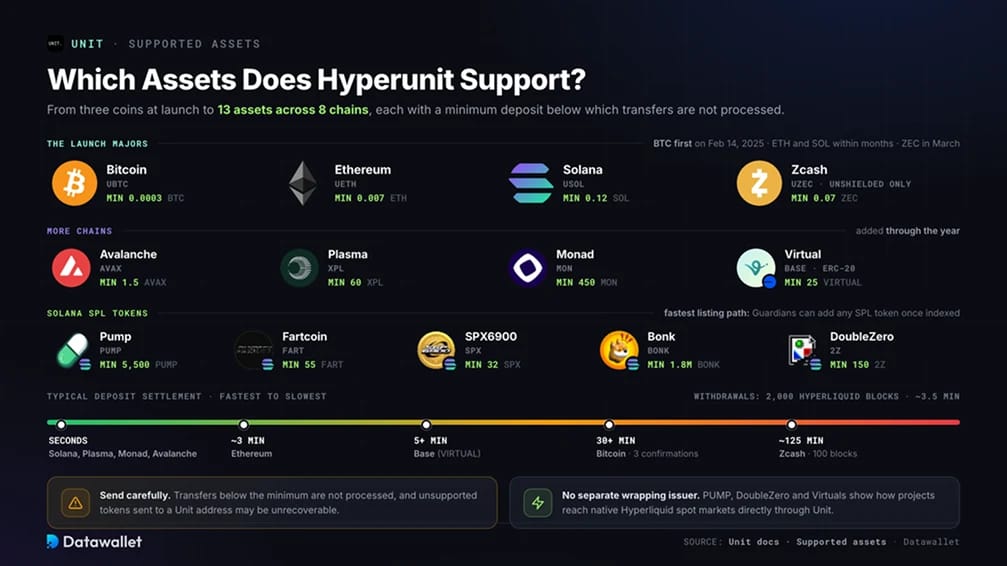
Unit now covers considerably more than BTC, ETH and SOL. Zcash spot deposits launched in March with support limited to unshielded ZEC, according to Unit's announcement. Avalanche, VIRTUAL on Base and the Solana-based ANSEM token arrived later in the year.
Minimum deposits are listed on Unit's supported assets page. Transfers below these thresholds are not processed. Unsupported tokens sent to a Unit address may be unrecoverable.
Asset support changes fastest on Solana because the Guardians can list any SPL token once it has been added to their systems. PUMP from Pump.fun, DoubleZero and Virtuals Protocol illustrate how projects can access native Hyperliquid spot markets without relying on a separate wrapping issuer.
How to Use Hyperunit
The deposit process is similar whether you use the Unit app or Hyperliquid's built-in deposit panel. Check both the network and minimum amount before sending funds, as addressing errors are a common cause of losses.
- Connect a wallet: Visit app.hyperunit.xyz or open the deposit menu on app.hyperliquid.xyz. Connect MetaMask, Rabby, OKX Wallet or another supported wallet. Our best Hyperliquid wallets guide compares the main options.
- Choose the asset: Select the coin and transfer direction. Unit displays the current fee estimate and expected settlement time before confirmation.
- Copy your deposit address: The Guardians generate a permanent address for each asset linked to your Hyperliquid account. It remains valid for future deposits. Developers can use the public API to check the address against Guardian signatures.
- Send from any wallet or exchange: Transfer more than the stated minimum to the address using the asset's native chain. Deposits from centralized exchanges work in the same way as transfers from self-custody wallets.
- Wait for finality: Your balance is credited after the source chain reaches the required number of confirmations, as outlined in the timing information below.
- Trade or move to HyperEVM: The funds appear in your spot wallet as UBTC, UETH or the relevant ticker. You can sell them for USDC, use them as spot collateral or transfer them to HyperEVM through the token's system address.
- Withdraw to the native chain: Select the asset and enter a destination address, then sign the Hyperliquid transfer. The Guardians broadcast the native transaction after 2,000 Hyperliquid blocks have confirmed.
Certain failed deposits, including transfers below the minimum, may be recoverable through Unit's Revert interface. This requires a longer confirmation period and a small network fee. Recovery is not guaranteed, while transfers sent over the wrong network are usually unrecoverable.
Unit charges no protocol fee. Users pay for their transaction on the source network and the destination transaction broadcast by the Guardians. This typically costs a few dollars for BTC and well under a dollar for Solana or Plasma.
Settlement times follow the confirmation requirements for each chain. Solana, Plasma, Monad and Avalanche take seconds. Ethereum requires about three minutes, Base takes five minutes or more, and Bitcoin generally needs at least 30 minutes. Zcash takes just over two hours. Withdrawals also require 2,000 Hyperliquid blocks, or around 3.5 minutes. Our Hyperliquid fees guide covers trading costs on the exchange.
Hyperunit Statistics & Adoption
The figures below come from DefiLlama, which tracks Unit's hot wallets on each source chain, and Unit's own counters.
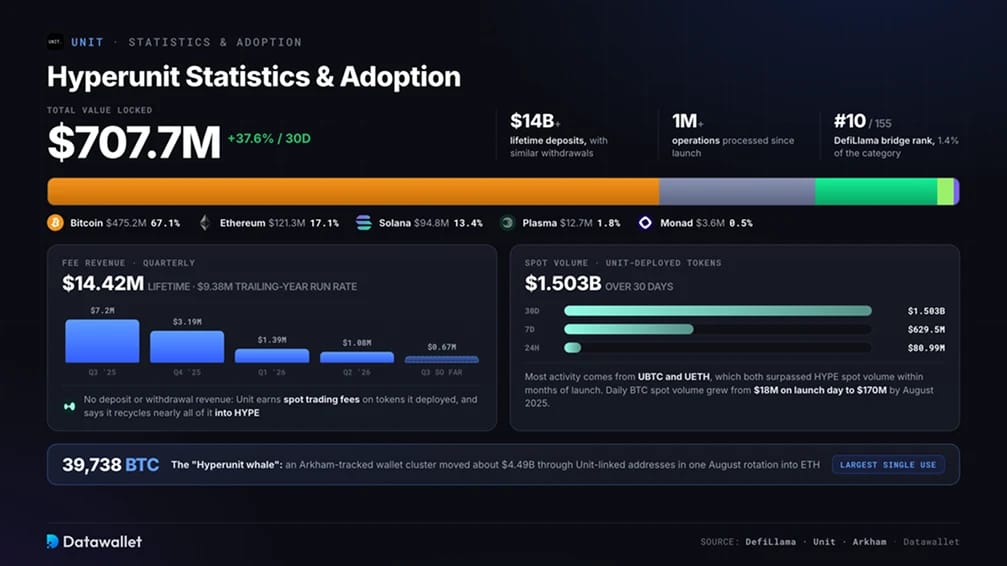
- Total Value Locked: Unit holds $707.72 million, an increase of 37.6% over 30 days. Bitcoin accounts for $475.22 million, or 67.1%. Ethereum holds $121.34 million, followed by Solana at $94.8 million, Plasma at $12.73 million and Monad at $3.63 million.
- Bitcoin Concentration: BTC represented roughly 58% of Unit's $561 million total during our December audit. Its share has since increased, reflecting a stronger BTC price and the unwind of last year's memecoin balances on Solana and Plasma.
- Category Rank: DefiLlama ranks Unit tenth among 155 bridges. It holds 1.4% of the category's $51.7 billion in value. Our TVL tracker provides a broader comparison.
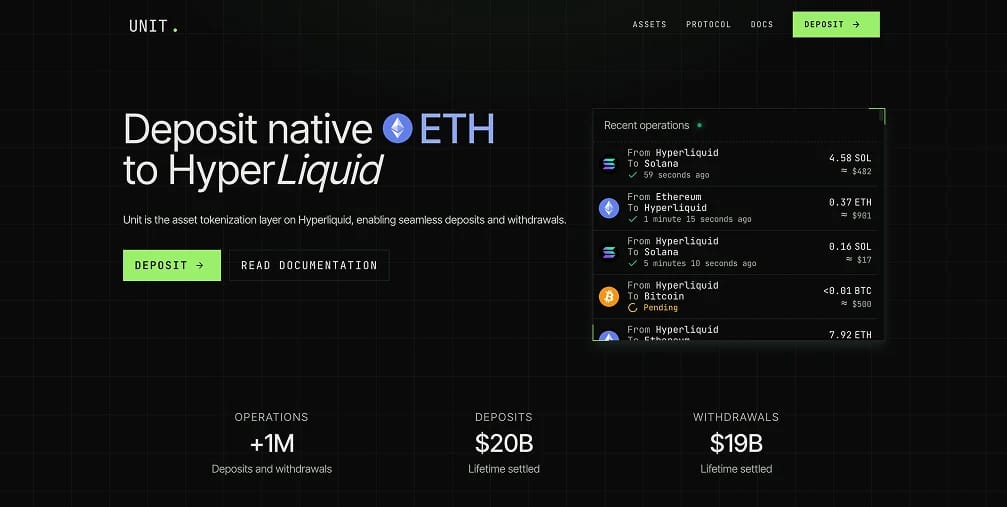
- Lifetime Operations: Unit's homepage reports more than $14 billion in deposits and a similar amount in withdrawals. The protocol has processed over one million operations since launch.
- Early Growth: Unit reported in August 2025 that daily BTC spot volume on Hyperliquid had risen from $18 million on launch day to $170 million. TVL was approaching $1 billion at the time.
- Largest Single Use: During the same month, an Arkham-tracked wallet cluster transferred 39,738 BTC, worth about $4.49 billion, through Unit-linked addresses to rotate into ETH. This transaction produced the "Hyperunit whale" label.
- Fee Revenue: Unit earns no revenue from deposits or withdrawals. Instead, it receives Hyperliquid spot trading fees from tokens it deployed. These fees have generated $14.42 million to date, including $407,015 over the past 30 days, with a $9.38 million trailing-year run rate.
- Revenue Trend: Quarterly revenue reached $7.2 million in Q3 2025 during the surge in memecoin listings. It then declined to $3.19 million, $1.39 million and $1.08 million over the next three quarters. Revenue stands at $671,000 so far this quarter. Unit said in August 2025 that it recycles nearly all revenue into HYPE.
- Spot Volume: Unit-deployed tokens produced $1.503 billion in Hyperliquid spot volume over 30 days. Seven-day volume reached $629.5 million, with $80.99 million recorded over 24 hours. Most activity came from UBTC and UETH, which Unit said had both surpassed HYPE spot volume within months of launch.
- Fee Compression: Revenue has declined faster than volume, suggesting that the average fee per dollar traded has fallen since the listing surge. Our Hyperliquid statistics page follows the exchange's wider metrics.
Does Hyperunit Have a Token?
Unit does not have a token and has announced no plans to issue one. The protocol describes itself as self-funded without outside investment. Its documentation presents Unit as infrastructure for Hyperliquid rather than a project built around a separate token economy.
Social channels regularly feature speculation about a potential airdrop. Bridging funds solely for that reason carries clear risk because no official information supports the claims, and the team's stated model directs revenue into HYPE.
Is Hyperunit Regulatory Compliant?
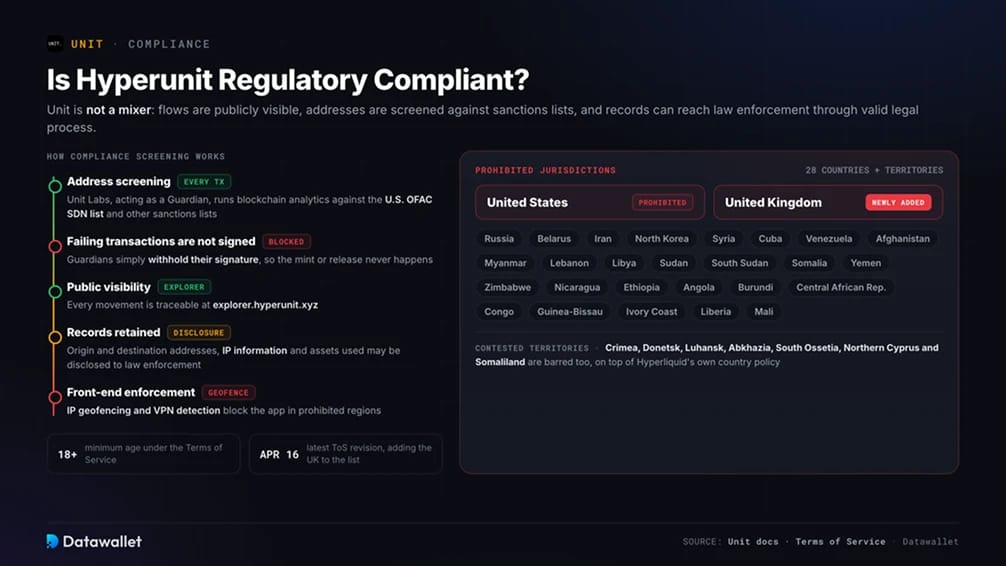
Unit Labs conducts compliance screening as one of the Guardians. It uses blockchain analytics software to check wallet addresses against the U.S. OFAC SDN list and other sanctions lists. Transactions from addresses that fail these checks are not signed.
Unit is not a mixer. Asset movements are visible through the public explorer at explorer.hyperunit.xyz. Unit Labs also retains records covering origin and destination addresses, IP information and the assets used. These records may be disclosed to law enforcement when required through valid legal process.
Hyperunit Restricted Countries
Unit's Terms of Service, last revised on April 16 this year, require users to be at least 18. Residents and citizens of listed Prohibited Jurisdictions cannot use the service. Since our previous audit, the United Kingdom has been added alongside the United States.
The complete list includes the United States, United Kingdom, Russia, Belarus, Iran, North Korea, Syria, Cuba, Venezuela, Afghanistan, Myanmar, Lebanon, Libya, Sudan, South Sudan, Somalia, Yemen, Zimbabwe, Nicaragua, Ethiopia, Angola, Burundi, Central African Republic, Congo, Guinea-Bissau, Ivory Coast, Liberia and Mali.
Unit also bars contested territories such as Crimea, the Donetsk and Luhansk regions of Ukraine, Abkhazia, South Ossetia, Northern Cyprus and Somaliland. These front-end controls apply in addition to Hyperliquid's own policy for supported and restricted countries.
Hyperunit Security and Risks
Unit's security model relies on independent verification by each Guardian. Operators check blockchain data and addresses before reviewing the transaction details. A compromised Guardian therefore cannot authorize a fraudulent mint without obtaining a second signature.
Messages between Guardians are end-to-end encrypted and routed through a relay server that holds no key material. A failure of this server cannot expose user funds. Guardians authenticate each other outside the network and verify configurations through hash checks. Circuit-breaker policies also allow them to pause operations when malicious activity is detected.
Risks of Using Unit
Unit's design offers more safeguards than a standard multisig, but it remains a permissioned bridge. Users should account for its trust assumptions before transferring large amounts.
- Guardian concentration: Three operators secure all supported assets through a 2-of-3 scheme. When one Guardian went offline on April 15, 2025, Bitcoin withdrawals and address generation were delayed. A compromise of two Guardians represents the worst-case scenario.
- No published audit: Unit's documentation does not cite a completed third-party security audit. The three founding Guardians also remain the only signers.
- Irreversible mistakes: Deposits below the minimum may be lost, as can unsupported tokens or transfers sent through the wrong network. Revert can recover some transactions, but users must wait three hours for BTC and several days for EVM and Solana chains.
- Scheduled pauses: Maintenance windows and source-chain upgrades place operations into a queue. The Zcash Ironwood upgrade earlier this year was one example, and these interruptions can delay withdrawals during volatile markets.
- Front-end dependence: Unit's app applies geofencing and VPN detection. Users in prohibited regions therefore lose access to the interface, even though the protocol remains available through its API.
- Thin markets on newer listings: Memecoins transferred through Unit may trade in shallow order books. A functioning bridge does not make the underlying asset liquid or safe.
Final Thoughts
Unit has established itself as the primary route for bringing native assets onto Hyperliquid. It supports 13 assets, holds $707 million and has processed more than $14 billion in deposits. DefiLlama ranks it among the ten largest bridges, despite the protocol having no token or venture funding.
Several structural questions remain. The Guardian network still consists of three operators, while spot fee compression has weakened revenue. Adding the United Kingdom to the prohibited list also shows that access conditions can change quickly.
For holders of Bitcoin, Ether or Solana seeking spot exposure with USDC settlement in one account, Unit offers the most direct route. Deposit sizes should still reflect the protocol's trust model. Our guide to bridging to Hyperliquid compares the available alternatives.