




What Is Leveraged Staking & Looping Strategy?
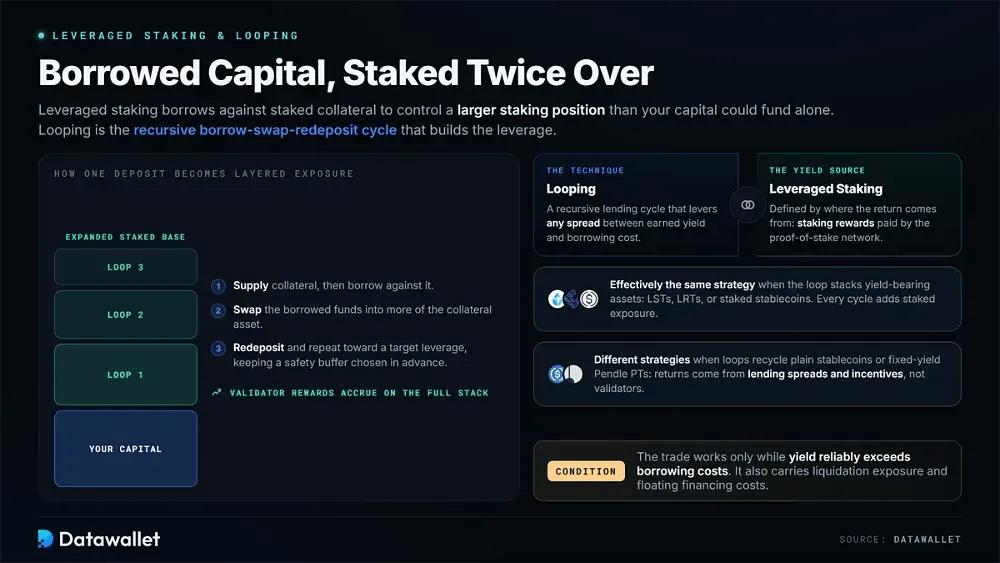
Leveraged staking borrows against staked collateral so you can control a larger staking position than your capital could fund on its own. Validator rewards accrue on the expanded base, but the trade also carries liquidation exposure and floating financing costs. It works only while yield reliably exceeds borrowing costs.
Looping is the recursive lending process commonly used to create that leverage. You supply collateral, borrow against it, swap the borrowed funds into more of the collateral asset, then redeposit. The cycle continues until the position reaches a target leverage level while retaining a safety buffer chosen in advance.
The concepts overlap heavily, but they refer to different layers of the strategy. Looping is a technique for levering any spread between earned yield and borrowing cost. Leveraged staking is defined by the source of the collateral return: staking rewards from the underlying proof-of-stake network.
They become effectively the same strategy when the loop accumulates yield-bearing assets such as LSTs, LRTs, or staked stablecoins because every cycle increases staked exposure. The distinction matters when loops recycle plain stablecoins or fixed-yield Pendle PTs. In those cases, returns come entirely from lending spreads and incentives rather than validator rewards.
How Does Crypto Leveraged Staking Work?
Crypto leveraged staking uses onchain money markets that accept staking tokens as collateral. Users borrow against those assets to scale toward a target exposure while managing financing costs, protocol parameters, and liquidation mechanics.
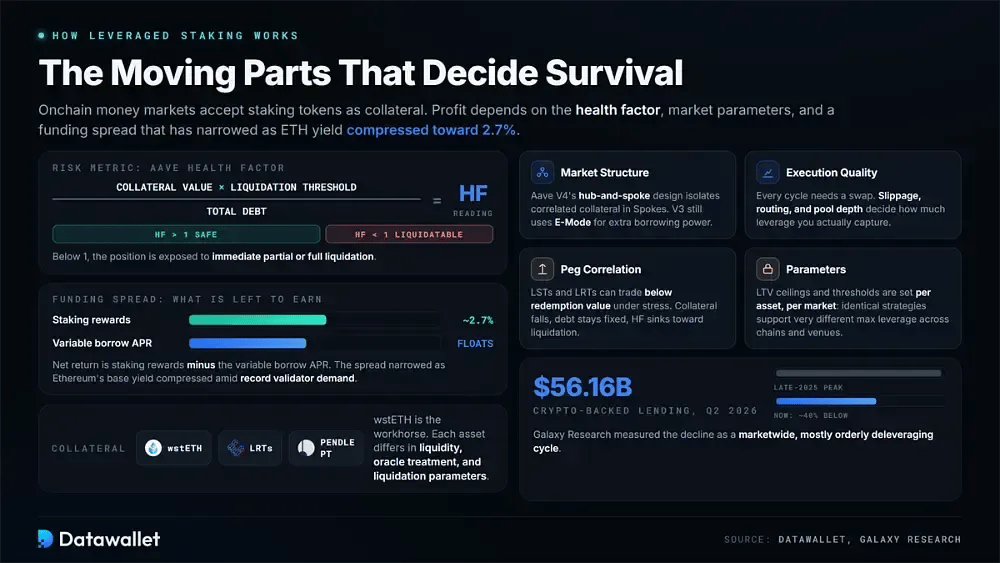
These are the moving parts that decide profitability and survival:
- Collateral choice: wstETH remains the workhorse, while restaking tokens and Pendle PT assets now compete with it. Each has different liquidity depth, oracle treatment, and liquidation parameters across lending venues.
- Market structure: Aave V4 uses a hub-and-spoke design that isolates correlated collateral in dedicated Spokes. V3 markets still rely on E-Mode to increase borrowing power for aligned asset pairs.
- Risk metric: Aave's health factor divides collateral value times liquidation threshold by total debt. A reading below 1 exposes the position to immediate partial or full liquidation.
- Parameters: Each market sets its own LTV ceiling and liquidation threshold by asset. As a result, identical strategies can support very different maximum leverage across chains, venues, and collateral types.
- Funding spread: Net return is staking rewards minus variable borrow APR. That spread has narrowed as Ethereum's base yield compressed toward 2.7% amid record validator demand.
- Execution quality: Every cycle requires a swap. Slippage, routing, and pool depth therefore determine how much leverage you actually capture, especially when stressed markets become thin and one-sided during an unwind.
- Peg correlation: LSTs and LRTs can trade below redemption value under stress. Collateral value then falls while debt remains fixed, pulling health factors toward liquidation.
- System context: Galaxy Research measured crypto-collateralized lending at $56.16 billion in Q2 2026, about 40% below its late-2025 peak. The decline reflects a marketwide, mostly orderly deleveraging cycle.
How Does Crypto Looping Strategy Work?
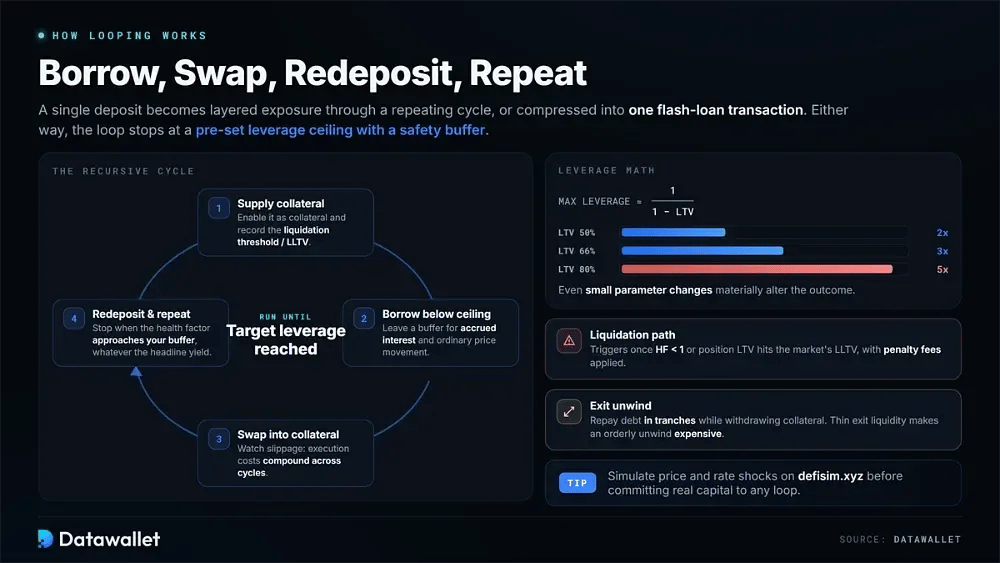
A looping strategy turns a single deposit into layered exposure by repeating the borrow, swap, and redeposit process. The same sequence can also be compressed into one flash-loan transaction. Either approach continues until leverage reaches the chosen ceiling.
Here is how a typical loop fits together, step by step:
- Collateral setup: Supply the asset, enable it as collateral, and record the liquidation threshold or LLTV. That parameter sets the maximum total borrowing the position can support.
- Borrow sizing: Take the first loan comfortably below the ceiling. The buffer should leave room for accrued interest and ordinary price movement between check-ins without pushing the position into liquidation territory.
- Swap execution: Convert the borrowed funds into more collateral and watch quoted slippage closely. Execution costs accumulate across repeated cycles and reduce the leverage actually obtained.
- Redeposit cycle: Supply the newly acquired collateral and borrow again. Continue until the health factor approaches the buffer you set beforehand, then stop adding leverage regardless of headline yields.
- Leverage math: Maximum effective leverage is approximately 1 divided by 1 minus LTV. An 80% limit therefore allows about 5x, and even small parameter changes can materially alter the outcome.
- Liquidation path: When collateral value falls or debt compounds, liquidation begins once the health factor drops below 1 or the position LTV reaches the market's LLTV, with penalty fees applied.
- Exit unwind: Closing the loop requires repaying debt in tranches while withdrawing collateral. If exit liquidity is thin during stress, an otherwise orderly unwind can become expensive.
Tip: Simulate how price moves and rate changes affect your health factor on defisim.xyz before committing real capital to any loop.
How to Combine Leveraged Staking With Looping
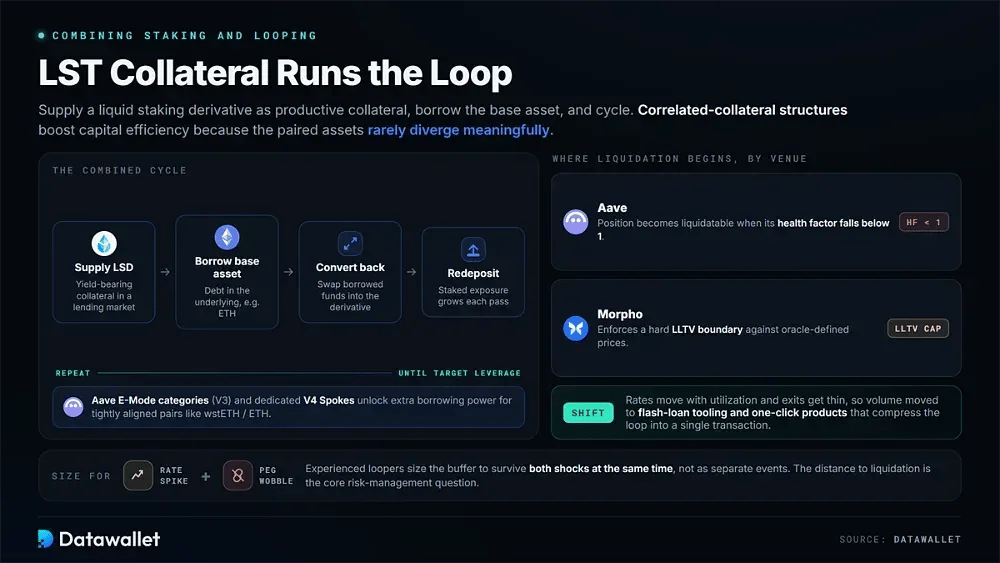
Combining the two starts with supplying a liquid staking derivative as productive collateral in a lending market. You borrow the base asset, convert it back into the derivative, and redeposit it. Correlated-collateral structures such as Aave's E-Mode categories or V4's dedicated Spokes improve capital efficiency because the paired assets rarely diverge meaningfully.
The main risk-management question is how far the position sits from liquidation. On Aave, a position becomes liquidatable when its health factor falls below 1. Morpho instead enforces a hard LLTV boundary against oracle-defined prices. Experienced loopers size positions so the buffer can withstand a rate spike and a peg wobble at the same time rather than treating those shocks as separate events.
Execution determines whether theoretical carry survives in live markets. Borrow rates move with utilization, liquidity can disappear during stressed exits, and each cycle incurs fees. Those constraints help explain why much of the volume has shifted toward flash-loan tooling and one-click products that compress the loop into a single transaction.
Latest Trends in Leveraged Staking and Looping
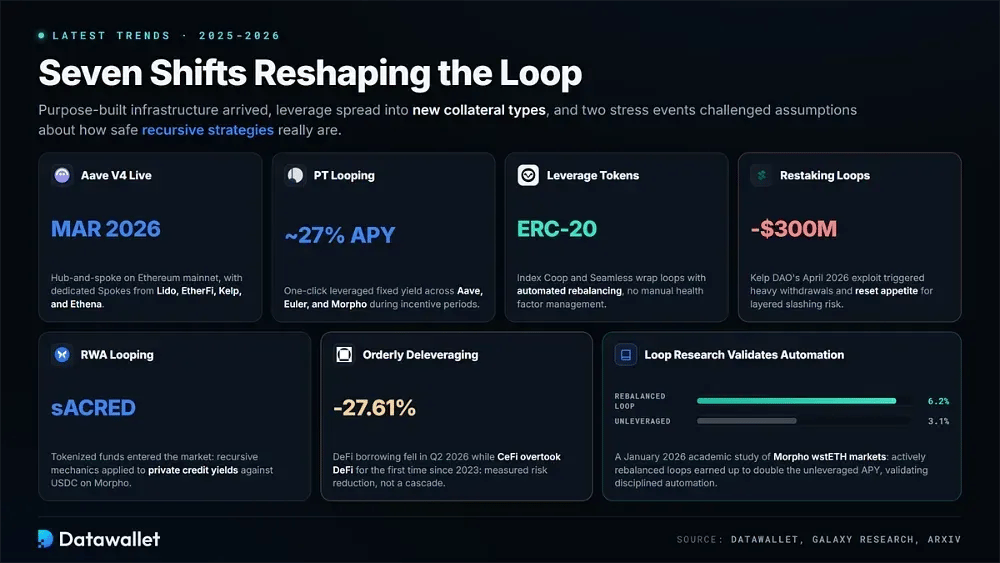
Between 2025 and 2026, the looping landscape changed rapidly. Protocols introduced purpose-built infrastructure, leverage expanded into new collateral types, and two stress events challenged assumptions about the safety of recursive strategies.
Seven developments currently shaping leveraged staking and looping strategies:
- Aave V4: Launched on Ethereum mainnet in March 2026, its hub-and-spoke architecture directs shared liquidity into isolated Spokes, including dedicated markets from Lido, EtherFi, Kelp, and Ethena.
- PT looping: Pendle's one-click PT Looping automates leveraged fixed-yield positions across Aave, Euler, and Morpho. During incentive periods, headline APYs on stablecoin principal tokens have reached roughly 27%.
- Leverage tokens: Index Coop and Seamless wrap looped positions into ERC-20s with automated rebalancing. Holders gain liquidation-protected leverage without manually managing health factors or their own unwind schedules.
- Restaking loops: LRT collateral extended looping into restaking yield. Kelp DAO's roughly $300 million April 2026 exploit, however, triggered heavy withdrawals and reset appetite for layered slashing risk.
- RWA looping: Tokenized funds entered the looping market. Strategies such as sACRED collateral against USDC on Morpho apply recursive mechanics to private credit yields instead of staking rewards.
- Orderly deleveraging: Galaxy Research reports that DeFi borrowing fell 27.61% in Q2 2026 while CeFi overtook DeFi for the first time since 2023. The shift points to measured risk reduction rather than a cascade.
- Loop research: A January 2026 academic study of Morpho wstETH markets found that actively rebalanced loops earned up to 6.2% APY, compared with 3.1% unleveraged, validating disciplined automation.
Examples of Crypto Leveraged Staking and Looping
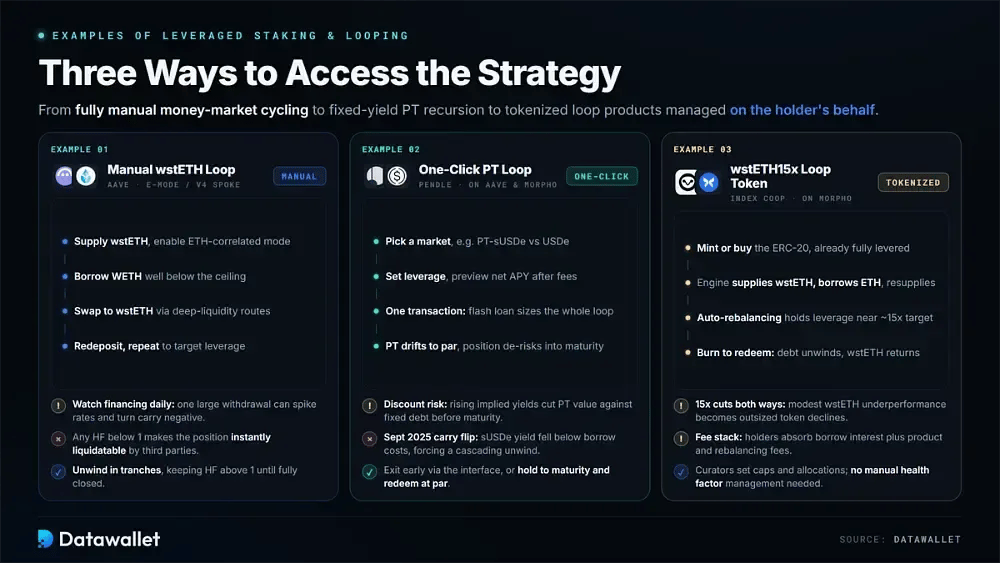
The examples below range from fully manual loops to one-click automation. Together, they cover the three main ways users access leveraged staking today: direct money-market cycling, fixed-yield PT recursion, and tokenized loop products managed on the holder's behalf.
1. Manual wstETH Looping on Aave Using E-Mode
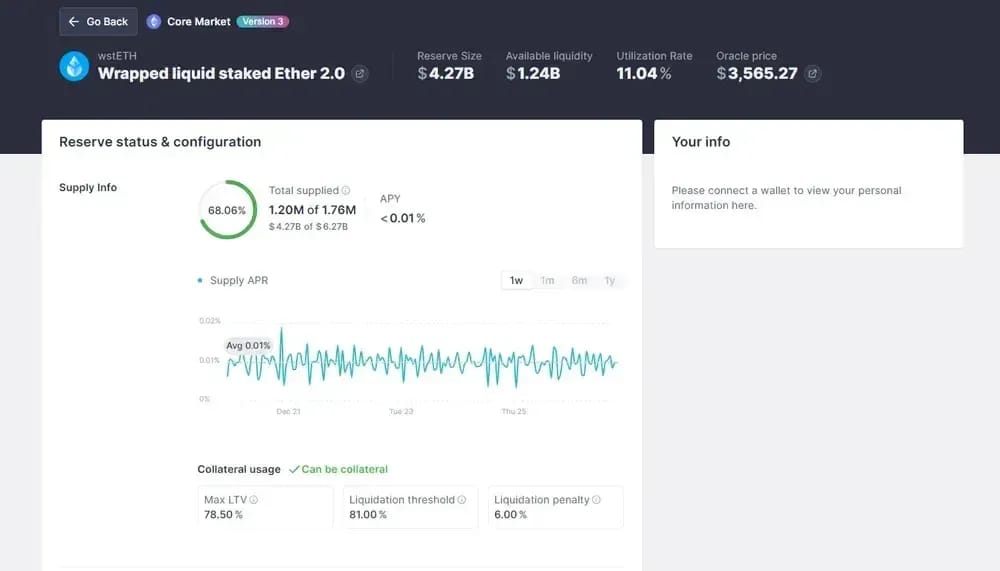
On Aave, users can supply wstETH inside an ETH-correlated category and borrow WETH against it. They then convert the WETH back into wstETH and redeposit it, repeating the process while keeping the health factor comfortably above a predefined liquidation buffer.
A manual loop for leveraged LST exposure typically proceeds like this:
- Select collateral: Acquire wstETH and check its liquidation threshold in your chosen market. That figure determines the maximum leverage the position can theoretically support.
- Enable correlated mode: On V3, activate the ETH-correlated E-Mode category. On V4, use an ETH Spoke. Both approaches unlock greater borrowing power for tightly aligned collateral pairs.
- Supply and verify: Deposit wstETH, enable it as collateral, and note the opening health factor. Use that value as the baseline for each later borrowing decision.
- Borrow WETH: Take the first loan well below the ceiling. Any health factor reading below 1 makes the position immediately eligible for liquidation by third parties.
- Swap back: Exchange the borrowed WETH for more wstETH through a deep-liquidity route. Repeated slippage compounds and can quietly erode the carry you are trying to capture.
- Redeposit and repeat: Supply the additional wstETH and borrow again until you reach the target leverage. Once there, avoid adding more simply because temporary incentives look attractive.
- Watch financing: Monitor the variable WETH borrow rate and utilization daily. A single large withdrawal can push rates sharply higher and turn staking carry negative.
- Unwind deliberately: Repay the debt in tranches and withdraw collateral gradually. Keep the health factor above 1 throughout the process until the position is fully closed.
2. One-Click PT Looping With Pendle on Aave and Morpho
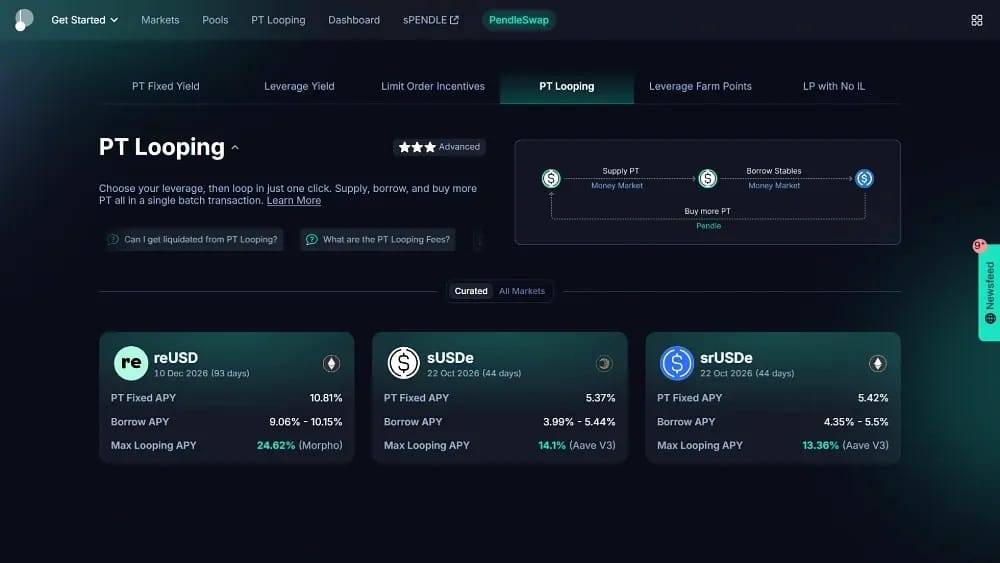
Pendle's PT Looping feature automatically converts fixed-yield principal tokens into leveraged carry positions. It supplies PT as collateral, borrows stablecoins, then recycles those funds into additional PT through one guided flow on supported lending venues.
Leveraged fixed yield through PT looping works like this:
- Understand PT: Principal tokens trade below face value and redeem at par on maturity. Holding PT therefore locks a fixed yield that does not depend on floating market rates.
- Pick a market: Select a supported pair such as PT-sUSDe against Ethena's USDe. Before committing, compare the fixed PT yield with the lending venue's current stablecoin borrow rate.
- Set leverage: Choose a leverage multiple in the interface. The system automatically sizes the flash-loan-assisted loop and previews estimated net APY after protocol fees and borrowing costs.
- Execute once: In one transaction, the feature supplies PT, borrows the paired stablecoin, swaps into additional PT, and redeposits it rather than requiring several manual, gas-heavy cycles.
- Mind maturity: PT moves toward par as expiry approaches, so leveraged positions gradually de-risk. Rolling into a new maturity, however, resets both yield and risk.
- Discount risk: PT prices can fall before maturity if implied yields rise. That reduces collateral value against fixed debt and can trigger liquidation even though the token eventually redeems at par.
- Carry flips: September 2025 demonstrated the failure mode. sUSDe yields fell below stablecoin borrowing costs, causing leveraged PT positions to unwind in a cascading, mechanical exit.
- Exit paths: Either close early through the interface by unwinding debt and selling PT, or hold through maturity, redeem at full face value, and repay the outstanding borrowings directly.
3. wstETH15x Smart Loop Token via Index Coop and Morpho
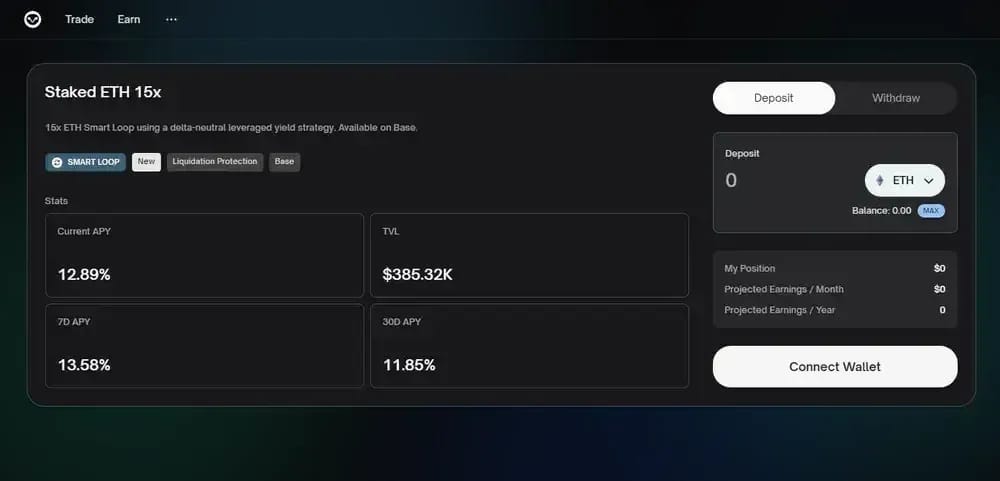
Index Coop packages an automated Morpho looping strategy into a single ERC-20 called wstETH15x. The product targets roughly 15x staked ETH exposure, while its rebalancing logic manages leverage maintenance for the holder.
Hands-off leveraged staking through a loop token looks like this:
- Know the wrapper: wstETH15x represents a looped Morpho position rather than wstETH held at parity. Its price therefore follows leveraged staking performance, not the underlying token one-for-one.
- Enter the product: Acquire wstETH, then mint or purchase wstETH15x through the product interface. The token is already fully levered when you enter.
- Automated engine: Behind the wrapper, the strategy supplies wstETH on Morpho, borrows ETH, and resupplies repeatedly. Continuous rebalancing keeps leverage near the advertised target.
- Market parameters: Each Morpho market defines LLTV and oracle configuration for its pair. Those settings determine when the wrapped position may come under liquidation pressure during sharp market moves.
- Curator layer: Vault curators set allocation caps and rebalance across underlying markets. Realized risk therefore depends partly on allocation decisions made outside the token contract itself.
- Fee stack: Holders continuously absorb borrowing interest along with product and rebalancing fees. Quoted net APY changes daily with rates, incentives, and broader market conditions.
- Amplified sensitivity: A 15x target magnifies both staking yield and drawdowns. Even modest wstETH underperformance relative to ETH can quickly translate into outsized declines in the token price.
- Redemption mechanics: Burning wstETH15x unwinds the debt and returns the underlying wstETH. During volatile deleveraging episodes, however, redemptions may process notably more slowly and at higher cost.
How Much APY With Leveraged Staking Looping?
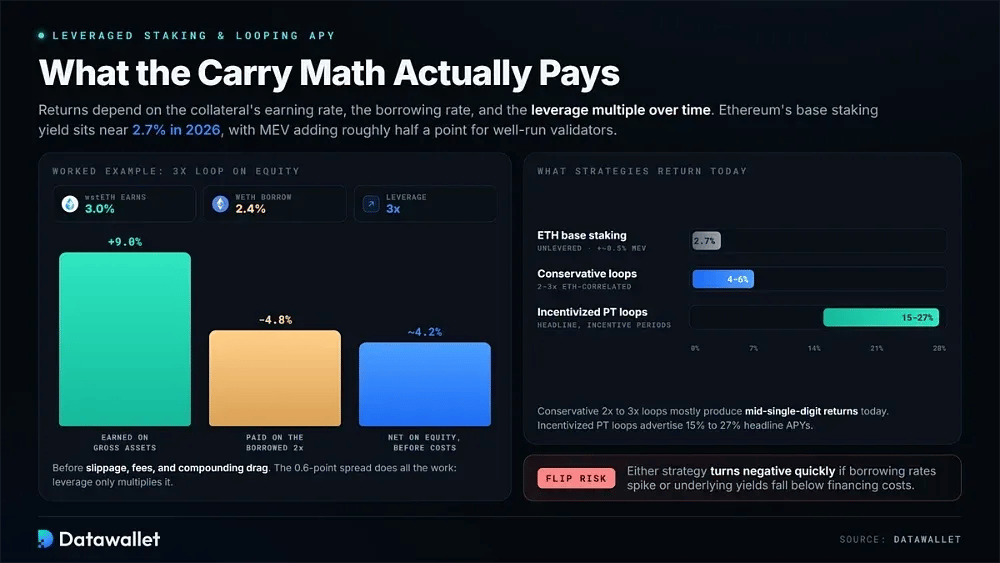
Looped returns ultimately depend on the collateral's earning rate, the borrowing rate, and the leverage multiple over time. Ethereum's base staking yield has compressed to roughly 2.7% in 2026 as validator demand surged. For well-operated validators, MEV may add roughly another half point.
The carry spread drives the result. Assume wstETH earns 3% all-in while WETH borrowing costs 2.4%. At 3x leverage, the position earns 9% on gross assets and pays about 4.8% on the borrowed portion, leaving roughly 4.2% on equity before slippage, fees, and compounding drag.
Outcomes vary materially by strategy. Conservative 2x to 3x ETH-correlated loops mostly produce mid-single-digit returns today, while incentivized PT loops have advertised headline APYs of 15% to 27%. Either can turn negative quickly if borrowing rates spike or underlying yields fall below financing costs.
Lessons From the 2025 Looping Stress Events
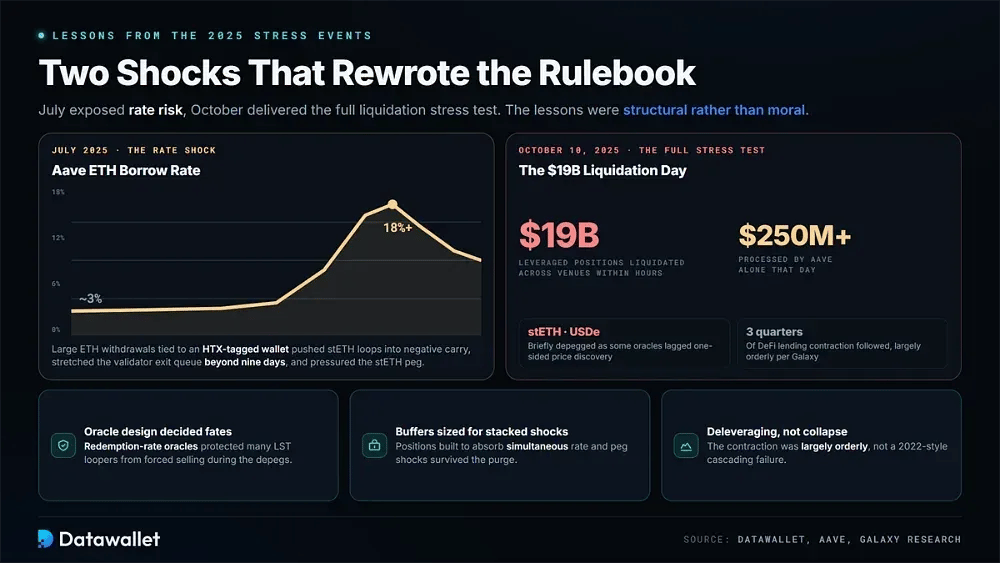
July 2025 exposed the rate-risk problem. Large ETH withdrawals from Aave linked to an HTX-tagged wallet drove borrow rates from around 3% to over 18%. The move pushed stETH loops into negative carry, extended Ethereum's validator exit queue beyond nine days, and put slight downward pressure on the stETH peg.
The full stress test arrived on October 10, 2025. Roughly $19 billion in leveraged positions were liquidated across venues within hours. Aave alone processed over $250 million that day, while collateral including stETH and USDe briefly depegged as some oracles lagged the violent, one-sided price discovery occurring across thin books.
The lessons were structural rather than moral. Redemption-rate oracles protected many LST loopers from forced selling, while positions sized for simultaneous shocks survived. DeFi lending then contracted for three consecutive quarters in what Galaxy Research describes as largely orderly deleveraging rather than a 2022-style cascading failure.
Risks of Leveraged Staking and Looping
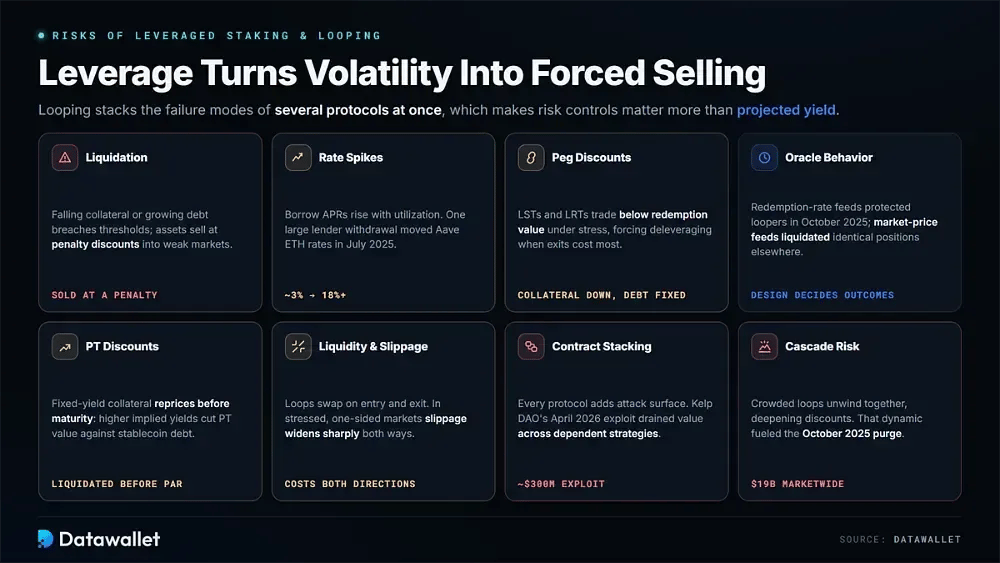
Leverage turns ordinary volatility into potential forced selling. Looping also combines the failure modes of several protocols, making risk controls more important than projected yield.
Weigh these risks carefully before scaling any looped position:
- Liquidation risk: Declining collateral value or growing debt can eventually breach liquidation thresholds. Liquidations then sell assets at penalty discounts, often when market prices are already under severe pressure.
- Rate spikes: Variable borrow APRs rise with utilization. In July 2025, one large lender withdrawal pushed Aave ETH rates from about 3% to over 18%.
- Peg discounts: LSTs and LRTs may trade below redemption value during stress. That reduces collateral against fixed debt and can force deleveraging when exits are most expensive.
- Oracle behavior: Redemption-rate oracles protected loopers during the October 2025 depegs, whereas market-price feeds elsewhere triggered liquidations. Oracle design can therefore produce very different outcomes for otherwise identical positions.
- PT discount risk: Fixed-yield collateral still reprices before maturity. Higher implied yields reduce PT value against stablecoin debt and can liquidate leveraged carry positions.
- Liquidity and slippage: Loops require swaps on entry and exit. In stressed, one-sided markets, slippage can widen sharply and raise the actual cost of both directions.
- Contract stacking: Every additional protocol adds another attack surface. Kelp DAO's April 2026 exploit showed how a single failure can drain collateral value across dependent strategies.
- Cascade risk: Crowded loops often unwind at the same time, deepening discounts and thinning order books. That dynamic helped turn isolated liquidations on October 2025 into a $19 billion marketwide purge.
Final Thoughts
Leveraged staking and looping remain viable in 2026, but the easy carry has disappeared. Base yields have compressed, borrow rates can move sharply, and two genuine stress events showed how quickly recursive positions can unwind. Infrastructure has improved substantially, though better tooling makes disciplined and undisciplined leverage equally efficient.
Treat every loop as a risk budget before looking at the yield number. Stress test a doubling of the borrow rate, model a peg discount, and price the exit under thin liquidity. Leverage should be capped at a level where all three can occur together without triggering liquidation. The APY that remains after that test is the one that matters.